

Neck and shoulder pain affects 50.9% of women and 41.7% of men at some point, according to a 2017 Federal Practitioner report. The pain spreads because the neck and shoulder share muscles, nerves and joints. Muscle strain, a pinched nerve in the neck or a rotator cuff problem can hurt both areas. Cold, heat and gentle movement ease many flare-ups, while physiotherapy and chiropractic care target the cause.
Key Takeaways
- The neck and shoulder share muscles, nerves and joints, so one problem hurts both.
- Common causes include muscle strain, a pinched nerve in the neck, rotator cuff disease and frozen shoulder.
- Cold or heat for 15 minutes, hourly movement and a higher screen ease many flare-ups.
- The NHS says most neck pain only lasts a few weeks, while shoulder pain can take 6 months or longer.
- Numbness, arm weakness, fever or pain after a fall needs prompt medical care.
What Causes Neck and Shoulder Pain
Three main problems cause this pain: muscle strain, nerve compression in the neck and joint or tendon damage in the shoulder. Muscle strain from posture, screens, lifting or stress is the everyday trigger. Cleveland Clinic lists poor posture, repetitive strain and mental stress among the common causes of neck pain.
A herniated disc or worn neck joint can press on a nerve root. The pressure sends sharp, burning pain into the shoulder and arm. Joint and tendon damage forms the third group, and these shoulder sources respond to targeted shoulder pain treatment. The three groups overlap, so one injury can hurt both the neck and shoulder together.
Why Do the Neck and Shoulder Hurt Together
The neck and shoulder hurt together because they share muscles, nerves and support structures. The upper trapezius and levator scapulae muscles run from the neck to the shoulder blade. Tension in those muscles pulls on both regions at once.
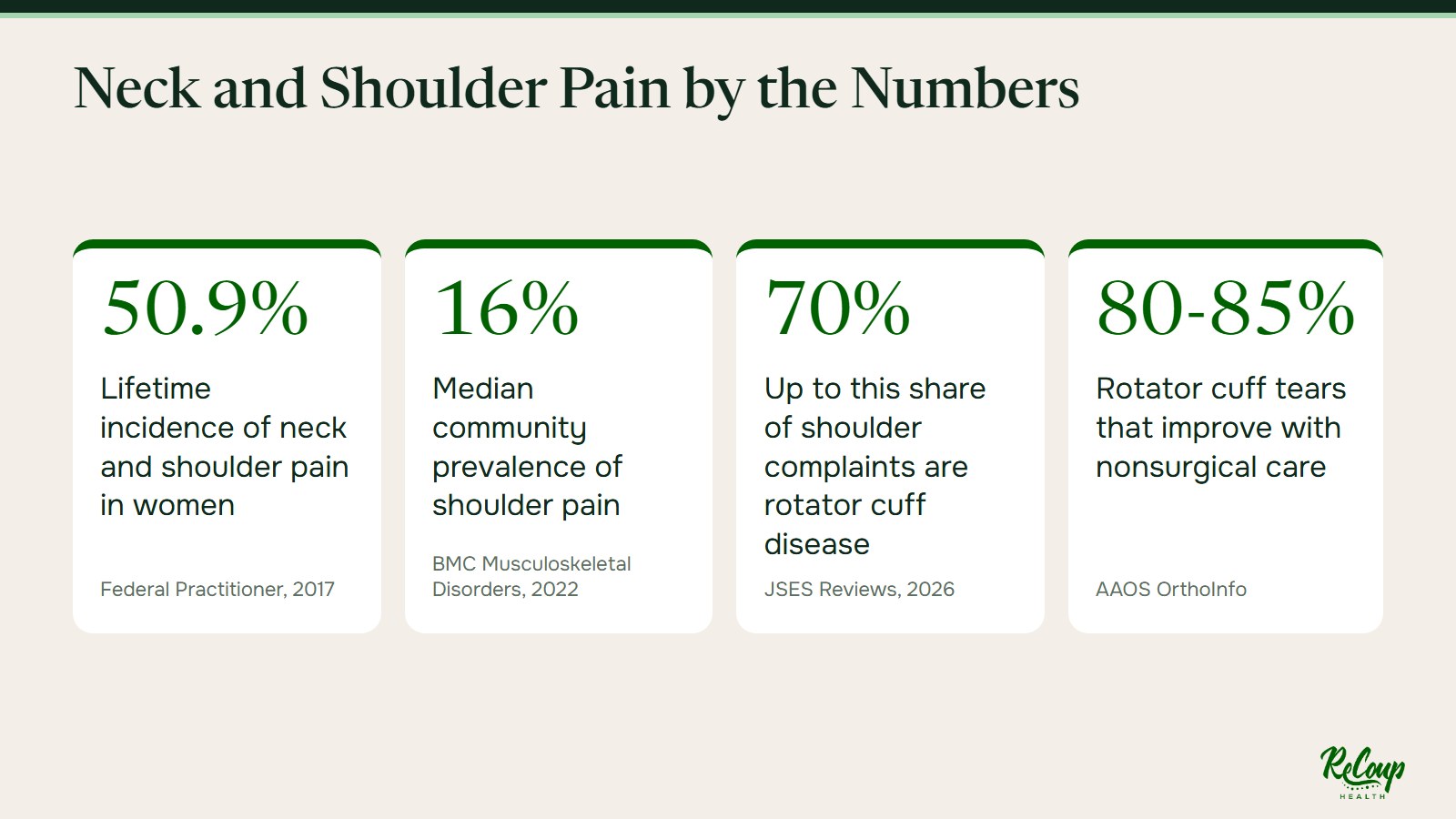
A 2017 Federal Practitioner case report cites a lifetime incidence of 41.7% in males and 50.9% in females. A 2022 BMC Musculoskeletal Disorders review of 61 studies found a median community prevalence of shoulder pain of 16%. The graphic below shows these figures alongside two rotator cuff numbers.
The same report describes a patient with a neck disc herniation and shoulder impingement at once. Shoulder pain can also appear with no injury at all.
What Causes Shoulder Pain Without Injury
Shoulder pain without injury comes from gradual tendon wear, joint stiffness or pain referred from the neck. Rotator cuff disease accounts for up to 70% of shoulder complaints, according to a 2026 review in JSES Reviews, Reports, and Techniques. The rotator cuff is a group of four muscles and tendons that hold the upper arm bone in its socket.
Frozen shoulder is another cause without injury. Frozen shoulder, or adhesive capsulitis, is a thickening and tightening of the joint capsule. American Family Physician (2019) estimates it affects 2% to 5% of the general population. The American Academy of Orthopaedic Surgeons (AAOS) reports it mainly affects people aged 40 to 60.
Diabetes raises the frozen shoulder risk. American Family Physician reports that people with diabetes were five times more likely to have frozen shoulder than a control group. Joint wear is a further source, and osteoarthritis care focuses on stiff, worn joints in the neck and shoulder. Worn neck joints can also pinch a nerve.
Can Nerve Pain in the Shoulder Come From the Neck
Yes, nerve pain in the shoulder can come from the neck through cervical radiculopathy. Cervical radiculopathy is irritation or compression of a nerve root as it leaves the spine in the neck. The 2017 Federal Practitioner report gives an annual incidence of 107.3 per 100,000 men and 63.5 per 100,000 women.
Nerve pain feels sharp, burning or electric, and the pain can travel past the elbow into the hand. Pins and needles or numbness point toward a nerve source rather than a shoulder tendon. The report names spondylosis, or age-related disc and joint wear, as the leading cause, followed by disc herniation.
A bulging disc presses on the same nerve root, and herniated disc care aims to ease that pressure through movement and exercise. Nerve signs are one clue for telling neck pain from shoulder pain.
Is the Pain Coming From Your Neck or Your Shoulder
The pain is coming from your neck when head movement triggers it, and from your shoulder when arm movement triggers it. Pain with head turns points to the neck, while pain with lifting or reaching points to the shoulder. The table below compares the main differences between the two sources.
| Feature | Pain from the neck | Pain from the shoulder |
|---|---|---|
| Main trigger | Turning, tilting or looking down | Lifting, reaching overhead or behind the back |
| Where pain spreads | Can travel past the elbow into the hand | Stays near the shoulder and upper arm |
| Common causes | Muscle strain, herniated disc, spondylosis | Rotator cuff disease, frozen shoulder, osteoarthritis |
| Other signs | Headache, tingling or numbness in the arm | Weakness when lifting, pain lying on that side |
Clinicians use exam tests such as the Spurling test, which turns and tilts the head to reproduce nerve symptoms. Both sources can coexist, so a full exam checks the neck and shoulder before any relief plan starts.
What Is the Fastest Way to Relieve Neck and Shoulder Pain
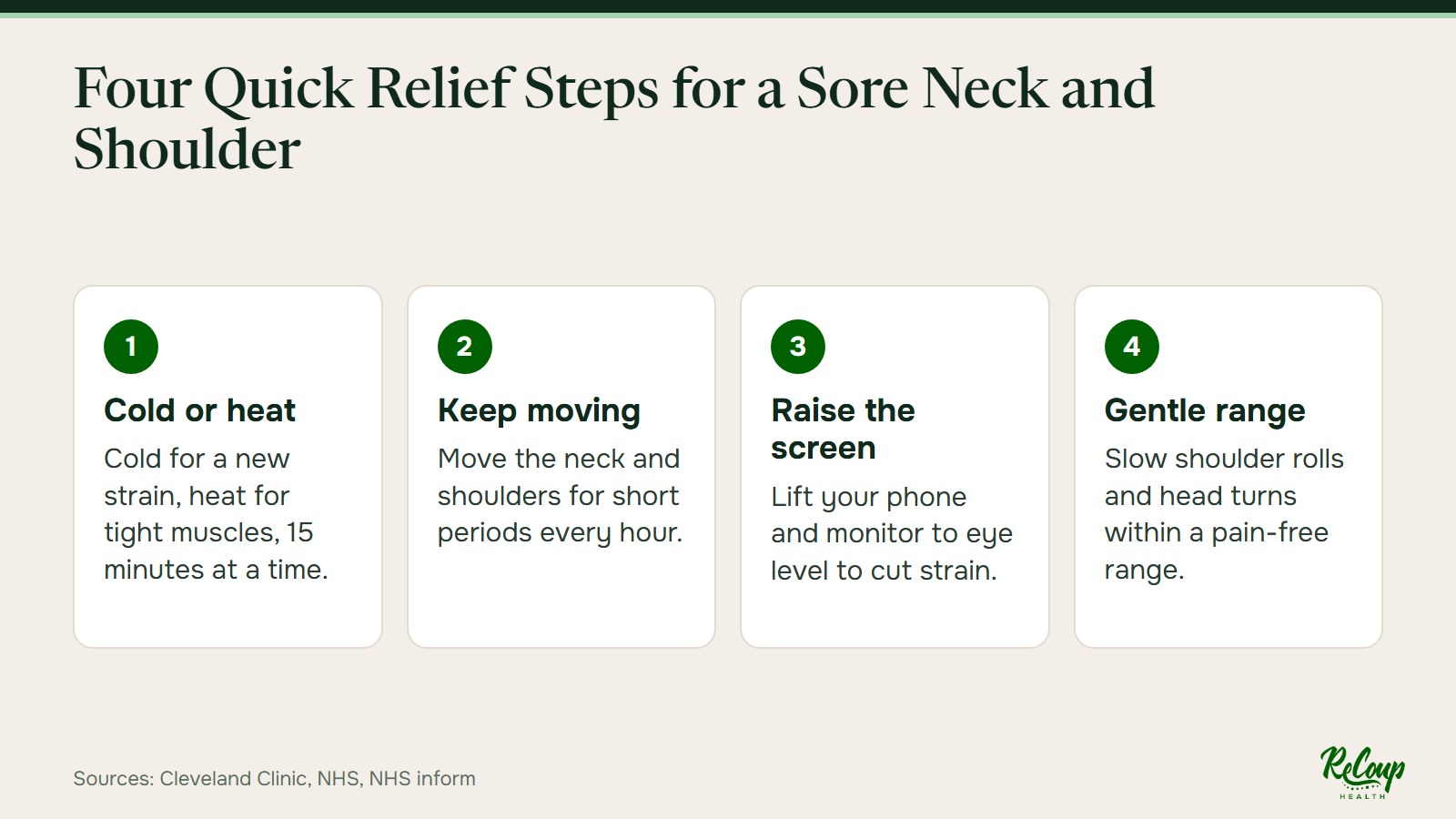
The fastest way to relieve the pain is to combine cold or heat with gentle movement in the first few days. Cold for a fresh strain and heat for tight muscles, 15 minutes at a time, is the approach Cleveland Clinic describes. These four relief steps follow Cleveland Clinic, NHS and NHS inform guidance:
- Apply a towel-wrapped cold pack for 15 minutes after a new strain, then use heat for tight muscles.
- Move the neck and shoulders for short periods every hour, as NHS inform advises.
- Raise your phone and monitor to eye level to cut forward head strain.
- Do slow shoulder rolls and head turns within a pain-free range.
The graphic below sums up these four quick relief steps for a sore neck and shoulder.
A pharmacist can advise which over-the-counter pain reliever fits your health history. Quick relief calms a flare-up, while lasting relief depends on treating the cause.
How Do You Get Rid of Pain in Your Neck and Shoulder
You get rid of pain in your neck and shoulder by treating the cause and building strength over several weeks. Keeping up shoulder exercises for 6 to 8 weeks helps stop the pain returning, the NHS advises. AAOS states that strengthening the supporting muscles can relieve pain and prevent further injury.
Strength work is the core of what to do for shoulder pain over the long term. AAOS reports that nonsurgical treatment relieves pain and improves function in about 80 to 85% of people with rotator cuff tears. A physiotherapist matches exercises to the cause found during a shoulder pain assessment. Specific exercises make up the core of that plan.
Which Exercises and Stretches Help a Stiff Neck and Shoulder
Exercises that help stiff neck and shoulder pain include chin tucks, shoulder blade squeezes, neck turns and pendulum swings. Cleveland Clinic suggests scapular squeezes, pinching the shoulder blades together 10 times, to strengthen the upper back. These five moves suit early recovery:
- Chin tucks: slide the chin straight back and hold briefly.
- Shoulder blade squeezes: pinch the shoulder blades together 10 times.
- Neck turns: turn the head slowly to each side within a pain-free range.
- Upper trapezius stretch: tilt one ear toward the shoulder and hold gently.
- Pendulum swings: lean forward and swing the hanging arm in small circles.
Stop any exercise that sends pain, tingling or numbness down the arm, and talk to your physiotherapist before adding weight. Exercise pairs with hands-on treatment in a full treatment plan.
Which Treatment Works for a Painful Neck and Shoulder
The treatment that works for a painful neck and shoulder is active, exercise-based care, with hands-on therapy added where it helps. Exercise plus manual therapy matched results from steroid injections in a 2016 Cochrane review, based on low-quality evidence from 5 trials.
A 2026 JSES Reviews, Reports, and Techniques review of 22 studies favoured physiotherapy over injections for partial rotator cuff tears. Evidence quality is mixed, so a treatment plan should match the person and the cause. Chiropractic care is one hands-on option with its own research base.
Does Chiropractic for Shoulder Pain Work
Chiropractic for shoulder pain helps some people, with the strongest evidence for neck-related pain rather than the shoulder joint itself. Spinal manipulation eased acute neck pain and disability in a 2025 Systematic Reviews meta-analysis of 8 trials and 965 patients. The review reported no serious adverse events.
A 2015 Cochrane review of 51 trials and 2,920 participants found no high-quality evidence for neck manipulation or mobilisation. The same review rated 41 of 51 studies, or 80%, as low or very low quality. Thoracic manipulation, which targets the upper back, improved short-term pain in 5 trials with 346 participants.
Shoulder joint evidence is thinner. A 2016 Cochrane review found one high-quality trial of manual therapy plus exercise, with 120 participants. Mild short-term pain followed treatment in 31% of that group versus 8% with placebo.
Our chiropractor combines chiropractic adjustments with exercise and soft tissue work, and also offers acupuncture and cupping. Exercise-based physiotherapy follows a similar active approach.
How Does Physiotherapy Help a Sore Neck and Shoulder
Physiotherapy helps a sore neck and shoulder by restoring movement, building strength and correcting the habits that load sore tissue. People searching for physical therapy for neck and shoulder pain in Canada will find the service listed as physiotherapy. A physiotherapy plan combines exercise, manual therapy and posture coaching.
Our physiotherapy sessions start with movement and nerve checks, then build an exercise plan from the findings. Soft tissue treatments can add short-term comfort to that plan.
Do Massage and Acupuncture Help Shoulder Pain
Massage and acupuncture give some people short-term shoulder pain relief, but evidence for lasting change is limited. WebMD summarizes a review showing massage offers little long-term relief for chronic neck pain, though massage relaxes tense muscles. Massage for neck and shoulder pain works as a short-term add-on to exercise, not a stand-alone fix.
WebMD also reports that a review of acupuncture for shoulder pain found short- to medium-term relief, alone or with other care. Our registered massage therapy targets tight upper trapezius and shoulder muscles alongside an exercise plan. Recovery time with any of these options depends on the cause.
How Long Does Neck and Shoulder Pain Last
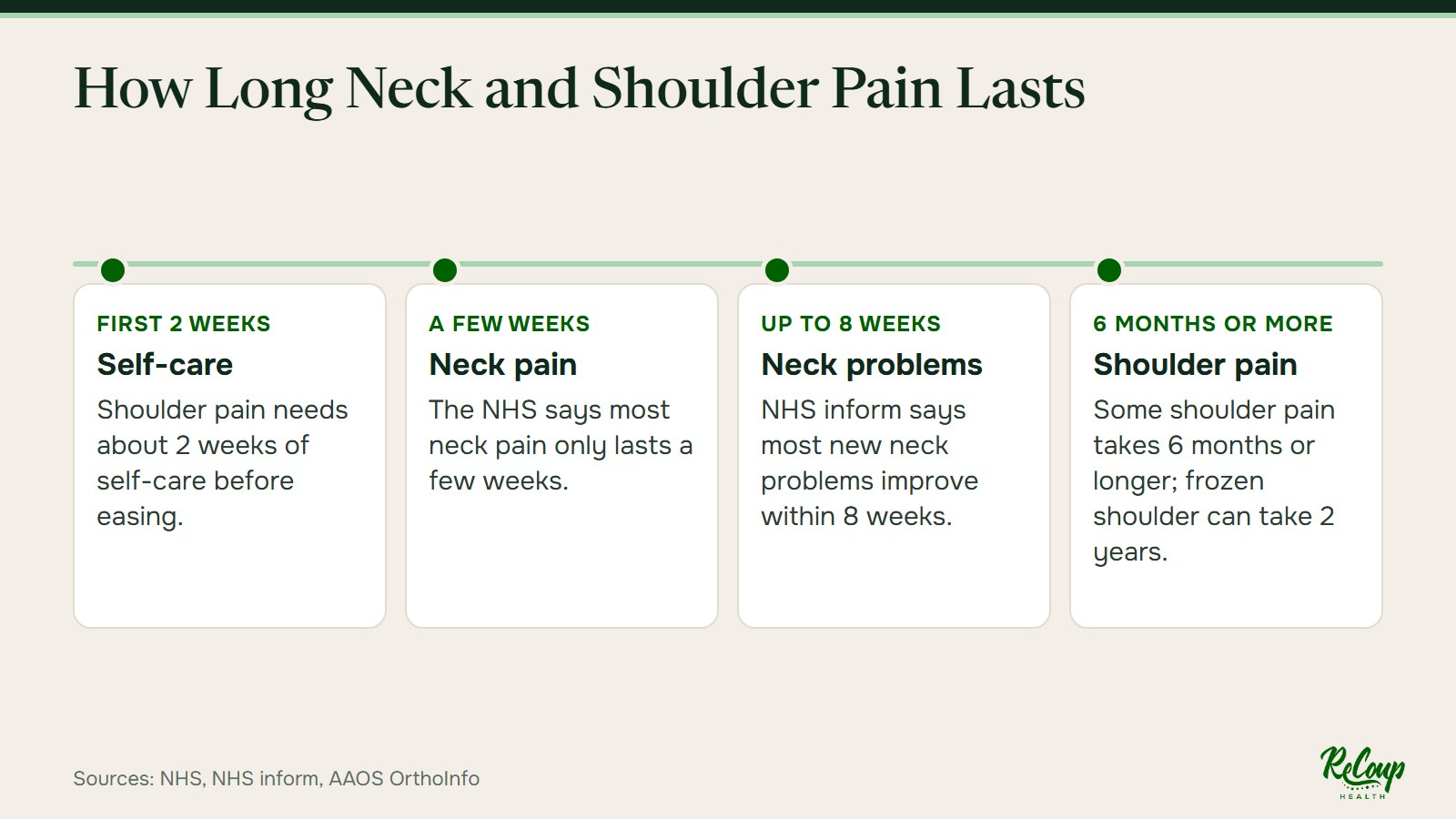
The pain lasts a few weeks for simple neck strains and 6 months or longer for some shoulder conditions. The NHS states that most neck pain only lasts a few weeks. The NHS also says shoulder pain needs about 2 weeks of self-care before it starts to ease.
NHS inform in Scotland states that most new neck problems improve within 8 weeks. The NHS adds that recovery from shoulder pain can take 6 months or longer. Frozen shoulder takes longer still, with AAOS reporting 6 months to 2 years for the final thawing stage.
The timeline below shows these recovery windows side by side.
Pain that breaks these patterns, or that arrives with nerve signs, needs a closer look for red flags.
What Are the Red Flags for Neck and Shoulder Pain
The red flags are numbness, weakness, loss of arm movement, fever and pain after a fall or accident. A red flag for neck pain is pins and needles or a cold arm, according to the NHS. Seek urgent care at an emergency department for these seven signs, based on NHS and Cleveland Clinic guidance:
- Sudden or very bad shoulder pain, or an arm you cannot move
- An arm or shoulder that has changed shape or is badly swollen
- Pins and needles that do not go away, or no feeling in the arm
- Pain after an injury or fall, or severe pain in both shoulders
- Fever, chills or feeling unwell along with the pain
- Neck pain with loss of bowel or bladder control
- Neck pain with leg weakness or loss of coordination
Chest pressure with left arm or shoulder pain needs a 911 call. The Heart and Stroke Foundation lists upper body discomfort in the arms, shoulders and neck among heart attack signs. Shoulder pain that does not improve after 2 weeks also needs treatment, according to the NHS.
What Else Should You Know About a Sore Neck and Shoulder
A sore neck and shoulder raises side questions, and these short answers cover sleep, headaches, arm limits and who to see.
Does Pain on the Left or Right Side Mean Something Different
Pain on the left or right side has the same muscle, nerve and joint causes. The sore side tends to match the arm you use or sleep on. Left-sided pain with chest pressure, shortness of breath or sweating needs a 911 call. Sleep position also shapes which side hurts in the morning.
Why Does Your Neck Hurt More After Sleeping
Your neck hurts more after sleeping when pillow height or sleep position bends the neck for hours. Cleveland Clinic advises against sleeping on your stomach with the head turned. Choose a pillow that keeps the head level with the spine, whether you sleep on your back or side. Shoulder pain can feel worse at night when lying on the sore side presses on the joint.
Can a Stiff Neck Cause Headaches or Dizziness
Yes, a stiff neck can cause headaches, and NHS inform lists headaches among the symptoms of neck problems. Tight neck muscles can trigger tension-type headaches felt at the base of the skull. Our tension headache treatment addresses the neck muscles behind that pattern.
Dizziness with neck pain needs a check. NHS inform advises contacting your doctor for neck pain with blurred vision, ringing in the ears or dizziness. Balance problems after that review can respond to vestibular therapy when the inner ear is involved.
Why Can’t You Lift Your Arm or Turn Your Head
You can’t lift your arm or turn your head when pain, muscle spasm or a stiff joint capsule blocks movement. Sudden loss of arm movement needs urgent care, according to the NHS. Slow loss of movement over weeks points toward frozen shoulder or a rotator cuff problem.
A locked neck after a sudden twist comes from muscle spasm, and muscle strain treatment restores range through graded movement. Choosing the right clinician speeds that recovery.
Who Should You See for a Sore Neck and Shoulder
You should see a physiotherapist, chiropractor or family doctor for a sore neck and shoulder, depending on your signs. Red flags go to a family doctor or emergency department first. Muscle, joint and posture problems suit a physiotherapist or chiropractor.
Our clinic sees patients without a doctor’s referral. A first visit with our clinical team includes checks of both the neck and shoulder. Desk workers raise one more common question.
What Causes Pain Between Neck and Shoulder at a Desk
Pain between neck and shoulder at a desk comes from the upper trapezius muscle holding the head forward for hours. Cleveland Clinic notes that straining the neck to view a computer screen for long periods is a common cause of neck pain.
Desk-related upper back pain responds to the same screen changes and shoulder blade exercises. Short movement breaks every hour, as NHS inform advises, ease both areas.
Frequently Asked Questions About Neck and Shoulder Problems
Can Neck Pain Be a Sign of Cancer
Neck pain is rarely a sign of cancer, according to NHS inform. Fever or unexplained weight loss with neck pain needs prompt review, says Cleveland Clinic.
Should You Wear a Neck Collar
No, you should not wear a neck collar for routine neck pain. The NHS states that keeping your neck moving is better.
Should You Use Ice or Heat on a Sore Neck
Use ice on a sore neck right after an injury, then heat for tight muscles. Cleveland Clinic advises 15 minutes at a time, with a towel between the pack and your skin.
Can Whiplash Cause Shoulder Pain
Yes, whiplash can cause shoulder pain, since the sudden head movement strains neck muscles that attach to the shoulder blade. Cleveland Clinic names whiplash from car accidents as a common neck injury.
How Recoup Health Helps a Sore Neck and Shoulder
Recoup Health helps a sore neck and shoulder by assessing both areas together. Each plan draws on physiotherapy, chiropractic care, massage therapy and exercise. One assessment checks both the neck and the shoulder, so a second source is less likely to be missed.
Our team includes a chiropractor who also provides acupuncture and cupping, three physiotherapists and three registered massage therapists. No doctor’s referral is needed, and our clinic contact page takes booking requests.
Care at our Vaughan clinic starts with a full history, movement tests and nerve checks for neck and shoulder pain. The first visit ends with a clear exercise plan from the Recoup Health team.