
Back of knee pain is discomfort in the crease between the hamstring and the calf. The pain points to a strained muscle, an irritated tendon, a fluid-filled cyst, a torn cartilage pad or arthritis. The NHS reports that Baker’s cysts appear more in people aged 35 to 70. A swollen, warm calf with the pain can signal a blood clot and needs same-day medical care.
Key Takeaways
- Cleveland Clinic lists six causes: arthritis, Baker’s cyst, PCL injury, tendinitis, meniscus tear and leg muscle strain.
- The movement that triggers the pain, bending or straightening, narrows down the cause.
- Calf swelling, redness or warmth in one leg needs same-day medical care to rule out a clot.
- Minor strains settle in a few days, while surgical repairs take 3 to 12 months.
- Exercise cut knee arthritis pain by 12 points on a 0 to 100 scale in a Cochrane review.
What Does Back of Knee Pain Mean?
Back of knee pain means a structure in the crease behind the knee is irritated, strained or swollen. Clinicians call this crease the popliteal fossa, a diamond-shaped hollow between the thigh and calf muscles. The hollow holds tendons, the posterior cruciate ligament (PCL), the back of the meniscus, a major nerve and a large vein.
Pain in back of knee therefore has more than one meaning. Each structure in the hollow gives its own pattern of ache, swelling and stiffness. Cleveland Clinic describes the pain as sore, sharp, aching, stabbing, or like a pressure or bubble.
The pattern guides the first step of posterior knee care. A physiotherapist notes where the pain sits, which movement triggers it and whether a lump or swelling appears. Those clues point to the causes below.
What Would Cause Pain Behind the Back of the Knee?
Pain behind the back of the knee comes from six causes listed by Cleveland Clinic. The six are arthritis, a Baker’s cyst, a PCL injury, tendinitis, a meniscus tear and a leg muscle strain. A deep vein thrombosis (DVT), a blood clot in a deep leg vein, is a less common but serious seventh cause.
The table below compares how each of the six causes feels and what sets it off.
| Cause | What it feels like | Common trigger | Typical clue |
|---|---|---|---|
| Baker’s cyst | Tightness or a soft lump behind the knee | Knee injury, osteoarthritis, rheumatoid arthritis or gout (NHS) | Fullness that grows with activity, trouble bending fully |
| Hamstring or calf strain | Sudden pull in the back of the thigh or upper calf | Sprinting, jumping, quick starts | Bruising, weakness, pain on tiptoe |
| Tendinitis | Ache at the edge of the crease | Running, cycling, a jump in training | Tender spot that aches after activity |
| Meniscus tear | Deep ache with catching or locking | Twisting on a bent knee | Stiffness and swelling build over 2 to 3 days (AAOS) |
| Arthritis | Stiff, aching joint | Age, past injury, body weight | Stiffness after rest, grinding |
| PCL injury | Pain and swelling after a hard blow | Blow to the front of a bent knee or a fall onto it (AAOS) | Stiffness, weakness, trouble walking |
The table shows patterns, not a diagnosis. AAOS OrthoInfo notes that a PCL injury needs a powerful force and is rarely caused by a simple misstep. A fall or sports collision points to the PCL more than a slow ache does.
Can a Meniscus Tear Cause Pain Behind the Knee?
Yes, a meniscus tear can cause pain behind the knee when the tear sits in the back part of the cartilage. The meniscus is a C-shaped cartilage pad that cushions the joint between the thighbone and shinbone. HSS lists a posterior meniscus tear as a less common cause of posterior knee pain.
AAOS OrthoInfo reports that many people feel a “pop” when the meniscus tears. Stiffness and swelling then build over about 2 to 3 days. A tear that keeps locking the knee may need surgery, followed by meniscus surgery rehab to rebuild strength. Arthritis creates a slower pattern of pain.
Can Arthritis Cause Pain Behind the Knee?
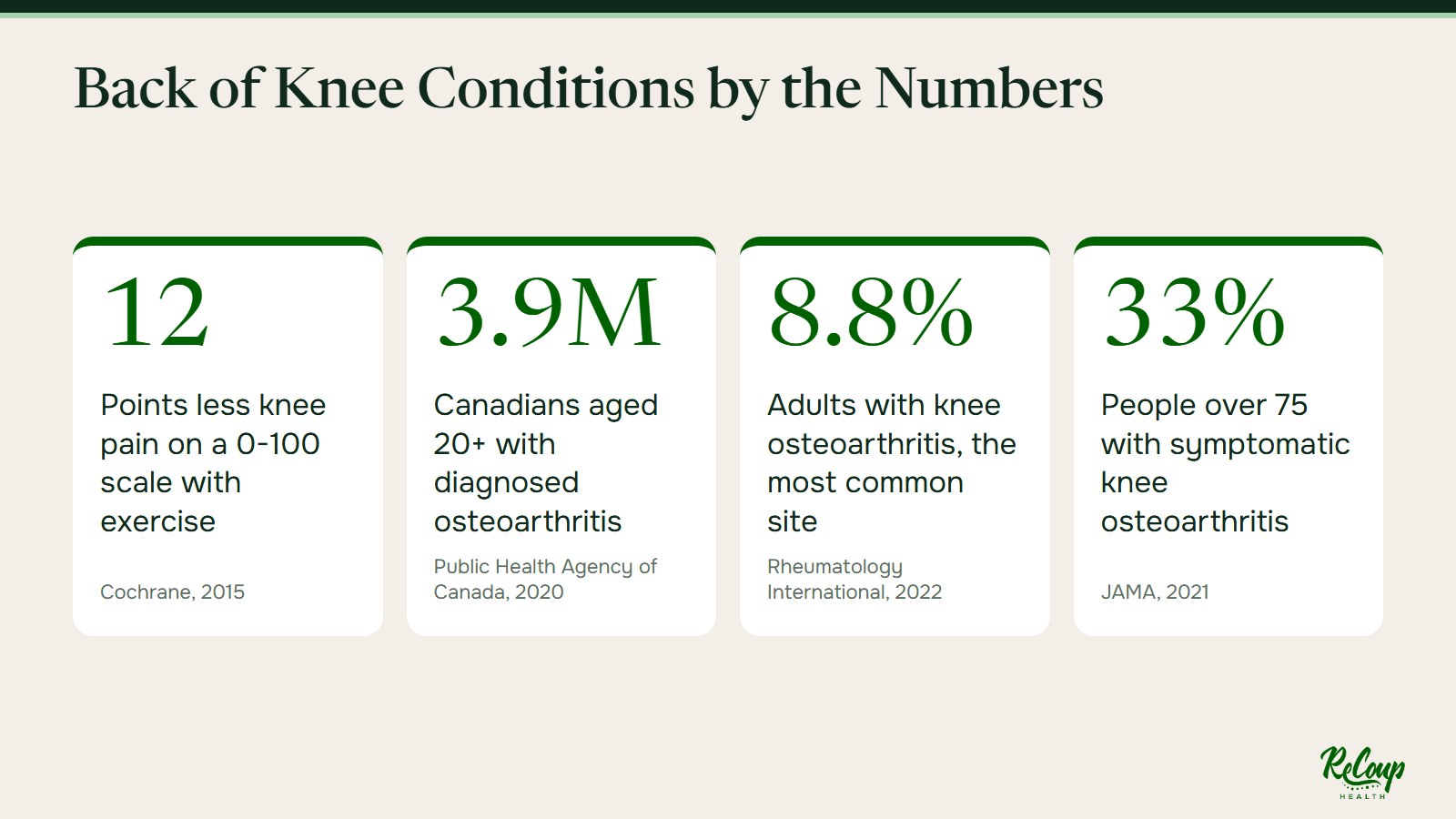
Yes, arthritis can cause pain behind the knee, though HSS notes it affects the back less than the sides or front. Osteoarthritis is the gradual breakdown of the cartilage that cushions the joint. The Public Health Agency of Canada reports diagnosed osteoarthritis in about 3.9 million Canadians aged 20 and over in 2016-2017. That figure equals 13.6% of adults.
The knee is a frequent site for that arthritis. A 2022 study in Rheumatology International found knee osteoarthritis in 8.8% of British Columbia adults, the most common site surveyed. A 2021 JAMA review reports symptomatic knee osteoarthritis in 33% of people over 75.
The graphic below shows these back of knee condition numbers side by side.
Arthritis also feeds Baker’s cysts. The NHS explains that adult cysts develop when another condition, such as osteoarthritis, damages the joint. Early knee arthritis treatment can calm the joint swelling that fills the cyst. Tendons are the next structure to check.
What Is Back of Knee Tendon Pain?
Back of knee tendon pain is irritation of the hamstring or calf tendons where they cross the knee crease. Healthline notes that injury to the biceps femoris, the outer hamstring muscle, causes pain in the back of the knee. HSS links posterior tendon strain to overuse from running or cycling.
Tendon pain tends to ache after activity rather than during the first few minutes. A sudden sharp pull with bruising points more to a muscle tear than to a tendon problem. Early hamstring strain care limits the time away from sport. The movement that hurts gives the next clue.
Why Does the Back of My Knee Hurt When I Bend or Straighten It?
The back of your knee hurts when you bend or straighten it because both movements load the tissues packed into the crease. Straightening stretches the hamstrings and tightens the joint capsule. Deep bending squeezes the back of the meniscus and any cyst between the thigh and calf.
The trigger movement narrows the likely cause in four ways:
- Pain on straightening: hamstring tightness or strain, a Baker’s cyst under pressure, or a stiff joint capsule.
- Pain on deep bending: a tear at the back of the meniscus or a Baker’s cyst, which Healthline links to trouble flexing.
- Pain on standing up after sitting: tendon irritation or arthritis stiffness after rest.
- A knee that will not fully straighten: a locked meniscus tear, which the NHS lists as an urgent sign.
A physiotherapist confirms the source with strength, range and joint tests. Squatting combines deep bending with body weight.
Why Does the Back of My Knee Hurt When I Squat?
The back of your knee hurts when you squat because a deep squat compresses the back of the joint. Pain in the back of my knee during squats, with clicking or catching, fits the meniscus and Baker’s cyst patterns. Healthline lists a locking or clicking sensation among Baker’s cyst symptoms.
Squat depth is the simplest variable to change. Squatting to a pain-free depth keeps the leg muscles working while the irritated tissue settles. Walking raises a similar question about loading.
Is Walking Good for Pain Behind the Knee?
Yes, walking is good for pain behind the knee when the cause is arthritis or mild tendon irritation. Healthline notes that low-impact walking can form part of long-term arthritis care. Rest suits the first days after a fresh injury, while swelling settles.
Exercise evidence is clearest for knee osteoarthritis. A 2015 Cochrane review pooled 44 trials with 3,537 people with knee osteoarthritis. Exercise cut pain by 12 points on a 0 to 100 scale right after treatment.
The updated Cochrane review covers 139 trials and 12,468 people. Exercise lowered pain by 13.14 points compared with usual care, with low to moderate certainty. The review authors call the clinical importance uncertain, so exercise eases pain but does not erase it.
Walking with a limp, new swelling or a hot calf is a reason to stop. Those signs lead into the question of when back-of-knee pain is serious.
When Is Pain Behind the Knee Serious?
Pain behind the knee is serious when it comes with calf swelling, warmth, redness, fever or a locked knee. The NHS lists these signs on its knee pain, Baker’s cyst and DVT pages. Ontario routes for each sign are below:
- Call 911 for leg pain or swelling with breathlessness or chest pain, which the NHS links to a clot in the lungs.
- Do not drive yourself to hospital with those breathing or chest symptoms.
- Go to the emergency department the same day for a swollen, warm, red or darker calf in one leg.
- Get urgent care for a knee that cannot bear weight, locks, gives way, or looks badly swollen or misshapen.
- Get urgent care for fever or chills with a hot, red knee, a possible sign of joint infection.
- Seek emergency care for numbness around the genitals or bottom, or new bladder or bowel problems.
A ruptured Baker’s cyst and a DVT can look alike. Cleveland Clinic reports that a burst cyst causes sharp knee or calf pain and calf swelling that mimics a clot. The comparison below shows the overlap between the two.
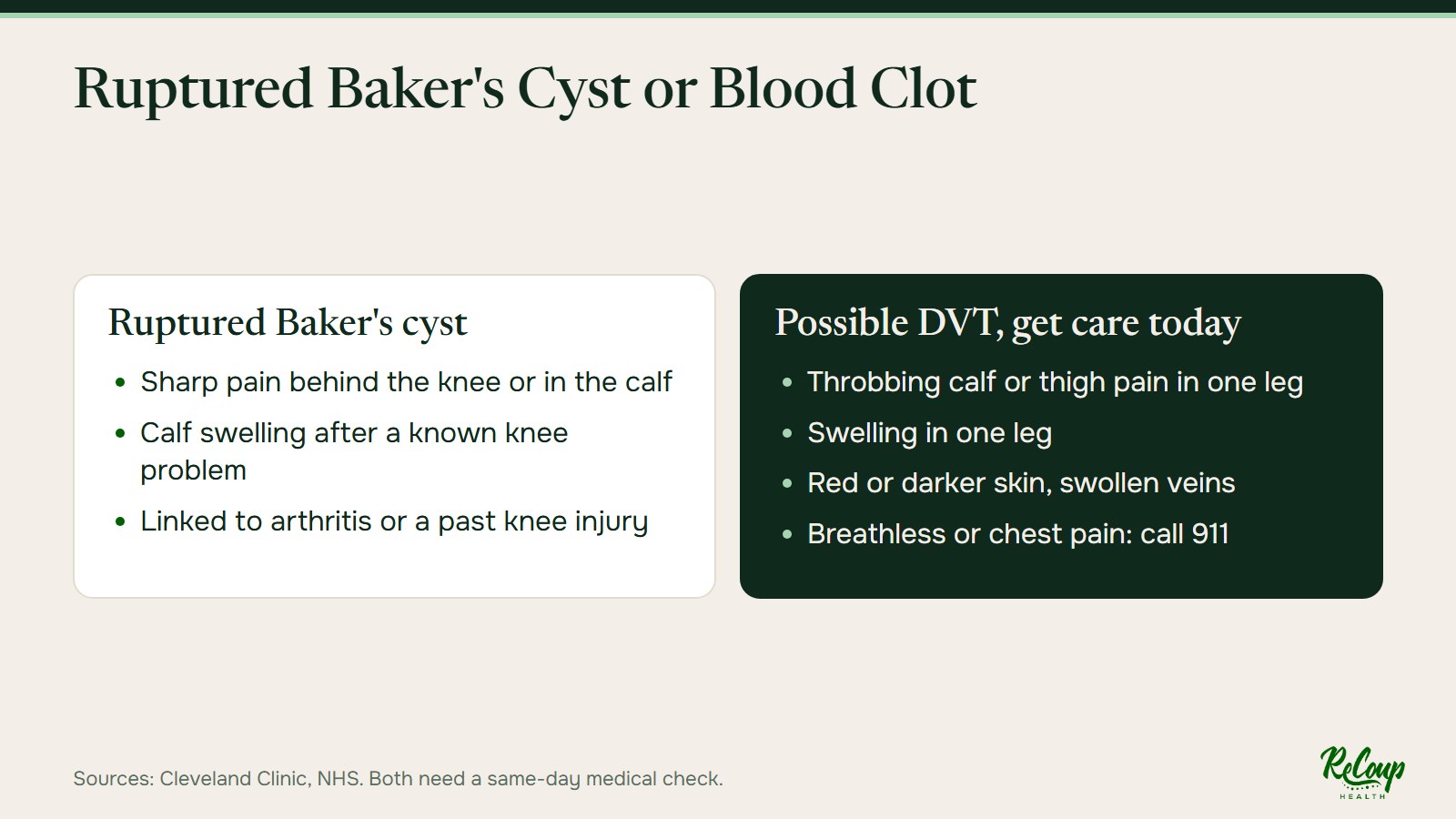
A clinician needs to examine the leg to tell the two apart. Health811 (dial 811) gives Ontario residents free nurse advice when the right level of care is unclear. Pain without these warning signs moves on to treatment.
How Do You Treat Back of Knee Pain?
Treat back of knee pain by calming the irritated tissue first, then rebuilding strength and movement around the knee. Cleveland Clinic lists rest-and-ice methods, medication, a knee brace, physiotherapy and, for some tears, surgery. These six steps cover what to do for knee pain behind the joint in the first weeks:
- Cut back on the movement that hurts for a few days, without full bed rest.
- Apply a wrapped ice pack for up to 20 minutes every 2 to 3 hours, as the NHS advises.
- Raise the leg on pillows and wear a light compression sleeve to limit swelling.
- Restart gentle movement, such as heel slides and short walks, once pain settles.
- Add strength work for the hamstrings, calves, thighs and hips over the following weeks.
- Book an assessment when pain lasts more than a few weeks, per the NHS, or returns with activity.
Medication choices belong with your pharmacist or family doctor. The right option depends on your health history and other medicines.
Physiotherapy targets the cause rather than the symptom alone. A physiotherapist tests strength, range of motion and the hamstring and calf tendons. The findings shape a graded plan through knee physiotherapy that loads the tissue in steps.
Hands-on care adds relief for tight tissue. Registered massage therapists use massage for knee pain to relax calf and hamstring tension around the crease. Regular calf massage pairs well with a stretching and strength routine.
How Long Does It Take for Pain Behind the Knee to Go Away?
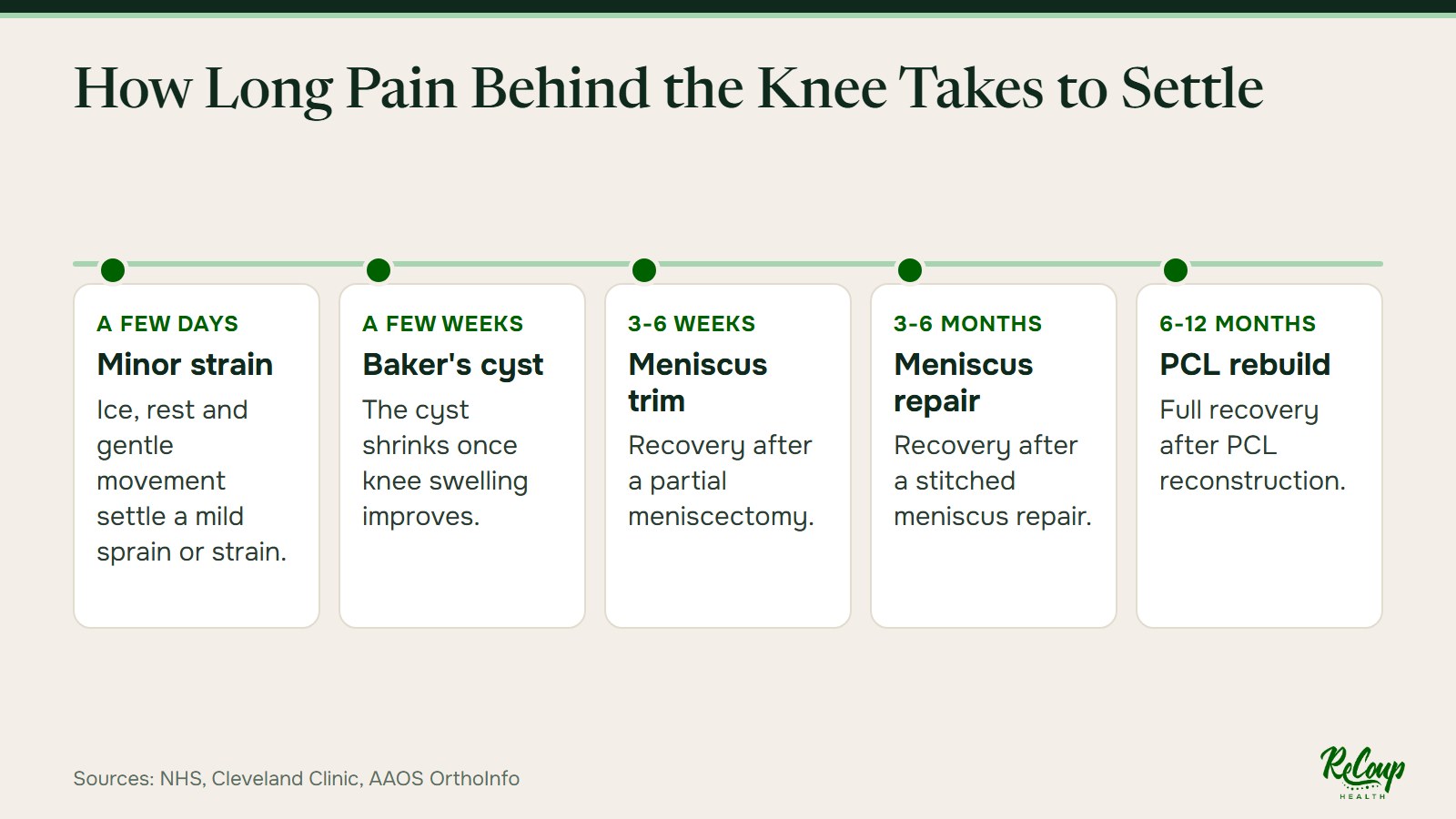
Pain behind the knee takes from a few days to 12 months to go away, depending on the cause. The NHS says people with a minor knee strain start to feel better in a few days. Cleveland Clinic reports that Baker’s cysts go away within a few weeks once knee swelling improves.
Surgical repairs take longer. AAOS OrthoInfo gives about 3 to 6 weeks of recovery after a partial meniscectomy, which trims the torn cartilage. A stitched meniscus repair takes about 3 to 6 months.
Full recovery after PCL reconstruction takes 6 to 12 months, according to AAOS OrthoInfo. The same source notes that many partial PCL tears heal on their own. The timeline below sets out each recovery range.
HSS defines chronic knee pain as pain lasting three months or more. Pain past that mark deserves a fresh behind-knee assessment that also checks the nerves and muscles above the knee.
What Else Should You Know About Pain in the Back of the Knee?
Pain in the back of the knee also links to the spine, running habits, calf tightness and bracing. The short answers below cover each link.
Can Sciatica Cause Pain Behind the Knee?
Yes, sciatica can cause pain behind the knee because the sciatic nerve runs down the back of the thigh. The NHS states that sciatica affects the bottom and the back of one leg. Spine-health, a patient education site, adds that L3 or L4 nerve-root compression in the low back can cause knee pain.
Sciatica and knee pain together point to the spine as the source, not the knee joint. The evidence here is thin, with no verified prevalence data. Cleveland Clinic reports that many sciatica cases improve within 4 to 6 weeks without medical treatment. Targeted sciatic nerve care treats the back and the leg together.
Why Does the Back of My Knee Hurt After Running?
The back of your knee hurts after running when a sudden jump in distance, speed or hills overloads the tendons. HSS names overuse strain from running as a cause of posterior knee pain. Back of knee pain after running tends to build over several runs rather than one.
Training load is the first variable to adjust. Cutting weekly distance and hills for a short block lets the tendon recover while you keep moving. A structured running tendon rehab plan rebuilds load in measured steps. Tight calves add to the strain.
Why Do the Back of My Knee and Calf Feel Tight?
The back of your knee and calf feel tight because the gastrocnemius calf muscle starts above the knee joint. Healthline explains that the calf muscles help bend the knee and point the toes. A strain of the gastrocnemius causes sudden pain and trouble standing on tiptoe.
Tightness alone responds to gentle stretching and gradual strength work. Tightness with swelling, warmth or redness in one calf needs a same-day medical check for a clot.
What Mistake Makes Bad Knees Worse?
Playing through pain is the mistake that makes bad knees worse, according to Cleveland Clinic prevention advice. The clinic warns against pushing on when the knee hurts during or after activity. The opposite error, stopping all movement, lets the muscles that protect the knee weaken.
Harvard Health quotes a Harvard physiatrist calling exercise one of the most important steps for knee pain. Balanced activity sits between those two errors.
Does a Knee Brace Help Pain Behind the Knee?
A knee brace helps pain behind the knee mainly when arthritis is the cause. The 2019 American College of Rheumatology and Arthritis Foundation guideline strongly recommends tibiofemoral bracing for knee osteoarthritis. A knee brace for pain from a strain gives short-term support while the tissue heals.
Knee swelling and pain also respond to a light compression sleeve during the first days. A 2026 review in Health Science Reports found 4 trials with 240 people combining orthotics and physiotherapy for knee arthritis. The evidence base is small. A physiotherapist can match unloader knee braces or sleeves to the cause.
Who Can Assess Pain in the Back of the Knee?
Physiotherapists and chiropractors can assess pain in the back of the knee without a doctor’s referral in Ontario. A family doctor or walk-in clinic handles imaging requests and medication. The emergency department handles the red-flag signs listed earlier.
A team approach covers the knee, hip, back and foot together. Physiotherapists, a chiropractor and registered massage therapists make up our knee team.
Frequently Asked Questions About Pain Behind the Knee
Can Knee Pain Go Away by Itself?
Yes, minor knee pain can go away by itself. The NHS says people with a minor strain start to feel better in a few days. Pain that does not improve within a few weeks needs an assessment.
Should I Still Run If My Knees Are Sore?
Run only when soreness stays mild and does not change your stride. HSS guidance on knee pain after running advises pausing when pain alters your gait, causes swelling or lasts into the next day.
Is Pain Behind the Knee a Sign of a Blood Clot?
Pain behind the knee is a less common sign of a blood clot, according to HSS. A clot in the popliteal vein can cause it. Calf swelling, warmth or redness in one leg needs same-day medical care.
Does Cycling Cause Pain Behind the Knee?
Cycling can cause pain behind the knee through overuse, according to HSS. Repeated pedalling strains the hamstring and calf tendons that cross the crease. A physiotherapist can review bike set-up and training volume.
How Recoup Health Helps With Pain Behind the Knee
Recoup Health helps with back of knee pain through assessment, hands-on care and graded exercise in one clinic. Our physiotherapists screen for red flags first, then match treatment to the structure involved. No doctor’s referral is needed to book.
Our team in Vaughan includes physiotherapists, a chiropractor, registered massage therapists, a naturopathic doctor and a performance coach. The Recoup Health providers team works together on knee, hip and back problems.