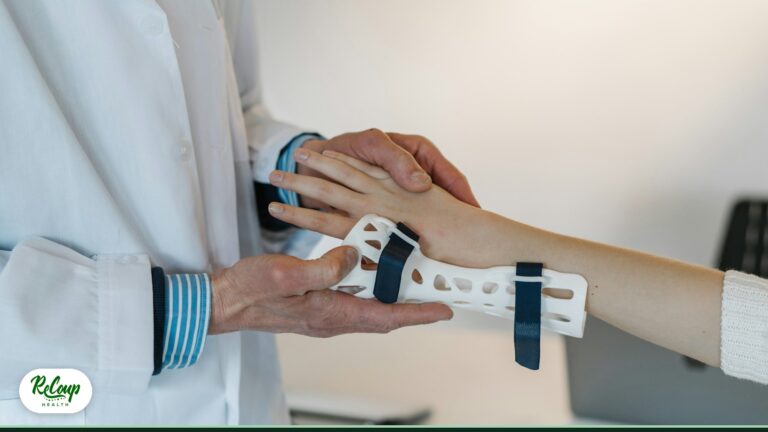

Diastasis recti before and after shows a midline bulge or dome near the belly button turning into a firmer, flatter centre line. Cleveland Clinic defines diastasis recti as a gap wider than 2 centimetres (cm) between the two rectus abdominis muscles. Exercise builds core strength and control, but the gap itself may narrow by only a few millimetres.
Key Takeaways
- A gap wider than 2 cm, or two finger widths, is the screening cut-off Cleveland Clinic uses.
- A 2016 Norwegian study of 300 first-time mothers found a gap in 60.0% at 6 weeks and 32.6% at 12 months postpartum.
- A home finger check is screening only, and a physiotherapist confirms width, depth and tension.
- Trials from 2018 to 2026 show exercise improves strength and control more consistently than it closes the gap.
- Surgery is generally considered for an umbilical hernia or a tummy tuck, according to Cleveland Clinic.
What Does Diastasis Recti Before and After Look Like?
Diastasis recti before and after looks different mainly in shape, firmness and control, beyond gap width alone. Before rehab, the belly shows a ridge or dome along the midline during effort. After rehab, the midline feels firmer and the dome shrinks or stays flat when you sit up. Cleveland Clinic notes the “before” belly can look pregnant months or years after the last baby.
Diastasis recti is the separation of the rectus abdominis, the paired “six-pack” muscles running down the front of the abdomen. The linea alba is the band of connective tissue that joins the left and right muscles. Pregnancy stretches the linea alba as the uterus grows, according to Cleveland Clinic. The stretched band explains why belly shape changes after birth.
Belly shape after birth is one part of a wider recovery picture. Our postnatal wellness care looks at breathing, posture, lifting habits and the abdominal wall together. Those habits shape how the stomach looks at rest and under load.
What Does Your Stomach Look Like If You Have Diastasis Recti?
Your stomach with diastasis recti looks like a soft pooch or a vertical ridge just above or below the belly button. The ridge, called doming or coning, rises when the abdominal wall works hard. Cleveland Clinic lists a jelly-like softness around the belly button as another sign. The pooch can remain even after pregnancy weight is gone, per the same source.
Diastasis recti from the front can look subtle, while the side view shows the lower belly pushing forward. That forward push leads to a frequent worry about belly size.
Can Diastasis Recti Cause a Big Belly?
Yes, diastasis recti can cause a bigger-looking belly, because a lax midline lets the abdominal contents press forward. The bulge reflects a stretched midline, not extra fat, although both can appear together. In a Norwegian survey of 460 first-time mothers, 96 women (20.9%) reported a midline abdominal protrusion at 6 to 8 months postpartum. The survey, published by Gluppe and colleagues in 2022, found 73.3% had worried in pregnancy about their postpartum belly.
Worry about belly appearance is common, so a clear way to check the midline helps.
How Do You Know If You Have Diastasis Recti?
You know you have diastasis recti when a midline gap wider than 2 cm appears during a partial sit-up. Cleveland Clinic pairs that finger check with these 5 signs:
- A visible bulge or pooch just above or below the belly button
- Softness or a jelly-like feeling around the belly button
- Coning or doming when you tighten your abs or lean back in a chair
- Difficulty lifting, walking or doing everyday tasks
- Low back pain and poor posture
Back pain has many possible sources besides the abdominal wall, including the spine, hips and pelvis. We screen those areas alongside our post-pregnancy back pain when the gap does not explain the symptoms. The midline check itself is quick to do at home.
How Do I Check Myself for Diastasis Recti?
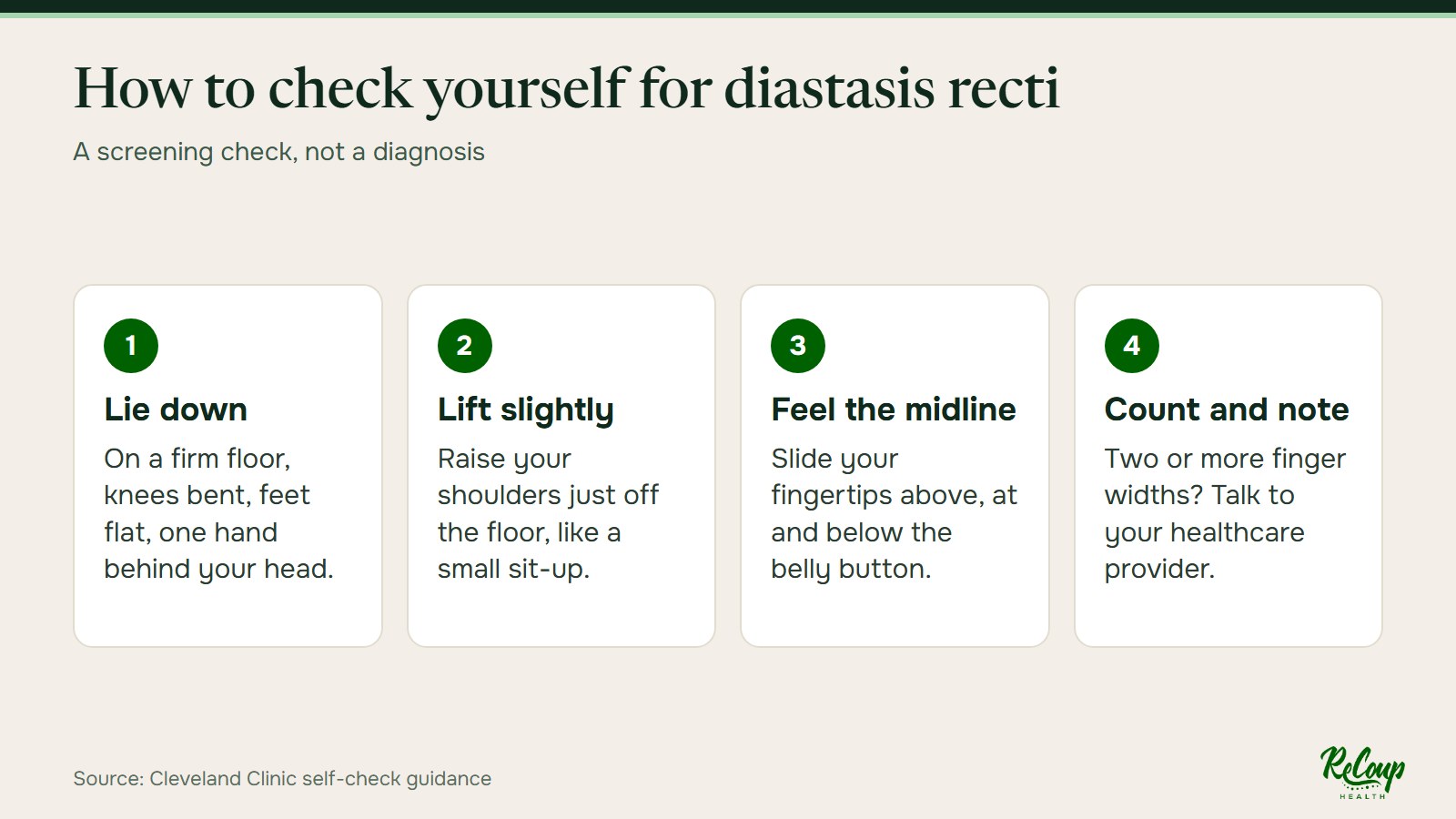
Check yourself for diastasis recti by lying on your back, lifting your shoulders slightly and feeling for a gap at the midline. Cleveland Clinic describes the self-check in 5 steps:
- Lie on your back on a firm floor with knees bent and feet flat.
- Place one hand behind your head for support.
- Lift your shoulders slightly off the floor, as in a small sit-up.
- Slide the fingertips of your other hand along the midline above the belly button, fingers pointing to your toes.
- Count the fingers that fit in the gap, and note how deep they sink.
A gap of two or more finger widths is the point to talk to your healthcare provider, per Cleveland Clinic. Repeat the check at the belly button and below it, since the gap can sit at any of these 3 sites. The graphic below condenses the self-check into 4 quick steps.
A finger check is a screening tool, not a diagnosis. Finger widths vary between people, so clinicians may confirm the gap with a tape measure, calipers or ultrasound, per Cleveland Clinic. Ultrasound also separates a gap from fat tissue.
How Do I Know If It’s Fat or Diastasis Recti?
You know it is diastasis recti rather than fat when the bulge forms a ridge or dome along the midline during effort. Belly fat spreads evenly under the skin and keeps its shape when you lift your head. A diastasis bulge, by contrast, changes shape as the muscles switch on. Extra fat makes the finger check harder, so press firmly into the midline before lifting your head.
Fat and a gap can coexist, and other conditions can also mimic a gap.
What Is Mistaken for Diastasis Recti?
An umbilical hernia, belly fat, bloating and loose skin are mistaken for diastasis recti. A hernia feels like a firm, localized lump rather than a soft ridge. A hernia forms when tissue pushes through a weak spot in the abdominal wall. Cleveland Clinic lists an umbilical hernia as a possible complication of severe or untreated separation. A firm lump needs an exam by your family doctor.
A confirmed gap is far from rare, as the numbers below show.
How Common Is Diastasis Recti After Birth?
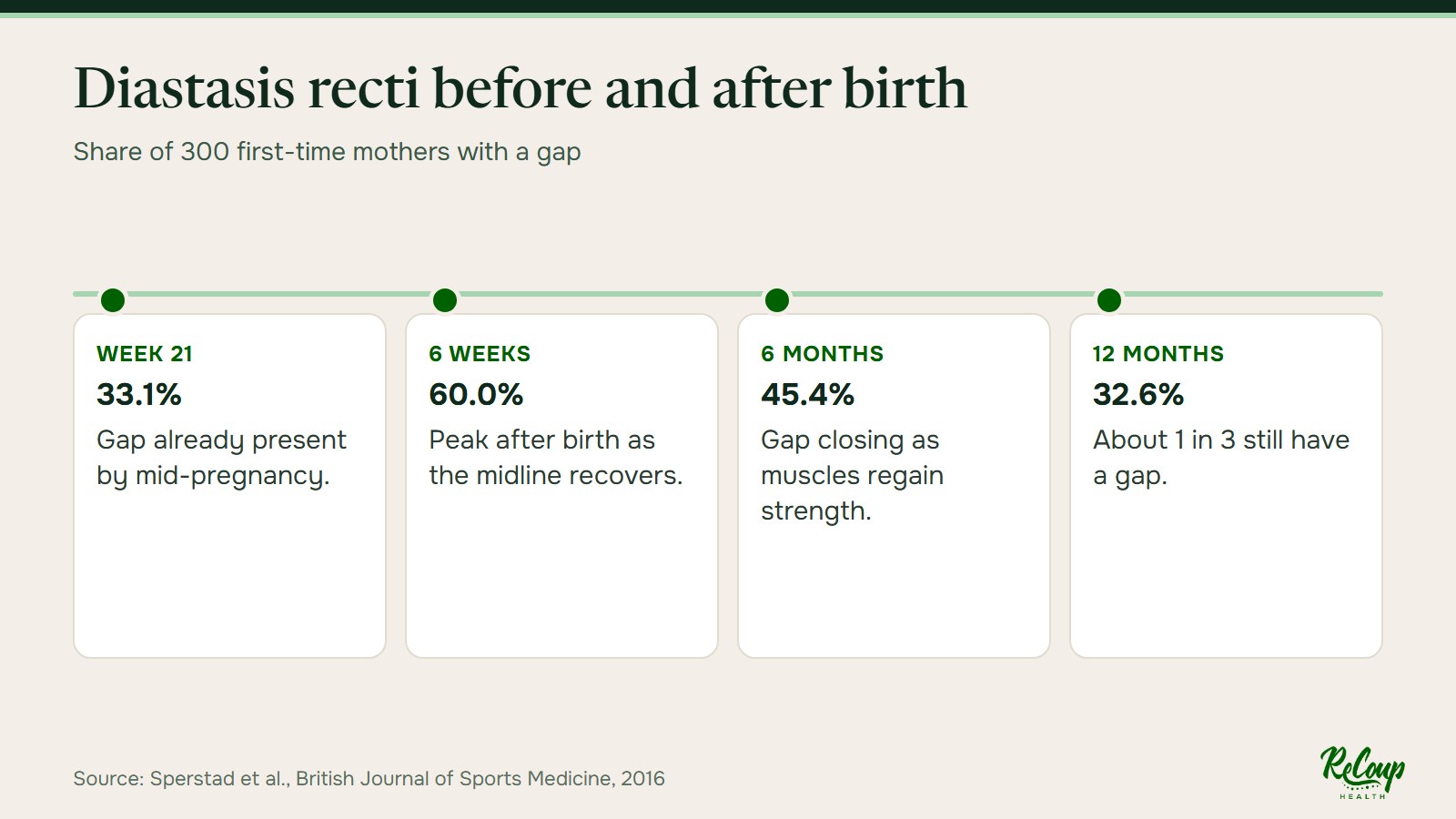
Diastasis recti after birth affects 60.0% of first-time mothers at 6 weeks postpartum, according to a 2016 Norwegian study. Sperstad and colleagues followed 300 women for the British Journal of Sports Medicine. The rate was 33.1% at week 21 of pregnancy, 45.4% at 6 months and 32.6% at 12 months postpartum.
Measuring methods change these figures. An ultrasound study of 84 first-time mothers found a gap in 100% at pregnancy week 35. The rate fell to 39% at 6 months postpartum (Fernandes da Mota, 2015). The stats graphic below compares results from palpation, ultrasound and computed tomography (CT) scans.
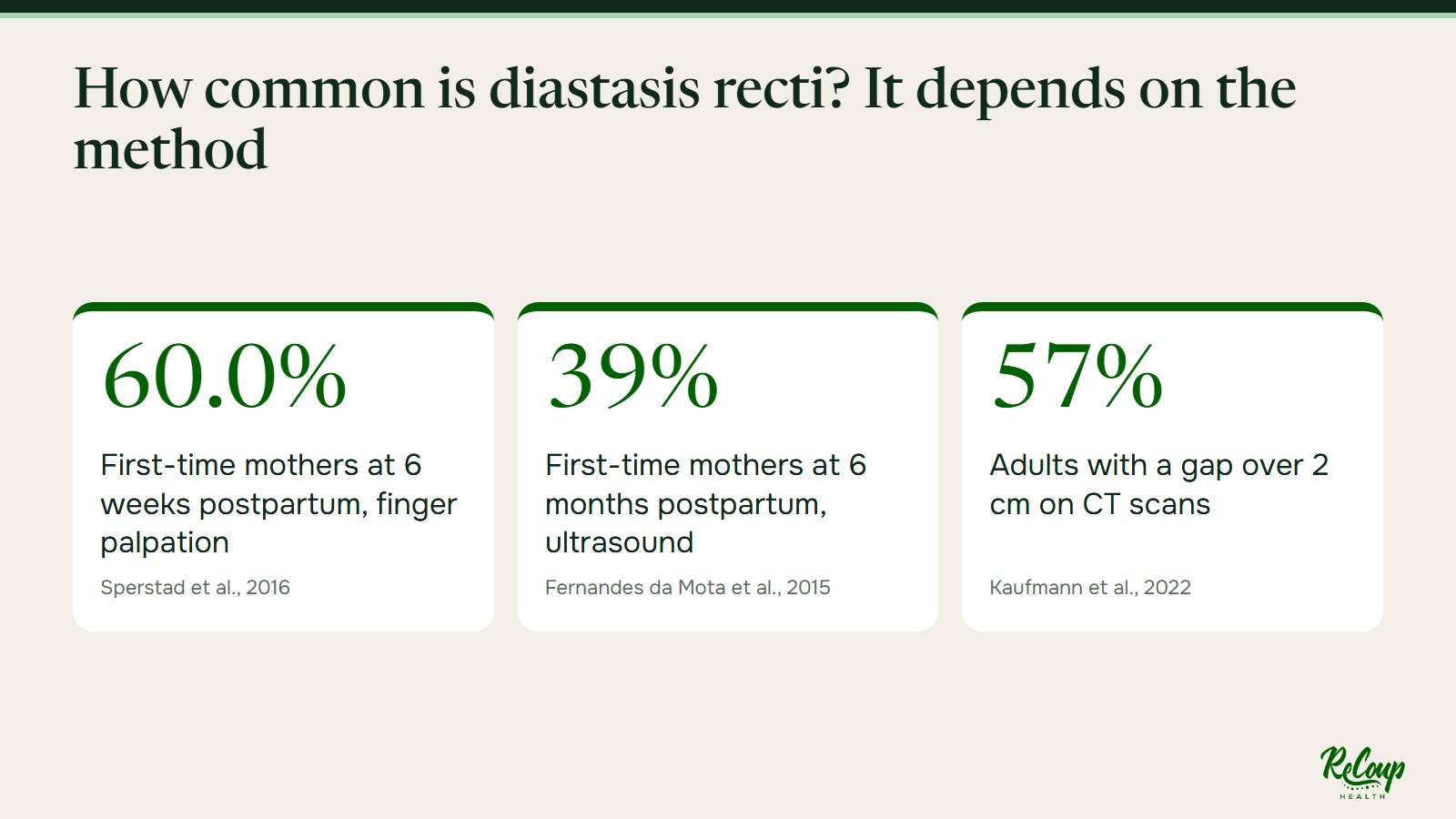
The answer to how common is diastasis recti also depends on who is measured. A CT study of 329 adults found a gap over 2 cm in 57% of participants (Kaufmann, Hernia, 2022). True prevalence is unknown, because methods and cut-offs differ, according to a 2021 review in Hernia. Those shifting numbers raise the question of natural healing.
Does Diastasis Recti Heal on Its Own?
Diastasis recti heals on its own in many women during the first year, but not in everyone. In the Norwegian cohort, prevalence fell from 60.0% at 6 weeks to 32.6% at 12 months postpartum. Roughly 1 in 3 first-time mothers still had a gap at 12 months. Cleveland Clinic states the gap starts to close after several weeks postpartum as muscles regain strength.
A small gap after birth is normal. Mota and colleagues (2018) measured normal ultrasound gaps of 9 to 21 millimetres (mm) below the belly button. Those readings came at 24 to 26 weeks postpartum. The same site measured 49 to 79 mm during weeks 35 to 41 of pregnancy. Those ranges show how far the midline recovers by itself, which frames the timing question.
How Long Does It Take to Correct Diastasis Recti?
Correcting diastasis recti function takes about 12 weeks of regular training in trials, and the gap can change for 12 months. Earlier training gives a larger change in gap width. A 2026 meta-analysis of 9 trials found exercise started under 3 months postpartum reduced the gap by 10.2 mm. The timeline below tracks prevalence at four points from pregnancy to the first birthday.
Healing speed depends on the amount of separation and consistency of strengthening, per Cleveland Clinic. Recurrence is possible with later pregnancies, according to the same source. Physiotherapy data show what that strengthening changes.
What Does Diastasis Recti Before and After Physical Therapy Show?
Diastasis recti before and after physical therapy shows bigger gains in strength and control than in gap width. A 2023 review of 16 trials found exercise narrowed the gap by only 0.43 cm versus usual care. Benjamin and colleagues, writing in Physiotherapy, judged that change not clinically significant. A newer 2026 meta-analysis of 450 women reported an 8.05 mm reduction, with no change in disability scores.
Strength can improve while the gap stays the same. A 2023 trial of 70 women found a 12-week home program changed the gap by only 1 mm. The same program increased abdominal strength by 9 newton-metres (Nm) and muscle thickness by 0.7 mm. Physiotherapy for diastasis recti therefore tracks function, not just a ruler reading.
Function includes how well the linea alba holds tension. Lee and Hodges (2016) found a standard curl-up narrowed the gap but distorted the linea alba more. Our abdominal wall physiotherapy measures width, depth and tension during real movements. Those findings guide the exercise choices your physiotherapist makes with you.
Leaking or pelvic heaviness alongside a gap deserves its own check. Bo and colleagues (2017) found women with a gap did not have weaker pelvic floor muscles. A 2025 review in the British Journal of Sports Medicine linked pelvic floor training with 37% lower odds of urinary incontinence. Our pelvic floor therapy addresses those symptoms separately from the abdominal gap.
Can You Really Fix Diastasis Recti?
Yes, you can really fix diastasis recti symptoms and function without surgery in many mild cases. Full closure of the gap is less predictable than better core function. A 2025 review of 355 publications in Hernia reported that conservative care improves function in mild cases. The same review noted that severe cases may need surgical repair.
Canadian data are limited. A pilot trial in Physiotherapy Canada (2023) studied 44 women with gaps of 30 mm or more. Rectus abdominis exercise narrowed the gap more than deep transversus abdominis training, with no adverse events reported. A pilot cannot settle the debate, but the result questions blanket bans on curl-ups.
Can I Get a Flat Tummy With Diastasis Recti?
Yes, you can get a flatter tummy with diastasis recti once the core controls the midline under load. A flat look depends on midline tension, skin and body fat together. Exercise improves tension and doming, while loose skin and fat respond to other factors. An elastic belly band can give support, but it “does not heal the separation,” according to Cleveland Clinic.
Loose skin and a wide, painful gap are the cases where surgery enters the discussion.
How Does Diastasis Recti Surgery Before and After Compare With Physiotherapy?
Diastasis recti surgery before and after shows a tighter, flatter profile, because the surgeon stitches the rectus muscles together. Surgery closes the gap directly, while physiotherapy improves control of the existing gap. Cleveland Clinic states surgery is generally considered for an umbilical hernia or a requested tummy tuck. The table below compares the two approaches, starting with the main difference.
| Feature | Physiotherapy-led rehab | Surgical repair (plication) |
|---|---|---|
| Main difference | Improves strength and midline tension; gap narrows by a few mm | Stitches the muscles together to close the gap |
| Typical candidate | Mild to moderate gap, first-line care | Umbilical hernia, tummy tuck request, or symptoms that persist after training |
| Reported outcome | 0.43 cm to 8.05 mm average gap reduction in reviews | No CT-confirmed recurrence at 1 year in 60 women (Olsson, 2019) |
| Evidence quality | Very low to moderate certainty trials | Mostly uncontrolled surgical series with short follow-up |
The surgical outcomes in the table come from small, selected groups. Olsson and colleagues (2019) reported improved trunk function in 98% and better exercise test results in 76%. A 2026 review of 5 studies covering 498 women reported reductions of at least 85% in back pain and incontinence.
A 2017 review of 1,691 patients found open repair was used in 85% of cases. Recovery after surgery still needs graded strengthening, and post-surgical rehab rebuilds trunk strength once the surgeon clears activity. That surgical decision belongs with a surgeon and your family doctor.
What Else Should You Know About Diastasis Recti?
Does Diastasis Recti Hurt?
Diastasis recti does not hurt in itself, according to Cleveland Clinic, although side effects of a weak core can cause pain. A wider gap was linked with more abdominal pain in one small study. Keshwani and colleagues (2018) studied 32 women at 3 weeks postpartum. Sperstad and colleagues (2016) found similar lumbopelvic pain in women with and without a gap at 12 months.
Back and hip tension from feeding and carrying a baby responds to hands-on care. Our postnatal massage therapy eases that muscle tension without pressing on the midline.
Can Diastasis Recti Get Worse?
Yes, diastasis recti can get worse with repeated pregnancies, according to Cleveland Clinic. Heavy lifting at least 20 times a week was linked with 2.18 times higher odds of a gap in the Norwegian cohort. Straining that pushes the belly forward adds load to a stretched midline.
What Happens If Diastasis Recti Is Left Untreated?
Diastasis recti left untreated can lead to a hernia, back pain, constipation, leaking or pelvic pain, per Cleveland Clinic. Cohort studies show weaker links than that list suggests. Gluppe and colleagues (2021) found no higher rate of pelvic floor disorders or back pain in 72 women with a gap. Pelvic and hip discomfort can respond to osteopathic treatment alongside exercise.
Is Running With Diastasis Recti Safe?
Running with diastasis recti is possible for many people once walking, lifting and single-leg tasks feel controlled. Doming, leaking or pelvic heaviness during a run are signs to scale back. The exercise trials cited in this post did not test running directly. A graded plan from return-to-run physiotherapy builds impact tolerance step by step.
What About Diastasis Recti After C-Section?
Diastasis recti after c-section is checked the same way, once the incision has healed and your care provider has cleared it. The self-check sites sit above the usual caesarean incision, according to Every Mother. Skip any tender spot and recheck after the scar settles.
Can Men Get Diastasis Recti?
Yes, men can get diastasis recti from chronic straining, heavy lifting, constipation or large weight changes, according to Cleveland Clinic. Older age, higher body mass index (BMI) and past pregnancies were independent risk factors in the 2022 CT study of 329 adults.
When Should You Seek Urgent Care for a Belly Bulge?
Seek urgent care for a belly bulge that is painful, stuck out, discoloured, or paired with vomiting or fever. Those signs can point to a trapped hernia, according to the NHS and Cleveland Clinic. Go to the emergency department rather than waiting for a clinic visit.
Frequently Asked Questions About Abdominal Separation
How Do You Tell If You Have Diastasis Recti While Pregnant?
You tell during pregnancy by watching for a ridge or dome along the midline when you sit up. Cleveland Clinic states diastasis develops in the third trimester for many people. Roll onto your side to get up, and ask your care provider before doing a finger check.
What Causes Diastasis Recti?
Diastasis recti is caused by stretching of the linea alba as the uterus grows during pregnancy. Cleveland Clinic lists multiples, age over 35 and pregnancies less than 12 months apart as risk factors.
Can You Get Diastasis Recti Again?
Yes, you can get diastasis recti again in a later pregnancy, according to Cleveland Clinic. Risk rises with each pregnancy as the linea alba loses elasticity.
Does a Belly Band Close the Gap?
No, a belly band does not close the gap. Cleveland Clinic states an elastic band gives support but does not heal the separation.
Does a Gap Mean Weak Pelvic Floor Muscles?
No, a gap does not mean weak pelvic floor muscles. Bo and colleagues (2017) found no difference in pelvic floor strength at 6 weeks, 6 months or 12 months postpartum.
How Does Recoup Health Help You Check and Rebuild Your Core?
Recoup Health helps you check and rebuild your core with an assessment of gap width, depth, tension and daily movement. Our postpartum core rehab combines physiotherapy, pelvic floor therapy and graded strength work. No referral from your family doctor is needed.
Our physiotherapists, registered massage therapists and naturopathic doctor work as one team in Vaughan. You can meet our postnatal clinicians and choose the clinician who suits your goals. Talk to your physiotherapist or family doctor before starting any new core program.
Your own diastasis recti before and after story starts with a clear baseline measurement, taken before any program begins. Book that first visit when you contact our reception by phone or online form.
A baseline today makes later progress easy to see and measure, from doming to daily lifting comfort. Every assessment, exercise plan and follow-up service listed on the Recoup Health website builds on that first measurement.