
The short answer to how to treat tennis elbow is relative rest, simple pain relief and a slow forearm strengthening program. AAOS OrthoInfo reports that 80 to 95% of patients get better without surgery. The NHS advises physiotherapy once home care has not helped after 6 weeks. Steroid injections bring quick relief but more relapses, so lasting repair depends on loading the tendon well.
Key Takeaways
- Relative rest means cutting the painful grip and twist loads, not putting the arm in a sling.
- In a BMJ trial of 198 adults, 94% of the physiotherapy group had succeeded at 1 year.
- Steroid injections won at 6 weeks but carried a 72% recurrence rate in the same trial.
- The NHS suggests a family doctor visit after 2 weeks of self-care and physiotherapy after 6 weeks.
- Surgery is discussed only after 6 to 12 months of nonsurgical care, according to AAOS OrthoInfo.
How Do You Treat Tennis Elbow in the First 6 Weeks
You treat tennis elbow in the first 6 weeks by calming the irritated tendon, then loading it again in small steps. Relative rest plus gradual strengthening is the core of early care. Tennis elbow is an overuse injury of the tendon joining the wrist extensor muscles to the outer elbow bone.
The tendon involved is the extensor carpi radialis brevis (ECRB), a forearm muscle that lifts and steadies the wrist. AAOS OrthoInfo explains that tiny tears form where this tendon attaches to the elbow. Those tears explain why outer elbow pain flares with gripping, lifting and twisting. The six steps below give that tendon a calm start.
- Cut back the trigger: reduce the gripping, twisting and lifting tasks that cause pain, but keep the arm moving.
- Use cold or heat: the NHS suggests a wrapped pack for up to 20 minutes every 2 to 3 hours.
- Ask about pain relief: talk to your pharmacist about paracetamol or an anti-inflammatory gel before you start either one.
- Try a forearm strap: the NHS notes these straps are sold in pharmacies and worn just below the sore spot.
- Start gentle movement: the NHS recommends simple exercises, such as bending and straightening the arm.
- Book a check at 2 to 6 weeks: the NHS advises a doctor visit after 2 weeks and physiotherapy after 6 weeks.
The NHS also warns that ibuprofen gel is flammable. Users of that gel should avoid smoking and naked flames. Those first steps can all happen at home, which leads to the next question.
Can You Treat Tennis Elbow on Your Own at Home
Yes, you can treat tennis elbow on your own at home in the early weeks, while pain eases week by week. The NHS states that tennis elbow tends to settle with rest but can sometimes last over a year. Home care works because the tendon recovers once the daily load drops below what it can tolerate.
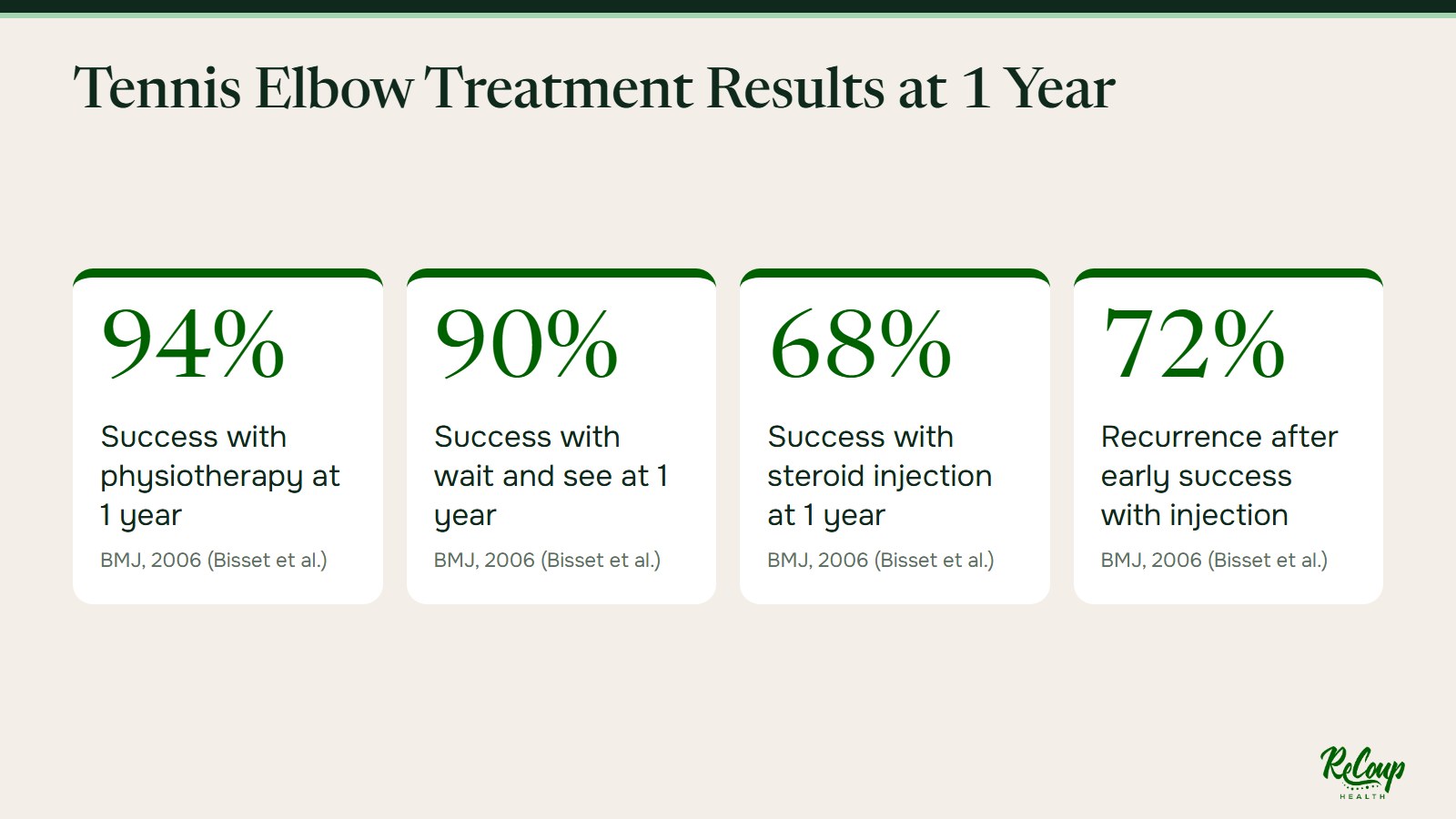
Natural recovery is real. In the 2006 BMJ trial by Bisset and colleagues, 90% of the wait-and-see group reported success at 1 year. That same group managed only 27% success at 6 weeks, so home care alone is slow.
Good home treatment for tennis elbow starts with the tasks that caused it. Knowing how to treat tennis elbow means finding its triggers. The NHS lists computer work, using a screwdriver, sewing and playing an instrument as common triggers. Heavy tools, meat cutting and plumbing are linked to repetitive work injuries like this one. The graphic below sums up a simple home routine.
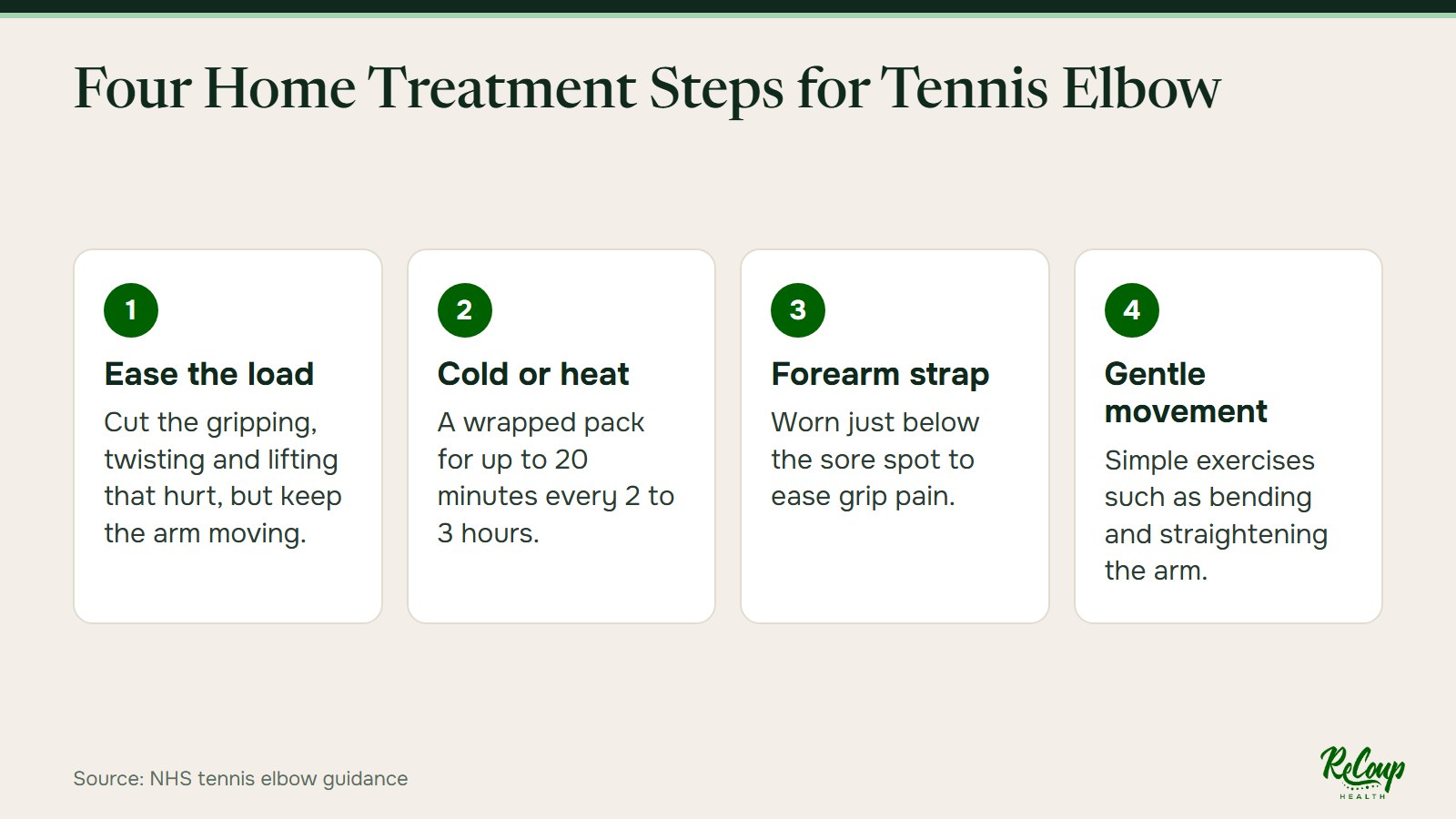
These four home steps cover tennis elbow pain relief in the first weeks. Pain relief alone does not repair the tendon, so the next section looks at speed.
What Is the Fastest Way to Heal Tennis Elbow
The fastest way to heal tennis elbow is to keep the arm active while removing the specific loads that hurt it. Quick relief and lasting healing are two different goals. People searching how to fix tennis elbow fast face a real trade-off between them.
The Bisset BMJ trial compared three approaches in 198 adults with symptoms lasting at least 6 weeks. The table below shows how each one performed early and at 1 year.
| Treatment | Recurrence after early success | Success at 6 weeks | Success at 1 year |
|---|---|---|---|
| Steroid injection | 72% | 78% | 68% |
| Physiotherapy (manipulation plus exercise) | 8% | 65% | 94% |
| Wait and see | 9% | 27% | 90% |
The table shows that the injection group felt better first but relapsed far more. Physiotherapy gave a fair early result and the highest 1-year success. The 1-year gap between physiotherapy and wait and see was not statistically significant, though. That gap between short-term and long-term results shapes every treatment for tennis elbow, as the next section shows.
Which Treatment for Tennis Elbow Works Long Term
The treatment for tennis elbow that works long term is active rehab, with injections kept for short-term relief only. A 2013 JAMA trial by Coombes and colleagues tested this in 165 adults. At 1 year, 83% of the steroid group had recovered or improved, versus 96% of the placebo injection group.
Recurrence told the same story in that JAMA trial. Recurrence reached 54% after steroid injection, compared with 12% after placebo. The authors concluded that steroid injection led to worse long-term outcomes. The graphic below gathers the key 1-year figures from the Bisset trial.
Newer options show a similar pattern. A 2024 Orthopaedic Surgery meta-analysis of 6 trials found shockwave therapy trailed steroid injection at 1 month. Shockwave then outperformed injection at 3 and 6 months for pain and function.
Platelet-rich plasma (PRP) is an injection made from a concentrate of your own blood. A 60-patient trial in the Journal of Clinical Medicine (2025) found PRP no better than saline placebo long term. Those results point to rehab as the long-term foundation, which is where physiotherapy comes in.
How Does Physiotherapy Treat Tennis Elbow
Physiotherapy treats tennis elbow by rebuilding the tendon’s tolerance to load through graded exercise, hands-on care and activity advice. The NHS lists massage, stretching, strengthening exercises and ultrasound therapy as standard physiotherapy options. Your physiotherapist also checks the wrist, shoulder and neck, since pain can be referred from those areas.
Eccentric exercise is a key tool. Eccentric means the muscle lengthens while it works, such as slowly lowering a light weight with the wrist. A physiotherapy loading program builds from easy lowering drills to heavier, faster work over weeks.
The evidence for this approach is promising but limited. A 2010 Journal of Shoulder and Elbow Surgery trial tested an eccentric rubber bar twist in 21 patients. Adding the twist cut pain by 81%, versus 22% without it. The trial was small and linked to the device maker, so larger independent studies are needed.
A 2024 Cochrane review pooled 23 trials with 1,612 people. The review found that manual therapy and exercise gave small benefits over minimal treatment, and those benefits were not sustained. Side effects were mild and short-lived. That honest picture explains why the choice of hands-on therapy matters too.
Can a Chiropractor, Massage or Acupuncture Help Tennis Elbow
A chiropractor, massage therapist or acupuncturist can help tennis elbow symptoms, but the research behind each one is thin. The 2024 Cochrane review rated the evidence for manual therapy as low certainty. Hands-on care works as a partner to exercise, not a replacement.
The answer to can a chiropractor help with tennis elbow is yes, as part of an active plan. Chiropractors use joint mobilization of the elbow and wrist, soft tissue work and loading advice. The Bisset trial’s physiotherapy arm included elbow manipulation plus exercise, and it reached 94% success at 1 year. Our chiropractic elbow care pairs that kind of hands-on work with a home exercise plan.
Patients also ask, does massage help tennis elbow. The NHS includes massage among physiotherapy treatments for the condition. Massage eases tight forearm muscles and can make exercise more comfortable. Registered massage therapists (RMTs) offer forearm massage therapy that targets the wrist extensor muscles.
Many people also wonder, does acupuncture help tennis elbow. Stanford Health Care states that small studies report relief, but there is not enough strong evidence to confirm it works. Osteopathy offers another hands-on option, and osteopathic manual therapy treats the elbow alongside the shoulder and neck. Short-term relief is useful, but lasting results depend on what you do next.
How Do You Fix Tennis Elbow for Good
You fix tennis elbow for good by building forearm strength above the level your work and sport demand, then keeping it there. Recurrence is the main threat to a lasting fix. The 2022 JOSPT clinical practice guideline notes that lateral elbow pain can recur and cause lengthy time off work.
Knowing how to fix tennis elbow permanently means changing the load as well as the tissue. Five habits lower the chance of a relapse:
- Keep strengthening the forearm two or three times a week after pain settles.
- Return to heavy gripping in stages, adding load only when the next day feels no worse.
- Set the keyboard and mouse so the wrist stays level, with frequent micro-breaks.
- Use tools with thicker handles to reduce the grip force needed.
- Have racquet equipment checked, since AAOS OrthoInfo links stroke technique and equipment to this injury.
Racquet players can cut forearm stress with a stiffer racquet or looser strings, according to AAOS OrthoInfo. Coaching on backhand technique helps too, and racquet sport physiotherapy builds a safe return to play.
Every person with tennis elbow carries a different mix of work tasks, sports, grip habits and past injuries. Each factor changes the load on the tendon from day to day. A proper tennis elbow assessment pinpoints which of these habits matter for you. Some cases still fail to settle, which raises the question of surgery.
When Does Chronic Tennis Elbow Treatment Involve Surgery
Chronic tennis elbow treatment involves surgery only after 6 to 12 months of nonsurgical care has failed, according to AAOS OrthoInfo. The NHS gives the same 6 to 12 month window. Cleveland Clinic calls the need for surgery very rare.
Tennis elbow treatment without surgery succeeds for 80 to 95% of patients, AAOS OrthoInfo reports. Surgery removes damaged tendon tissue and reattaches healthy tissue. AAOS OrthoInfo reports success in 80 to 90% of patients, with return to sport at 4 to 6 months.
Recovery after an operation needs structured elbow surgery rehab to restore motion and strength. The timeline below shows when each stage of care fits.
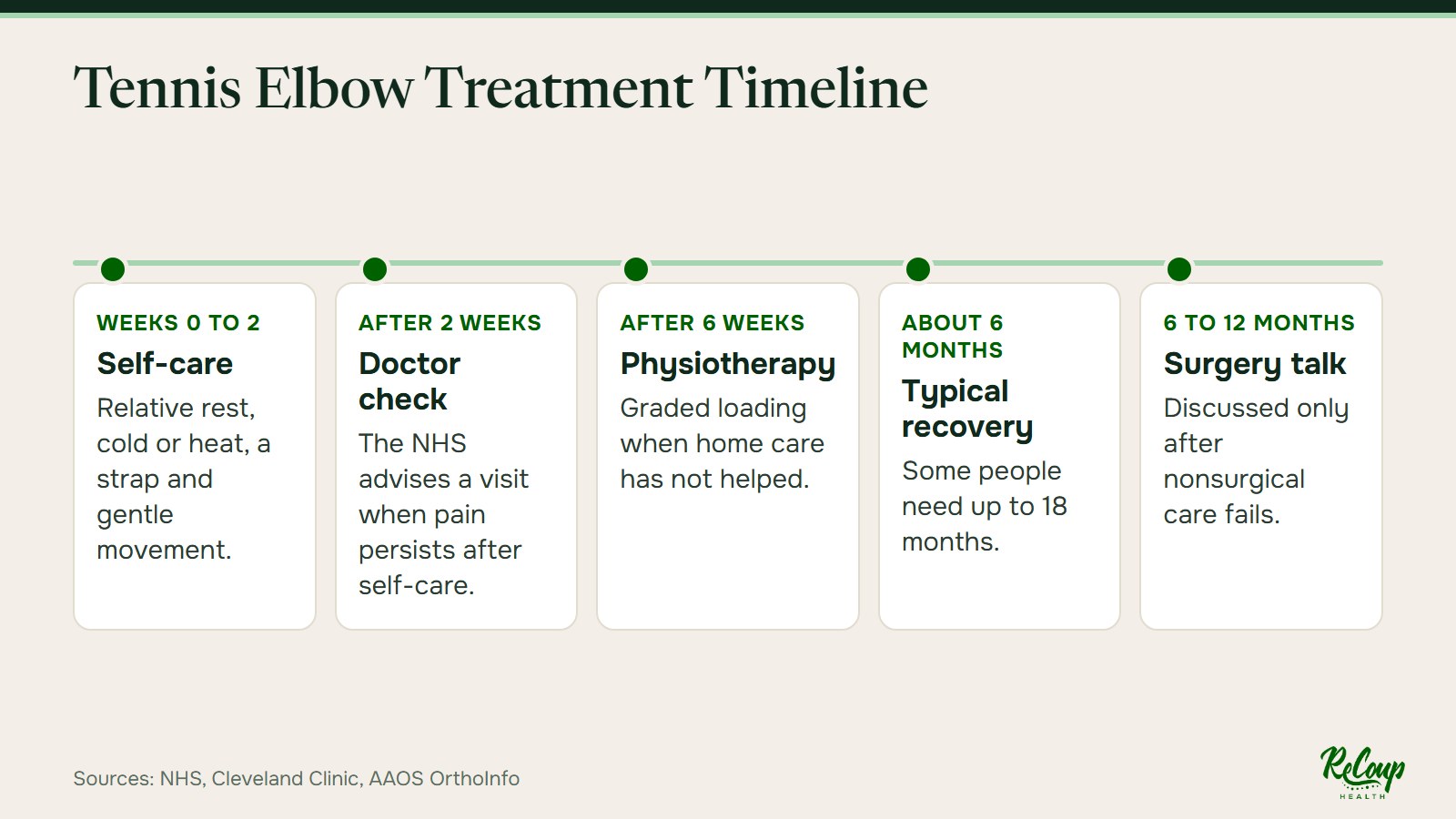
That timeline covers the main path, but several side questions come up during recovery.
What Else Should You Know About Treating Tennis Elbow
Treating tennis elbow raises a handful of practical questions about timing, causes and look-alike conditions. The short answers below cover the side questions that patients raise during treatment.
Will Tennis Elbow Eventually Go Away
Yes, tennis elbow will eventually go away for the large majority of people. The Bisset trial found 90% success at 1 year with wait and see alone. The NHS adds that some cases last over a year, so slow progress deserves a professional check.
How Long Does It Take for Tennis Elbow to Heal
Tennis elbow takes around 6 months to heal, and some people need up to 18 months, according to Cleveland Clinic. Recovery time depends on tendon damage, age and job demands. Early treatment shortens the slow phase.
Why Did I Suddenly Get Tennis Elbow
Tennis elbow can appear suddenly after a spike in gripping or lifting, even though the tendon strain built up over weeks. A weekend of painting, a new gym routine or a long renovation job can tip the tendon over its limit. The NHS says it is more common between ages 35 and 54.
Tennis is a minor cause. Cleveland Clinic estimates that more than 9 in 10 people develop the condition for other reasons. A 2006 American Journal of Epidemiology study found a prevalence of 1.3% in adults aged 30 to 64.
What Not to Do With Tennis Elbow
With tennis elbow, do not keep pushing through tasks that sharply raise pain, and do not fully immobilize the arm. Stanford Health Care warns that continuing the harmful activity lengthens rehab and can cause severe tendon damage. Avoid repeated steroid shots, which Stanford notes may harm the tendon.
Is It Better to Keep Tennis Elbow Straight or Bent
A slightly bent elbow is better for gripping and lifting with tennis elbow. AAOS OrthoInfo explains that the ECRB steadies the wrist when the elbow is straight, which loads the sore tendon. Lifting with the palm facing up and the elbow close to the body spreads the load.
What Could Be Mistaken for Tennis Elbow
Elbow arthritis, a pinched nerve and neck problems can be mistaken for tennis elbow. AAOS OrthoInfo notes that doctors may order an MRI to check for a cervical disc herniation or neck arthritis. Nerve tests can rule out nerve compression near the elbow.
Golfer’s elbow is a close cousin that affects the inside of the elbow. The 2006 Finnish study found it in 0.4% of adults, versus 1.3% for tennis elbow. A physiotherapist can tell inner elbow pain apart from the outer form in one visit.
When Should You Seek Urgent Care for Elbow Pain
Seek urgent care at an emergency department for elbow pain after a fall, a visible deformity, or a hot joint with fever. Cleveland Clinic advises seeing a provider for trouble moving the arm, swelling or discolouration. New numbness or weakness in the hand also needs prompt medical review.
Frequently Asked Questions About Tennis Elbow Treatment
Can Physiotherapy Treat Tennis Elbow
Yes, physiotherapy can treat tennis elbow. The Bisset BMJ trial reported 94% success at 1 year with physiotherapy. The NHS recommends it when home care has not worked after 6 weeks.
Does a TENS Unit Help Tennis Elbow
A TENS unit (transcutaneous electrical nerve stimulation) may ease tennis elbow pain for short periods. Stanford Health Care notes that TENS is sometimes used in a physical therapy setting. TENS does not strengthen the tendon.
Can You Get Tennis Elbow From Weight Lifting
Yes, you can get tennis elbow from weight lifting. Heavy gripping, rows and wrist curls all load the wrist extensor tendon. Lighter loads and a neutral grip help while the tendon settles.
What Doctors Treat Tennis Elbow
Family doctors, sports medicine doctors and orthopaedic surgeons treat tennis elbow. Physiotherapists, chiropractors and RMTs manage the rehab side. In Ontario, you can see a physiotherapist without a doctor’s referral.
Does Ibuprofen Help Tennis Elbow
Ibuprofen and other anti-inflammatory medicines can ease tennis elbow pain in the short term. The NHS lists anti-inflammatory gel as a home option. Talk to your pharmacist or family doctor before using any medicine.
How Recoup Health Helps You Recover From Tennis Elbow
Recoup Health helps you recover from tennis elbow with a plan that matches your work, sport and daily grip demands. We start with a full assessment of the elbow, wrist, shoulder and neck. You do not need a doctor’s referral to book.
Our physiotherapists, chiropractor and RMTs work as one elbow rehab team at our Vaughan clinic. That shared approach shows you how to treat tennis elbow with loading, hands-on care and habit changes that hold up over time.
The aim is a tendon strong enough for the tasks you care about, without a relapse months later. Book a visit with the Recoup Health physiotherapists to start your tennis elbow plan.