
Repeated gripping, twisting and wrist lifting cause tennis elbow by overloading the tendon on the outer elbow faster than it can repair. Cleveland Clinic estimates more than 9 in 10 people develop the condition for reasons other than tennis. Typing, painting, plumbing tools and weight training load the same tendon. Age, smoking, obesity and forceful work raise the risk, per the NHS and a 2006 Finnish study.
Key Takeaways
- Tennis elbow comes from repeated load on the wrist extensor tendon at the outer elbow, with too little recovery time.
- Cleveland Clinic estimates more than 9 in 10 cases have nothing to do with tennis.
- Gripping while the forearm rotates, jerky throwing motions and work with the arms reaching forward carry the highest strain, per CCOHS.
- A 2006 Finnish study of 4,783 adults found 1.3% had the condition, with links to smoking, obesity and forceful work.
- Pain flares when the original task continues at the same load, and steroid injections raised recurrence to 72% in one BMJ trial.
What Causes Tennis Elbow and Why Does the Tendon Break Down?
What causes tennis elbow is repeated overload of the tendon that joins the forearm muscles to the outer elbow. The root cause is tendon load that outpaces tendon recovery, day after day. The Canadian Centre for Occupational Health and Safety (CCOHS) links the condition to repeated forearm muscle contraction.
Those forearm muscles anchor to a small bony point called the lateral epicondyle, on the outside of the upper arm bone. CCOHS describes the anchor point as a weak spot, too small for the force of the muscles it serves. Every grip, lift or throw pulls on that small anchor. Months of repeated pulls are the starting point of lateral elbow tendinopathy, the medical term for this tendon disorder.
Cleveland Clinic explains that extra use from repetitive movements builds up over time until the stress damages the tendon. A single sudden arm or elbow injury can also start the problem, but Cleveland Clinic calls that route less common. The gradual route depends on two tissues, a specific tendon and a specific muscle.
What Tendon Causes Tennis Elbow?
The tendon that causes tennis elbow is the outer elbow extensor tendon, mainly from the extensor carpi radialis brevis (ECRB) muscle. The ECRB holds the wrist steady when the elbow is straight, according to the American Academy of Orthopaedic Surgeons (AAOS). People who ask what muscle causes tennis elbow are pointing at this same muscle.
AAOS explains that the ECRB position makes the muscle prone to wear. The underside of the muscle rubs against bony bumps as the elbow bends and straightens. Our earlier guide on tennis elbow anatomy and symptoms covers the basics in more depth. The anatomy also explains the pain pattern inside the tendon.
What Causes Tennis Elbow Pain Inside the Tendon?
What causes tennis elbow pain is a tendon that has started to break down and has become sensitive to load. CCOHS compares the tendon to a rope made of strong, smooth fibres. Strong forces or sudden impacts fray those fibres apart, much like a worn rope.
The frayed tendon heals with scar tissue, according to CCOHS. Over time, strained tendons become thickened, bumpy and irregular. CCOHS warns that strained tendons without rest and healing time can become permanently weakened. A weakened tendon then hurts with loads it once handled easily.
The medical name, lateral epicondylitis, ends in “-itis,” a suffix that means inflammation. CCOHS describes overused tendons that become inflamed and degenerate, which together form a tendinopathy. Degeneration means the tendon structure has changed, which explains why pain lasts for months in some people.
Cleveland Clinic describes the pain as sharp or burning, worse with twisting, and spreading down the forearm into the wrist at night. Forearm pain that reaches the hand can overlap with true wrist pain from other causes. Grip strength drops because the painful tendon serves the gripping muscles. Those gripping muscles come under heavy strain during specific activities.
What Activities Cause Tennis Elbow Besides Tennis?
Activities that cause tennis elbow besides tennis include painting, plumbing, carpentry, cutting meat, raking and mouse use, per CCOHS and WebMD. Any task with repeated or forceful finger, wrist and forearm movement can cause the condition. CCOHS notes that harm comes from too much force at once or small forces for too long.
CCOHS lists four conditions that turn ordinary gripping, twisting and reaching tasks into hazards for the elbow:
- Working in a fixed or awkward position.
- Repeating the same movement constantly.
- Using excessive force.
- Working without time for the body to recover from wear and tear.
CCOHS also names four high-risk movements. These are forearm rotation with wrist bending, hard gripping while the forearm turns, jerky throwing motions and hitting objects with the hand. Each movement carries more strain with the arms reaching forward or sideways, away from the body. These patterns explain why tool-use elbow strain clusters in certain trades.
The table below groups common activities linked to tennis elbow by the forearm movement that strains the tendon.
| Activity group | Examples | Forearm strain | Source |
|---|---|---|---|
| Trades and manual work | Plumbing tools, driving screws, carpentry, painting | Gripping while the forearm rotates | CCOHS, WebMD |
| Desk work | Typing, repetitive computer mouse use | Long periods of small wrist and finger effort | CCOHS, WebMD |
| Food and household tasks | Cutting meat, raking, cleaning | Forceful gripping and pulling | CCOHS, Boston Children’s Hospital |
| Racquet and striking sports | Tennis, squash, racquetball, fencing | Jerky swings and hitting with the hand | WebMD, CCOHS |
| Strength training and crafts | Weightlifting, knitting | Heavy or repeated gripping | WebMD |
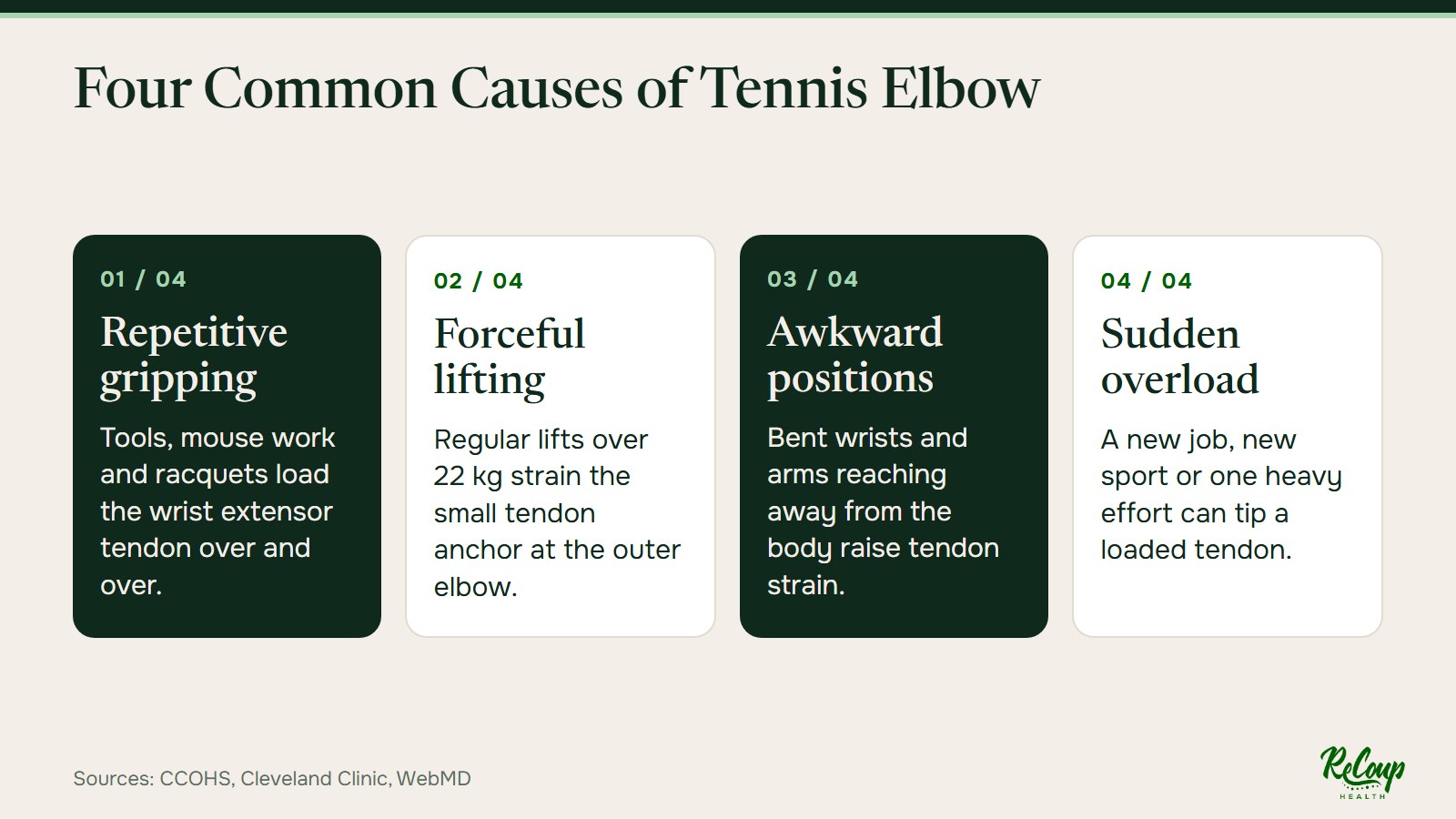
The table shows that work and household tasks outnumber sports as causes. The four common causes of tennis elbow in the graphic below sum up the same load patterns.
Can Typing Cause Tennis Elbow?
Typing can cause tennis elbow, and CCOHS names repetitive computer mouse use as an associated motion. The small forces of typing add up when they continue for too long without breaks. CCOHS advises working without bending the wrist and using work and rest schedules.
WebMD lists typing and knitting among hobbies and jobs linked to tennis elbow. Desk tasks share a pattern with gym exercises: steady load on the wrist extensors.
What Exercises Cause Tennis Elbow?
The exercises that cause tennis elbow are those with heavy or repeated gripping, such as weightlifting and racquet sports. Cleveland Clinic lists regular lifting of more than 22 kg (45 pounds) as a risk factor. WebMD names weightlifting, squash, racquetball and fencing as linked activities.
Older research cited in a 2019 Journal of Orthopaedics review found symptoms in 40-50% of regular tennis players. Pickleball places a similar grip and backhand load on the forearm through repeated paddle strikes. Players returning from a flare-up benefit from pickleball elbow rehab that rebuilds grip tolerance. Golf grip changes also appear in Cleveland Clinic advice on tennis elbow treatment. Running belongs in a different category from these grip-heavy sports.
Can Running Cause Tennis Elbow?
Running is not a recognized cause of tennis elbow, because jogging places little grip or wrist load on the forearm tendon. None of the causes listed by CCOHS, Cleveland Clinic or WebMD involve running. Runners who also lift weights, garden or use tools carry the forearm load from those tasks.
Forearm load, not sport type, decides the risk, and personal factors decide how well each tendon copes.
Who Is at Higher Risk of Tennis Elbow?
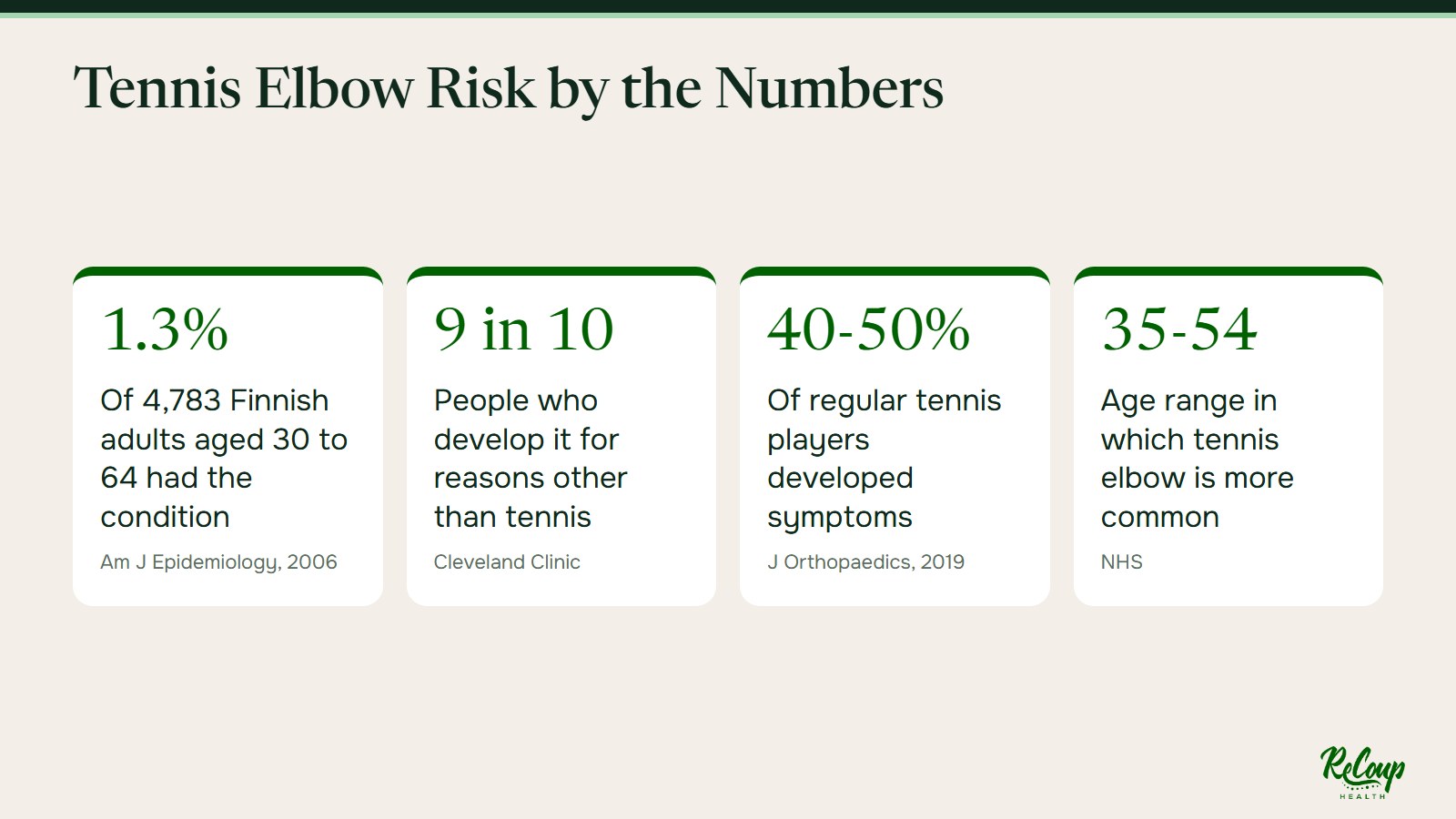
Adults aged 35 to 54 are the group in which tennis elbow is more common, according to the NHS. Age, smoking, obesity and forceful repetitive work are the main personal risk factors. AAOS places the typical patient between ages 30 and 50.
A 2006 American Journal of Epidemiology study measured lateral epicondylitis in 4,783 Finnish adults aged 30 to 64. The study found 1.3% had the condition, with links to smoking, obesity, repetitive movements and forceful activities. A 2019 Journal of Orthopaedics review estimates tennis elbow affects 1-3% of adults each year. The same review cites a dated study in which prevalence reached 19% at the peak age of 40 to 50.
Cleveland Clinic lists six risk factors for tennis elbow:
- Lifting more than 22 kg (45 pounds) on a regular basis.
- Being over age 40.
- Smoking.
- Living with obesity.
- Playing sports with frequent arm swinging or twisting.
- Jobs or hobbies with tools or positions that stress the elbows.
The graphic below shows the key tennis elbow risk numbers from these sources.
Risk factors build quietly, which is why pain can seem to appear overnight.
Why Did I Suddenly Get Tennis Elbow?
Tennis elbow can appear suddenly after starting a new job, a new task or a single severe muscle effort, according to CCOHS. Sudden pain marks the point where a strained tendon can no longer cope with its load. Some people develop symptoms gradually after years of the same work, while others have no obvious trigger.
A weekend of painting, a home move or a new racquet sport can tip a loaded tendon into pain. CCOHS adds that a direct elbow injury can start symptoms right away. That same hidden load explains why some cases keep getting worse.
Why Is My Tennis Elbow Getting Worse?
Tennis elbow gets worse when the activity that caused it continues at the same load, with no time for tendon recovery. CCOHS warns that elbow damage can become chronic when the causing activity is not changed or stopped. Cleveland Clinic adds that using an injured elbow before the tendon heals raises the chance of a tendon tear.
Common triggers for a flare-up include:
- Returning to full grip work or sport before the arm feels strong, which WebMD warns can worsen damage.
- Taking on a new grip-heavy task at work or home.
- Hard gripping with the wrist bent back, which CCOHS advises against.
- Relying on short-term pain relief while the load stays the same.
Short-term relief carries a long-term cost in some trials. In a 2006 BMJ trial, recurrence was 72% after corticosteroid injection, versus 8% with physiotherapy. A 2013 JAMA trial found recurrence of 54% after corticosteroid injection, compared with 12% after placebo injection. Guided tendon loading physiotherapy targets the load problem instead of masking pain.
A 2022 Journal of Orthopaedic and Sports Physical Therapy guideline notes that lateral elbow pain recurs and causes lengthy time off work. Pain that lasts beyond 2 weeks of rest and self-care is a reason to see a family doctor, the NHS advises. The NHS also suggests physiotherapy when 6 weeks of home treatment have not helped. Our guide to treating tennis elbow explains those options. Worsening pain can also spread to the second arm.
What Causes Tennis Elbow in Both Arms?
Tennis elbow in both arms comes from the same forearm load on each side, such as two-handed work or shared risk factors. CCOHS reports that tennis elbow affects one arm in most cases, the arm that does most of the work. WebMD confirms that tennis elbow can affect both arms.
Smoking and obesity, both linked in the 2006 Finnish study, affect tendons in both arms equally. The non-dominant arm can develop tennis elbow when it grips a workpiece, steadies a tool or carries loads. These causes overlap with other elbow and arm complaints worth knowing about.
What Else Should You Know About Tennis Elbow Causes?
Tennis elbow causes connect to side questions about swelling, numbness, look-alike conditions and recovery.
Does Tennis Elbow Cause Swelling?
Tennis elbow can cause mild swelling, and Cleveland Clinic lists swelling among the symptoms. CCOHS reports there is usually no outward sign of redness or swelling. Cleveland Clinic advises a provider visit for an elbow that is swollen, discoloured, hard to move or painful at night. Seek urgent care at an emergency department for a deformed elbow after a fall, or a hot, red, swollen joint with fever.
Can Tennis Elbow Cause Hand Numbness?
Tennis elbow does not cause hand numbness on its own, because the condition affects a tendon rather than a nerve. Numbness or tingling points to a nerve problem that needs a separate check. WebMD notes that doctors may use electromyography (EMG), a nerve and muscle test, to look for nerve problems at the elbow. Numbness in the thumb and first fingers can come from carpal tunnel syndrome instead.
Can Tennis Elbow Cause Neck Pain?
Tennis elbow does not cause neck pain directly, but neck problems can cause elbow pain that feels similar. WebMD notes that an MRI can find neck arthritis that could cause elbow pain. Neck stiffness alongside arm pain is worth raising with your physiotherapist or family doctor.
What Can Tennis Elbow Be Mistaken For?
Tennis elbow can be mistaken for golfer’s elbow, nerve irritation, elbow arthritis or pain referred from the neck. The location of the pain is the main clue, since tennis elbow hurts on the outer side. CCOHS explains that tendon damage on the inner side of the elbow is called medial epicondylitis, or golfer’s elbow. WebMD notes that X-rays can check the elbow bones for arthritis.
Will Tennis Elbow Just Go Away?
Tennis elbow will go away for many people once the cause is removed, but recovery takes months. In a 2006 BMJ trial, 90% of the wait-and-see group reported success at 52 weeks, compared with 94% after physiotherapy. Most people recover in about 6 months, though some need up to 18 months, Cleveland Clinic notes. Our guide on tennis elbow recovery covers the timeline in detail.
Is It Okay to Massage a Tennis Elbow?
Massaging a tennis elbow is okay, and the NHS lists massage among physiotherapy treatments for the condition. Massage eases symptoms but does not remove the load that caused them. A 2024 Cochrane review found manual therapy and exercise gave small benefits that were not sustained, based on low-certainty evidence. Gentle forearm massage works well alongside load changes.
How Do You Stop the Causes of Tennis Elbow From Returning?
Change the grip, posture and rest pattern that caused the overload in the first place. CCOHS and WebMD both point to smoother movement, a straight wrist and planned rest breaks. Useful changes include:
- Keep the wrist straight during lifting and tool use.
- Hold tools with a looser grip, and choose a padded hammer.
- Arrange the workstation so the arms do not reach far forward.
- Use smooth movements rather than jerky ones.
- Choose a racquet with the right handle size and string tension, per Boston Children’s Hospital.
- Use a two-handed backhand and fresh, dry tennis balls, per WebMD.
Prevention depends on a clear picture of the original cause, which leads to the questions below.
Frequently Asked Questions About What Causes Tennis Elbow
What Is the Most Common Cause of Tennis Elbow?
The most common cause of tennis elbow is repeated gripping and wrist effort at work or home, not tennis, per Cleveland Clinic. Cleveland Clinic estimates more than 9 in 10 people develop the condition for reasons other than tennis. Common causes of tennis elbow include tool use, painting and computer mouse work.
Can Carpal Tunnel Cause Tennis Elbow?
Carpal tunnel syndrome does not cause tennis elbow, because the two conditions involve different structures. Carpal tunnel syndrome is pressure on a nerve at the wrist, while tennis elbow is a tendon problem at the outer elbow. Both conditions can occur together in people with repetitive hand work.
Can Golf Cause Tennis Elbow?
Golf can cause tennis elbow through repeated hard gripping and swinging. Cleveland Clinic lists changing your golf grip as one way to treat the condition. Golf is also linked to golfer’s elbow, which affects the inner side.
Can Driving Cause Tennis Elbow?
Driving can contribute to tennis elbow through long periods of steady grip on the steering wheel. CCOHS explains that small forces held for too long can cause the condition. Relaxing the grip and taking breaks on long drives reduces that load.
How Recoup Health Helps Find the Cause of Your Tennis Elbow
Recoup Health helps you find what causes tennis elbow in your own arm, then changes the load behind it. Our physiotherapists assess grip, wrist position, work tasks and sport technique to pinpoint the source of strain. A clear cause shapes elbow pain treatment that fits your work and sport.
Our team includes physiotherapists, registered massage therapists, a chiropractor and a performance coach, and no referral is needed. You can request an elbow pain appointment online when outer elbow pain lasts more than 2 weeks.
Our clinic in Vaughan sees office workers, trades workers and racquet players with outer elbow pain. Each of these patients works with Recoup Health’s experts on a plan that targets the cause first. A cause-first plan gives the tendon a fair chance to recover.