
The newer options for heel pain are shockwave therapy, platelet-rich plasma (PRP) injections, botulinum toxin injections and needle-based procedures. These add-ons do not replace the basics. The American Academy of Orthopaedic Surgeons (AAOS) reports that more than 90% of patients improve within 10 months of simple care. That simple care includes stretching, supportive shoes and physiotherapy.
Key Takeaways
- Shockwave therapy, PRP and botulinum toxin are second-line add-ons, not first steps.
- A 2021 review of 51 trials in the British Journal of Sports Medicine puts taping, stretching and education first.
- Cortisone shots ease pain for about one month and carry a small risk of fascia rupture.
- About 40% of people still have symptoms at 2 years, according to Canadian Family Physician.
- Surgery is a last step after 12 months of nonsurgical care, according to AAOS.
What Is the New Treatment for Plantar Fasciitis
The new treatment for plantar fasciitis is a group of procedures that stimulate repair in a stubborn plantar fascia. The plantar fascia is the thick band of tissue under the foot that runs from the heel to the toes. Each plantar fasciitis new treatment targets chronic pain that has not settled with exercise, footwear changes and plantar fascia physiotherapy.
The main new treatments for plantar fasciitis are extracorporeal shockwave therapy (ESWT), PRP injections, botulinum toxin injections, dry needling and radiofrequency microtenotomy. A 2021 review by Morrissey and colleagues in the British Journal of Sports Medicine ranked these options behind the basics. Shockwave comes in only after taping, stretching and education fail to help. Each newer option still needs a clear plan behind it.
How Does Shockwave Therapy Work for Heel Pain
Shockwave therapy works for heel pain by sending strong sound waves into the fascia to trigger a local healing response. A 2025 network meta-analysis in PM&R pooled 22 trials with 2,299 participants. All shockwave intensities beat placebo for treatment success, but the certainty of that evidence was low to very low. Only medium and high intensities beat placebo for pain.
Shockwave looks weaker when compared with exercise. A 2026 network meta-analysis in the journal Physical Therapy reviewed 24 trials with 1,240 participants. Shockwave added no significant benefit for pain or function over a home exercise program. That exercise program stays the anchor of any plantar fasciitis new treatment plan.
Are PRP and Botox Injections Better Than Cortisone
PRP and botulinum toxin (Botox) injections compare well with cortisone in recent meta-analyses, though the trials vary widely. PRP is a concentrate made from your own blood platelets. A 2025 meta-analysis in Foot and Ankle Specialist pooled 13 trials with 901 participants. PRP and cortisone matched each other in the short term, while PRP gave better pain scores at the medium term.
Botulinum toxin is a muscle-relaxing protein. A 2026 network meta-analysis in the International Journal of Surgery covered 59 trials with 3,833 patients. Botulinum toxin A ranked first among six injections, and PRP ranked second. Injection choice belongs to your family doctor or specialist, and these findings come from mixed trials.
Which Needle and Radiofrequency Procedures Are Newer Options
The newer needle and radiofrequency procedures are dry needling, percutaneous needle tenotomy and radiofrequency microtenotomy. Dry needling places a thin, sterile needle into tight muscle or fascia. The 2026 Physical Therapy meta-analysis found short-term pain gains for dry needling, laser and manual therapy added to home exercise.
Radiofrequency microtenotomy uses a small probe to create tiny controlled injuries in the fascia. A 2023 network meta-analysis in Archives of Orthopaedic and Trauma Surgery covered 17 studies with 865 patients. Fasciotomy, calf release, radiofrequency microtenotomy and dry needling all improved pain scores without major complications. The authors called the evidence equivocal on which procedure to choose, so the comparison below summarizes each option.
| Treatment | Main difference | What the evidence shows | Where it fits |
|---|---|---|---|
| Shockwave therapy (ESWT) | Non-invasive sound waves | Beats placebo, low certainty; no clear gain over home exercise (PM&R 2025, Physical Therapy 2026) | After exercise and taping stall (Morrissey 2021) |
| PRP injection | Uses your own platelets | Equal to cortisone short term, better at medium term (13 trials, 901 people) | Chronic cases, specialist referral |
| Botulinum toxin injection | Relaxes surrounding tissue | Ranked first of six injections (59 trials, 3,833 patients) | Chronic cases, specialist referral |
| Cortisone injection | Fast anti-inflammatory effect | Small benefit up to one month; rare rupture (Cochrane 2017) | Short-term relief only |
| Dry needling | Thin needle into tight tissue | Short-term pain gains over exercise alone (24 trials) | Add-on to an exercise program |
The comparison shows that every newer option sits on top of exercise rather than replacing it. That exercise foundation is where effective treatment starts.
What Should You Do First for Plantar Fasciitis
The first thing to do for plantar fasciitis is start plantar fascia stretching, short-term taping and clear education on load. The 2021 Morrissey review covered 51 trials with 4,351 participants. Plantar fascia stretching had a large effect on first-step pain, with a standardized mean difference (SMD) of 1.21. Taping had a smaller short-term effect, with an SMD of 0.47.
A standardized mean difference compares the size of an effect across studies, and 0.8 or more counts as large. Stretching technique matters for that effect. DiGiovanni and colleagues tested plantar fascia stretching against calf stretching in 101 patients in 2003. The plantar fascia group had less first-step morning pain at 8 weeks.
AAOS suggests holding each plantar fascia and calf stretch for 10 seconds and repeating 20 times per foot. The plantar fascia stretch suits the morning, before you stand. Those daily stretches then fit into a wider plan.
How to Treat Plantar Fasciitis Effectively Step by Step
Treat plantar fasciitis effectively by moving through a stepped plan with clear checkpoints. The order below follows the 2021 Morrissey review, AAOS and the NHS. Each step adds a new layer only after the previous layer has had time to work. A heel pain physiotherapy program can guide each checkpoint.
- Start self-care for 2 weeks: plantar fascia stretches, calf stretches, supportive shoes and less time standing on hard floors.
- See a clinician after 2 weeks without improvement, as the NHS advises, for an assessment and taping.
- Add high-load strengthening daily for at least 3 months, as Canadian Family Physician recommends.
- Consider shockwave therapy and then custom orthoses when progress stalls, following the Morrissey review order.
- Talk to your family doctor about injections or specialist options when pain lasts beyond 6 months.
- Discuss surgery only after 12 months of nonsurgical care, according to AAOS.
The timeline below shows how this plantar fasciitis treatment plan unfolds over a year.
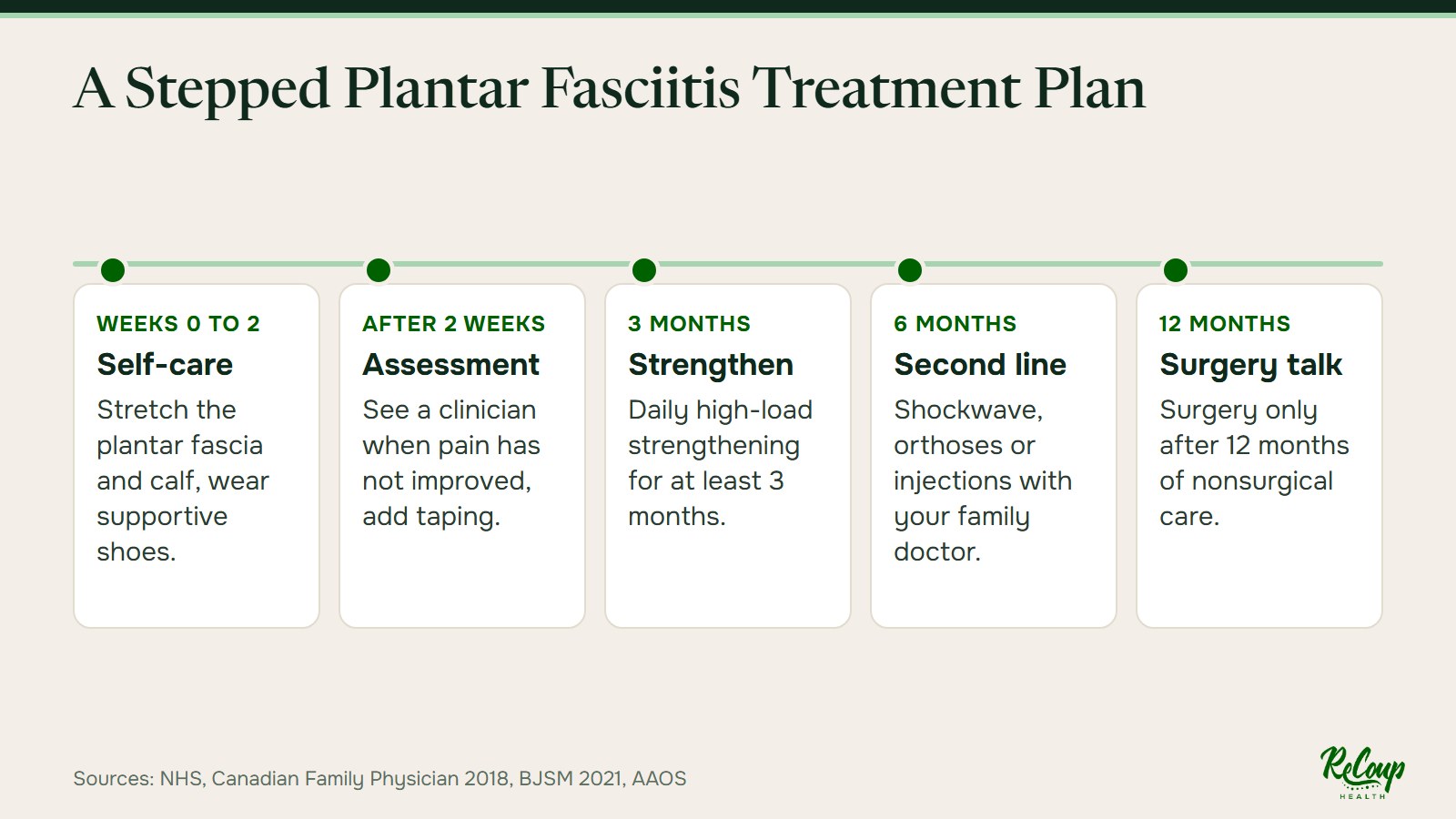
That timeline answers how to treat plantar fasciitis in order. Many people still want quicker relief inside that plan.
What Is the Fastest Way to Relieve Plantar Fasciitis
The fastest way to relieve plantar fasciitis is to pair plantar fascia stretching with taping in the first weeks. The Morrissey review found both helped first-step pain in the short term. Stretching gave the larger short-term effect on first-step pain. Cortisone also works fast, but the Cochrane review found its benefit fades after about one month.
Fast relief differs from full recovery. Recovery depends on building tissue capacity over months, which is why walking habits matter too.
Is Walking Good for Plantar Fasciitis
Walking is good for plantar fasciitis in moderate amounts, as long as heel pain stays mild during and after. Long hours on your feet are a different matter. All-day standing at work carried 3.6 times higher odds of plantar fasciitis in a 2003 study. That study appeared in the Journal of Bone and Joint Surgery.
Break long standing shifts with short seated rests. Wear supportive shoes on hard floors. Your physiotherapist can set a walking target that matches your pain level, which helps you avoid the common mistakes.
What Is the Worst Thing You Can Do for Plantar Fasciitis
The worst thing you can do for plantar fasciitis is ignore it for months or rely on repeated cortisone shots. The Cochrane review covered 39 studies with 2,492 adults. Trials reported 2 plantar fascia ruptures and 3 infections after corticosteroid injections. AAOS adds that cortisone can weaken the fascia.
Ignoring pain carries its own cost. Canadian Family Physician advises seeing a family physician when symptoms persist beyond 6 months. That 6-month mark links directly to how long treatment takes.
How Long Does Plantar Fasciitis Treatment Take
Plantar fasciitis treatment takes 3 to 10 months for the majority of people, according to AAOS and Canadian Family Physician. AAOS reports that more than 90% of patients improve within 10 months of simple treatment. Canadian Family Physician recommends daily strengthening for at least 3 months or until pain stops. That plantar fasciitis treatment time varies with how long symptoms lasted before care began.
Some cases last longer. Canadian Family Physician reports that about 40% of patients still have symptoms at 2 years. The figures below show the main recovery numbers side by side.
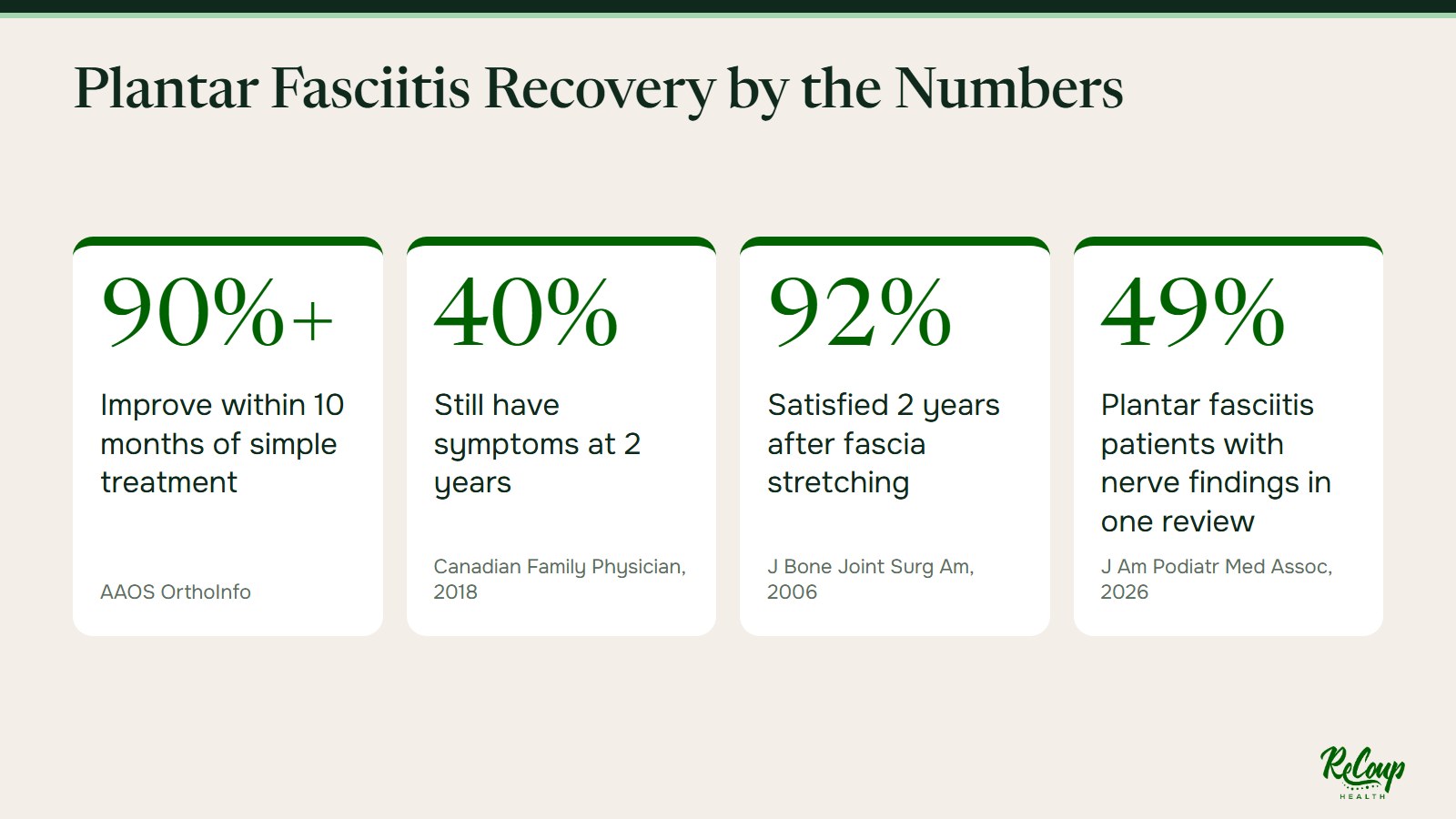
These recovery numbers come from different definitions, so they do not contradict each other. Recovery numbers also raise the question of whether heel pain clears for good.
Can Plantar Fasciitis Go Away for Good
Plantar fasciitis can go away for good, and long-term follow-up supports that outcome. The 2006 follow-up of the DiGiovanni stretching trial tracked 66 patients for 2 years. Of those patients, 92% were satisfied and 94% had less pain. Still, 16 of the 66 sought further treatment from a clinician.
Lasting results depend on keeping the calf and foot strong after pain settles. A small group of people need more than conservative care, and that group raises the surgery question.
When Is Surgery Needed for Plantar Fasciitis
Surgery is needed for plantar fasciitis only after 12 months of aggressive nonsurgical care without improvement, according to AAOS. Plantar fasciitis treatment without surgery remains the standard path. Endoscopic plantar fascia release had an 8.9% complication rate across 26 studies, according to Foot and Ankle Specialist in 2025. Gastrocnemius (calf) release had a pooled complication rate of 8.5% in a 2022 review.
Those numbers explain why surgeons reserve both procedures for refractory cases. Rehabilitation after any foot procedure matters, and post-surgery foot rehab helps restore walking and strength. Surgery aside, several supporting therapies can fit into care.
What Else Should You Know About Plantar Fasciitis Treatment
Plantar fasciitis treatment also includes supporting options such as orthotics, manual therapy and nerve checks. The short answers below cover each one.
Do Custom Orthotics Help Plantar Fasciitis
Custom orthotics help plantar fasciitis a little, mostly in the medium term, according to a 2018 meta-analysis by Whittaker and colleagues. That review pooled 19 trials with 1,660 participants. Custom and prefabricated insoles performed about the same. A pair of custom foot orthotics suits feet that do not fit standard inserts.
Can a Chiropractor Treat Plantar Fasciitis
A chiropractor can treat plantar fasciitis with manual therapy, soft-tissue work and exercise advice. The 2026 Physical Therapy meta-analysis found short-term pain gains when manual therapy joined home exercise. Chiropractic treatment for plantar fasciitis works as an add-on to exercise. Our chiropractic foot care includes ankle and foot mobility work.
Does Acupuncture Help Plantar Fasciitis
Acupuncture may help plantar fasciitis pain in the short term, based on related needle research. The 2026 Physical Therapy meta-analysis found short-term pain gains for dry needling added to exercise. Acupuncture treatment for plantar fasciitis has less direct trial evidence than dry needling. Our chiropractor offers acupuncture and cupping alongside an exercise plan.
Does Massage Help Plantar Fasciitis
Massage helps plantar fasciitis pain, based on small recent trials. A 2026 trial in the International Journal of Therapeutic Massage and Bodywork treated 58 adults 3 times weekly for 8 weeks. Myofascial release beat calf stretching for pain and function. A course of foot massage therapy pairs well with home stretching as plantar fasciitis massage treatment.
Why Do Tight Calves Matter for Heel Pain
Tight calves matter for heel pain because they pull on the heel and load the fascia. The 2003 Journal of Bone and Joint Surgery study linked ankle bend of 0 degrees or less to 23.3 times higher odds. Restoring ankle range takes pressure off the plantar fascia. Sessions of assisted calf stretching can add range beyond home stretches.
How Does Plantar Fasciitis Affect Runners
Plantar fasciitis affects runners as up to 8% of all running-related injuries, according to Canadian Family Physician. Sudden jumps in mileage and hard surfaces add load. Runners need a graded return that matches fascia capacity. A program of running injury rehab builds that capacity step by step.
Why Does Persistent Heel Pain Need a Nerve Check
Persistent heel pain needs a nerve check because nerve irritation can mimic plantar fasciitis. A 2026 review in the Journal of the American Podiatric Medical Association covered 459 patients. Neurological findings appeared in 49% of those patients. About 56% of those cases resolved with conservative care, and persistent pain care addresses symptoms that linger.
When Should You Seek Urgent Care for Heel Pain
Seek urgent care for heel pain when warning signs appear, as the NHS and the Cochrane review advise. The main red flags are listed here.
- Tingling or loss of feeling in the foot.
- Foot pain in a person with diabetes.
- Severe pain that stops normal activity.
- Sudden sharp heel pain after a cortisone injection, a possible fascia rupture.
Go to an emergency department or walk-in clinic for these signs, or call your family doctor. These red flags need medical review before any exercise plan.
Frequently Asked Questions About Plantar Fasciitis Treatment
What Finally Fixes Stubborn Plantar Fasciitis
Consistent loading and stretching over months fixes stubborn plantar fasciitis for the large majority of people. In the 2006 DiGiovanni follow-up, 92% were satisfied at 2 years. Sticking with one plan for at least 3 months matches Canadian Family Physician advice.
What Is Stage 4 Plantar Fasciitis
Stage 4 plantar fasciitis is not a formal medical stage. Clinicians describe heel pain as acute or chronic instead. Chronic cases are those lasting several months despite care.
What Is the Root Cause of Plantar Fasciitis
The root cause of plantar fasciitis is repeated load that exceeds what the fascia can handle. A 2016 British Journal of Sports Medicine meta-analysis linked a body mass index above 27 to 3.7 times higher odds. Tight calves and long standing add to that load.
Is Chronic Plantar Fasciitis Treatment Different
Chronic plantar fasciitis treatment adds second-line options to the exercise base. Shockwave, custom orthoses and specialist injections enter the plan after months without progress. The exercise base stays in place throughout.
Can Plantar Fasciitis Come Back
Plantar fasciitis can come back, and the NHS advises seeing a GP when it keeps returning. Keeping calf strength and ankle range lowers the load that drives a relapse.
How Recoup Health Helps With Heel Pain Recovery
Recoup Health helps with heel pain recovery through a stepped plan built on exercise and hands-on care. We start with an assessment of your foot, ankle and calf. Each plantar fasciitis new treatment option we discuss sits on top of that exercise base. Our foot pain physiotherapy covers stretching, strengthening, taping and plantar fasciitis physiotherapy treatment.
The clinic team includes physiotherapists, registered massage therapists, a naturopathic doctor and a performance coach. A chiropractor on the team also offers acupuncture and cupping for foot and calf pain. Each of our physiotherapists works with you on a plan that fits your work and activity. Treatment plans also cover footwear, orthotics and graded return to running.
No doctor’s referral is needed to start care at our Vaughan clinic. You can contact our clinic to book a first visit for heel pain. Talk to your family doctor as well when red flags or other health conditions apply.
Heel pain recovery takes steady work over months, and support makes that work easier to keep up. Our Recoup Health clinicians can guide each stage of that plan.