
Stretches for plantar fasciitis ease heel pain by lengthening the plantar fascia and the calf muscles. A 2003 trial of 101 patients found a fascia-specific stretch reduced first-step morning pain within 8 weeks. The core routine pairs a seated toe-pull, a towel stretch in bed and a wall calf stretch. Slow, heavy heel raises then build arch strength over about 3 months.
Key Takeaways
- The plantar fascia stretch beat a calf-only stretch for first-step pain in a 101-patient trial (J Bone Joint Surg Am, 2003).
- AAOS OrthoInfo suggests holding each stretch for 10 seconds and repeating it 20 times per foot.
- Strengthening exercises belong in the plan, done daily for at least 3 months (Canadian Family Physician, 2018).
- A stretch should feel like firm tension, and sharp or burning pain is a signal to stop.
- Tingling, numbness, diabetes or no change after 2 weeks are reasons to see a clinician (NHS, 2025).
Which Stretches for Plantar Fasciitis Ease Heel Pain?
The stretches for plantar fasciitis that ease heel pain target two tissues, the plantar fascia and the calf. The plantar fascia is a thick band of tissue under the arch, running from the heel bone to the toes. Stretching the fascia and calf gives strong first-step relief, according to a 2021 British Journal of Sports Medicine review. That review pooled 51 trials with 4,351 participants.
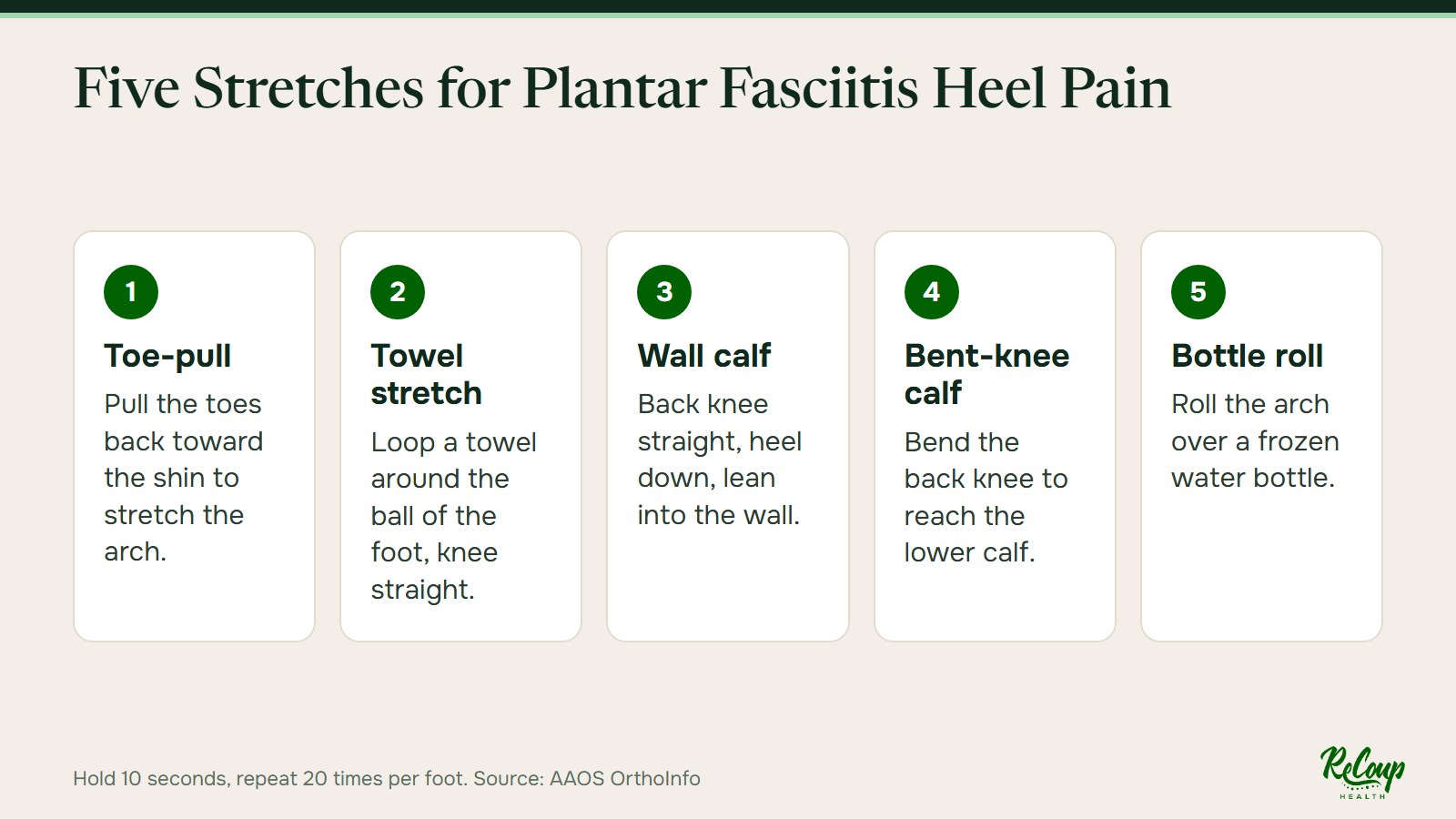
The American Academy of Orthopaedic Surgeons (AAOS) gives a simple dose for each stretch. Hold each stretch for 10 seconds and repeat it 20 times per foot. Here is how to stretch plantar fasciitis with five moves that need only a towel, a wall and a bottle:
- Seated toe-pull stretch: cross the sore foot over the other knee and pull the toes back toward the shin.
- Towel stretch: sit with the leg straight, loop a towel around the ball of the foot, and pull gently toward you.
- Wall calf stretch: hands on a wall, sore foot behind, back knee straight, heel down, then lean forward.
- Bent-knee calf stretch: same wall position, but bend the back knee to reach the lower calf and Achilles tendon.
- Frozen bottle roll: sit and roll the arch over a frozen water bottle from heel to toes for a few minutes.
The five-step graphic below shows the same routine in the order many people do it across a day.
These five moves form a starting routine, and a physiotherapist can adjust the hold, the angle and the order for your foot. A short session of guided stretching physiotherapy checks your form so each stretch loads the right tissue. The right tissue matters early in the day, and the first minutes after waking set up the next stretch.
How Do You Stretch Your Foot Before Getting Out of Bed?
Stretch your foot before getting out of bed by pulling your toes back toward your shin under the covers. AAOS OrthoInfo advises doing the plantar fascia stretch in the morning before you stand. A 10-second toe-pull before the first step prepares the fascia for weight. The NHS lists pain with the first steps after sleep or rest as the main symptom of plantar fasciitis.
A towel or belt looped around the ball of the foot works well when your hands cannot reach your toes. Keep the knee straight so the stretch reaches both the arch and the calf. The calf link explains why a calf stretch belongs in every morning routine.
Why Stretch Your Calf for Plantar Fasciitis?
You stretch your calf for plantar fasciitis because a tight calf pulls on the heel and adds strain to the plantar fascia. The calf muscles join the Achilles tendon, which attaches to the heel bone next to the fascia. Stiff ankles carried 23.3 times the odds of plantar fasciitis in a 2003 Journal of Bone and Joint Surgery study. That study defined stiffness as ankle dorsiflexion of 0 degrees or less, meaning the foot could not lift past neutral.
Calf stretches work in two positions. A straight-knee stretch reaches the upper calf, and a bent-knee stretch reaches the lower calf. People who struggle to get deep calf range on their own can add assisted fascial stretching with a trained therapist. Calf range is one part of the picture, and the evidence shows how stretching compares with other home care.
Does Stretching Help Plantar Fasciitis More Than Other Home Care?
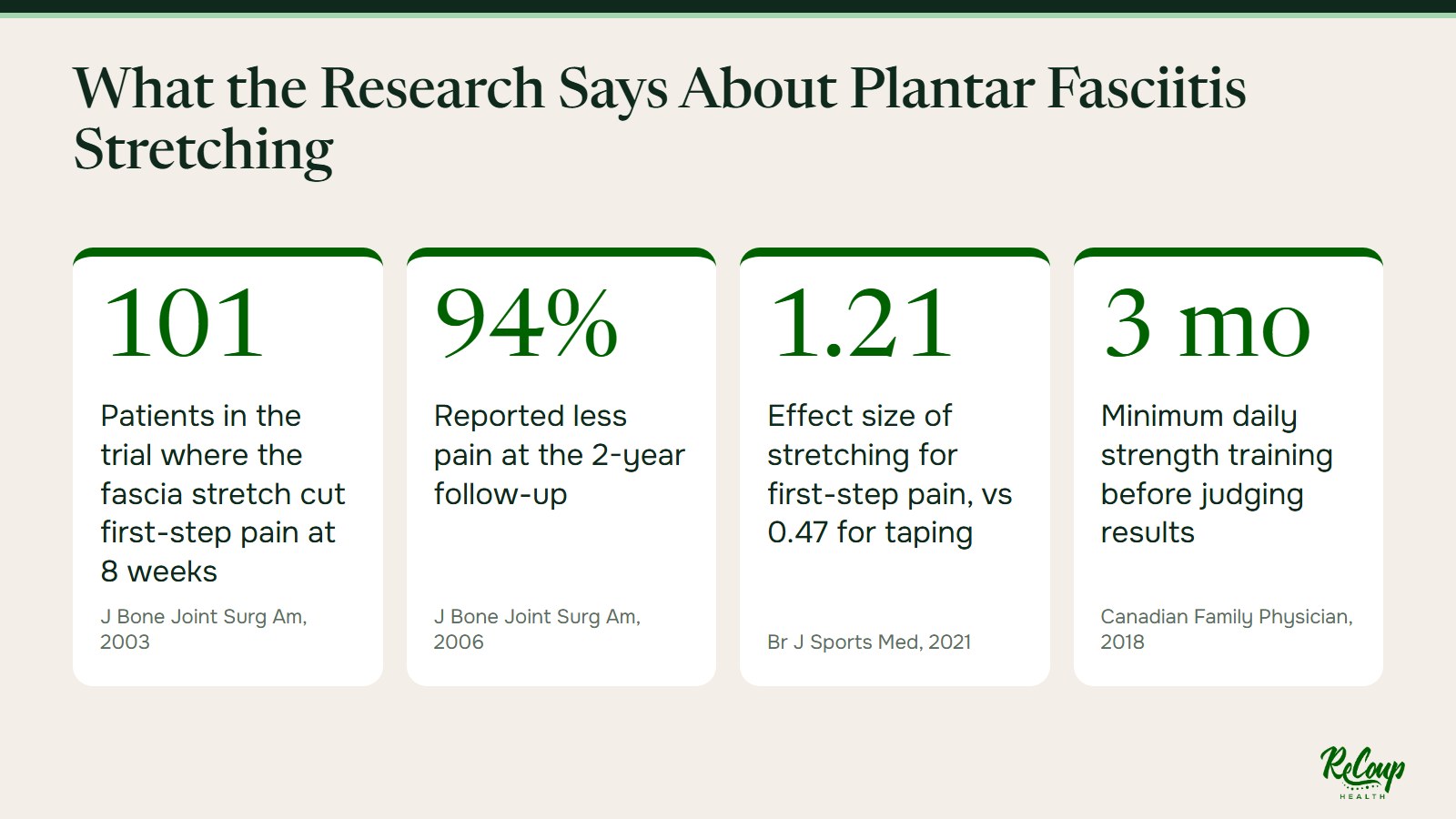
Yes, the research suggests that stretching helps plantar fasciitis more than several other first-line home options for short-term heel pain. The 2021 review by Morrissey and colleagues rated plantar fascia stretching with an effect size of 1.21 for first-step pain. Taping scored 0.47 on the same measure, well below stretching. An effect size, or standardized mean difference, of 1.21 is a large effect in research terms.
The question “does stretching help plantar fasciitis” also has a direct trial answer. DiGiovanni and colleagues compared a plantar fascia-specific stretch with an Achilles stretch in 101 adults. Each adult had heel pain lasting at least 10 months. At 8 weeks, the fascia-stretch group had less worst pain and less first-step morning pain. A two-year follow-up of 66 patients found 94% reported less pain and 92% were satisfied or satisfied with minor reservations.
The stats graphic below sums up these trial and review numbers in one view.
Hands-on soft tissue work can sit beside stretching. A 2026 trial of 58 adults found myofascial release eased pain more than calf stretching alone over 8 weeks. Myofascial release is a slow, sustained pressure on tight tissue, similar to calf massage therapy. That single trial is small, so stretching remains the base and the next question is whether it can do the job alone.
Can You Fix Plantar Fasciitis With Stretching Alone?
You can fix plantar fasciitis with stretching alone in some cases. The 2021 British Journal of Sports Medicine review still places stretching inside a wider core plan. That core plan is stretching, taping and clear education about load. The same review adds shockwave therapy and then custom orthoses for people who do not improve.
Recovery takes time even with good care. AAOS OrthoInfo states that more than 90% of patients improve within 10 months of simple treatment. Canadian Family Physician notes that about 40% still have symptoms at 2 years. Some people with a flat or high arch pair their stretches with orthotic insoles while the tissue settles. Stretching also works better with strength work added, which is the next layer.
Which Plantar Fasciitis Strengthening Exercises Should You Add?
The plantar fasciitis strengthening exercises to add are slow heel raises, towel curls and resisted ankle work with a band. Canadian Family Physician recommends high-load strengthening every day for at least 3 months or until the pain settles. High-load means the last few repetitions feel hard, not easy. These are the home exercises for plantar fasciitis that build strength alongside your stretches:
- Single-leg heel raise on a towel: roll a towel under the toes, rise slowly on one foot, then lower slowly.
- Towel curls: sit with the foot on a small towel and pull it toward you using only the toes.
- Band ankle push: loop an elastic band around the forefoot and press the foot down against the resistance.
- Balance hold: stand on the sore foot near a counter and hold steady, then progress to a soft surface.
The towel under the toes lifts the big toe, which tightens the fascia during the heel raise. That tension lets the fascia take load in a controlled way. Plantar fasciitis stretches with band resistance also work for people who cannot yet stand on one foot. A guided physiotherapy program sets the weight and progressions, and the next step is fitting these into a daily schedule.
How Often Should You Do Plantar Fasciitis Exercises?
You should do plantar fasciitis exercises every day, with stretches 2 to 3 times daily and strength work once daily. People searching how often to do plantar fasciitis exercises get the clearest answer from AAOS OrthoInfo. The AAOS dose is a 10-second hold repeated 20 times per foot. Canadian Family Physician sets the strength timeline at a minimum of 3 months.
The table below turns those guidelines into a daily routine with timing and purpose for each exercise.
| Exercise | Main target | When | Dose |
|---|---|---|---|
| Seated toe-pull stretch | Plantar fascia | Before first steps in the morning | 10-second hold, 20 times per foot (AAOS) |
| Wall calf stretch | Upper calf and Achilles tendon | Morning and evening | 10-second hold, 20 times per foot (AAOS) |
| Bent-knee calf stretch | Lower calf | Morning and evening | Same as wall calf stretch |
| Single-leg heel raise on a towel | Calf and arch strength | Once daily | Daily for at least 3 months (Canadian Family Physician) |
| Frozen bottle roll | Arch comfort | After long periods of standing | A few minutes per foot |
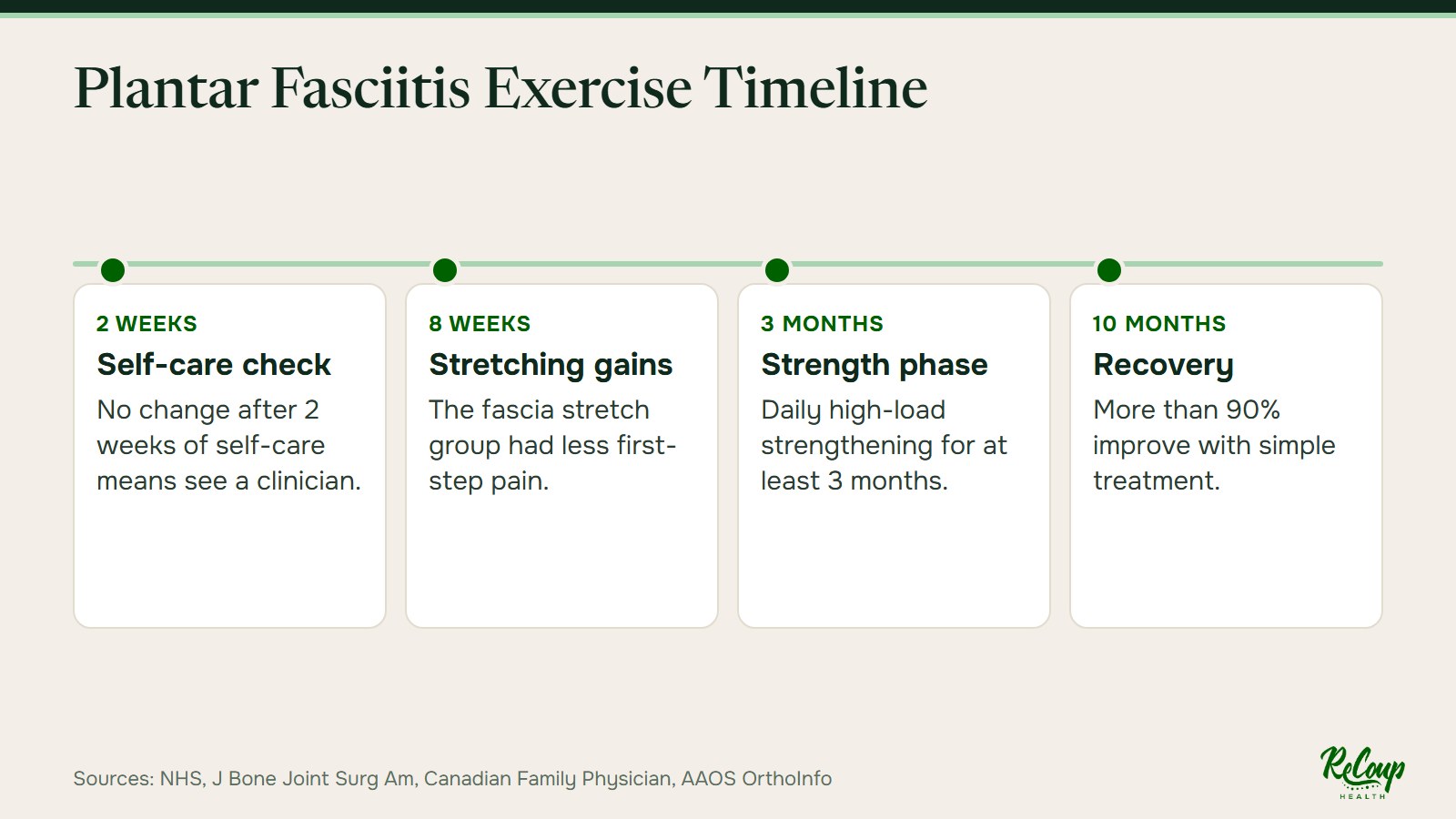
The routine in this table takes about 15 minutes a day once you know the moves. The timeline graphic below shows what the research says about progress over the months.
A steady daily routine works better than a long session once a week. Consistency also lowers the risk of overdoing it, which raises the question of whether stretching can backfire.
Can Stretching Make Plantar Fasciitis Worse?
Yes, stretching can make plantar fasciitis worse when the stretch is forced, bounced or pushed into sharp pain. The NHS notes that stretching the sole of the foot hurts with plantar fasciitis. People who ask “can stretching make plantar fasciitis worse” tend to be pushing the stretch too hard or too fast. A safe stretch feels like firm tension that eases during the hold. Pain that builds or lingers for hours is a sign to back off.
Three exercises to avoid or adjust are deep heel drops off a step, bouncing calf stretches and barefoot stretching on hard floors. Pain that keeps climbing despite gentle stretches may point to another cause. A 2026 review of 459 patients found nerve-related findings in 49% of people diagnosed with plantar fasciitis. Long-lasting pain like this can need long-term pain care rather than more stretching. The side questions below cover activity, causes and warning signs.
What Else Should You Know About Plantar Fasciitis Exercises?
Can You Exercise With Plantar Fasciitis?
Yes, you can exercise with plantar fasciitis by choosing lower-impact activity while the heel settles. Cycling, swimming and rowing keep fitness up with less load on the fascia. Cut back on running and jumping until first-step pain eases. The answer to “can you exercise with plantar fasciitis” depends on impact, not effort.
Plantar fasciitis accounts for up to 8% of running-related injuries, according to Canadian Family Physician. Runners can return in stages with sports physiotherapy rehab that grades mileage and hills.
Is Walking Good for Plantar Fasciitis?
Walking is good for plantar fasciitis in moderate amounts, on forgiving surfaces and in supportive shoes. Short walks that leave pain no worse the next morning are a safe level. Long walks on concrete, or walking barefoot on tile, add strain. Use next-morning pain as your guide for how far to go.
What Is the Worst Thing You Can Do for Plantar Fasciitis?
The worst thing you can do for plantar fasciitis is keep loading a painful heel with sudden jumps in activity. Sharp increases in running, standing or barefoot time keep the fascia irritated. Ignoring warning signs such as tingling or numbness is also a mistake, according to the NHS. Gradual change, with daily stretching and strength work, gives the tissue time to adapt.
What Is the Root Cause of Plantar Fasciitis?
The root cause of plantar fasciitis is repeated strain on the plantar fascia that outpaces the tissue’s ability to recover. AAOS OrthoInfo lists people aged 40 to 60, athletes, people with higher body weight and people who stand for long periods. Standing for most of the workday raised the odds 3.6 times in the 2003 Journal of Bone and Joint Surgery study. Long shifts on hard floors are a common thread in workplace injury care for heel pain.
What Is the Sock Trick for Plantar Fasciitis?
The sock trick for plantar fasciitis is wearing a stretch sock or night splint that holds the toes pulled up overnight. The goal is to keep the fascia lengthened overnight so the first steps hurt less. AAOS OrthoInfo describes night splints as very effective. A 2019 review in the Journal of Sport Rehabilitation found night splints worked better when combined with insoles. Recent trial evidence on splints alone is limited.
When Should You Get Heel Pain Checked?
You should get heel pain checked when it is severe, keeps coming back, or has not improved after 2 weeks of self-care. That advice comes from the NHS. Seek urgent care for sudden severe pain, a heel you cannot bear weight on, or signs of infection. The NHS also flags tingling or loss of feeling in the foot and diabetes with foot pain.
Canadian Family Physician advises seeing your family doctor when symptoms last beyond 6 months on a loaded program. Heel pain is one of many conditions we treat with exercise-based care.
Frequently Asked Questions About Plantar Fasciitis Stretches
How Long Should You Hold Each Stretch?
You should hold each stretch for 10 seconds and repeat it 20 times per foot, according to AAOS OrthoInfo. Some patient handouts use longer holds of 30 to 45 seconds with fewer repetitions. Both approaches aim for the same total stretch time. Your physiotherapist can pick the version that suits your foot.
Should a Plantar Fasciitis Stretch Hurt?
A plantar fasciitis stretch should not hurt sharply. Firm tension along the arch or calf is normal. Burning, stabbing or tingling pain means you should ease off and talk to your physiotherapist or family doctor.
Do Toe Stretches Help Plantar Fasciitis?
Toe stretches help plantar fasciitis because pulling the toes back tightens the fascia along the arch. The DiGiovanni trial used exactly this type of toe-pull stretch. That group had less first-step pain at 8 weeks than the calf-stretch group.
Should You Stretch Before or After a Workout?
You should stretch both before and after a workout, with a short warm-up first. A few calf and toe-pull stretches before activity prepare the heel. Stretches after a cool-down help limit stiffness the next morning.
How Recoup Health Helps You Stretch and Strengthen for Heel Pain
We help you turn stretches for plantar fasciitis into a plan that fits your foot, your work and your sport. A first physiotherapy assessment checks ankle range, calf length, arch strength and walking pattern. Each exercise is then matched to what the assessment finds, with clear progressions over the 3-month strength phase.
Physiotherapists, registered massage therapists and a fascial stretch therapist work side by side on heel pain cases. You can meet our rehab team before your visit to see who fits your goals. No doctor’s referral is needed to start care.
Patients from across Vaughan come to us with heel pain that has lasted weeks or months. Some have tried stretching alone and want a clearer plan with measured progress. You can reach our clinic by phone or online to book a time.
Daily stretching, steady strength work and smart load changes give the heel its fairest chance to settle. Each follow-up visit reviews your routine and compares your progress with the last session. The whole Recoup Health team keeps your home routine simple, measurable and easy to follow.