
Plantar fasciitis is caused by repeated overload of the plantar fascia, the thick band of tissue under your foot. That overload creates small tears where the fascia attaches to the heel bone. The condition affects 3.6% to 7% of people, according to Canadian Family Physician. Tight calves, higher body weight, long hours standing and sudden training jumps add load. Mild heel swelling can appear too.
Key Takeaways
- Plantar fasciitis comes from repeated strain on the plantar fascia, which leads to small tears and wear near the heel bone.
- Tight ankles, high body weight and all-day standing raised the odds in a 2003 Journal of Bone and Joint Surgery study.
- Sudden triggers include a jump in running distance, new or worn-out shoes, and longer shifts on hard floors.
- Cleveland Clinic lists swelling around the heel as a symptom, but marked swelling, redness or warmth points to another problem.
- Heel pain can change how you walk, which may strain the knee, hip and back over time.
What Causes Plantar Fasciitis in the Heel and Arch?
Repeated stress on the plantar fascia is what causes plantar fasciitis, when that load outpaces the tissue’s ability to repair itself. The plantar fascia is a thick band of connective tissue running from the heel bone to the base of the toes. That band supports the arch and acts like a spring with every step.
Constant strain on the fascia leads to small tears and gradual wear in its fibres, according to Harvard Health Publishing. These tears cluster where the fascia attaches to the heel bone. Ultrasound scans show the fascia thickening at that attachment point, the same source notes. The thickened attachment explains why the pain sits at the front and bottom of the heel.
Foot shape changes how load spreads across the fascia. A collapsing arch or a very rigid arch concentrates strain on the heel attachment. A custom orthotic assessment looks at how your arch handles that strain during standing and walking. The next piece of the puzzle is why the pain peaks at certain times of day.
Why Does Plantar Fasciitis Hurt With Your First Steps in the Morning?
Plantar fasciitis hurts with your first steps because the fascia and calf tighten while you sleep or sit. The NHS lists pain with the first steps after sleeping or resting as the main symptom pattern. Those first steps stretch the stiff tissue suddenly across the damaged heel attachment.
The pain then eases after a few minutes of walking, according to Harvard Health Publishing. The same pain returns after long periods on your feet or once exercise ends. This daily pain pattern helps clinicians tell plantar fasciitis apart from other heel problems. The pattern also points back to the risk factors that load the fascia in the first place.
Which Risk Factors Make Plantar Fasciitis More Likely?
Plantar fasciitis becomes more likely with age 40 to 60, higher body weight, tight calves and long hours on your feet. The American Academy of Orthopaedic Surgeons (AAOS) lists these same groups, plus athletes and people with flat feet or high arches. The AAOS reports that about 2 million people are treated for plantar fasciitis each year in the US. The table below sets out the measured odds for each risk factor.
| Risk factor | What the research found | Source |
|---|---|---|
| Ankle bend (dorsiflexion) of 0 degrees or less | 23.3 times the odds of plantar fasciitis | J Bone Joint Surg Am 2003, 50 patients |
| Body mass index (BMI) over 30 | 5.6 times the odds | J Bone Joint Surg Am 2003 |
| Spending the workday on your feet | 3.6 times the odds | J Bone Joint Surg Am 2003 |
| BMI over 27 | 3.7 times the odds, the only significant clinical link across 51 studies | British Journal of Sports Medicine 2016 |
| Age 40 to 60 | Peak age group | NHS and AAOS |
| Running | Up to 8% of running-related injuries | Canadian Family Physician 2018 |
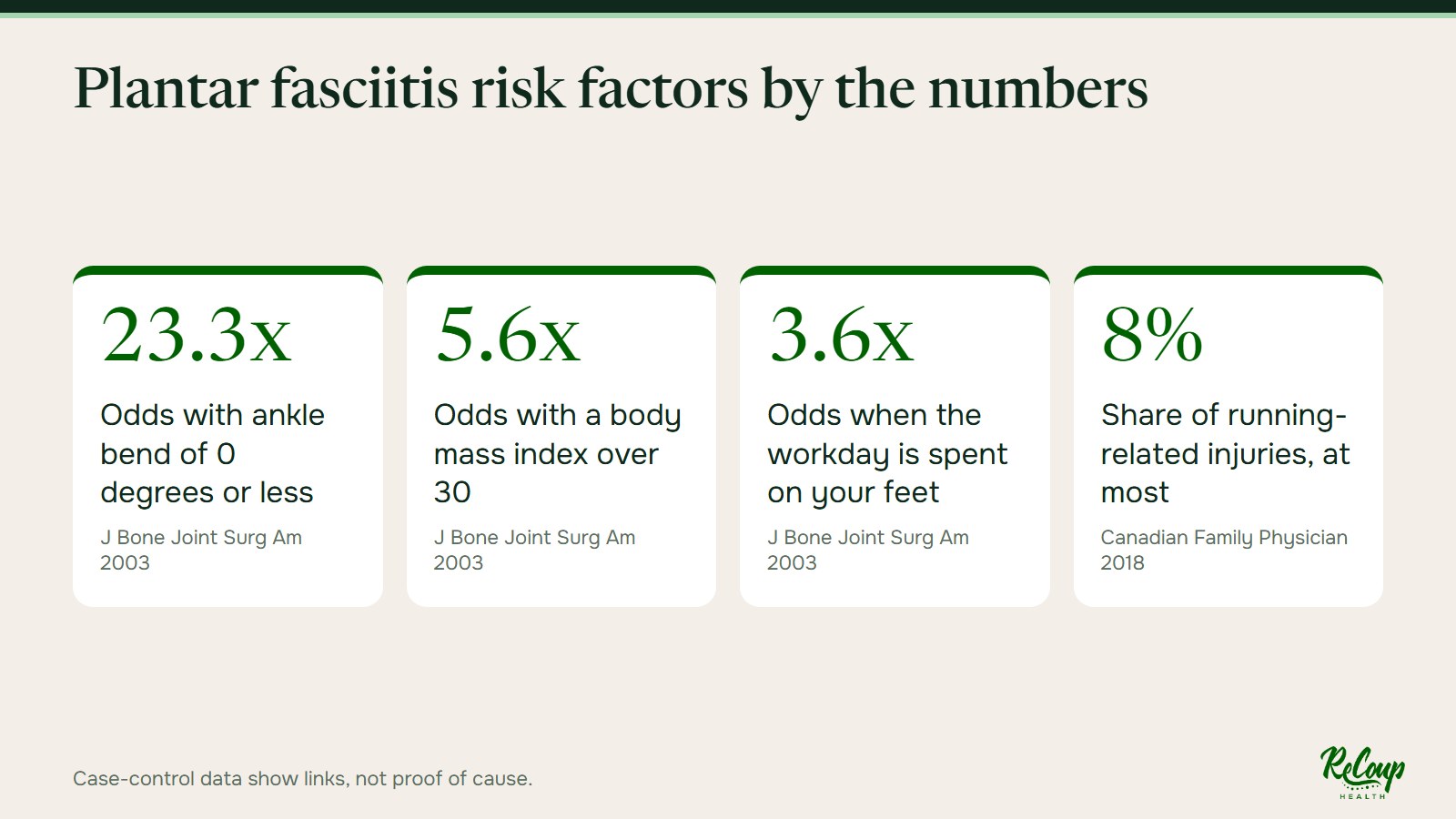
Both risk studies compared people with and without heel pain, so they show links rather than proof of cause. Dorsiflexion means bending the ankle so the toes move up toward the shin. The ankle result came from a small sample with wide error margins. That ankle finding still points to calf stiffness as a major load factor.
The graphic below shows four of these measured plantar fasciitis risk factors side by side.
Stiff ankles can also follow an old injury. Stiffness left after old ankle sprains can limit ankle bend and shift extra strain onto the fascia. Foot shape is the next factor to look at.
Can Flat Feet Cause Plantar Fasciitis?
Flat feet can cause plantar fasciitis by letting the arch collapse and pull harder on the heel attachment. Cleveland Clinic and Harvard Health Publishing both list flat feet and high arches as risk factors. A high, rigid arch absorbs less shock, so more force passes straight into the heel.
Research on arch supports for plantar fasciitis is mixed. A 2008 Cochrane review rated the evidence for custom orthoses in plantar fasciitis as unclear but found them safe. A clinician can check whether prescription foot orthotics suit your foot shape and activity. Activity level matters as much as foot shape, especially for runners.
How Does Running Cause Plantar Fasciitis?
Running causes plantar fasciitis when distance, speed or hill work rises faster than the fascia can adapt. Up to 8% of running injuries are plantar fasciitis, Canadian Family Physician reports. Harvard Health Publishing names long-distance running and downhill running on uneven surfaces as specific risks.
Running load builds over weeks, so a busy training block can tip the fascia past its limit. Runners can plan safer mileage changes with running injury physiotherapy and a gradual return schedule. Footwear is the other half of the running picture.
Can Shoes Cause Plantar Fasciitis?
Shoes can contribute to plantar fasciitis when they lack arch support or have soft, worn-out soles. Cleveland Clinic names flip-flops, flat flexible sneakers and barefoot walking at home as triggers. The same source advises replacing sneakers every 6 to 9 months, or after 400 to 800 km. Worn shoes pass more impact to the heel, which matters even more when body weight changes quickly.
Can Pregnancy Cause Plantar Fasciitis?
Pregnancy can cause plantar fasciitis through rapid weight gain that adds load to the arch. Harvard Health Publishing lists significant weight gain, including during pregnancy, as a trigger. Cleveland Clinic flags gaining more than about 7 kg (15 pounds) in a few months as a risk.
Foot pain during pregnancy deserves a check with your midwife, family doctor or physiotherapist. Footwear advice and gentle calf work form part of prenatal wellness care at our clinic. Weight and load changes like these also explain why heel pain can appear without warning.
Why Did I Get Plantar Fasciitis All of a Sudden?
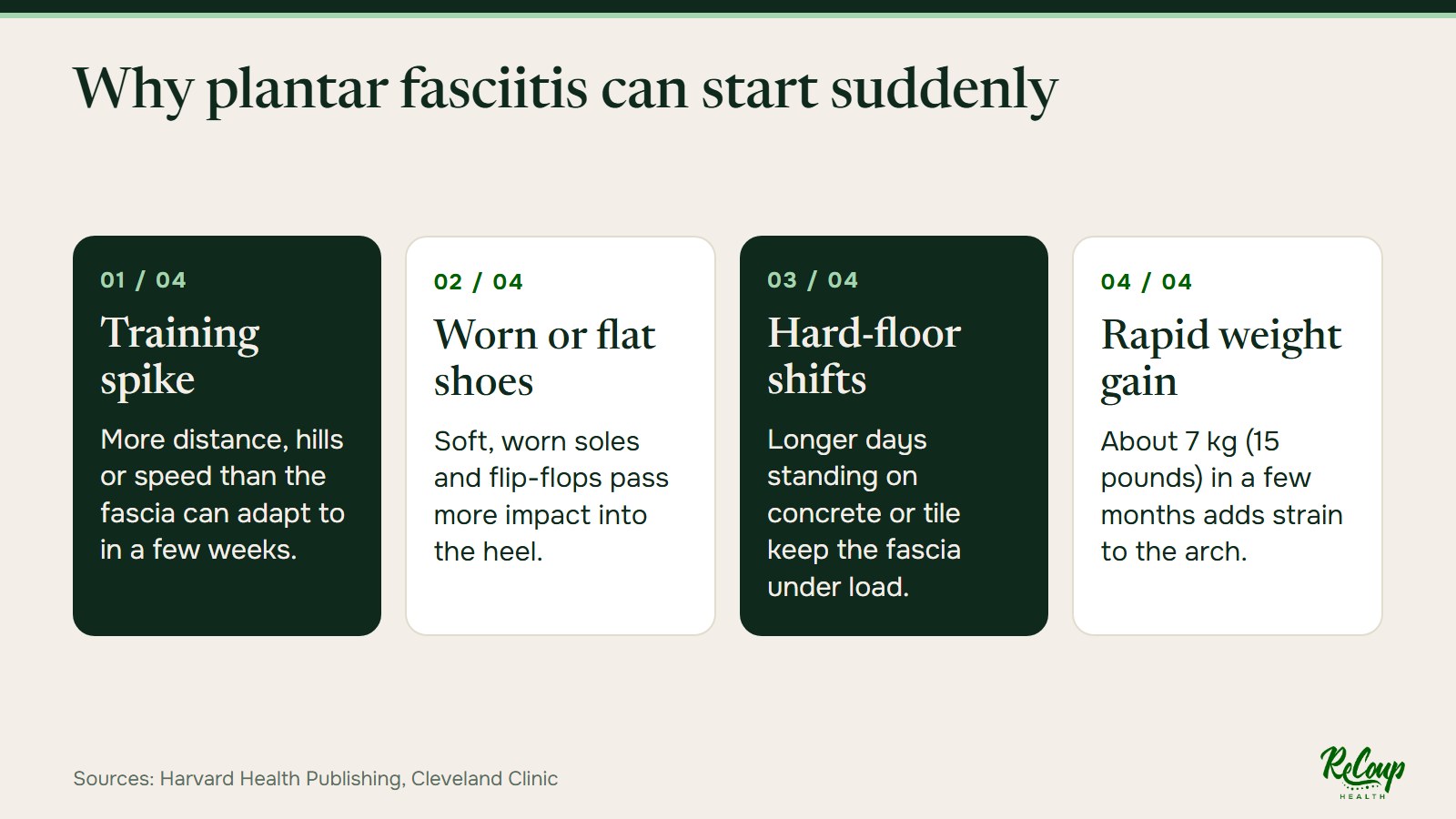
Plantar fasciitis appears all of a sudden because a recent change pushed load past what the fascia could handle. Harvard Health Publishing notes that symptoms can start suddenly after intense physical activity. The same source lists abrupt changes in activity level as a risk factor. Common sudden triggers include these five changes:
- A jump in running distance, hill work or speed over a few weeks.
- A new job or longer shifts standing on concrete or tile.
- A switch to flat, flexible or worn-out footwear.
- Walking barefoot on hard floors at home.
- Weight gain of about 7 kg (15 pounds) or more over a few months.
The graphic below sums up four of these sudden plantar fasciitis triggers.
Each trigger adds strain to tissue that was already near its limit. That same strain explains why some cases keep getting worse instead of settling.
Why Is My Plantar Fasciitis Getting Worse?
Plantar fasciitis gets worse when the fascia keeps meeting the same load that injured it. Long runs, all-day standing in unsupportive shoes, or full rest followed by a rushed return can trigger a flare-up. Cleveland Clinic warns that returning to sport before the fascia heals can re-injure it.
Slow recovery is common. The Canadian Family Physician article reports that about 40% of people still have symptoms at 2 years. A flare-up physiotherapy assessment can find which daily load keeps the flare-ups going. Walking is one of the first loads to review.
Does Walking Make Plantar Fasciitis Worse?
Walking makes plantar fasciitis worse when the walks are long, on hard ground or in unsupportive shoes. The NHS lists starting exercise on hard surfaces as a risk factor. Cleveland Clinic notes that movement can ease pain briefly, then the pain returns once you stop. Pain that lingers into the next morning signals that the walk was too much load. Load can also differ between your two feet.
Why Does Plantar Fasciitis Affect One Foot or Both Feet?
Plantar fasciitis affects one foot when a side-specific factor loads one heel more than the other. Cleveland Clinic states that plantar fasciitis affects one foot at a time in the majority of people. Both feet can still be involved, according to the same source.
One stiffer ankle, an old sprain or favouring one leg can explain a single painful heel. Body-wide factors such as weight, footwear and standing work tend to affect both feet. Both patterns raise the same question about swelling.
Does Plantar Fasciitis Cause Swelling?
Plantar fasciitis can cause mild swelling around the heel, but large visible swelling is not a typical sign. Cleveland Clinic lists swelling around the heel among its plantar fasciitis symptoms. Harvard Health Publishing adds that ultrasound may show thickening and swelling of the plantar fascia itself. The NHS symptom page does not mention swelling at all.
The swelling seen on ultrasound sits deep inside the fascia, so the skin can look normal. Puffiness across the ankle or the top of the foot points to another cause. A sprain, a stress fracture, an infection or a circulation problem needs to be ruled out. The comparison below shows how typical heel swelling differs from warning signs.
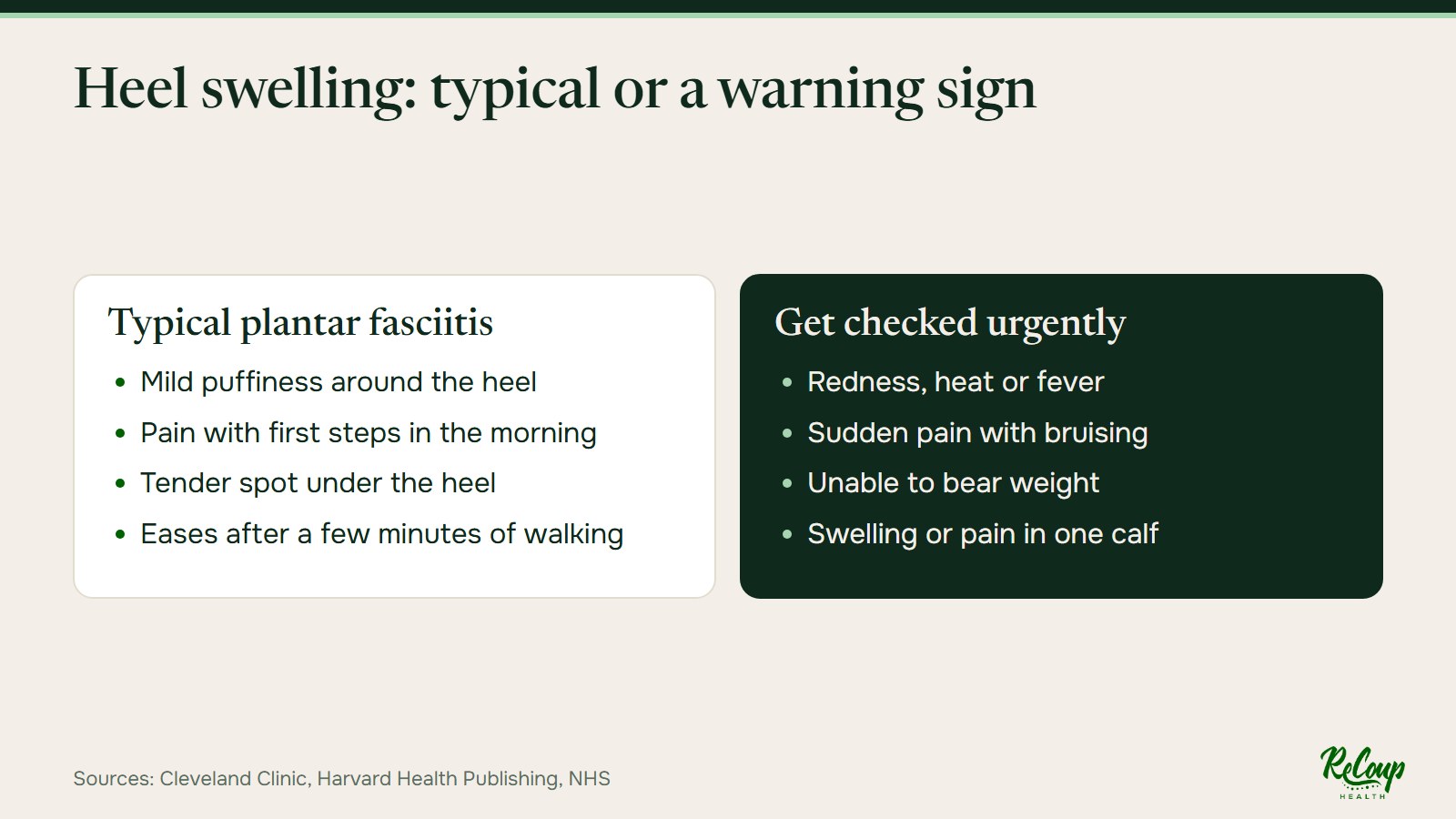
Seek urgent care at a walk-in clinic or emergency department for any of these signs:
- Heel swelling with redness, heat or fever.
- Sudden sharp pain with bruising after a pop, a fall or an injection.
- Being unable to put weight on the foot.
- Swelling, warmth or pain in one calf.
- New tingling or loss of feeling in the foot, which the NHS says needs a doctor’s review.
People living with diabetes should have foot pain assessed early, according to the NHS. Swelling questions lead naturally to questions about pain further up the leg.
Can Plantar Fasciitis Cause Hip Pain, Back Pain or Leg Pain?
Plantar fasciitis can lead to hip, back or leg pain indirectly, through the way heel pain changes your walking. People with a sore heel shift weight onto the outer foot or toes and shorten their stride. That limp changes the load on the knee, hip and lower back.
No large study has measured this knock-on effect, so the link rests on clinical observation. Pain can also travel the other way. Both low back pain and irritated spinal nerves can refer symptoms into the foot. A direct path from heel to hip remains unproven, so an assessment checks the whole chain. Nerve symptoms deserve the same whole-chain approach.
Can Plantar Fasciitis Cause Numbness?
Plantar fasciitis does not typically cause numbness, so tingling or numbness points to a nerve problem alongside or instead of the fascia. A 2026 review in the Journal of the American Podiatric Medical Association found neurological findings in 49% of 459 plantar fasciitis patients. Of those 225 patients, 56% improved with conservative care. Washington University Orthopedics also lists a pinched nerve in the heel among causes of heel pain. Nerve overlap is one reason heel pain needs a careful look at related conditions.
What Else Should You Know About the Causes of Plantar Fasciitis?
The causes of plantar fasciitis overlap with nerve problems, bone changes and general health factors covered below.
Can Sciatica Cause Plantar Fasciitis?
Sciatica is not listed as a cause in NHS or AAOS guidance, but sciatica can produce similar heel and sole pain. Sciatica is irritation of the sciatic nerve, which runs from the lower back down the leg into the foot. Nerve pain from the back tends to burn, tingle or spread rather than sit in one tender spot. An assessment for sciatica nerve pain checks the back, hip and leg before treating the foot alone.
What Gets Mistaken for Plantar Fasciitis?
Several heel conditions get mistaken for plantar fasciitis because they share pain under or behind the heel. Harvard Health Publishing and Washington University Orthopedics name these four look-alikes:
- Insertional Achilles tendinitis, which causes pain at the back of the heel.
- A heel bone stress fracture, a small crack from repeated impact.
- Plantar nerve entrapment, a pinched nerve that causes burning or tingling.
- Heel fat pad loss, a thinning of the cushion under the heel bone.
Pain that does not match the classic first-step pattern needs a closer exam. Heel spurs are another frequent source of confusion.
Are Heel Spurs a Cause of Plantar Fasciitis?
Heel spurs are not a cause of plantar fasciitis; a spur is a bony growth from the same long-term strain. Cleveland Clinic explains that a spur can develop as a reaction to plantar fasciitis stress and inflammation. The same source notes that many people with a heel spur feel no pain from it.
Can Diabetes or Menopause Cause Plantar Fasciitis?
Diabetes and menopause are not on the main risk-factor lists from the NHS or AAOS. Both can still shape heel pain indirectly through weight change and activity levels. The NHS advises people with diabetes to get foot pain assessed early. A naturopathic doctor can support general weight and lifestyle goals alongside foot care.
Can You Be Born With Plantar Fasciitis?
You cannot be born with plantar fasciitis, but you can be born with a foot shape that raises your risk. Flat feet and high arches both appear on the AAOS risk list. The condition itself peaks between ages 40 and 60, according to the NHS.
How Can You Prevent Plantar Fasciitis?
Prevent plantar fasciitis by building activity gradually, keeping calves flexible and wearing supportive shoes. Cleveland Clinic and Washington University Orthopedics recommend daily stretching, soft mats on hard floors and a healthy weight. Tight calves respond to regular stretching, and some people add therapeutic massage sessions for comfort.
Trials on massage for heel pain remain small and short, so massage fits as one part of a wider plan. Stiffness through the calves, hamstrings and hips can also be addressed with table-assisted fascial stretching from a trained therapist.
Frequently Asked Questions About Plantar Fasciitis Causes
Does Plantar Fasciitis Go Away on Its Own?
Plantar fasciitis does go away on its own for many people, but recovery can take a year or longer. Canadian Family Physician reports that about 40% of people still have symptoms at 2 years. The AAOS states that more than 90% of patients improve within 10 months of simple treatment.
What’s the Worst Thing You Can Do for Plantar Fasciitis?
The worst thing you can do for plantar fasciitis is keep loading a painful heel without changing anything. Running through pain, walking barefoot on hard floors and rushing back to sport all slow healing, according to Cleveland Clinic.
How Do I Fix Plantar Fasciitis?
Fix plantar fasciitis by reducing the load that caused it and rebuilding the tissue’s tolerance. A 2021 British Journal of Sports Medicine review of 51 trials named taping, stretching and individualised education as core treatment. Talk to your physiotherapist or family doctor when pain has not improved after 2 weeks, as the NHS advises.
Why Do I Keep Getting Plantar Fasciitis?
Plantar fasciitis keeps coming back when the original cause, such as tight calves or worn shoes, is still present. The NHS advises seeing a doctor when heel pain keeps returning.
How Recoup Health Helps Find the Cause of Your Heel Pain
Recoup Health helps by finding the load behind your heel pain before choosing treatment. Knowing what causes plantar fasciitis in your own foot shapes every step of care. Ankle bend, calf length, foot shape, footwear and walking pattern are all checked by our rehab clinicians during the first visit.
Treatment can combine exercise, footwear advice and orthotics where foot shape plays a role. Our Innovation Drive clinic in Vaughan sees clients without a doctor’s referral. Appointment requests go through our clinic contact form for a foot and heel assessment. Bring the shoes you wear every day, since footwear is part of the review.
Physiotherapy, chiropractic care, massage and custom orthotics all sit under one roof at the Recoup Health practice. That shared care helps each part of your heel pain get the right attention.