
To relieve a tension headache, step away from screens, warm your neck and rub tight spots at the temples and skull base. Then drink water and walk. Tension-type headache affects 26.0% of people worldwide, according to a 2022 Journal of Headache Pain review. Headaches that return on 15 or more days a month need a professional assessment, not just more home remedies.
Key Takeaways
- Fast relief comes from five simple steps: pause screens, breathe slowly, warm the neck, rub tight spots, then drink water and walk.
- Tension-type headache affects 26.0% of people worldwide, compared with 14.0% for migraine (Journal of Headache Pain, 2022).
- Pain relievers taken on 15 or more days a month for over 3 months can trigger medication-overuse headache.
- Soft tissue manual therapy reduced headache pain and frequency in low-certainty evidence, while spinal manipulation alone did not beat no treatment.
- A sudden, extremely painful headache, weakness, confusion or vision loss needs emergency care through 911.
How to Relieve Tension Headache Pain Fast in the First 30 Minutes
To relieve tension headache pain fast, lower your muscle tension and remove the trigger within the first 30 minutes. Cleveland Clinic describes the pain as a tight band pressing on the forehead and temples. Calm the muscles, then calm the setting around you. You get rid of a tension headache fast by easing tight neck and jaw muscles and removing screen glare, noise and hunger. The five steps below follow that order.
- Pause screens, dim bright lights and step away from noise for a few minutes.
- Breathe slowly, making each exhale longer than the inhale, for 2 to 3 minutes.
- Rest a warm pack or warm towel across the back of the neck and upper shoulders.
- Press slow circles into the temples, jaw muscles and the base of the skull with your fingertips.
- Drink a glass of water, eat a small snack after a skipped meal, then walk at an easy pace.
The steps above show how to relieve a tension headache fast without special equipment. Harvard Health links tension headaches to stress, eye strain, jaw clenching and skipped meals. Headaches that keep coming back after these steps call for tension headache care that looks at your neck, jaw and daily habits.
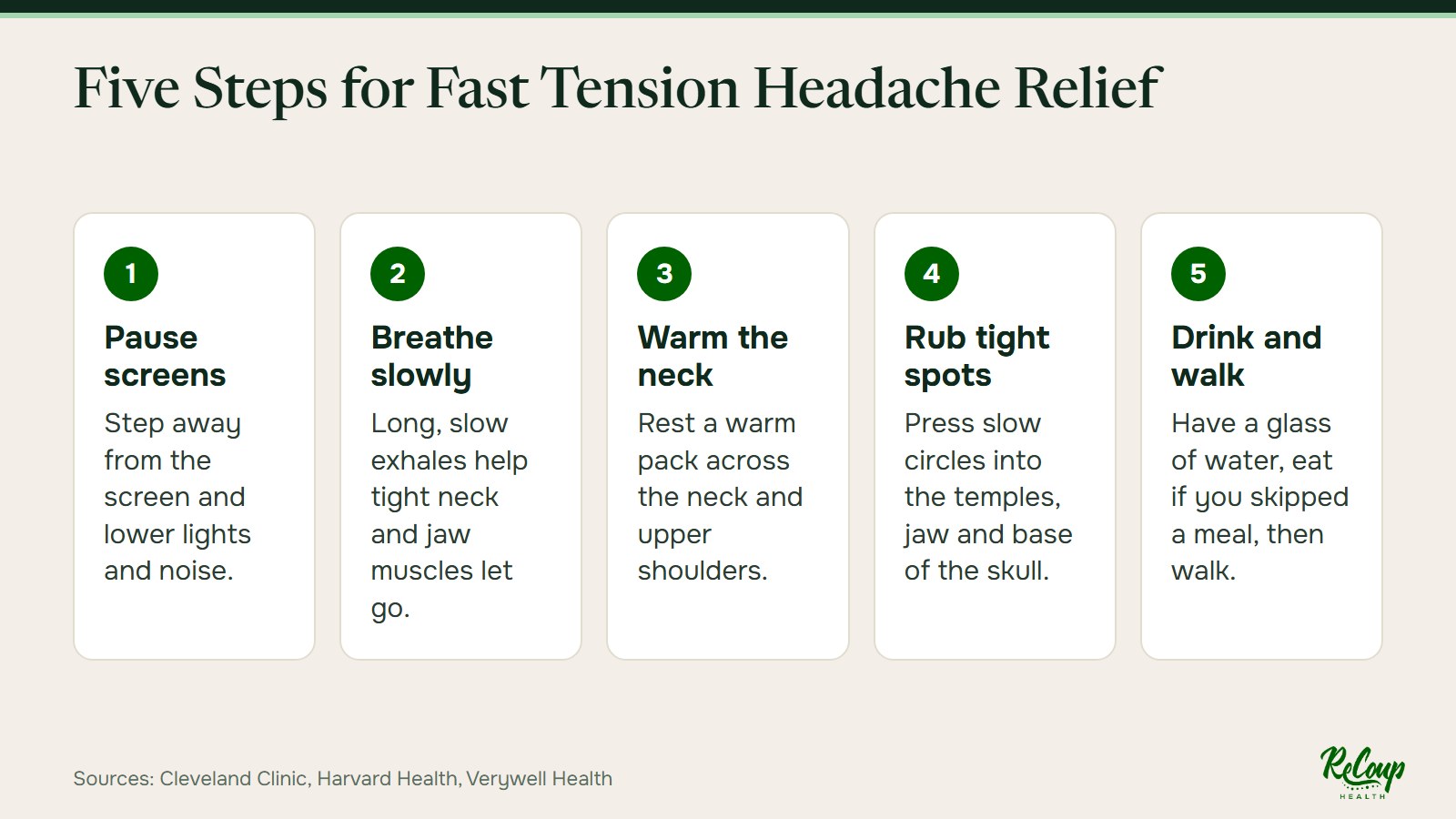
The graphic above sums up the five fast relief steps in order. Those steps work for a true tension headache, so the next job is confirming that the headache type matches.
How Do You Know If You Have a Tension Headache?
You know you have a tension headache when steady pressure or a tight band squeezes both sides of the head. Cleveland Clinic notes that tension headaches feel dull rather than throbbing. Light walking or stair climbing does not make a tension headache worse, according to Cleveland Clinic. Migraine behaves in a different way, and the table below compares the two with headaches that signal danger.
| Feature | Tension-type headache | Migraine | Red-flag headache |
|---|---|---|---|
| Main difference | Dull pressure or tight band | Throbbing pain with nausea or light sensitivity | Sudden, extremely painful onset |
| Location | Both sides, forehead, temples, back of head | One side of the head in many cases | Any location |
| Activity and senses | Not worse with walking or stairs | Extreme sensitivity to light or sound | May come on with coughing, bending or exercise |
| Other signs | Tight neck, shoulder and scalp muscles | Visual aura in some people | Weakness, confusion, vision loss, fever with stiff neck |
| What to do | Home relief steps, then an assessment for repeat headaches | See your family doctor for diagnosis | Call 911 or go to the emergency department |
The comparison draws on Cleveland Clinic, Calm and the NHS headache guidance. With the headache type confirmed, the next question is where the tightness sits and how to target it.
How Do You Relieve a Tension Headache in the Neck, Temples or Base of Skull?
To relieve a tension headache in the neck, temples or skull base, press slowly into the tight muscles there. Verywell Health highlights the temples, skull base, jaw muscles and neck as key self-massage zones. Small circles held on a tender spot for several slow breaths ease local tightness.
- Temples: press two fingertips into the soft area beside each eye and circle slowly.
- Base of the skull: place your thumbs where the neck meets the head and lean your head back gently into them.
- Neck: tilt one ear toward the shoulder, then turn the chin slightly down to stretch the side of the neck.
- Upper shoulders: squeeze the muscle between the neck and shoulder and roll the shoulders back.
Neck muscles play a large part in this pattern. A 2026 study in Headache found that 91.2% of people with tension-type headache and normal neck tests still reported neck pain. Stiffness that spreads into the shoulder blades can also involve upper back tightness worth assessing. Self-massage covers one approach, so the next section looks at other drug-free options.
How to Relieve Tension Headache Without Medication
Relieve tension headache pain without medication by combining stress control, regular movement, steady sleep and good hydration. Harvard Health lists enough sleep, regular meals and pacing your day as the basics. Stress management has clear numbers behind it. A 2025 Journal of Headache Pain review of 19 studies found psychological treatments cut headache days by 4.53 per month.
Exercise has weaker evidence. A 2025 Postgraduate Medical Journal network analysis of 12 trials found no clear overall drop in headache frequency, with very low certainty. Resistance exercise in that analysis did reduce frequency, and exercise overall lowered pain intensity. Stretching alone increased headache frequency, so gentle stretches belong alongside strength work, not in place of it.
Heat, cold packs and hydration remain common home advice from Cleveland Clinic and Verywell Health. Our fact checks found no reliable effect sizes for heat or cold in tension-type headache. Treat them as comfort measures, and save the evidence-backed effort for stress and strength work. Some people still reach for a pill first, which raises the question of what to take and how much is safe.
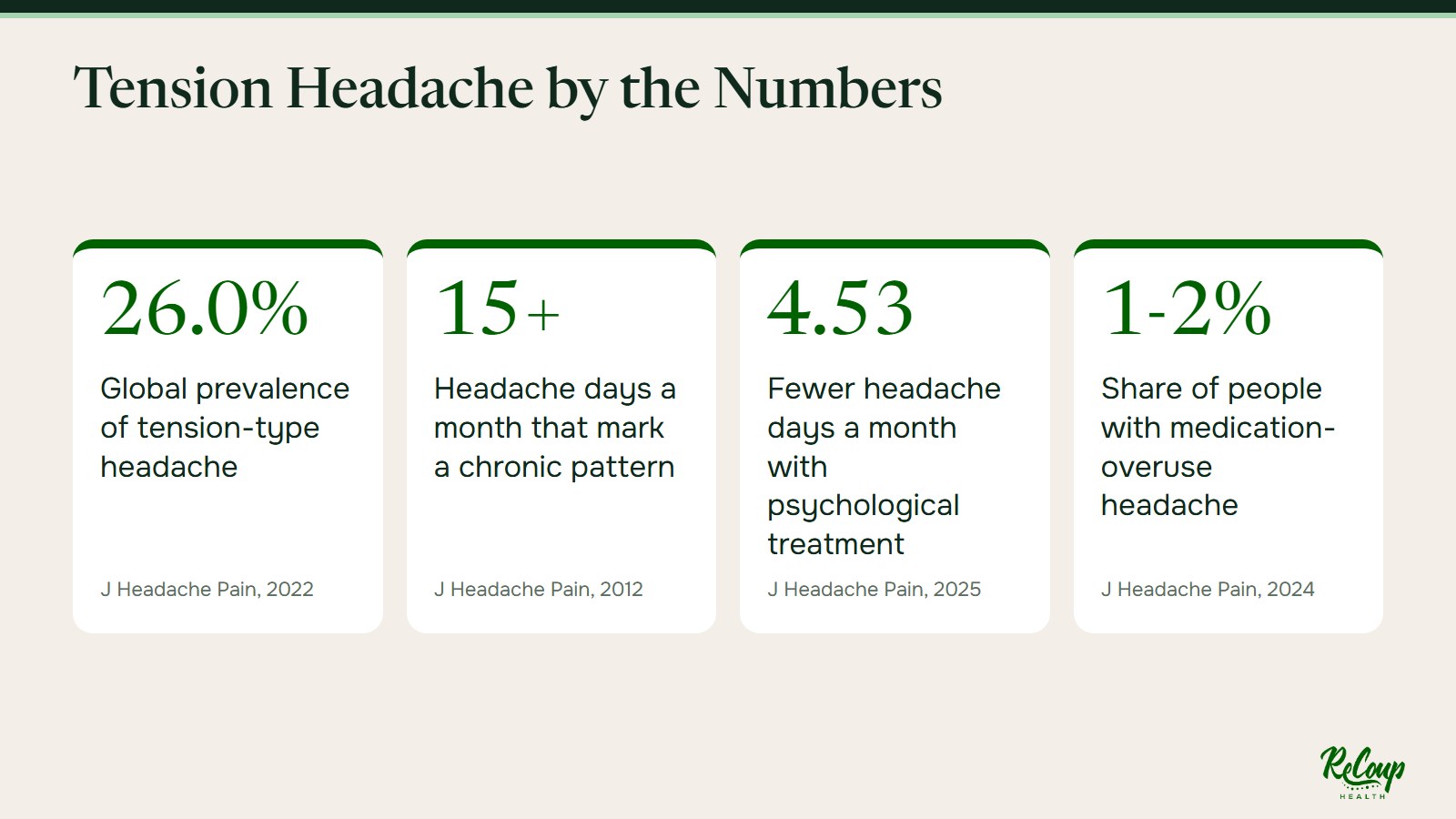
The stats graphic shows prevalence, the chronic threshold, the gain from psychological treatment and the share of people with medication-overuse headache.
What to Take for Tension Headache and How Many Days Is Too Many
What to take for tension headache is a question for your pharmacist or family doctor. The right medicine for tension headaches depends on your health history, so ask a pharmacist which over-the-counter option suits you.
The bigger risk with any pain reliever is how many days a month you take it. Cleveland Clinic lists acetaminophen, ibuprofen, naproxen and aspirin as common over-the-counter options. Frequent use of pain relievers can itself cause daily headaches. Doctors call this medication-overuse headache.
A 2024 Journal of Headache Pain review, citing the international headache criteria, sets clear limits. Medication-overuse headache means headache on 15 or more days a month for more than 3 months. The threshold is 15 or more days a month for simple pain relievers such as acetaminophen and anti-inflammatory drugs. The threshold drops to 10 or more days a month for combination pain relievers, triptans and opioids.
The same review reports that medication-overuse headache affects 1% to 2% of the population. In the COMOESTAS study, 47% of patients returned to an episodic pattern after stopping the overused drug. About 22% relapsed into overuse within one year.
Talk to your family doctor before stopping any medication. A neck exercise physiotherapy program is one way to reduce reliance on pills. Hands-on care is another drug-free route, starting with massage.
Can Massage for Tension Headache Relieve the Pain?
Yes, massage for tension headache can reduce pain intensity and how frequently headaches return, though the evidence is low certainty. A 2022 Disability and Rehabilitation meta-analysis pooled 15 studies with 1,131 participants. Soft tissue work beat no treatment for both pain intensity and headache frequency. The same review found no clear benefit for overall headache impact on daily life.
Many of the trials were small and unblinded, which limits confidence. A registered massage therapist (RMT) works on the neck, shoulders, scalp and jaw muscles linked to tension headaches. Our headache massage therapy sessions focus on those areas and pair the work with home self-massage. Massage is one form of manual therapy, and spinal manipulation is another with different results.
Does a Chiropractor for Tension Headache Relief Help?
A chiropractor for tension headache relief can help when care blends soft tissue work, exercise and mobility rather than neck manipulation alone. The 2022 Disability and Rehabilitation meta-analysis found high-velocity, low-amplitude manipulation did not beat no treatment for pain. Manipulation belongs inside a wider plan, not as the whole plan. Ontario’s OPTIMa guideline advises against cervical spine manipulation as the sole treatment for headaches linked to neck pain.
A 2021 review of 10 randomized trials in Neurologia found manual therapy improved pain, frequency, disability and neck motion. No single technique stood out as superior in that review. Our chiropractic neck care combines joint mobility work with muscle release and exercise. Some people notice a tension headache after chiropractor visits, and that soreness deserves a mention at your next appointment. Headaches that persist for months need a longer plan, covered next.
What Is the Chronic Tension Headache Treatment That Works?
Chronic tension headache treatment rests on exercise, multimodal care and stress management for headaches on 15 or more days a month. Researchers applying the international criteria set the chronic line at 15 or more headache days a month. A 2012 German study found chronic tension-type headache in 0.5% of the population. Low-load neck and shoulder blade exercise is the guideline-backed core of care.
The Ontario OPTIMa guideline in 2019 recommends low-load craniocervical and cervicoscapular endurance exercise for tension-type headache lasting over 3 months. Craniocervical means the joint where the skull meets the neck, and cervicoscapular means the neck and shoulder blade. The guideline also suggests general exercise, multimodal care or clinical massage for chronic cases. A 2016 Bone and Joint Decade Task Force update concluded that care for headaches with neck pain “should include exercise”.
Our headache physiotherapy follows that exercise-first approach.
Long-running tension headaches can also affect sleep, mood and work. Cleveland Clinic notes that ongoing pain can make it hard to focus on work or family. For that reason, long-running headaches also overlap with ongoing pain support, where sleep, stress and activity pacing sit alongside treatment. Several side questions come up once the main plan is clear.
What Else Should You Know About Tension Headache Relief?
Tension headache relief also depends on how long the headache lasts and on related symptoms. Dizziness, jaw pain and pregnancy each change the plan.
What Triggers Tension Headaches?
Tension headaches are triggered by stress, poor sleep, long screen time, eye strain, jaw clenching and skipped meals. Harvard Health also lists alcohol, too much caffeine or caffeine withdrawal, and fatigue. Stress and tight neck muscles sit at the centre of the trigger list, according to Cleveland Clinic. A short headache diary helps you spot your own pattern.
What Is the Finger Trick for Headaches?
The finger trick for headaches is acupressure, which means pressing firmly on set points with a fingertip or thumb. Common points are the temples, the base of the skull and the web between the thumb and index finger. Hold firm, steady pressure for several slow breaths, then switch sides. Our fact checks found no reliable trial numbers for this trick, so treat it as a comfort measure. People who are pregnant should ask their midwife or family doctor before pressing the thumb web point.
Can a Tension Headache Last for Days?
Yes, a tension headache can last for days. Cleveland Clinic reports tension headaches lasting from 30 minutes to a week. A headache present for days with no break warrants a visit to your family doctor. Daily headaches over weeks may point to a chronic pattern or medication overuse.
Can a Tension Headache Make You Dizzy?
Tension headache and dizziness can occur together, but dizziness is not on the Cleveland Clinic symptom list for tension headache. Neck stiffness and inner ear problems can both produce dizziness. Dizziness that keeps returning needs its own assessment. A dizziness assessment checks the balance system and neck together.
How Do You Get Jaw Tension Headache Relief?
Get jaw tension headache relief by unclenching the teeth and massaging the jaw muscles near the ears. Resting the tongue behind the front teeth also helps. Cleveland Clinic lists temporomandibular joint (TMJ) disorders as a tension headache trigger. Night-time grinding needs a dentist’s review and possibly a night guard, according to Cleveland Clinic. Hands-on osteopathic jaw care can address the jaw, neck and posture together.
How to Relieve Tension Headache While Pregnant
Relieve a pregnancy tension headache with rest, water, regular meals, gentle neck massage and slow breathing before reaching for medicine. Verywell Health advises contacting a healthcare provider about headaches during pregnancy. Ask your family doctor, midwife or pharmacist before taking any pain reliever while pregnant. Our pregnancy wellness care includes positioning and muscle care suited to each trimester.
Does Acupuncture for Tension Headache Relief Work?
Acupuncture for tension headache relief is listed by Cleveland Clinic among therapies that may help, alongside massage and meditation. Our fact checks did not confirm a reliable effect size, so expectations should stay modest. Acupuncture fits as one part of a wider plan. Ask our founding chiropractor whether acupuncture or cupping suits your headache pattern.
Can Posture Cause a Tension Headache?
Posture is linked with headaches, but research has not proven it causes them. A 2020 Pain Medicine meta-analysis of 12 studies found greater forward head posture in people with chronic primary headache. The link is an association, not proof of cause. Raising your screen to eye level and taking movement breaks are still low-risk habits, per Cleveland Clinic.
When Is a Headache an Emergency?
A headache is an emergency when it starts suddenly and is extremely painful, according to the NHS. The NHS also lists seizure, weakness, difficulty speaking, confusion, vision loss, a non-fading rash or fever with stiff neck. Call 911 or go to the nearest emergency department for these signs. A headache after a head injury in the last 3 months also needs urgent care.
The NHS advises an urgent medical assessment for headaches triggered by coughing, sneezing or bending. Vomiting or jaw pain when eating also need urgent review. A tender scalp also belongs on that urgent list.
Frequently Asked Questions About Relieving Tension Headaches
Will Tension Headaches Go Away on Their Own?
Yes, an occasional tension headache goes away on its own within 30 minutes to a week. Cleveland Clinic gives an average duration of 4 to 6 hours. Frequent headaches need an assessment.
Is a Tension Headache the Same as a Stress Headache?
Yes, a stress headache is another name for a tension headache. Cleveland Clinic also calls it a muscle contraction headache. Stress is one trigger among several.
Can Walking Relieve a Tension Headache?
Walking can ease a tension headache because light activity does not worsen the pain, per Cleveland Clinic. A short walk also breaks up long sitting and screen time.
What Should You Eat to Relieve a Tension Headache?
Eat regular meals and drink enough water to relieve a tension headache, since Harvard Health lists skipped meals as a trigger. A small snack with protein helps after a missed meal.
Can You Relieve a Tension Headache in 30 Seconds?
Thirty seconds of slow breathing and jaw unclenching can take the edge off a tension headache. Full relief takes longer, and the five steps above take about 30 minutes.
Why Is My Tension Headache So Bad?
A tension headache feels worse with poor sleep, high stress, long screen time or frequent pain reliever use. A severe or unusual headache needs a medical check to rule out other causes.
How Recoup Health Helps With Tension Headache Relief
Recoup Health helps with tension headache relief through physiotherapy, chiropractic care, massage therapy and performance coaching for the neck and shoulders. We start by checking the headache pattern, neck movement, jaw and daily habits. Our recurring headache treatment then follows the exercise-first approach backed by the Ontario OPTIMa guideline. No doctor’s referral is needed to book.
Knowing how to relieve tension headache pain at home covers the occasional bad day, and our Vaughan clinic covers the rest. Repeat headaches deserve a plan built around your triggers and your neck.
Booking a first visit is simple. Send a headache appointment request and our team will reply with available times. Bring a short headache diary listing dates, triggers and any pain relievers taken.
Physiotherapists, massage therapists, a chiropractor and a performance coach share notes on each headache case. Shared notes keep the plan consistent between visits. Every one of our Recoup Health professionals follows the same headache plan from the first visit.