
To heal tennis elbow, cut back the gripping and lifting that strain your forearm, then rebuild the tendon with gradual strengthening. Cleveland Clinic states recovery takes around 6 months, and some people need up to 18 months. AAOS OrthoInfo reports that 80 to 95% of patients recover without surgery. Steady loading and patience matter more than quick fixes.
Key Takeaways
- Tennis elbow heals in about 6 months for a typical case, and slower cases take up to 18 months (Cleveland Clinic).
- Relative rest plus gradual forearm strengthening forms the core of healing, not complete rest.
- Steroid injections gave fast relief in a 2006 BMJ trial, but 72% of early successes relapsed.
- Physiotherapy reached 94% success at 1 year in the same trial, with 8% recurrence.
- The NHS advises physiotherapy when home care brings no improvement after 6 weeks.
How Do You Heal Tennis Elbow Step by Step
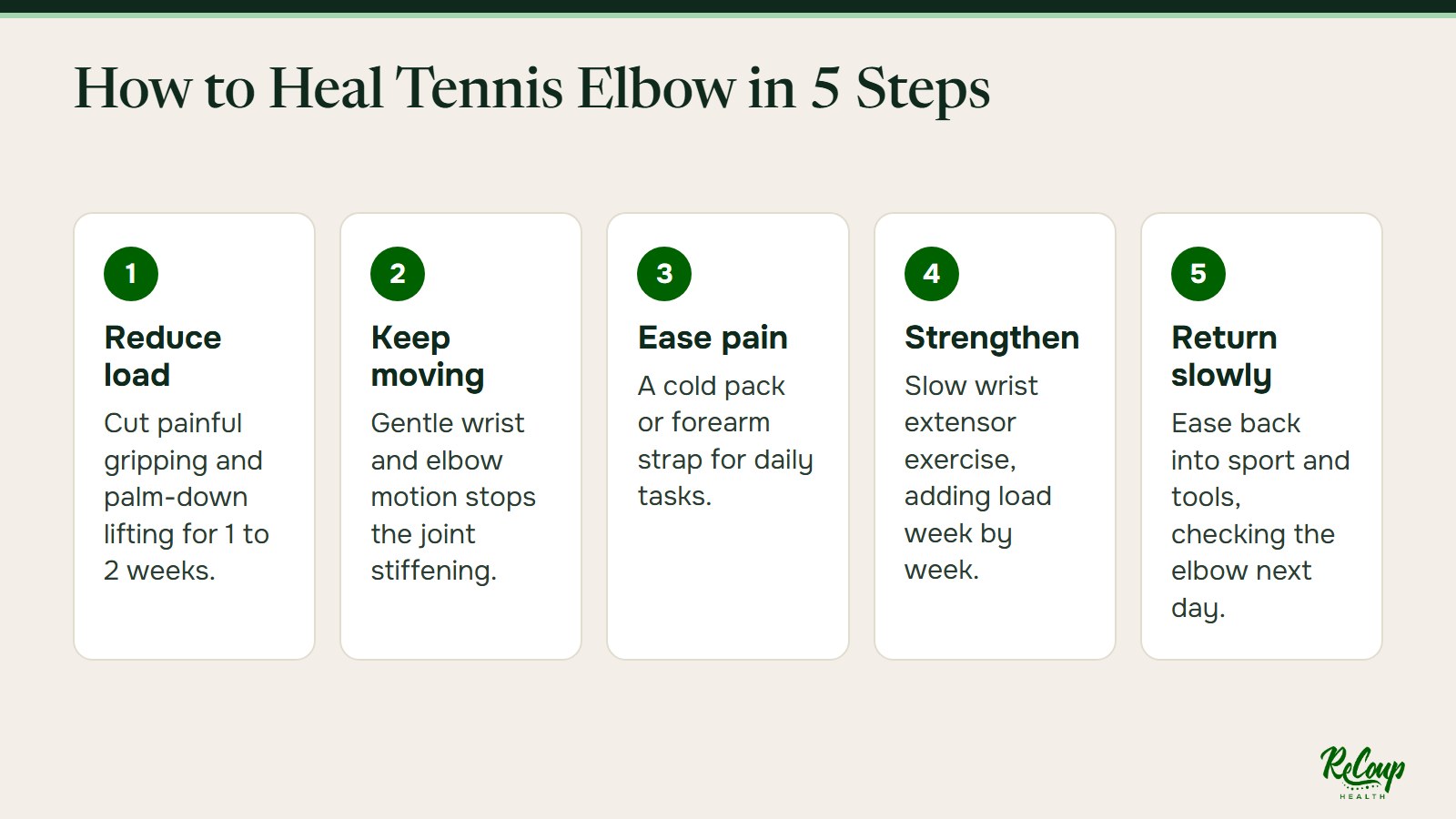
You heal tennis elbow step by step by lowering the load on the sore tendon, then rebuilding its strength. Tennis elbow heals through calm-down, reload and return phases, not through rest alone. Tennis elbow, also called lateral epicondylitis, is an overuse injury of the tendon joining the forearm muscles to the outer elbow.
The forearm muscles in question are the wrist extensors, which lift the back of your hand. Repeated gripping, twisting and lifting overload these muscles and their shared tendon. The steps below show how to heal tennis elbow in a practical order.
- Reduce the gripping, twisting and palm-down lifting that trigger sharp pain for 1 to 2 weeks.
- Keep the arm moving with gentle wrist and elbow motion so the joint does not stiffen.
- Use a cold pack or a forearm strap for short-term pain relief during daily tasks.
- Start slow strengthening for the wrist extensors once pain settles, adding load week by week.
- Return to sport, work tools or heavy lifting gradually, watching how the elbow responds the next day.
Each step builds on the last, and skipping ahead to heavy loading can restart the pain cycle. A physiotherapist can match these steps to your work and activity level as part of elbow tendon recovery. The image below sums up the same steps in order.
Those steps take time to work, which raises the question of how long healing really takes.
How Long Does It Take for Tennis Elbow to Heal
Tennis elbow takes around 6 months to heal for a typical case, according to Cleveland Clinic. Cleveland Clinic adds that some people need longer, up to 18 months. The NHS states that tennis elbow goes away with rest in many cases but can sometimes last over a year.
A Canadian source gives the same picture. The Government of Canada’s National Defence Maple Leaf article says recovery takes several months, and symptoms last years for some. That article names four recovery factors: the amount of tissue damage, age, how early treatment starts and job demands.
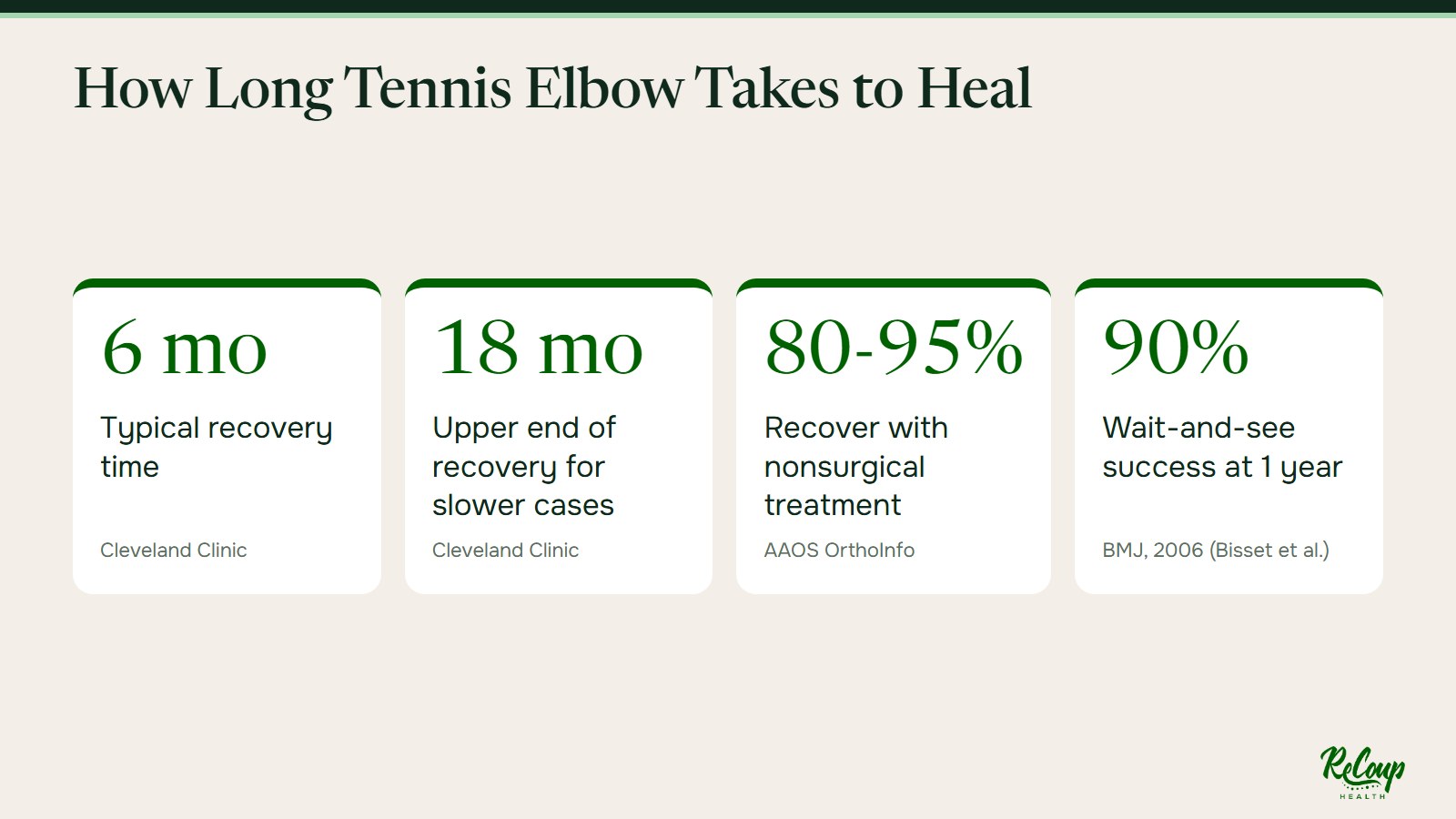
The stats graphic above shows how long tennis elbow takes and how many people recover without an operation. Those numbers make more sense once you know how a tendon moves through recovery.
How Long Does Tennis Elbow Last Without Treatment
Tennis elbow without active treatment lasts many months, yet a large share of people still recover within a year. In a 2006 BMJ trial by Bisset and colleagues, 90% of the wait-and-see group reported success at 52 weeks. That same group reported only 27% success at 6 weeks.
Waiting therefore works slowly, and the first months can be painful and limit work. Those slow early months explain why the healing stages matter.
What Are the Tennis Elbow Healing Stages
The tennis elbow healing stages move from an irritated tendon, through a reloading phase, to full return to activity. Researchers Cook and Purdam described tendon pain as a continuum in a 2009 British Journal of Sports Medicine paper. That continuum runs from a reactive tendon to a degenerative tendon. A reactive tendon is a recently overloaded tendon that has not yet changed in structure.
A practical timeline follows the checkpoints that health agencies use. The NHS advises seeing a family doctor when pain persists after 2 weeks of rest and self-care. The NHS also advises physiotherapy when home treatment brings no improvement after 6 weeks.
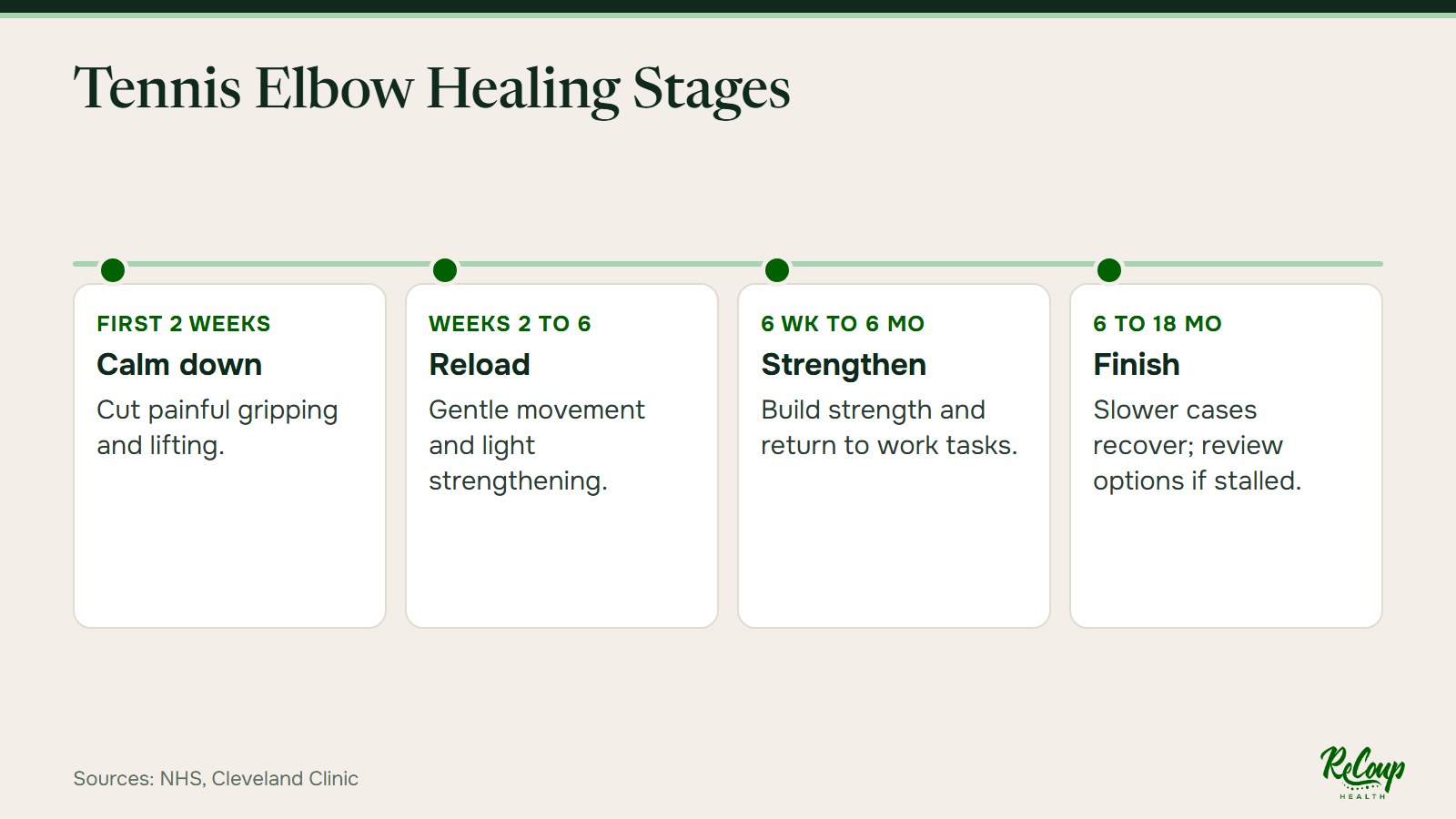
The timeline above shows four phases, from calming the tendon in 2 weeks to full return by 6 to 18 months. Each phase has its own goal:
- First 2 weeks: calm the tendon by cutting painful gripping and lifting.
- Weeks 2 to 6: reload with gentle movement and light strengthening.
- 6 weeks to 6 months: build strength and return to work tasks with a forearm physiotherapy program where needed.
- 6 to 18 months: finish recovery for slower cases, and discuss other options when progress stalls.
Some elbows move through these stages slowly, and the reasons behind that delay are worth knowing.
Why Is Tennis Elbow So Hard to Heal
Tennis elbow is hard to heal because the injured tendon keeps getting loaded by everyday gripping, and the condition tends to return. Daily hand use keeps stressing the tendon while it repairs. A 2022 clinical practice guideline in the Journal of Orthopaedic and Sports Physical Therapy (JOSPT) covers this problem. The JOSPT guideline states that lateral elbow pain often recurs and causes lengthy time off work.
Personal factors also slow healing. A 2006 American Journal of Epidemiology study of 4,783 Finnish adults linked smoking, obesity, repetitive movements and forceful activities to the condition. Trades and assembly jobs demand grip strength all day. Those jobs can turn healing into a stop-start process covered in grip-heavy job injuries care.
Healing speeds up once the main cause of tendon overload is clear.
What Is the Root Cause of Tennis Elbow
The root cause of tennis elbow is repeated overload of the wrist extensor tendon where it attaches to the outer elbow. Cleveland Clinic estimates that more than 9 in 10 people develop it for reasons other than tennis. Painting, typing, using hand tools and carrying heavy bags all load the same tendon.
The tendon cause points to the treatment, which is to manage the load rather than chase speed.
Is There a Fast Way to Heal Tennis Elbow
No proven fast way to heal tennis elbow exists, because the quickest pain relief does not lead to the quickest recovery. Readers searching how to heal tennis elbow fast tend to find steroid injections, which act within weeks. Trial data show those early gains fade, as the table below compares.
| Approach | Success at 6 weeks | Success at 52 weeks | Recurrence after early success |
|---|---|---|---|
| Steroid injection | 78% | 68% | 72% |
| Physiotherapy (manipulation and exercise) | 65% | 94% | 8% |
| Wait and see | 27% | 90% | 9% |
The table shows injections winning at 6 weeks and losing at 52 weeks. Fast relief from injections came with a 72% relapse rate. A 2013 JAMA trial by Coombes and colleagues found a similar pattern. Recovery at 1 year was 83% after steroid injection versus 96% after placebo injection.
The faster route in practice is the one with the fewest setbacks. That route depends on what you do at home every day.
What Helps Heal Tennis Elbow at Home
What helps heal tennis elbow at home is a mix of load changes, gentle movement and slow strengthening. Small daily habits protect the tendon while it repairs. The home measures below have the clearest support:
- Lift with your palm facing up so the wrist extensors work less.
- Carry bags on the other side or in both hands to share the load.
- Use a forearm strap for painful tasks; a 2026 Scientific Reports crossover trial of 56 people found it improved pain-free grip.
- Add slow eccentric exercise, where the muscle lengthens under load, such as the Tyler twist with a rubber bar.
- Take short breaks from typing, mouse use and tool work to spread the strain across the day.
The Tyler twist evidence is promising but small. A 2010 Journal of Shoulder and Elbow Surgery trial studied 21 patients. Pain improved 81% with the exercise versus 22% without it. Home care works well alongside hands-on care, which leads to the question of massage.
Should I Rub My Tennis Elbow
Rubbing your tennis elbow gently can ease muscle tension, but firm pressure on a freshly irritated tendon can increase pain. A 2024 Cochrane review of 23 trials found manual therapy and exercise gave only small, short-lived pain benefits over minimal care. Light massage during forearm massage sessions works as a comfort measure next to strengthening, not in place of it.
Arm position during rest matters as much as massage.
Is It Better to Keep Tennis Elbow Straight or Bent
Keeping tennis elbow relaxed and close to straight during rest is gentler than holding it sharply bent for long periods. Many physiotherapists suggest avoiding sleeping or sitting with the elbow tightly bent and the wrist curled. A slightly bent, supported arm on a pillow is a comfortable middle ground.
Position changes help, yet some habits slow recovery no matter how you rest.
What Not to Do With Tennis Elbow
Avoid pushing through sharp pain, stopping all arm use for weeks and lifting heavy loads with the palm down. Complete rest weakens the forearm, and that weakness makes the tendon more sensitive when you return to work. Repeated steroid injections deserve caution, since both the BMJ and JAMA trials linked them with more recurrence.
These mistakes explain many cases of tennis elbow not healing on schedule.
Why Is My Tennis Elbow Not Healing
Tennis elbow that is not healing after several weeks has met too much load, too little strengthening or a different diagnosis. The NHS advises physiotherapy when 6 weeks of home care bring no improvement. A physiotherapist checks the elbow, wrist, neck and shoulder to find the pain source. That check can change the plan for slow-healing elbow pain.
Long-standing cases can also involve a sensitive pain system that reacts to light loads. The nervous system then treats ordinary gripping as a threat, so progress feels slow even as the tendon repairs. Support from long-lasting pain care helps people pace activity through slow months. Persistent cases then raise the question of whether surgery is needed.
Can Tennis Elbow Heal Without Surgery
Yes, tennis elbow can heal without surgery in 80 to 95% of patients, according to AAOS OrthoInfo. AAOS OrthoInfo adds that surgery is considered when symptoms persist after 6 to 12 months of nonsurgical care. Surgery succeeds in 80 to 90% of patients, and return to sport takes 4 to 6 months afterward.
People who do have surgery need structured post-operative elbow care to rebuild strength safely. Beyond surgery, a few side questions shape tennis elbow recovery time.
What Else Should You Know About Tennis Elbow Recovery Time
Tennis elbow recovery time depends on the right diagnosis, the risk of relapse, your job and your age. The short answers below cover the side questions people ask while waiting for the tendon to settle.
What Is Commonly Mistaken for Tennis Elbow
Golfer’s elbow, wrist problems and nerve irritation from the neck are commonly mistaken for tennis elbow. Golfer’s elbow causes pain on the inner side of the elbow, the opposite side to tennis elbow. A clinician can separate inner elbow tendinopathy from outer elbow pain with simple strength and stretch tests.
Pain that spreads down the forearm and into the hand can also come from the wrist joint itself. Wrist problems change how you grip, and that change adds strain to the elbow. A clinician can rule out wrist causes with a sore wrist exam. The right diagnosis also lowers the chance of the pain coming back.
Does Tennis Elbow Come Back After It Heals
Tennis elbow can come back after it heals, especially after steroid injections. The 2006 BMJ trial recorded recurrence in 72% of injection patients, 8% with physiotherapy and 9% with wait and see. Ongoing forearm strengthening after symptoms clear helps protect the tendon.
Can Acupuncture Help Tennis Elbow Heal
Acupuncture can help some people with tennis elbow pain, but the research quality is mixed and it does not replace strengthening. Acupuncture uses thin sterile needles placed at set points to reduce pain. A chiropractor trained in chiropractic and acupuncture can add it to an exercise-based plan.
Does Playing Sport Slow Tennis Elbow Healing
Playing racquet sports or golf at full intensity can slow tennis elbow healing by reloading the tendon too soon. Changing grip size, stroke technique and weekly volume lets many players keep active. A graded return through return-to-play physiotherapy spreads the load over several weeks.
Who Gets Tennis Elbow
Tennis elbow affects adults in midlife, and the NHS states it is more common in people aged 35 to 54. The Journal of Orthopaedics reported in 2019 that the condition affects 1 to 3% of adults each year. Midlife workers with grip-heavy jobs place repeated load on the tendon.
When Should You Seek Urgent Care for Elbow Pain
Seek urgent care at an emergency department for elbow pain that follows a fall or blow, or comes with these signs:
- A visible deformity or an elbow you cannot bend or straighten.
- Rapid swelling, heat or redness, especially with a fever.
- Numbness, tingling or weakness spreading into the hand.
- Severe pain that stops sleep or normal arm use.
Cleveland Clinic also advises seeing a provider for elbow swelling, discolouration or pain lasting more than a week. Your family doctor or physiotherapist can assess milder pain that is slow to settle.
Frequently Asked Questions About Healing Tennis Elbow
Which Ointment Helps Tennis Elbow
An anti-inflammatory gel such as ibuprofen gel can ease tennis elbow pain for a short time. The NHS warns that ibuprofen gel is flammable, so keep it away from flames and cigarettes. Ask your pharmacist which product suits you.
Does Tennis Elbow Heal on Its Own
Yes, tennis elbow heals on its own in many cases, but slowly. The 2006 BMJ trial found 90% success at 1 year with wait and see, compared with 27% at 6 weeks.
Can You Heal Tennis Elbow in a Week
No, tennis elbow does not heal in a week. Cleveland Clinic states that recovery takes around 6 months, though pain can ease earlier with load changes.
How Long Does Tennis Elbow Last After Surgery
Tennis elbow recovery after surgery takes 4 to 6 months before return to athletic activity, according to AAOS OrthoInfo. The operation is considered only after 6 to 12 months of nonsurgical care.
How Recoup Health Helps You Heal Tennis Elbow
Recoup Health helps you heal tennis elbow with a clear plan that matches the healing stages above. We start with an assessment of the elbow, wrist, neck and shoulder, then build a graded strengthening program. A realistic timeline for your case helps set goals for work and sport.
You can meet our elbow physiotherapists before your first visit. Our physiotherapists check grip strength, wrist movement and the tasks that flare your pain. That check shapes a home program you can follow between visits, with load added week by week as the tendon settles.
Physiotherapy, massage therapy, chiropractic care and acupuncture all sit under one roof with Recoup Health’s team on Innovation Drive. No doctor’s referral is needed to start care for a sore elbow. The first visit covers a full assessment and a starting set of home exercises, so recovery begins on day one.
To book an assessment, use our elbow assessment request page and pick a time that fits your week. Knowing how to heal tennis elbow early saves months of frustration later.