

Whiplash usually gets better within 2 to 3 months, according to the NHS. Minor cases can settle within days or a few weeks. Recovery is fastest in the first 3 months, then levels off, based on a 2008 meta-analysis in the journal Pain. A Canadian-led task force found that roughly half of people still report some neck pain one year later. Early movement and the right care shape where you land on that range.
Key Takeaways
- The NHS says whiplash usually gets better within 2 to 3 months.
- Recovery is fastest in the first 3 months and changes little after that point (Pain, 2008).
- Roughly half of people with whiplash still report neck pain at 1 year (Bone and Joint Decade Task Force).
- Staying active beat a soft collar for pain in all 4 trials of a 2021 meta-analysis.
- Numbness, weak arms or legs, or trouble walking after a crash need urgent care.
How Long Does Whiplash Last on Average?
On average, whiplash lasts about 2 to 3 months, and the NHS says it usually gets better within that window. Some people keep symptoms for longer, and the NHS whiplash page states that plainly. Cleveland Clinic reports that minor whiplash can recover within days or a few weeks. Severe whiplash can take several weeks or even months to heal, per the same source.
Whiplash recovery follows a clear curve in the research. A 2008 meta-analysis in Pain pooled 38 cohorts of people with neck pain after a car crash. Pain and disability fell quickly in the first 3 months, then changed little after that point. That 3-month mark is the key checkpoint for any recovery plan.
Whiplash from a collision is also called a whiplash-associated disorder (WAD), meaning neck pain and related symptoms after a sudden jolt. An early check through car accident rehab helps a clinician grade the injury and set realistic recovery goals. Those goals line up with the time points in the table below.
| Time after injury | What the research shows | Source |
|---|---|---|
| First hours to days | Symptoms can take several hours to start; some take 12 hours to a few days | NHS; Cleveland Clinic |
| 1 week | See a doctor when symptoms have not improved | NHS |
| 2 to 3 months | Typical window for whiplash to get better | NHS |
| 3 months | Recovery levels off; pain and disability change little afterward | Pain, 2008 |
| 6 months | 3.1% of grade I cases had intermittent pain; 12.5% in one grade II trial | Global J Health Sci, 2012; Arch Phys Med Rehabil, 2006 |
| 1 year | Roughly half report neck pain; 48% had considerable pain in one trial | Spine, 2008; Spine, 2007 |
These whiplash figures vary because each study defines recovery in its own way. The timeline starts the moment symptoms appear, which can be later than the crash itself.
How Long Does It Take to Get Whiplash After a Crash?
Getting whiplash symptoms after a crash can take several hours or more, according to the NHS. Cleveland Clinic notes that some symptoms take at least 12 hours to appear. Other symptoms can take a full day or a few days to show up, per the same source.
Whiplash symptoms listed by Cleveland Clinic include neck pain, stiffness, muscle spasms, headaches, dizziness and tingling in the arms. Neck pain can spread to the head, shoulder and shoulder blade. Pain between the shoulder blades can feel like an upper back strain, even though the neck is the source. These symptoms change as the injury moves through its stages.
What Are the Stages of Whiplash Recovery?
The stages of whiplash recovery are acute, subacute and chronic. A 2007 Cochrane review treated symptoms under 3 weeks as acute. A 2025 meta-analysis in the European Journal of Pain defined the chronic group as symptoms lasting over 3 months. The 3 stages look like this:
- Acute stage, first 3 weeks: pain and stiffness peak, and the NHS advises you to keep moving and continue everyday activities.
- Subacute stage, 3 weeks to 3 months: pain and disability fall quickest here, based on the 2008 Pain meta-analysis.
- Chronic stage, beyond 3 months: progress slows, and roughly half still report neck pain at 1 year (Spine, 2008).
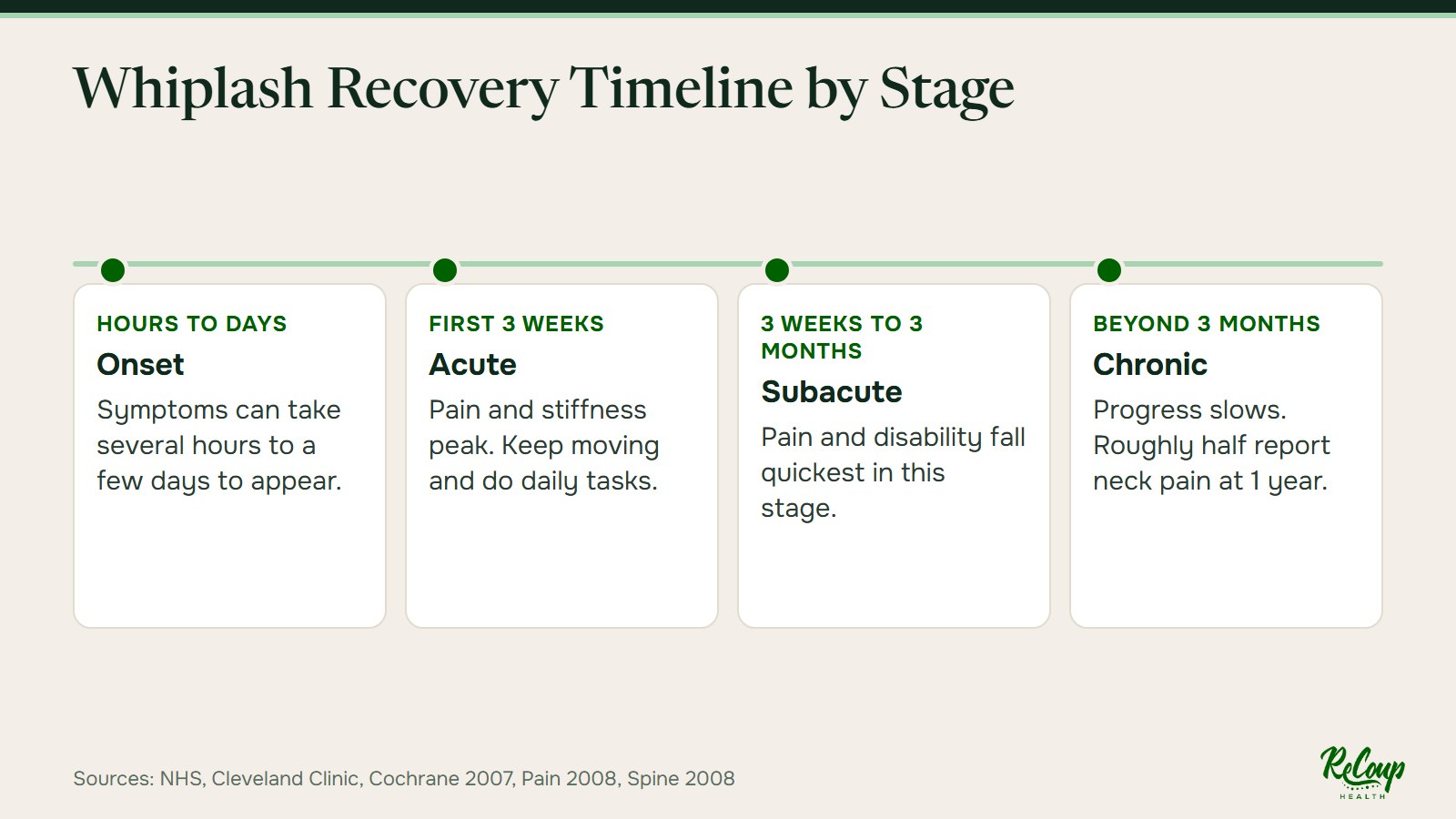
The timeline graphic above shows the three whiplash recovery stages and the 3-month checkpoint. Each stage moves at a different pace depending on how severe the injury is at the start.
How Long Does Mild Whiplash Last?
Mild whiplash lasts days to a few weeks for many people, according to Cleveland Clinic. A 2012 study in the Global Journal of Health Science followed 162 people with mild, Quebec Task Force grade I whiplash. These patients received “act as usual” advice. At six months, 5 people (3.1%) had intermittent pain and 3 reported ongoing disability.
That mild whiplash study came from a single German centre and had no control group. The result fits the wider pattern, but stronger injuries after a car crash can last much longer.
How Long Does Whiplash Last After Car Accident Injuries?
After a car accident, whiplash can last a year or more for roughly half of people (Spine, 2008). That finding comes from the Bone and Joint Decade Task Force. That task force reviewed 47 valid studies on whiplash-associated disorders. A Danish trial of 458 people backs up that long tail. At one year, 48% reported considerable neck pain, 53% reported disability and 14% were still on sick leave (Spine, 2007).
Long-lasting crash symptoms call for collision injury treatment that tracks progress at each stage. Researchers have also identified clear reasons why some people heal faster than others.
Why Does Whiplash Take Longer to Heal for Some People?
Whiplash takes longer to heal when early pain, symptoms and disability are high, per the Bone and Joint Decade Task Force. The same review linked these factors to slower or less complete recovery:
- Greater neck pain right after the injury
- A larger number of symptoms at the start
- Greater disability in daily tasks early on
- Passive coping, such as waiting for pain to pass without activity
- Depressed mood after the crash
- Fear of movement, also called kinesiophobia
Crash details, such as the type of collision, were mostly not prognostic in that task force review. Clinicians answer how long does whiplash take to heal for each person by checking these factors in the first weeks.
Insurance systems also shape the whiplash timeline. A 2000 study in the New England Journal of Medicine followed 7,462 whiplash claimants in Saskatchewan. Median claim closure fell from 433 days under a tort system to 194 and 203 days under no-fault. Claim closure is a stand-in for recovery, not a direct measure of healing.
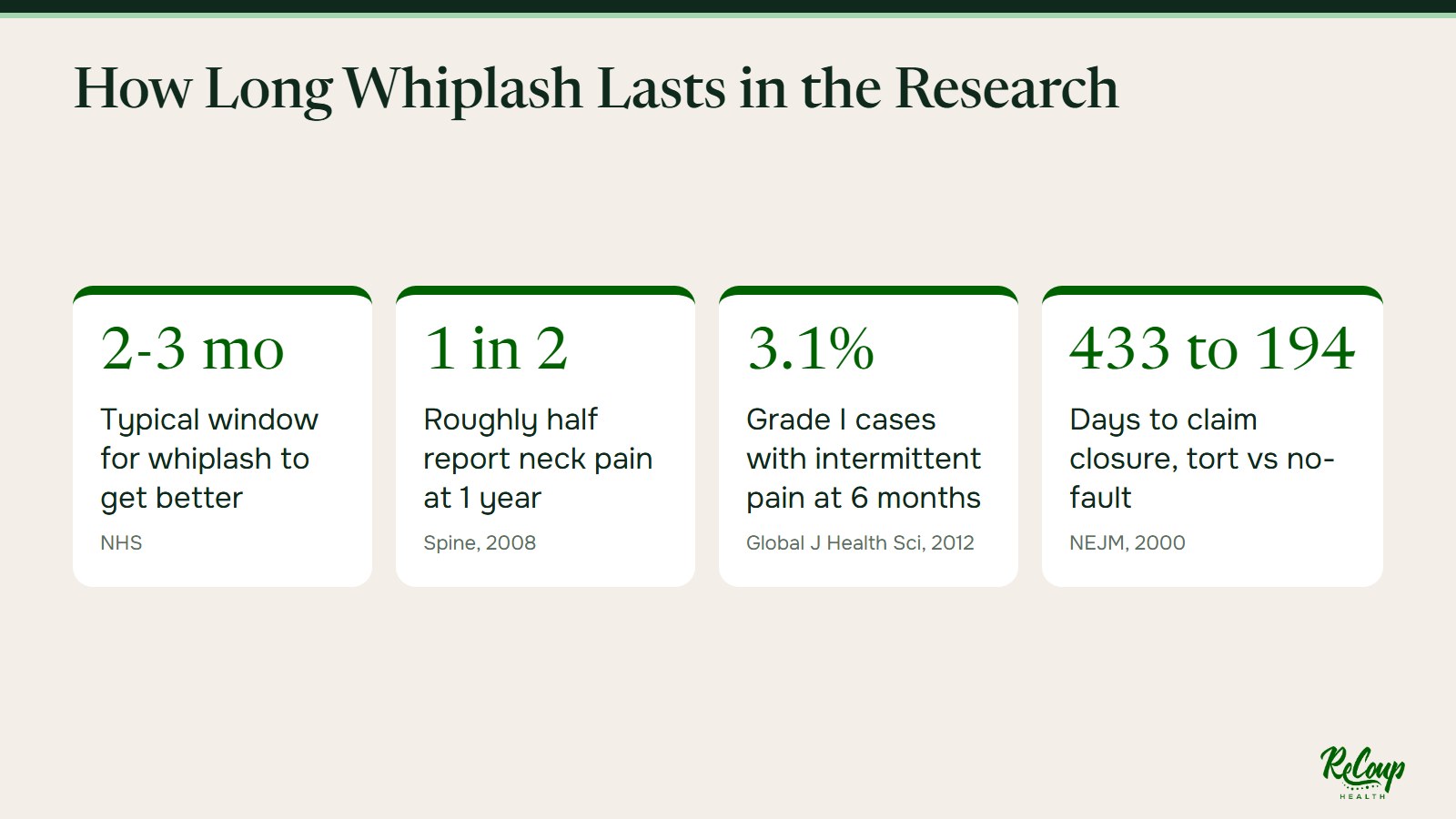
The stats graphic above sums up the key whiplash recovery numbers from these studies. Pain that stays past 3 months can need a chronic neck pain plan built on graded activity. Some symptoms, though, point to a serious injury rather than slow healing.
How Do I Know If My Whiplash Is Serious?
Whiplash is serious when it causes tingling, weakness, trouble walking or an electric-shock feeling, according to the NHS. The NHS also lists severe pain despite painkillers and pins and needles as urgent signs. Trouble sitting upright and weak hands, arms or legs need urgent assessment too. In Ontario, call 911 or go to the nearest emergency department for these signs.
A sudden, extremely painful headache after a crash also needs emergency care, per the NHS headache guidance. Any head injury in the last 3 months adds to that concern. A blow to the head can cause a concussion, which needs its own concussion rehab plan alongside neck care.
Whiplash that has not improved after 1 week deserves a visit to your family doctor or a walk-in clinic, the NHS advises. Once serious injury is ruled out, the focus shifts to healing whiplash as fast as safely possible.
What Is the Fastest Way to Heal Whiplash?
The fastest way to heal whiplash is to keep moving and continue everyday activities, which the NHS says speeds recovery. A 1986 trial in the BMJ tested this with 61 acute whiplash patients. Early active movement beat rest with a soft collar for neck motion and pain at 8 weeks.
Ontario guidance points the same way. The 2016 OPTIMa guideline, from an Ontario research group, covers neck pain lasting 3 months or less. That guideline suggests structured education with range-of-motion exercise, or multimodal care, which combines exercise, hands-on therapy and advice. Guided whiplash physiotherapy applies that model through gentle neck exercise and education.
Hands-on care can support that exercise plan once the neck tolerates gentle movement. The 2019 OPTIMa guideline warns against neck manipulation as the sole treatment for neck-related headaches. Joint mobility work through cervical chiropractic care fits within multimodal care instead. Exercise stays at the centre of the plan.
Soft tissue work is another piece of multimodal care. Tight shoulder and neck muscles can respond to neck massage therapy as part of an active plan. The evidence for any single treatment remains limited, which matters for how to heal whiplash quickly.
A 2007 Cochrane review of 23 studies and 2,344 participants found the evidence neither supports nor refutes passive or active treatments. Only 8 of those studies were high quality. That honest gap makes the list of what not to do after whiplash just as useful.
What Not to Do After Whiplash?
After whiplash, do not wear a neck collar or rest the neck for long periods, according to the NHS. The NHS states that a collar does not help. A 2021 meta-analysis in Musculoskeletal Science and Practice pooled 4 trials with 409 participants. All four trials favoured an active approach over soft-collar use for pain, though certainty was low.
Collar time made no clear difference in a 2006 trial of 70 grade II patients. Two days and 10 days of collar use gave similar pain scores at two months (Archives of Physical Medicine and Rehabilitation). The Danish trial of 458 people also found no difference between collar, act-as-usual advice and active mobilization.
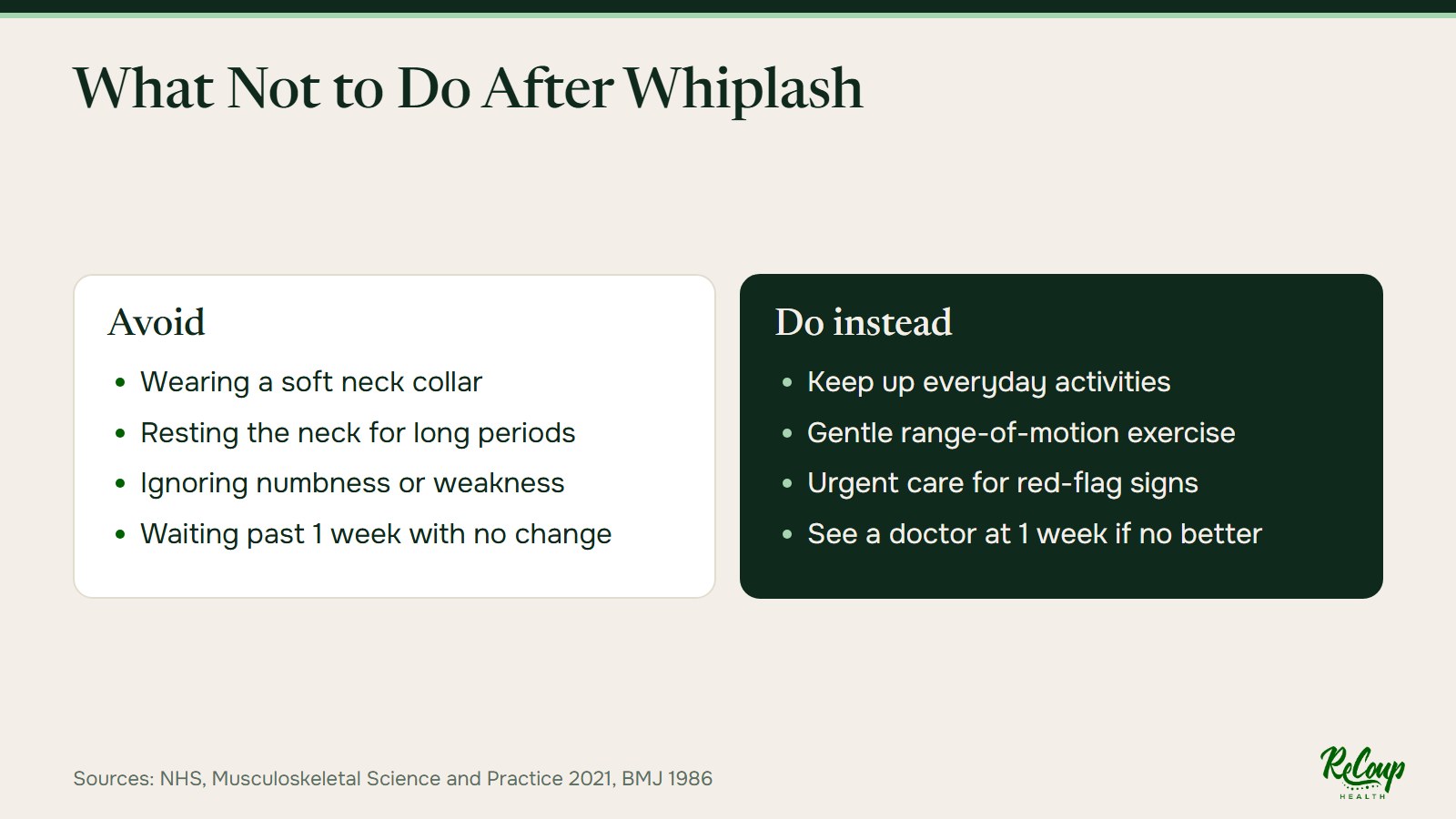
The comparison graphic above sets out what to avoid and what to do after whiplash. Staying active without a collar gives the neck a better chance to heal on its own timeline.
Can Your Neck Heal From Whiplash?
Yes, your neck can heal from whiplash, and the NHS says whiplash usually gets better within 2 to 3 months. Mild cases show strong results in the research. Only 3.1% of grade I patients reported intermittent pain at six months (Global Journal of Health Science, 2012).
Healing rates fall for stronger injuries. The Bone and Joint Decade Task Force found roughly half of people still report neck pain at 1 year. Definitions of recovery differ between studies, so that figure is a rough guide, not a fixed outcome. Talk to your physiotherapist or family doctor about your own healing timeline and related symptoms.
What Else Should You Know About Whiplash Recovery?
How Long Does a Whiplash Headache Last?
A whiplash headache has no single set duration in the studies we reviewed. The 2016 Bone and Joint Decade Task Force update recommends exercise for headaches linked to neck pain. Low-load neck exercise is part of post-whiplash headaches care. Jaw pain can join headaches after whiplash, which leads to a related symptom.
Jaw pain affected 18.9% of people after acute whiplash and 26.8% in the chronic stage (European Journal of Pain, 2025). Only 5.7% of people without whiplash had jaw pain. Jaw pain did not decrease from the acute to chronic stage. People who ask how long does a whiplash headache last should mention jaw pain at their assessment, along with any dizziness.
How Long Does Dizziness Last After Whiplash?
Dizziness after whiplash has no set timeline in the sources we checked. Cleveland Clinic lists dizziness and vertigo as whiplash symptoms. Severe cases can lead to long-term dizziness, per the same source.
The answer to how long does dizziness last after whiplash depends on its source, such as the neck or the inner ear. Balance problems from the inner ear can respond to vestibular rehab, a form of physiotherapy for dizziness. That care fits into a wider physiotherapy plan.
How Long Is Physical Therapy for Whiplash?
Physiotherapy for whiplash lasts as long as each recovery stage needs, not a fixed number of weeks. Ontario’s Minor Injury Guideline sets a three-stage treatment framework for grade I and II whiplash (Canadian Underwriter, 2010). The answer to how long is physical therapy for whiplash follows those stages, with progress reviewed at each one.
How to Sleep With Whiplash?
Sleep with whiplash on your back or side, using a pillow that keeps your neck level with your spine. Stomach sleeping twists the neck for hours. Sleep position does not change how long whiplash lasts by itself, but better rest makes daytime movement easier.
Can You Drive With Whiplash?
You can drive with whiplash once you can turn your head fully to check blind spots without sharp pain. Ask your pharmacist whether any pain medicine affects driving. Short trips first help build neck tolerance for longer drives.
Is Whiplash Dangerous?
Whiplash is rarely dangerous, and Cleveland Clinic says severe spinal injuries from it are extremely rare. Lasting pain and dizziness are the more common long-term problems. The red flags listed earlier still need urgent care.
Frequently Asked Questions About Whiplash Recovery Time
How Long Does It Take to Recover From Whiplash?
Recovery takes about 2 to 3 months for typical cases, per the NHS. People asking how long does it take to recover from whiplash should know the fastest gains come in the first 3 months.
How Long Does Whiplash Pain Last?
Whiplash pain eases within weeks for minor cases, according to Cleveland Clinic. The answer to how long does whiplash pain last is longer for severe cases. Roughly half report neck pain at 1 year (Spine, 2008).
How Long Can Whiplash Last?
Whiplash can last a year or longer for some people. How long can whiplash last depends on early pain, disability and mood, according to the Bone and Joint Decade Task Force.
How Recoup Health Helps With Whiplash Recovery
Recoup Health helps whiplash recovery with a team approach that matches care to each recovery stage. Our physiotherapists, chiropractor and registered massage therapists work together on one plan. Meet our whiplash clinicians to see who guides each stage of care.
Every plan starts with an assessment of pain, movement, headaches and dizziness. We screen for red flags and refer to your family doctor or the emergency department when needed. The aim is steady progress toward normal daily tasks within the typical 2 to 3 month window.
Our clinic serves Vaughan and nearby areas. Patients see Recoup Health’s practitioners without a doctor’s referral. Knowing how long does whiplash last for your own injury starts with that first visit.
A first visit sets the baseline for every later stage of care. Use our front desk to book a whiplash assessment at a time that suits you.