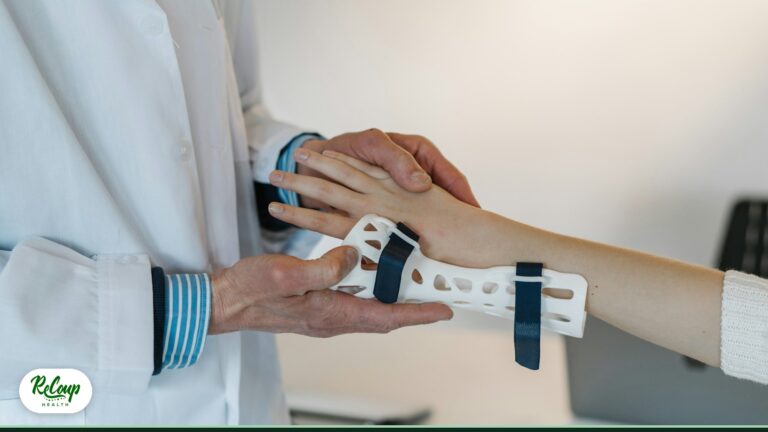

Yes, a brace for tennis elbow can ease pain during gripping, though the relief is small and short-term. A 2026 Scientific Reports trial of 56 people found a forearm strap improved pain-free grip right away. The strap lowers strain on the sore tendon but does not rebuild it. Physiotherapy exercise does that work, and AAOS OrthoInfo reports 80 to 95% success with nonsurgical care.
Key Takeaways
- A counterforce strap spreads gripping force away from the sore tendon at the outer elbow.
- A 2002 Cochrane review of five small trials could not confirm that braces work.
- Wear the strap during gripping tasks, snug without tingling, and take it off at rest.
- Physiotherapy builds tendon strength, with 94% success at one year in a 2006 BMJ trial.
- The NHS advises seeing a professional when pain lasts past 2 weeks of self-care.
How Does a Brace for Tennis Elbow Work
A brace for tennis elbow works by pressing on the upper forearm muscles so they pull less on the sore tendon. Tennis elbow, or lateral epicondylitis, is overuse damage where the forearm tendons attach to the outer elbow bone. The strap acts like a second anchor point that absorbs part of each grip. Covenant Health describes a brace centred over the back of the forearm as a way to rest the muscles and tendons.
Resting the tendon matters because every grip, twist and lift loads the same small attachment. The tendon involved is the extensor carpi radialis brevis (ECRB), a muscle that steadies the wrist. Lower load during daily tasks gives the irritated tendon calmer conditions. A brace is one tool, and our page on lateral elbow pain explains how we assess the whole problem. That whole problem starts with what overloads the tendon in the first place.
What Is the Root Cause of Tennis Elbow
The root cause of tennis elbow is repeated gripping and wrist extension that overloads the ECRB tendon faster than it repairs. Cleveland Clinic states that more than 9 in 10 people develop it for reasons other than tennis. Covenant Health names painters, plumbers, carpenters, cooks and butchers among higher-risk workers. Those trades share hours of forceful hand use, a pattern also seen in trade-related forearm strain.
Age adds to the risk of that strain. AAOS OrthoInfo reports that most people with tennis elbow are between 30 and 50. A 2006 American Journal of Epidemiology study of 4,783 adults aged 30 to 64 found a prevalence of 1.3%. Smoking, obesity and forceful repetitive work were linked to the condition in that study. Repeated load is the trigger a brace tries to soften, and research shows how well it does that.
Do Tennis Elbow Braces Actually Work
Tennis elbow braces actually work for short-term pain relief during activity, but proof of long-term healing is missing. A 2002 Cochrane review of orthotic devices found five small trials, with 7 to 49 people per group. The reviewers concluded that no definitive conclusions could be drawn about effectiveness. In one included trial, a corticosteroid injection beat an elbow band for short-term improvement.
Newer trials test the immediate effect of a brace. In a 2025 Pain Management pilot of 18 patients, pain during a pickup test averaged 63.2 mm without a brace. That pain fell to 53.9 mm with a counterforce brace and 38.9 mm with a dynamic orthosis, on a 100 mm scale. A 2026 Scientific Reports crossover trial of 56 people found a forearm strap improved pain-free grip and pain.
People asking do tennis elbow braces work get a clear pattern from these studies. Braces are good for tennis elbow as a comfort tool, not a standalone treatment. Neither newer study tracked results beyond the test session. A strap fits well as one part of broader outer elbow treatment that includes exercise. The statistics graphic below sums up these brace figures.
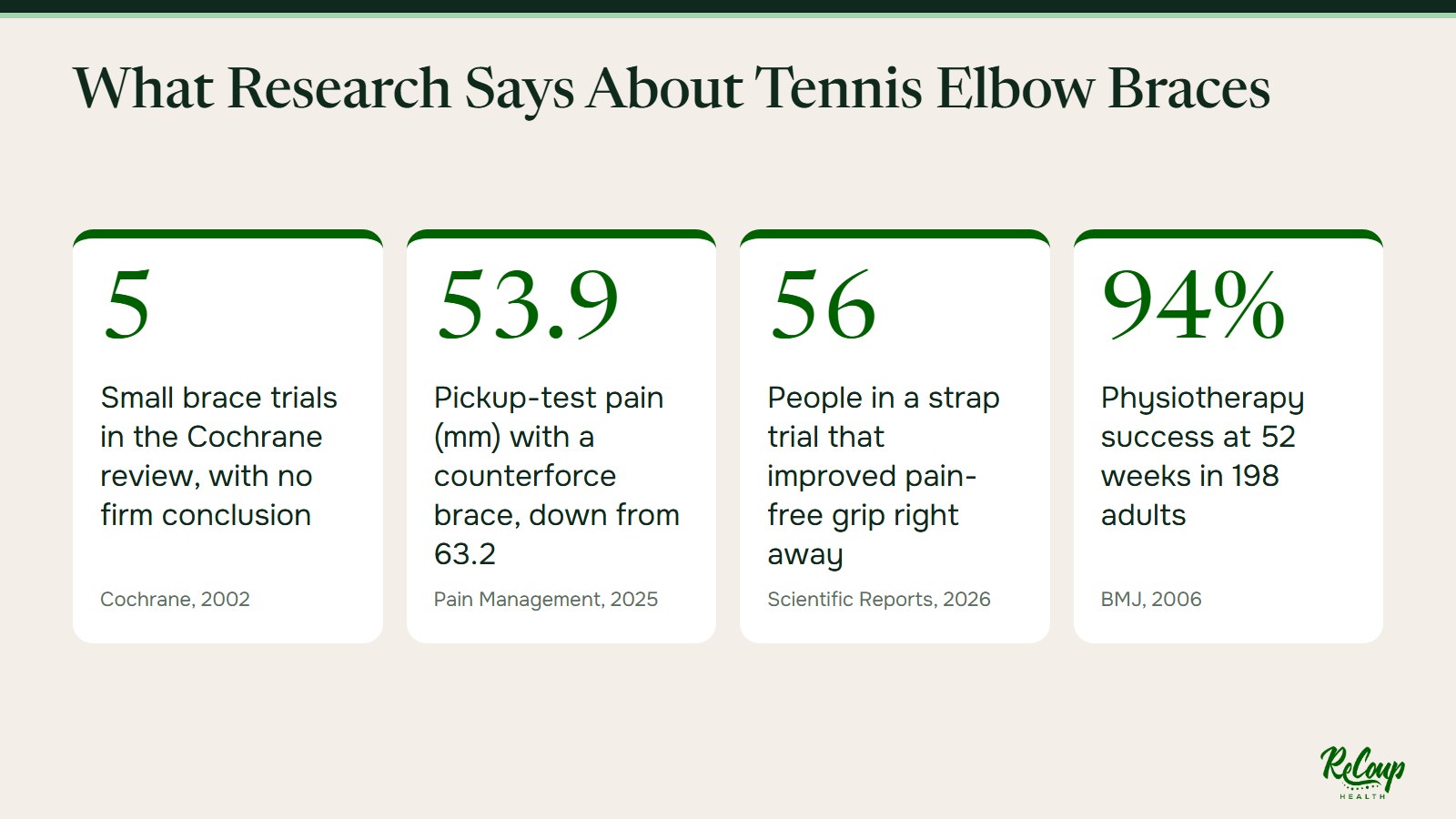
These figures show modest relief from a strap, and the size of that relief depends on the type of brace you choose.
Which Type of Brace Works for Tennis Elbow
Three types of brace work for tennis elbow: the counterforce strap, the compression sleeve and the wrist brace. A counterforce strap puts pressure right over the forearm muscles that feed the sore tendon. A sleeve spreads lighter pressure, and a wrist brace stops the motion that loads the tendon. The table below compares the three types, with the main difference first.
| Brace type | Main difference | Fits this use | Limits |
|---|---|---|---|
| Counterforce strap | Firm band or pad just below the elbow spreads grip force | Gripping, lifting, tool work and racquet sports | Tested for immediate relief in small trials only |
| Compression sleeve | Even, mild pressure over the whole elbow and forearm | Mild ache and light support during longer wear | Less focused pressure on the tendon |
| Wrist brace | Holds the wrist still so the extensor muscles rest | Flaring pain or wrist-heavy tasks | Blocks wrist motion needed for daily tasks |
The table shows that each brace type trades focus of pressure against comfort and freedom of movement. The cards graphic below gives a quick look at each type.
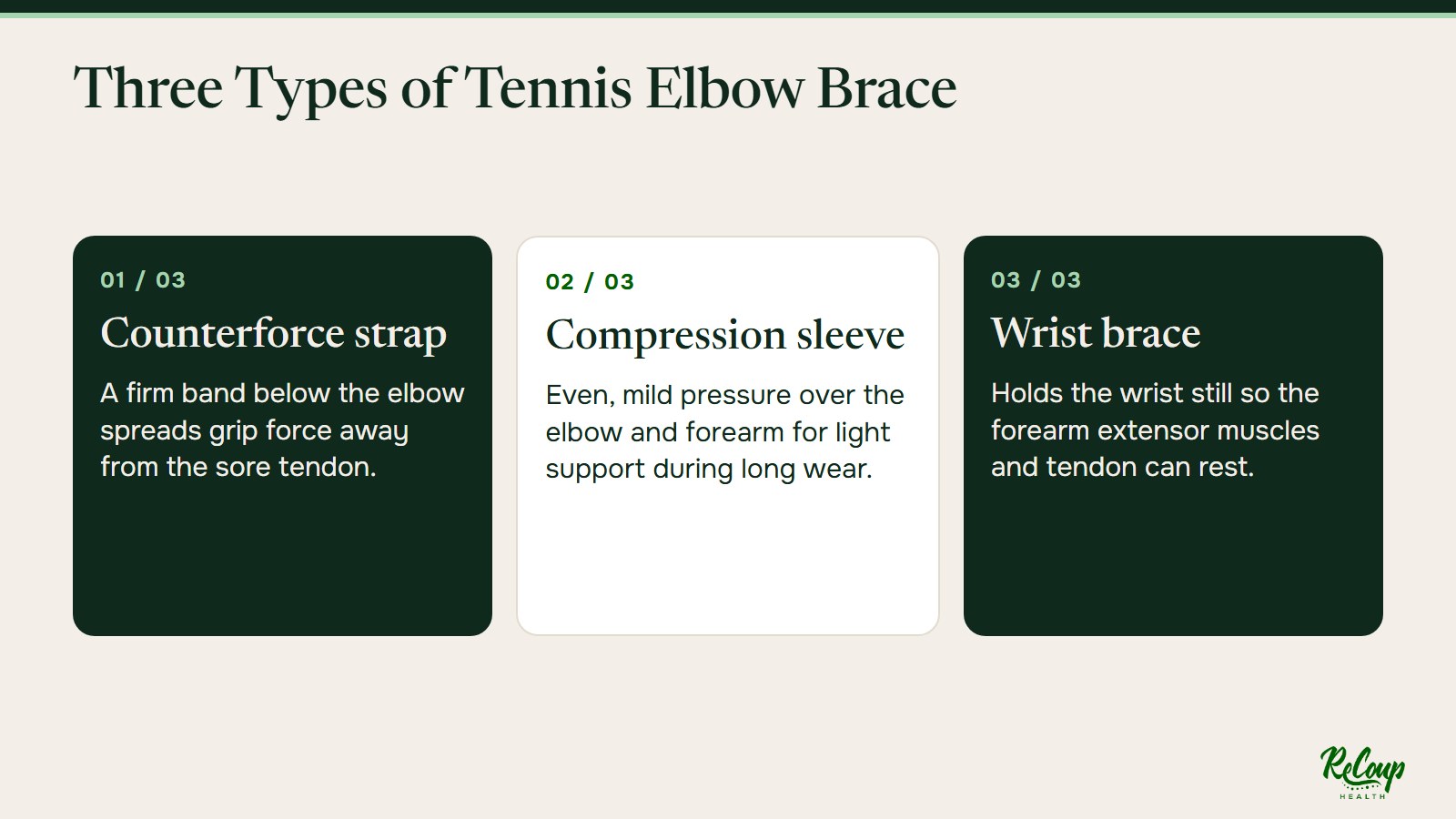
A wrist brace for tennis elbow can seem odd, since the pain sits at the elbow. The wrist extensor muscles start at the outer elbow, so holding the wrist still also rests the tendon. Pain that centres in the wrist itself may point to a separate need for wrist pain rehab.
A compression brace for tennis elbow suits people who want light support during long shifts. An elbow brace for tennis elbow with a gel pad sits between a strap and a sleeve in focus. The answer to what type of brace for tennis elbow fits you depends on your daily tasks. Whichever type you pick, fit decides how much the brace helps.
How Do You Wear a Tennis Elbow Strap Correctly
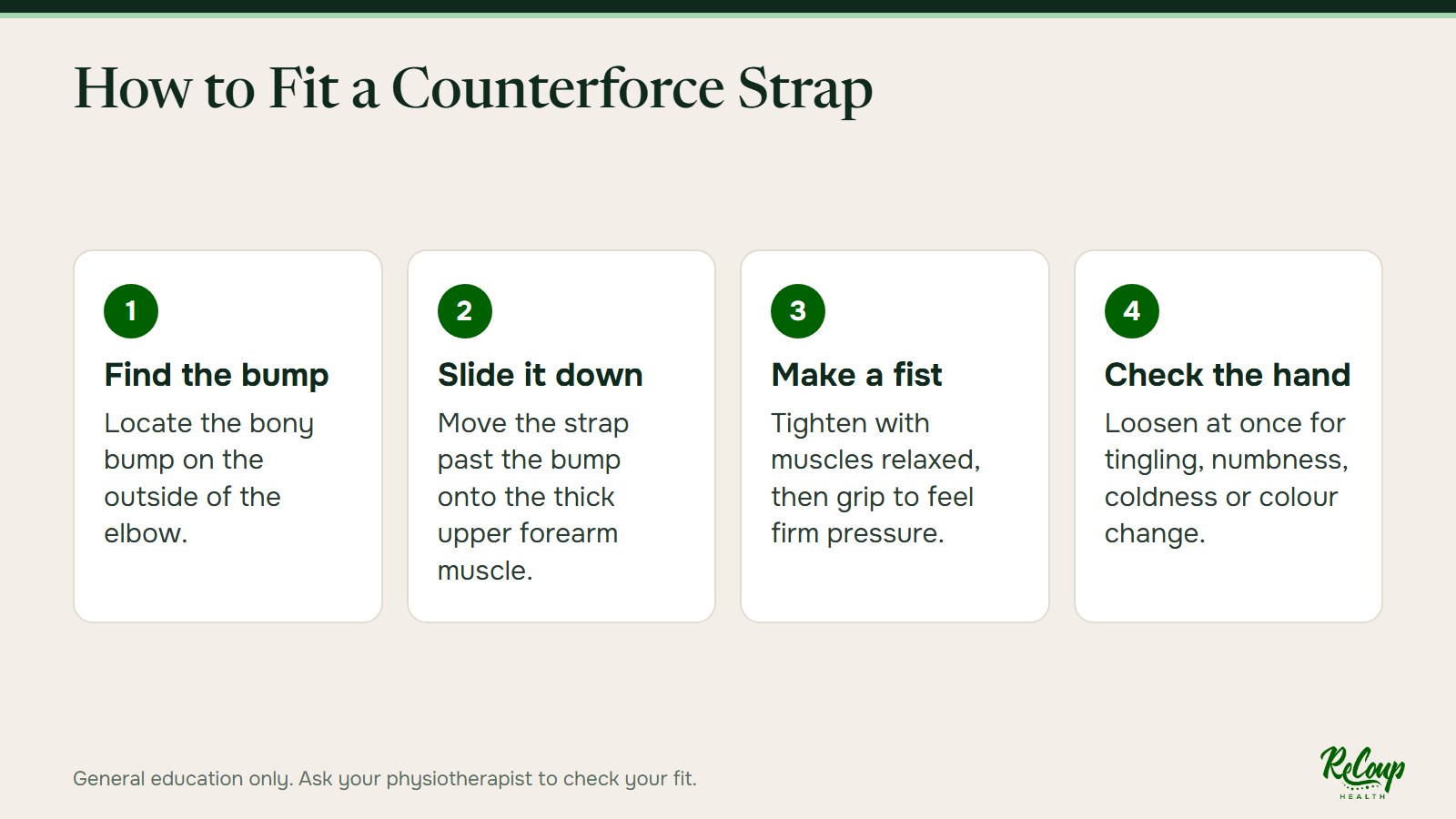
Wear a tennis elbow strap correctly by placing it on the upper forearm, just below the bony bump of the outer elbow. Follow these six steps for a counterforce strap:
- Find the bony bump on the outer elbow, called the lateral epicondyle.
- Slide the strap down past the bump onto the thick muscle of the upper forearm.
- Turn the pad, on straps that have one, so it sits over the tender muscle area.
- Tighten the strap while your forearm muscles are relaxed.
- Make a fist and feel the strap press firmly as the muscles tighten.
- Check your hand for tingling, numbness, coldness or colour change, and loosen the strap at once.
The steps graphic below shows the same fit check in four moves.
People ask how tight should a tennis elbow brace be, and the answer is firm but comfortable. The strap should press firmly when you grip, with no tingling or numbness in the hand. A strap sitting on the bony bump itself presses on the sore attachment. Correct placement over muscle rather than bone keeps the pressure where it helps, during the hours you need it.
When Should You Wear a Tennis Elbow Strap
Wear a tennis elbow strap during the tasks that trigger pain, such as gripping tools, carrying bags or playing racquet sports. Activity-only wear gives the strap force to spread and gives the skin time to recover. Take the strap off at rest, because relaxed muscles create no grip force to redirect.
Sleep is a time for removing the counterforce strap as well. A wrist splint at night is a separate tool that a physiotherapist or family doctor may suggest for a severe flare. A strap lowers load during daily tasks, but only exercise raises how much load the tendon can handle.
Why Pair a Brace With Physical Therapy for Tennis Elbow
Pair a brace with physical therapy for tennis elbow because the brace lowers load. Exercise then builds the tendon’s capacity to carry that load. In a 2006 BMJ trial of 198 adults, physiotherapy reached 65% success at 6 weeks, versus 27% with wait and see. At 52 weeks, physiotherapy success reached 94% in that trial. Physiotherapy there meant elbow manipulation plus exercise over eight sessions, much like a structured physiotherapy treatment plan.
Exercise loading sits at the core of that plan. A 2010 Journal of Shoulder and Elbow Surgery trial of 21 patients added an eccentric wrist exercise called the Tyler twist. Eccentric means the muscle works while it lengthens, as in slowly lowering a weight. Pain dropped 81% with the added exercise, versus 22% with standard care alone.
The exercise evidence has limits. A 2024 Cochrane review of 23 trials and 1,612 people rated gains from exercise and manual therapy as small and not sustained. Wait-and-see patients in the BMJ trial also reached 90% success by one year. A physiotherapist uses the brace to keep pain low enough for daily loading, then weans it as strength returns.
Players heading back to tennis, squash or pickleball need grip and stroke work on top of that base. Stroke mechanics and racquet grip size are part of racquet sport rehab. Steady loading of this kind is also the honest answer to the search for a fast fix.
What Is the Fastest Way to Heal Tennis Elbow
The fastest way to heal tennis elbow is steady, graded loading with brace support, not a quick injection. A corticosteroid injection gave 78% success at 6 weeks in the 2006 BMJ trial. That same injection group had 72% recurrence, versus 8% with physiotherapy. Quick relief from an injection can come at the cost of lasting recovery.
A 2013 JAMA trial of 165 adults found 83% recovery at one year with a corticosteroid injection. The placebo injection group reached 96%. Recurrence reached 54% with the corticosteroid, versus 12% with placebo. Talk to your family doctor about these trade-offs before choosing an injection. Daily arm position also shapes how fast the tendon settles.
Is It Better to Keep Tennis Elbow Straight or Bent
Keeping tennis elbow slightly bent during lifting is gentler than locking it straight. Covenant Health explains that the ECRB muscle steadies the wrist when the elbow is straight, as in a tennis groundstroke. A straight arm with a palm-down grip therefore loads that tendon hard. Lift with elbows bent, close to the body and with the palm facing up when possible. At rest, a relaxed position with the forearm supported on a pillow or armrest takes load off the tendon.
Arm position is one of several daily habits worth changing.
What Not to Do With Tennis Elbow
Avoid these five habits, which keep tennis elbow irritated:
- Gripping tools, bags or a computer mouse hard for long stretches without breaks.
- Lifting heavy loads with a straight arm and the palm facing down.
- Wearing a strap so tight that the hand tingles or changes colour.
- Stopping all arm use for weeks, since trials show graded exercise helps recovery.
- Using a brace to push through sharp pain during sport.
Knowing what not to do with tennis elbow protects the progress that bracing and exercise build. Small changes to grip and lifting habits reduce daily tendon load. Several side questions about recovery come up once these basics are in place.
What Else Should You Know About Tennis Elbow Recovery
Tennis elbow recovery raises side questions about timing, look-alike conditions and other hands-on care. The short answers below cover each one.
Will Tennis Elbow Go Away by Itself
Tennis elbow can go away by itself, and the NHS says it usually improves with rest. The NHS adds that it can last over a year. In the 2006 BMJ trial, 90% of wait-and-see patients reported success at 52 weeks. Time alone helps, but that recovery is slow. Wait-and-see success was only 27% at 6 weeks in the same trial.
Do You Ever Fully Recover From Tennis Elbow
You can fully recover from tennis elbow, and Cleveland Clinic puts typical recovery at around 6 months. Some people need longer, up to 18 months, according to the same source. The 2022 JOSPT clinical practice guideline notes that tennis elbow often recurs and causes lengthy time off work. Recurrence stayed at 8% with physiotherapy in the 2006 BMJ trial.
What Could Be Mistaken for Tennis Elbow
Four conditions could be mistaken for tennis elbow: golfer’s elbow, carpal tunnel syndrome, elbow arthritis and a pinched nerve in the neck. The Canadian Chiropractic Association places golfer’s elbow pain near the bump on the inner side of the elbow. That pattern of medial elbow pain involves the wrist flexor muscles instead of the extensors.
Covenant Health notes that X-rays can rule out arthritis, and an MRI can check the neck for a herniated disc. An exam is the way to tell tennis elbow or arthritis apart. Covenant Health adds that an electromyography (EMG) nerve test can rule out nerve compression. Numbness in the thumb and fingers points more to carpal tunnel symptoms than to tendon pain.
Can Massage or Chiropractic Care Help Tennis Elbow
Massage and chiropractic care can help tennis elbow as part of a plan built around exercise. The NHS lists massage, stretching and strengthening as parts of physiotherapy for this condition. The 2024 Cochrane review rated manual therapy evidence as low certainty, with small, short-lived gains. Hands-on care works as a support to loading, not a replacement.
Massage for tennis elbow eases tight forearm muscles before exercise sessions. Our registered massage therapists offer extensor muscle massage that targets the wrist extensors.
Chiropractic care adds another hands-on option for a sore outer elbow. Our chiropractor uses joint mobilization, acupuncture and cupping alongside home exercise. Each visit with this kind of chiropractic forearm treatment also reviews your strap fit and daily grip habits.
When Should You See a Professional for Elbow Pain
See a professional for elbow pain that persists after 2 weeks of rest and self-care, the NHS advises. The NHS also suggests physiotherapy when 6 weeks of home treatment bring no improvement. Cleveland Clinic advises care for trouble moving the arm, swelling, discolouration or pain that disturbs sleep. Seek urgent care for a sudden pop, major swelling, deformity or numbness after a fall.
When Is Surgery Considered for Tennis Elbow
Surgery is considered for tennis elbow after 6 to 12 months of nonsurgical treatment fails, according to AAOS OrthoInfo. Cleveland Clinic states that it is very rare to need surgery. AAOS reports that surgery succeeds in 80 to 90% of patients, with return to sport at 4 to 6 months. Rehab after the operation restores range and grip strength. We guide that stage through post-surgery elbow rehab.
Frequently Asked Questions About Tennis Elbow Braces
Should You Wear a Tennis Elbow Brace All Day
No, a tennis elbow brace belongs on the arm during tasks that trigger pain, not all day. Remove it at rest and before sleep so the skin and circulation recover.
Can a Tennis Elbow Brace Make Pain Worse
Yes, a tennis elbow brace can make pain worse when it sits too tight or directly on the bony bump. Tingling, numbness or colour change in the hand means the strap needs loosening at once.
Can You Work With Tennis Elbow
Yes, many people keep working with tennis elbow by changing grip, taking breaks and wearing a strap for heavy tasks. The 2022 JOSPT guideline notes the condition can cause lengthy time off work, so early care matters.
How Recoup Health Helps With Tennis Elbow Bracing and Rehab
Recoup Health helps with tennis elbow by combining brace advice with an exercise-based rehab plan. Our physiotherapists check where your pain starts, test grip strength and show you how to fit and wean a counterforce strap. The physiotherapists, massage therapists and chiropractor on our multidisciplinary team share one plan for your elbow.
We pair that brace advice with graded loading, massage and chiropractic care where each fits your goals. No doctor’s referral is needed to book a tennis elbow evaluation. Bring any strap you already own, and we will check whether a brace for tennis elbow suits your daily tasks.
Patients from Vaughan and nearby communities visit us on Innovation Drive. Each plan from our Recoup Health staff starts with a hands-on exam. A brace eases the load today, and steady exercise builds an elbow that handles that load tomorrow.