

Exercises for shoulder pain pair gentle stretches with light band strengthening, done at least 4 days a week. The British Elbow and Shoulder Society (BESS) says a sore shoulder should start to feel better within 6 to 12 weeks. A home plan starts with pendulum swings and a cross-body stretch. Band rotations, rows and wall push-ups follow as pain settles.
Key Takeaways
- Start each session with a 5 to 10 minute warm-up, then stretch, strengthen and stretch again.
- Hold each shoulder stretch for 30 seconds at a gentle pull, not at pain.
- Exercise pain is acceptable when it settles within 30 minutes and is not worse the next day.
- Nonsurgical care relieves pain in about 80 to 85% of people with rotator cuff tears, per AAOS OrthoInfo.
- Sudden severe pain, a deformed shoulder or lasting numbness needs urgent care, not home exercise.
Which Exercises for Shoulder Pain Should You Start With
The exercises for shoulder pain to start with are gentle range-of-motion moves such as pendulum swings and cross-body stretches. The American Academy of Orthopaedic Surgeons (AAOS) OrthoInfo conditioning program opens with pendulum swings at 2 sets of 10. Gentle movement keeps the joint moving while sore tissue settles.
Shoulder pain is common enough that a clear starting plan matters. A 2022 systematic review in BMC Musculoskeletal Disorders found a median community prevalence of 16%. New shoulder pain cases reached a median of 37.8 per 1,000 people each year in that review.
Rotator cuff disease accounts for up to 70% of shoulder complaints, according to a 2026 review in JSES Reviews, Reports, and Techniques. The rotator cuff is a group of 4 small muscles that hold the ball of the arm in its socket. A clear diagnosis guides which moves to choose, and our shoulder pain rehab page explains how that assessment works.
The routine below shows the order of one session, from warm-up to the closing stretch.
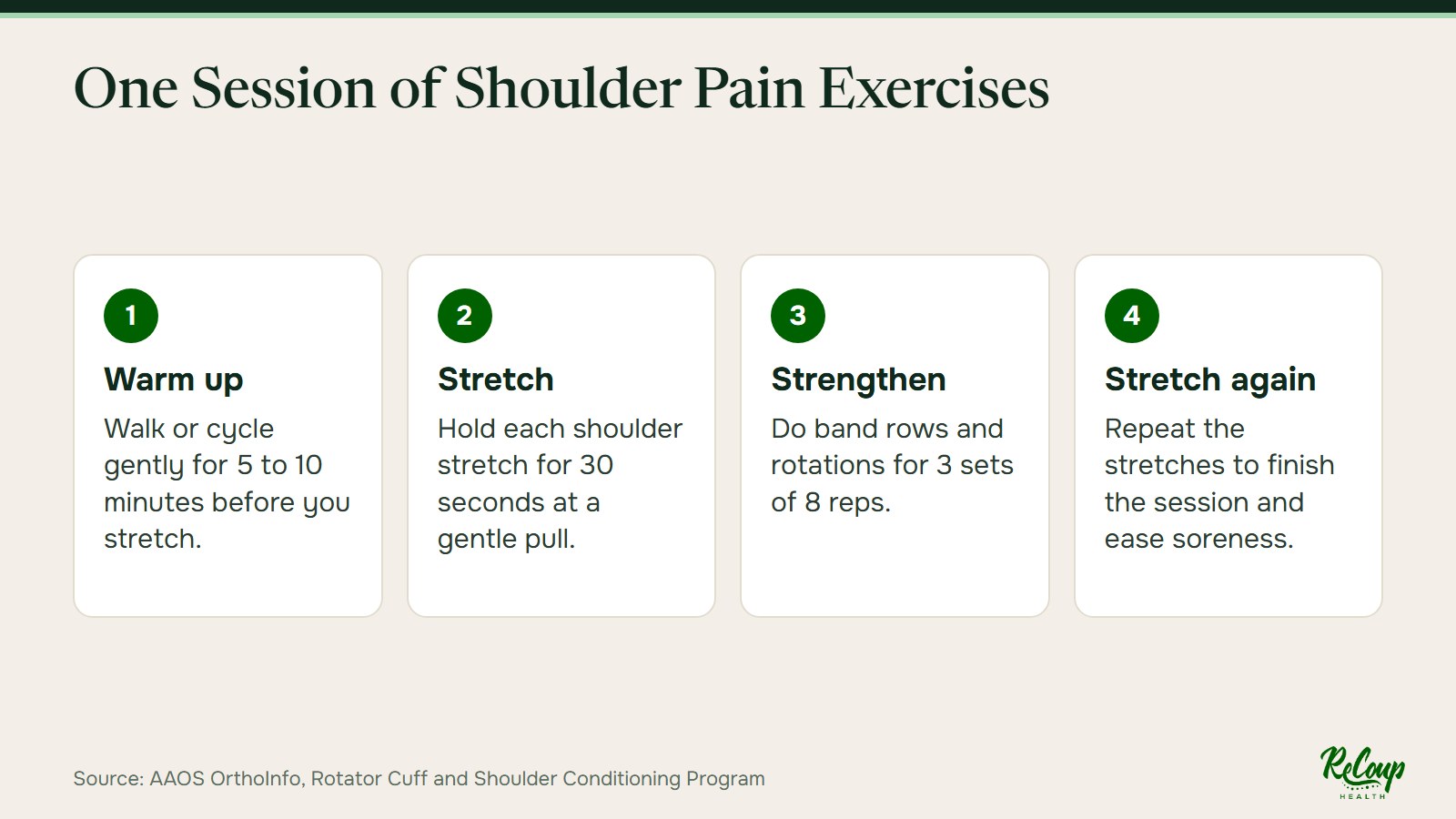
Each step in the routine builds on the one before, so the stretching phase comes next.
How to Do Stretches for Shoulder Pain Safely
Do stretches for shoulder pain slowly and hold each one for 30 seconds at a gentle pull. AAOS OrthoInfo advises holding the crossover stretch for 30 seconds, then relaxing for 30 seconds. The same program asks for a 5 to 10 minute warm-up first, such as walking or a stationary bike.
The following 5 stretches cover the front, back and top of the shoulder:
- Pendulum swing: lean on a table, let the sore arm hang, and swing it in small circles for 2 sets of 10.
- Cross-body stretch: pull one arm across your chest by the upper arm, not the elbow, and hold 30 seconds.
- Doorway chest stretch: rest your forearms on a door frame at 90 degrees, step forward, and hold 30 seconds.
- Sleeper stretch: lie on the sore side with the elbow bent, then press the forearm down gently with the other hand.
- Towel stretch: hold a towel behind your back and pull the lower hand upward with the top hand.
Shoulder stretches feel stiff for the first week, and the stiffness eases as the joint warms up. Tight chest and upper back muscles respond well to shoulder mobility stretching, where a therapist moves the arm through its range. Stretching restores range, while strength keeps the joint stable once range returns.
Which Shoulder Strengthening Exercises for Pain Work at Home
The shoulder strengthening exercises for pain that work at home are band external rotation, band rows, wall push-ups and wall slides. AAOS OrthoInfo states that strengthening the muscles that support the shoulder can relieve pain and prevent further injury. These 4 moves need only a resistance band and a wall.
The table below lists starting doses from BESS and AAOS OrthoInfo, plus how to progress each exercise.
| Exercise | Main muscles | Starting dose | How to progress |
|---|---|---|---|
| Band external rotation | Infraspinatus, teres minor | 3 sets of 8 | Build to 3 sets of 12, then a firmer band |
| Band standing row | Middle and lower trapezius | 3 sets of 8 | Build to 3 sets of 12 |
| Wall push-up | Chest, serratus, front shoulder | 3 sets of 8, 1 minute rest | Step the feet farther from the wall |
| Wall slide | Rotator cuff, upper back | 3 sets of 8, 1 minute rest | Lift the hands off the wall, add a light weight |
| Supported shoulder rotation | Rotator cuff | No weight | Add a 500 g weight or a 500 mL water bottle |
The table shows that each exercise starts light and grows by reps first, then load. Band exercises for shoulder pain suit early rehab because a band lets you control resistance in small steps. Some people need help to pick a safe load, and guided physiotherapy covers form and progression. Load should rise only while pain stays in an acceptable range.
How Much Pain Is Okay During Shoulder Exercises
A pain increase is okay when it settles within 30 minutes and is not worse the next day, according to BESS. AAOS OrthoInfo takes a stricter line and advises no pain during each exercise. Both sources agree that sharp or lingering pain means the load is too high.
BESS advises doing fewer repetitions next time, then building up again, whenever pain lingers. Stop the session and talk to your physiotherapist when any of these signs appear:
- Sharp or catching pain at one point in the movement.
- Pain that stays higher the morning after exercise.
- Pins and needles or numbness in the arm or hand.
- Night pain that grows worse week by week.
The numbers that guide a safe week of exercise are shown below.
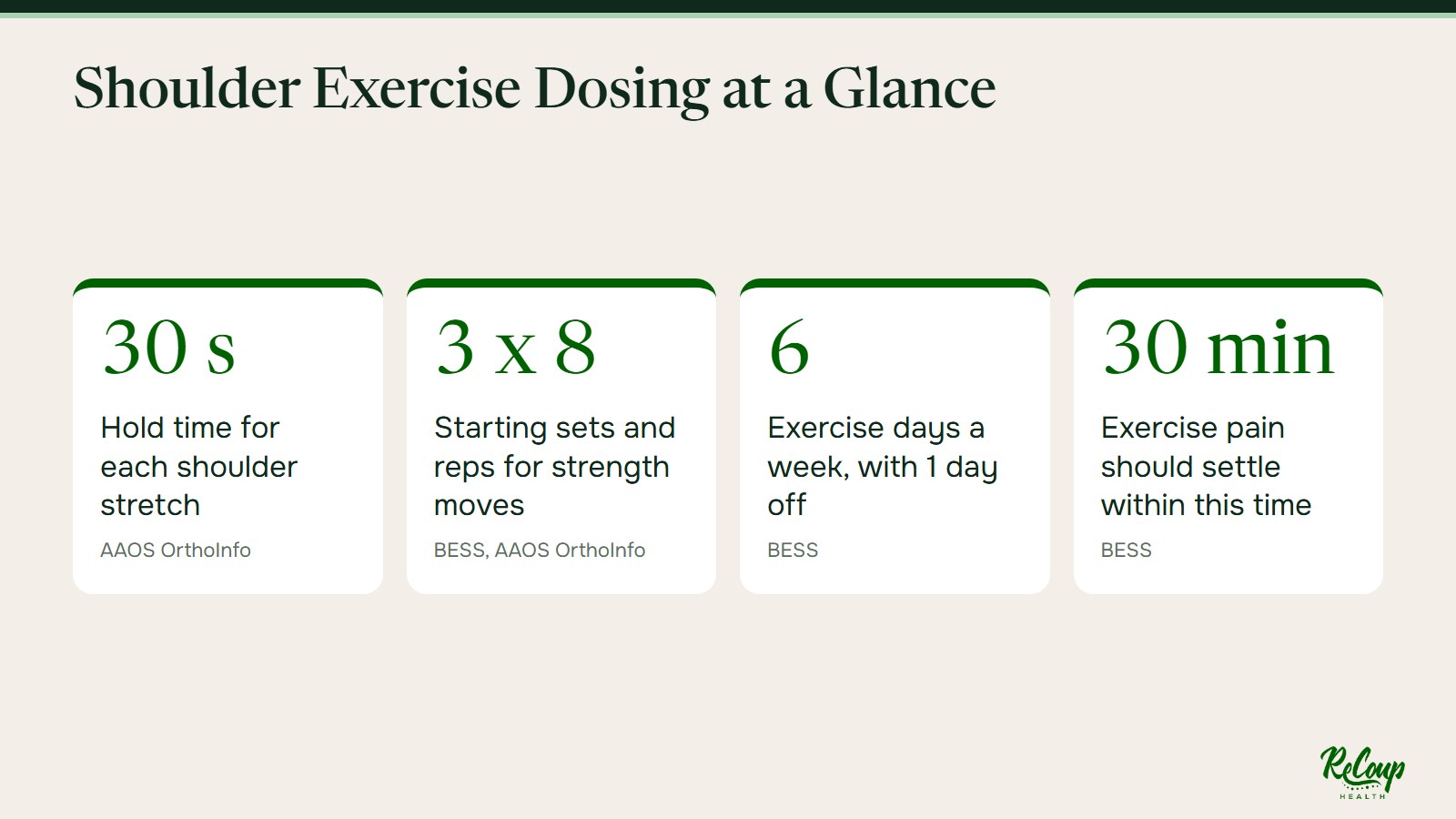
Pain rules keep training safe, and the next question is whether that training clears the pain.
Can Shoulder Pain Go Away With Exercise
Yes, shoulder pain can go away with exercise for many common problems, such as rotator cuff irritation. AAOS OrthoInfo reports that nonsurgical treatment relieves pain and improves function in about 80 to 85% of people with rotator cuff tears. Shoulder exercises should continue for 6 to 8 weeks to keep pain from coming back, the NHS advises.
Exercise compares well with injections in research. A 2016 Cochrane review found no important differences between manual therapy plus exercise and steroid injection from 4 weeks to 12 months. A 2026 review of 22 studies and 1,137 patients found physical therapy beat injection therapy for partial rotator cuff tears.
The evidence has honest limits. The Cochrane review covered 60 trials, but only 1 high-quality trial of 120 people tested exercise against placebo. In that trial, 31% of the exercise group had mild short-term pain, compared with 8% on placebo. Exercise pays off as a steady habit, so the timeline matters.
How Long Do Shoulder Exercises Take to Work
Shoulder exercises take 6 to 12 weeks to bring clear relief, according to BESS. The NHS notes that pain needs about 2 weeks of self-care before it starts to ease. Full recovery from shoulder pain can take 6 months or longer, per the NHS.
The timeline below shows each stage of a typical home exercise plan.
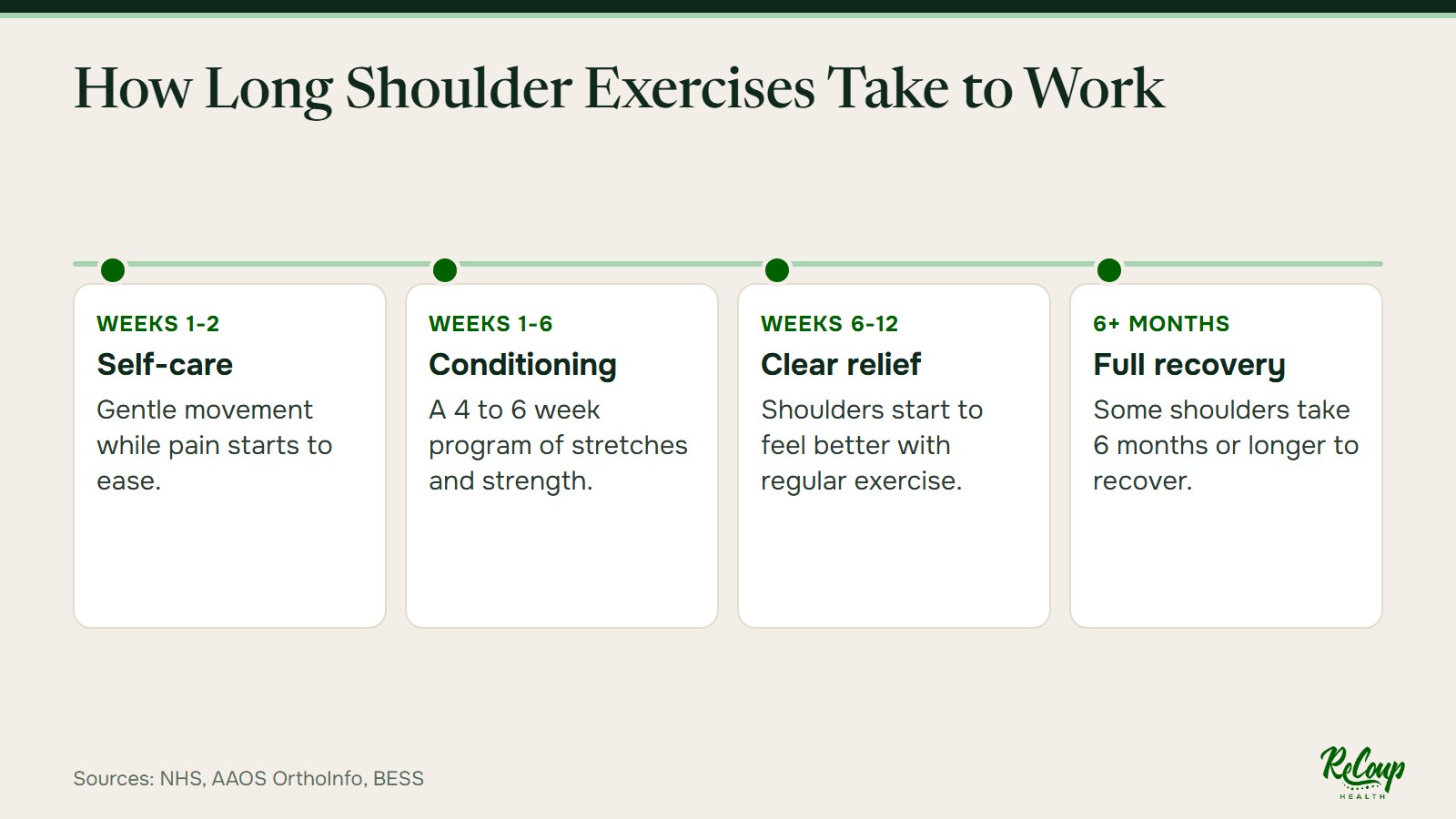
AAOS OrthoInfo suggests 2 to 3 sessions a week after recovery to maintain strength and range. Steady progress also depends on knowing which moves to skip.
What Should You Not Do With Shoulder Pain
With shoulder pain, do not lift heavy loads overhead or push through sharp pain. Heavy overhead work squeezes irritated tendons at the top of the joint. The following gym moves load the shoulder at the end of its range and are worth pausing:
- Behind-the-neck presses and pulldowns.
- Upright rows with a narrow grip.
- Heavy overhead presses and snatches.
- Bench dips and deep chest flyes.
Complete rest is also a mistake, because a still shoulder stiffens. Swap the paused lifts for the band and wall exercises above, then reload under guidance. Paused lifts return faster once you know whether the pain comes from muscle or tendon.
How Can You Tell If Shoulder Pain Is Muscle or Rotator Cuff
Muscle pain is a broad ache that eases as you move. Rotator cuff pain sits at the front or side of the shoulder. Rotator cuff pain flares when you lift the arm sideways or reach behind your back. AAOS OrthoInfo notes that people over 40 face a greater risk of rotator cuff tears.
The table below compares common signs, with the main difference first.
| Sign | Muscle strain or tension | Rotator cuff problem |
|---|---|---|
| Pain lifting the arm | Mild, spread out | Sharp arc of pain between shoulder and head height |
| Location | Top of shoulder, neck, upper back | Front or outer upper arm |
| Night pain | Rare | Common when lying on the sore side |
| Weakness | Little or none | Weak when raising or turning the arm out |
Signs overlap, so the table guides questions rather than giving a diagnosis. Tight, overworked muscle may respond to treatment for shoulder muscle strains, which pairs hands-on care with exercise. Weakness that lasts more than 2 weeks deserves a hands-on assessment of the shoulder and neck.
Persistent weakness points to the tendon, and a physiotherapist can test each cuff muscle in one visit. Our shoulder injury care starts with those strength and movement tests. The tests then shape the exercise plan, along with a few side questions worth answering.
What Else Should You Know About Shoulder Pain Exercises and Stretches
Is It Better to Rest or Exercise a Sore Shoulder
Exercise is better than full rest for a sore shoulder once the first severe pain eases. The NHS advises about 2 weeks of self-care, with gentle movement, before pain starts to settle. You can still exercise with shoulder pain by lowering the load and skipping painful ranges.
Should You Do Neck Stretches for Shoulder Pain
Yes, neck stretches for shoulder pain help when tight neck muscles pull on the top of the shoulder. The NHS says it is better to keep your neck moving and advises against a neck collar. Try an upper trapezius stretch by tilting your ear to the opposite shoulder for 30 seconds.
Chin tucks and shoulder blade squeezes also relieve tension that spreads between the shoulder blades. Stiffness in that area can link to upper back stiffness, which responds to the same posture drills.
Which Exercises Help Shoulder Arthritis Pain
Exercises for shoulder arthritis pain focus on gentle range of motion, such as table slides, arm raises and pendulum swings. Arthritis UK recommends checking posture first by sliding the shoulders gently up and back. Worn joints tolerate light, frequent movement better than heavy loads, and shoulder osteoarthritis care follows that approach.
What Exercises Help Shoulder Pain From Computer Use
Shoulder pain from computer use eases with chin tucks, shoulder blade squeezes and doorway chest stretches. These moves reverse the rounded posture of long screen sessions. Short movement breaks each hour help, and a workstation set-up at eye level reduces strain. Repeated desk strain can count among desk work injuries when symptoms persist.
Why Do You Get Shoulder Pain After Exercise
Shoulder pain after exercise comes from a sudden jump in load, poor form or too little recovery between sessions. Soreness that fades within 30 minutes fits the BESS rule for safe exercise pain. Pain that lasts into the next day signals overload, and athletes may need sports physiotherapy to adjust technique.
Do Stretches Help Frozen Shoulder
Stretches help frozen shoulder, a stiff and painful joint, once the sharpest pain eases. AAOS OrthoInfo reports that frozen shoulder most commonly affects people aged 40 to 60. The NHS states that physiotherapy for frozen shoulder lasts at least 6 weeks.
When Is Shoulder Pain an Emergency
Shoulder pain is an emergency when the NHS red flags appear, so go to the emergency department or a walk-in clinic for:
- Sudden or very bad pain after a fall or injury.
- An arm you cannot move, or a shoulder that has changed shape.
- Pins and needles or numbness that does not go away.
- An arm that is hot or cold to touch, or fever with shoulder pain.
Who Should Guide Your Shoulder Exercise Plan
A physiotherapist should guide your shoulder exercise plan when pain lasts beyond 2 weeks or limits daily tasks. Physiotherapy exercises for shoulder pain start from a strength and movement test, not a generic list. A family doctor or pharmacist can also advise on pain relief. Each of our shoulder clinicians builds plans around those test results.
Frequently Asked Questions About Shoulder Pain Exercises
What Is the Fastest Way to Ease Shoulder Pain
The fastest way to ease shoulder pain is to cut painful tasks, use a cold or heat pack, and keep moving gently. Gentle pendulum swings and short walks keep blood flowing without stressing the tendon. Shoulder pain relief exercises then rebuild strength over the following weeks.
Which Sleeping Position Helps Shoulder Pain
Sleeping on your back or on the pain-free side helps shoulder pain. Hug a pillow in front of your chest to support the sore arm. Avoid lying directly on the painful shoulder, which compresses irritated tendons.
Are Home Exercises for Shoulder Pain Safe for Seniors
Home exercises for shoulder pain are safe for seniors when they start seated and use light bands. Table slides, supported rotations and wall push-ups suit older adults with balance concerns. Talk to your family doctor before starting a new exercise plan with heart or bone conditions.
What Exercises Are Good for Shoulder Pain at Night
What exercises are good for shoulder pain at night depends on the cause. Pendulum swings and cross-body stretches before bed ease stiffness. Night pain that keeps waking you up for more than 2 weeks needs an assessment.
How Recoup Health Helps You Exercise a Painful Shoulder
We help you exercise a painful shoulder by testing strength, range and neck movement, then building a plan that progresses each week. Our physiotherapists, registered massage therapists and chiropractor work as one team. Each plan follows the same rules shown above: warm up, stretch, strengthen and respect the 30 minute pain limit.
Patients at our Vaughan clinic receive written home programs and regular reviews of form and load. Each review checks pain, range and strength against the previous week, so the plan keeps pace with your recovery. Our sore shoulder treatment blends hands-on care with these exercises for shoulder pain. No doctor’s referral is needed to start. Your first session includes a full movement assessment and a starter routine to take home.
The team at Recoup Health rehab can review your current routine and adjust any move that still hurts. A short review of form and load can turn a stalled home plan into steady weekly progress.
Questions about a first visit go through our appointment contact form, where the front desk can help you book.