
Exercises for tennis elbow are slow, controlled forearm moves that load the sore tendon in small steps, paired with gentle wrist stretches. Cleveland Clinic suggests starting with 2 sets of 12 to 15 reps, 2 days a week for the first 2 weeks. Stretches hold for 15 to 30 seconds each. Strength work, eccentric lowering and grip training form the core of a safe home program.
Key Takeaways
- Strengthening, eccentric lowering and grip work form the core of a tennis elbow program, with stretches in a support role.
- MyHealth Alberta suggests starting with a 0.5 to 1 kg weight and 8 to 12 repetitions per exercise.
- In a BMJ trial by Bisset and colleagues, physiotherapy with exercise reached 94% success at 1 year.
- Heavy palm-down gripping and lifting are the main loads to cut while the elbow is flaring.
- Cleveland Clinic advises a professional evaluation when 6 to 8 weeks of exercises bring no improvement.
Which Exercises for Tennis Elbow Ease the Pain
The exercises for tennis elbow that ease the pain combine slow strengthening, eccentric lowering, grip work and gentle wrist stretches. Gradual loading of the forearm tendon is the main goal of every exercise. Healthline quotes US physiotherapist Kelly Starrett, who explains that a tendon heals when it is moved and loaded over time.
Tennis elbow, or lateral epicondylitis, is a painful overload of the tendon that joins the forearm muscles to the outer elbow. That tendon responds to gradual load better than to complete rest. Exercise forms the base of our tennis elbow treatment, alongside hands-on care and changes to daily activity.
Evidence for exercise is real but modest. A BMJ trial by Bisset and colleagues (2006) followed 198 adults with tennis elbow. Physiotherapy with elbow manipulation and exercise reached 94% success at 52 weeks. The same trial found 90% success with a wait-and-see approach, so time also helps the tendon. Physiotherapy carried a recurrence rate of 8%, compared with 72% after steroid injection.
The table below lists eight common exercises and stretches with the starting doses published by named health sources.
| Exercise | Main target | Starting dose | Source |
|---|---|---|---|
| Isometric palm-up hold | Supinator muscle and outer elbow tendon | Hold about 30 seconds | Healthline |
| Eccentric wrist extension | Wrist extensor muscles | Lower over 3 to 5 seconds; 2 sets of 12 to 15 | Cleveland Clinic |
| Resisted wrist flexion | Wrist flexor muscles | 0.5 to 1 kg; 8 to 12 reps | MyHealth Alberta |
| Forearm rotation | Muscles that turn the palm up and down | 2 sets of 12 to 15, slow and controlled | Cleveland Clinic |
| Ball or sock squeeze | Grip strength | Hold about 6 seconds; 8 to 12 reps | MyHealth Alberta |
| Tyler twist with a rubber bar | Eccentric wrist extensor loading | 3 sets of 15 daily | Tyler et al., 2010 |
| Wrist extensor stretch | Top of the forearm | Hold 15 to 30 seconds; 2 to 4 times | MyHealth Alberta |
| Wrist flexor stretch | Inside of the forearm | Hold 15 to 30 seconds; 1 to 3 times a day | Cleveland Clinic |
These starting doses are general guides, and your physiotherapist may adjust each dose to your pain and strength. The timing of the first session matters as much as the dose itself.
When Should You Start Tennis Elbow Exercises
You should start tennis elbow exercises once the first sharp flare settles and gentle movement feels tolerable. Medical News Today advises waiting for any swelling to go down before the first session. MyHealth Alberta, a Government of Alberta site, advises starting each exercise slowly and easing off when pain starts.
Early sessions can begin with isometric holds, which are muscle contractions without joint movement. Healthline suggests a palm-up hold of about 30 seconds before adding any weight. Gentle isometric work bridges the gap between rest and full strengthening.
Can You Exercise With Tennis Elbow
Yes, you can exercise with tennis elbow, provided the activity does not sharpen pain on the outer elbow. Relative rest means cutting only the movements that hurt while the rest of the body stays active. Walking, cycling, leg training and core work place very little load on the elbow.
How Do You Do Tennis Elbow Strengthening Exercises
Do tennis elbow strengthening exercises seated, with your forearm supported on a table and your wrist free past the edge. A slow, controlled tempo matters more than the weight in your hand. MyHealth Alberta suggests a 0.5 to 1 kg weight, such as a small dumbbell, a food can or a filled water bottle. The six wrist exercises for tennis elbow below run in order from easiest to hardest.
- Isometric palm-up hold: tuck your elbow at your side and turn your palm up against your other hand. Hold the push without movement for about 30 seconds.
- Eccentric wrist extension: lift your hanging wrist up with your other hand, then let go. Lower the wrist alone over 3 to 5 seconds, as Cleveland Clinic describes.
- Resisted wrist flexion: turn your palm up and hold the light weight. Curl the wrist up, then lower it slowly for 8 to 12 repetitions.
- Forearm rotation: keep your elbow bent to 90 degrees and tucked at your side. Turn a light can slowly from palm down to palm up and back.
- Ball or sock squeeze: grip a rolled sock or soft ball and squeeze. Hold for about 6 seconds, then relax, for 8 to 12 repetitions.
- Towel twist: hold a rolled towel with both hands and wring it as if squeezing out water. Repeat 10 times in each direction, as Healthline describes.
Each exercise should feel like steady work in the forearm, not sharp pain at the elbow. Pain that sits inside the wrist joint itself may point to a separate problem that needs sore wrist care instead. A physiotherapist can sort out which tissue drives the pain before the load goes up.
What Are Eccentric Tennis Elbow Exercises
Eccentric tennis elbow exercises are moves where the forearm muscle lengthens under load, as in slowly lowering a weight. The Tyler twist is the eccentric exercise with the clearest trial data. The Tyler twist uses a flexible rubber bar that you twist with both hands, then untwist slowly with the sore wrist.
A 2010 trial in the Journal of Shoulder and Elbow Surgery tested the Tyler twist. Adding it improved disability scores by 76% versus 13%. Pain improved by 81% versus 22% in the same 21-patient trial. The group did 3 sets of 15 repetitions daily, according to a ScienceDaily report on the study.
The trial was small and industry-linked, so larger independent trials are still needed. A 2023 Cureus trial of 30 patients found the Tyler twist reduced pain more than active release technique. Active release technique is a hands-on soft tissue method. Eccentric work suits a supervised plan, and eccentric loading physiotherapy can set the right bar resistance from the start.
How Often Should You Do Tennis Elbow Exercises
You should do tennis elbow exercises 2 days a week for the first 2 weeks, according to Cleveland Clinic. After that, build to 3 or 4 days a week. Sports medicine physician Dominic King, quoted by Cleveland Clinic, recommends 2 sets of 12 to 15 reps per exercise. Two weeks at a low frequency shows how the tendon responds before the load rises. King warns that ramping up too fast can trigger tendon pain or muscle strain.
Other programs use daily doses, such as the 3 sets of 15 in the Tyler twist trial. The timeline below shows how a weekly progression builds over the first 2 months and beyond.
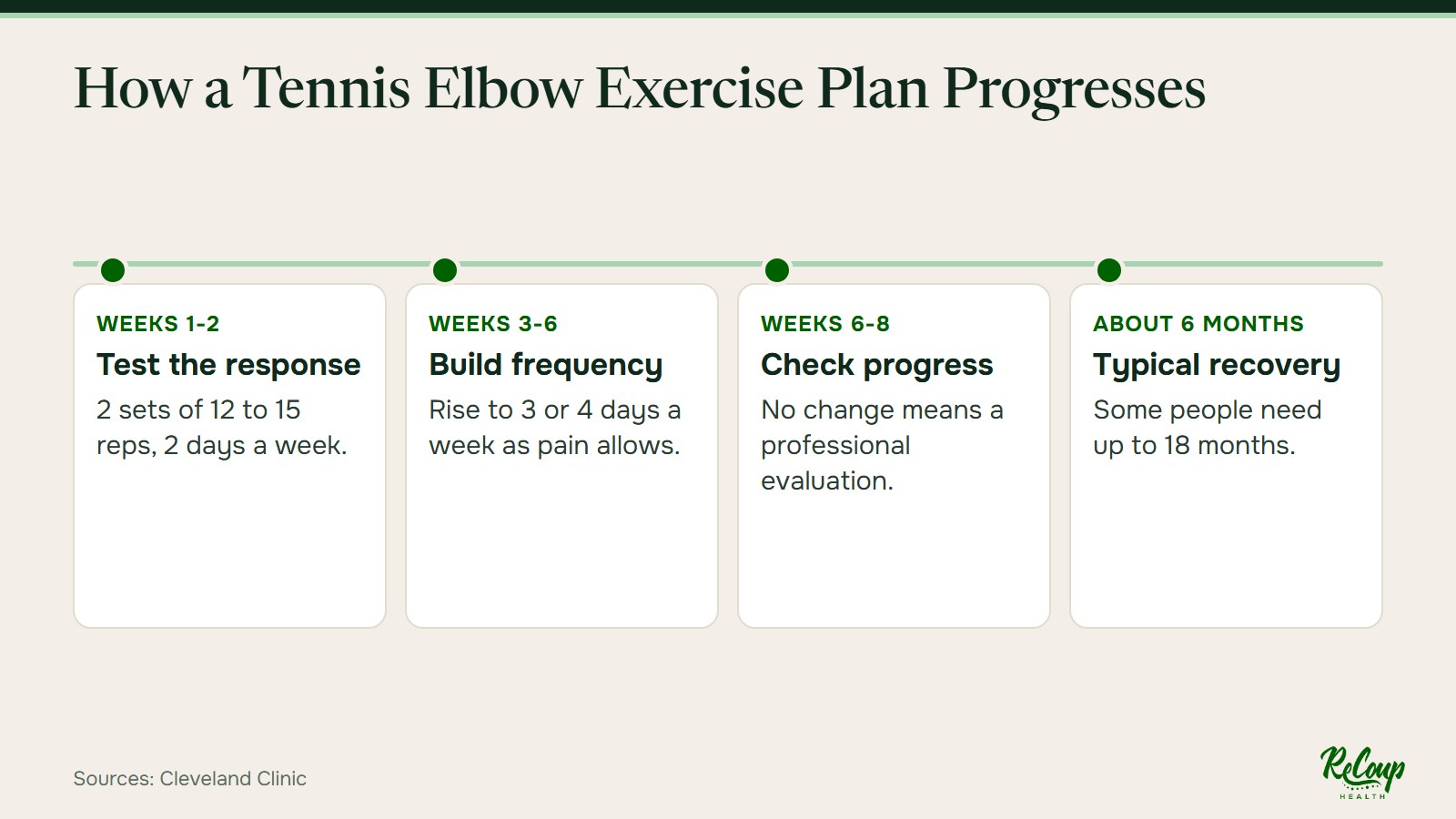
Stretching sessions sit alongside the strength schedule on the same days.
How Do You Stretch Tennis Elbow Safely
Stretch tennis elbow by moving the wrist gently to a mild pull and holding it for 15 to 30 seconds. Cleveland Clinic suggests doing each stretch 1 to 3 times a day. MyHealth Alberta suggests 2 to 4 repetitions of each hold. Knowing how to stretch tennis elbow well means stopping at a mild to medium pull, not a sharp pain.
These four stretches for tennis elbow cover the forearm, the wrist and the upper back.
- Wrist extensor stretch: hold your arm straight, palm down, and gently bend the wrist so the fingers point to the floor.
- Wrist flexor stretch: hold your arm straight, palm up, and gently pull the fingers back and down with your other hand.
- Forearm rotation stretch: bend the elbow to 90 degrees at your side. Turn the palm up for 3 to 5 seconds, then down.
- Shoulder blade hold: sit tall and squeeze the shoulder blades back and down for 5 seconds, building to 30 seconds.
Another option for stiff forearms and shoulders is assisted arm stretching, where a trained therapist moves the limb through each position. The bigger question is how much stretching adds on its own.
Does Stretching Help Tennis Elbow
Stretching helps tennis elbow mainly as a support to strengthening, not as a stand-alone fix. Stretching eases tightness, while loading rebuilds tendon capacity. A 2024 Cochrane review of manual therapy and exercise pooled 23 trials with 1,612 participants. Compared with minimal or no treatment, pain improved by a mean of only 0.53 points, and the gains did not last.
The review rated this evidence as low certainty. Side effects were mild and short-lived, with no serious adverse events reported. The comparison below sets stretches beside strengthening work.
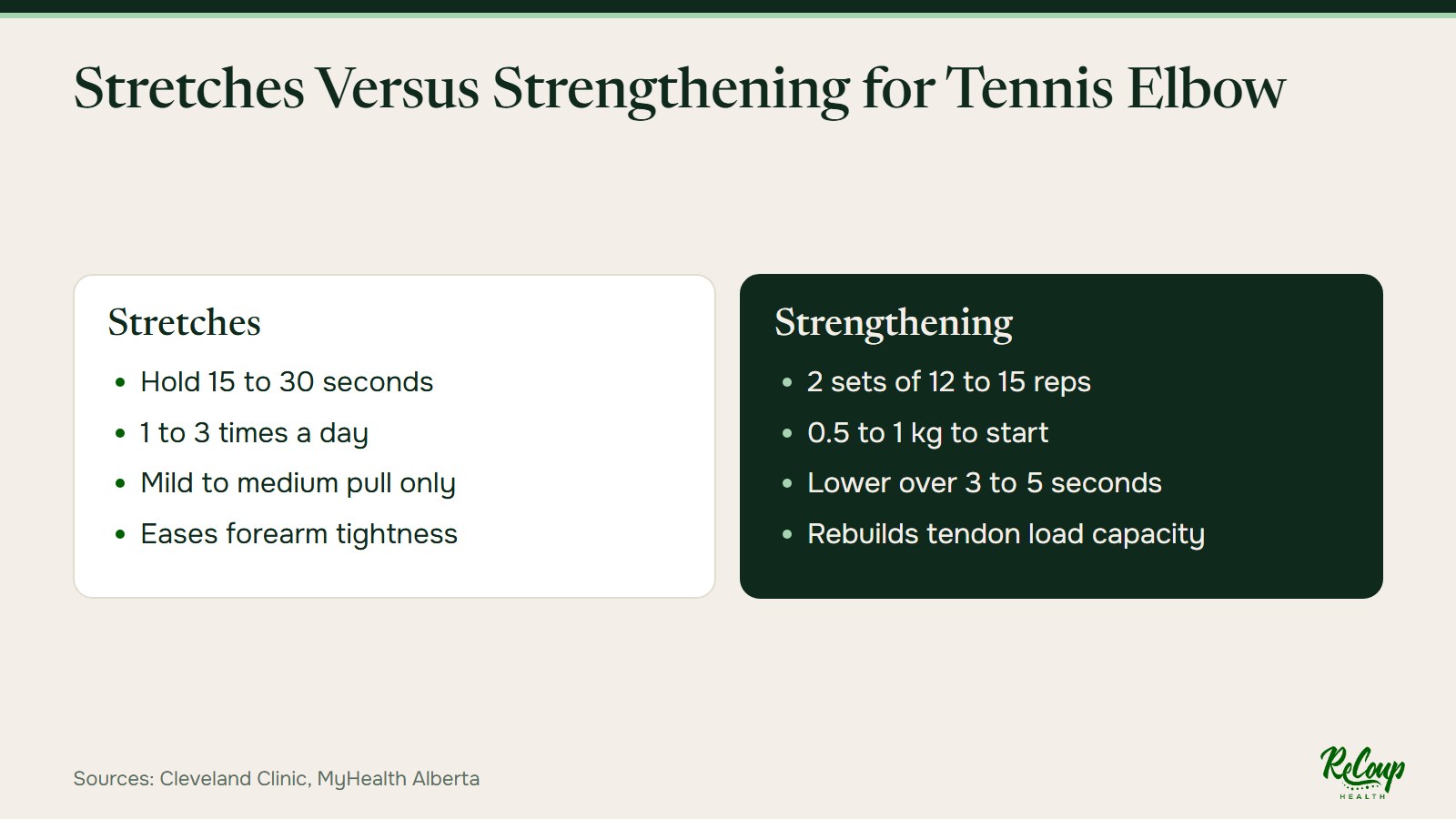
Stretches and strengthening work well as a pair. Some exercises, however, add strain during a flare.
What Exercises Should You Avoid With Tennis Elbow
Avoid exercises that combine a tight grip with a palm-down wrist lift, since these moves load the sore extensor tendon heavily. Heavy gripping with the palm facing down is the main load to cut during a flare. The exercises not to do with tennis elbow during a flare include five common gym and home moves.
- Heavy reverse wrist curls and reverse barbell curls
- Pull-ups, deadlifts and heavy rows with an overhand grip
- Push-ups and planks on flat palms that sharpen elbow pain
- Hammering, screwdriver work or racquet drills repeated through pain
- Heavy carries, such as tightly gripped shopping bags or farmer’s walks
Beyond the gym, you should not push through pain, grip heavy loads palm down or rest the arm completely. Cleveland Clinic’s Dr. King names pushing through tennis elbow pain as a common mistake. These moves can return once strength builds and the elbow tolerates lighter versions without pain.
Should Tennis Elbow Exercises Hurt
Tennis elbow exercises may cause mild discomfort, but they should not cause sharp or rising pain. Healthline quotes Kelly Starrett, who expects some discomfort as movement returns to the tendon. MyHealth Alberta advises easing off the exercises when pain starts. Discomfort that settles soon after a session is acceptable, while pain that builds signals a lighter load. Tracking that response also shows how long the program needs.
How Long Do Tennis Elbow Exercises Take to Work
Tennis elbow exercises take about 6 to 8 weeks to show clear progress, based on Cleveland Clinic guidance. NHS guidance suggests physiotherapy when symptoms have not improved after 6 weeks of home treatment. The fastest way to heal tennis elbow is steady graded loading while cutting painful grip work, not a quick fix.
Full recovery takes longer. Cleveland Clinic states recovery takes around 6 months, with some people needing up to 18 months. In the Bisset BMJ trial, 65% of the physiotherapy group reported success at 6 weeks, rising to 94% at 52 weeks.
AAOS OrthoInfo reports that 80 to 95% of patients succeed with nonsurgical treatment. The 2022 JOSPT clinical practice guideline notes that lateral elbow pain recurs and can mean long time off work. A lighter maintenance routine after pain eases is a sensible step against that return. The figures below summarize what research shows about exercise and recovery.
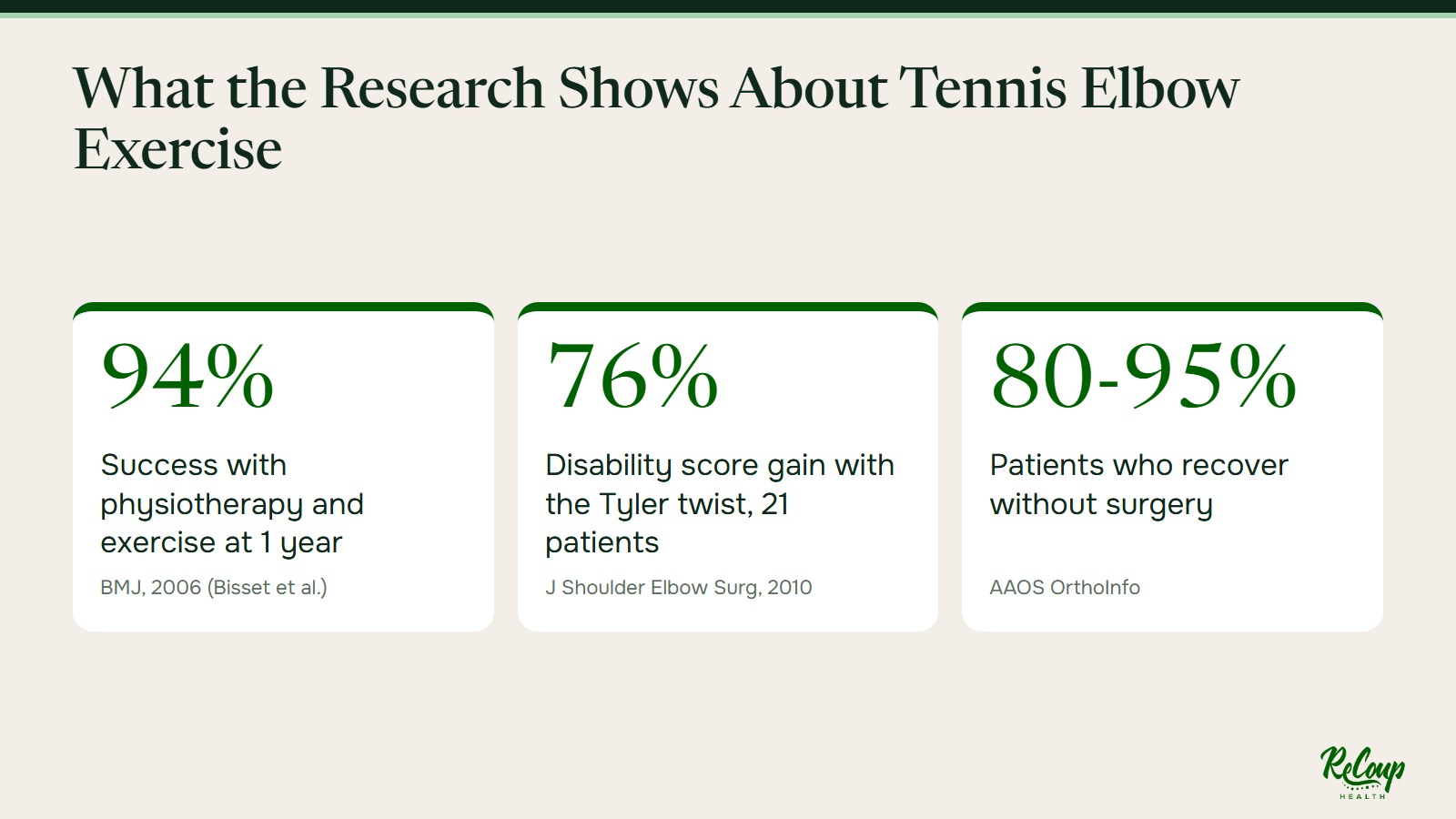
These numbers come from small to mid-sized trials, so they guide expectations rather than promise results. Several side questions also shape how the exercises fit into daily life.
What Else Should You Know About Tennis Elbow Exercises
Do Tennis Elbows Ever Go Away
Yes, tennis elbows do go away for the large majority of people. In the Bisset BMJ trial, 90% of people who simply waited reported success at 1 year. The NHS notes that tennis elbow can sometimes last over a year, so exercise aims to speed that recovery.
Why Did I Suddenly Get Tennis Elbow
You suddenly get tennis elbow when forearm load outpaces the tendon’s capacity, even though the damage builds over weeks. A 2006 Finnish study linked repetitive and forceful arm movements, smoking and obesity with the condition. A new tool, sport or workload is a common trigger for the first pain.
Do Tennis Elbow and Golfer’s Elbow Exercises Differ
Tennis elbow and golfer’s elbow exercises differ in which side of the forearm they load. Tennis elbow affects the outer elbow and the wrist extensor muscles. Golfer’s elbow affects the inner elbow and the wrist flexors. For that reason, golfer’s elbow care shifts the focus to palm-up curls and flexor stretches.
Can You Use Band Exercises for Tennis Elbow
Yes, resistance bands work well for tennis elbow as a light alternative to dumbbells. A band held under your foot gives resistance for wrist extension and flexion. Bands let you start light and add tension in small steps. Physiotherapy exercises for tennis elbow can use colour-coded bands to grade resistance from light to heavy.
Do Shoulder Exercises Help Tennis Elbow
Shoulder exercises can help tennis elbow by giving the arm a stable base. Cleveland Clinic’s Dr. King says stable shoulders let the elbow and wrist move with less strain. Shoulder blade holds and light rows are simple starting points. Ongoing shoulder pain care may join the plan when both joints hurt.
Can Massage Support Tennis Elbow Exercises
Yes, it is okay to massage tennis elbow, and massage can support the exercises by easing tight forearm muscles. The 2024 Cochrane review rated evidence for manual therapy with exercise as low certainty. Hands-on care pairs with exercise rather than replacing it. One way to combine the two is forearm extensor massage between strength sessions.
Who Needs Tennis Elbow Exercises Beyond Tennis Players
Tennis elbow exercises suit anyone with outer elbow pain, whether or not they play tennis. More than 9 in 10 cases develop for reasons other than tennis, according to Cleveland Clinic. The NHS notes the condition is more common in people aged 35 to 54.
Painters, carpenters and office workers who repeat the same forearm movements all day can develop repetitive job strain. Workstation changes, tool grips and short breaks reduce that strain alongside the exercises. Office workers can also adjust desk height and mouse position to ease the same forearm load.
Tennis, squash and pickleball players returning to play may need sports elbow rehab that rebuilds grip strength and swing load.
When Should You Stop Exercising and Get Help
Stop exercising and get help when elbow pain does not ease after 2 weeks of rest and self-care, which is NHS guidance. Cleveland Clinic advises seeing a provider for trouble moving the elbow, swelling or discolouration. Seek urgent care at an emergency department for a visible deformity or a sudden pop with severe pain. Numbness or a hot, swollen elbow with fever also needs same-day care. Talk to your physiotherapist or family doctor before restarting exercises after any of these signs.
Frequently Asked Questions About Tennis Elbow Exercises
Can You Strengthen Tennis Elbow
Yes, you can strengthen the forearm around tennis elbow with gradual loading. Strengthening raises the tendon’s tolerance for gripping and lifting.
Are Home Exercises for Tennis Elbow Enough
Home exercises can be enough for mild tennis elbow. In the Bisset trial, 90% of the wait-and-see group reported success at 1 year. NHS guidance suggests physiotherapy when 6 weeks of home care brings no improvement.
What Are the First Signs of Tennis Elbow
The first signs of tennis elbow are pain or burning on the outer elbow and a weaker grip. AAOS OrthoInfo lists outer elbow pain and weak grip strength as typical symptoms.
Is Heat or Ice Better for Tennis Elbow
Heat and ice both have a place for tennis elbow, depending on timing. A wrapped cold pack can calm a painful flare, while gentle warmth can loosen the forearm before exercise.
Can You Lift Weights With Tennis Elbow
Yes, you can lift weights with tennis elbow when the grip load stays pain-free. Lower-body lifts and machines with a light grip are reasonable choices. Heavy overhand pulls and wrist curls wait until strength returns.
How Recoup Health Guides Your Tennis Elbow Exercise Program
Recoup Health builds exercises for tennis elbow into a guided plan. Each plan starts with an assessment of grip strength, wrist movement and daily demands. Our physiotherapists set the starting load, teach each exercise and adjust the dose as pain settles. Every plan for tennis elbow rehab also covers activity changes at work and in sport.
Hands-on care such as massage, acupuncture from our chiropractor and fascial stretching can support the loading work. A naturopathic doctor and a performance coach round out the clinic for longer-term goals. Meet our elbow clinicians who lead each part of care.
No doctor’s referral is needed to start care with our team. Bring a short list of the movements that hurt, plus any exercises you have already tried. The front desk can arrange a first visit through the elbow appointment booking form. A clear exercise plan, practised a few minutes a day, gives the tendon the steady load it needs to recover.
Patients across Vaughan with long-standing elbow pain, recent flare-ups or a return to sport all start with the same careful assessment. Clinicians at the Recoup Health facility on Innovation Drive then match each exercise to the person and the goal.