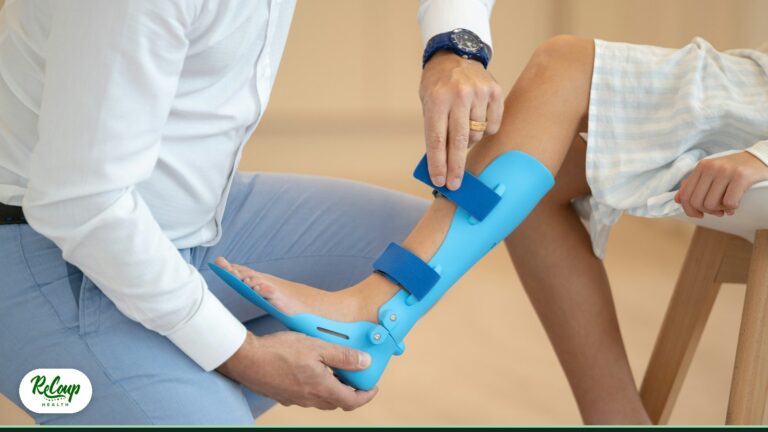

Plantar fasciitis lasts several months to about one year for most people, according to the American Academy of Orthopaedic Surgeons (AAOS). The AAOS reports that more than 90% of patients improve within 10 months of starting simple treatment. Canadian Family Physician adds that about 40% still have heel pain at 2 years. Daily stretching and strengthening shorten that window for many people.
Key Takeaways
- More than 90% of people with plantar fasciitis improve within 10 months of simple treatment (AAOS).
- About 40% still have symptoms 2 years after onset (Canadian Family Physician, 2018).
- Plantar fascia stretching reduced first-step morning pain within 8 weeks in a 101-patient trial.
- Daily high-load strengthening needs a minimum of 3 months (Canadian Family Physician, 2018).
- Heel pain that has not improved after 2 weeks of self-care needs a clinician review (NHS).
How Long Does Plantar Fasciitis Last on Average
Plantar fasciitis lasts between a few months and about 12 months for the average person who starts simple treatment. The AAOS states that more than 90% of patients improve within 10 months of starting that care. Plantar fasciitis is irritation of the plantar fascia, a thick band of tissue running from the heel bone to the toes.
The answer to how long does plantar fasciitis last depends on when treatment starts and on daily foot load. Canadian Family Physician (2018) notes that symptoms typically improve within a year of onset, regardless of treatment. Treatment still matters, because a guided plan with plantar fasciitis physiotherapy eases pain sooner and keeps you moving while the tissue settles. The settling time looks different with and without treatment.
How Long Does Plantar Fasciitis Last Without Treatment
Plantar fasciitis without treatment can last 1 to 2 years. The question of how long does plantar fasciitis last without care has a clear answer in Canadian data. Canadian Family Physician reports that about 40% of patients still have symptoms 2 years after onset. That 40% figure shows why waiting it out carries a real cost in lost walking, work and sport.
The same Canadian article states that most cases improve within a year whatever the treatment. Pain during that year limits daily life, though, and untreated loading habits keep irritating the fascia. A treated case follows a shorter and more predictable path.
How Long Does It Take for Plantar Fasciitis to Heal With Treatment
Plantar fasciitis with treatment shows first gains in about 8 weeks. More than 90% of people improve within 10 months (AAOS). In a 101-patient trial by DiGiovanni and colleagues in 2003, plantar fascia stretching cut first-step morning pain at 8 weeks.
The 2-year follow-up of that stretching trial found that 92% of 66 patients were satisfied with their outcome. In the same group, 94% reported less pain and 77% had no limits on recreation. Those long-term results map onto a recovery timeline with clear checkpoints.
What Does the Plantar Fasciitis Recovery Timeline Look Like
The plantar fasciitis recovery timeline runs from a 2-week self-care check to a 12-month surgical review. Each checkpoint below comes from a named guideline or trial. The table lists every checkpoint, so you can compare your own plantar fasciitis recovery time with the published evidence.
| Time point | What the evidence shows | Source |
|---|---|---|
| 2 weeks | See a clinician if self-care has not helped | NHS |
| 8 weeks | Plantar fascia stretching eased first-step morning pain | J Bone Joint Surg Am, 2003 |
| 3 months | Minimum length of daily high-load strengthening | Canadian Family Physician, 2018 |
| 6 months | Persistent pain calls for a family physician review | Canadian Family Physician, 2018 |
| 10 months | More than 90% have improved with simple treatment | AAOS |
| 12 months | Surgery considered only after failed nonsurgical care | AAOS |
| 2 years | About 40% still report symptoms | Canadian Family Physician, 2018 |
The table shows that plantar fasciitis healing time stretches across months, not days. The figures below summarize the key recovery numbers from these studies.
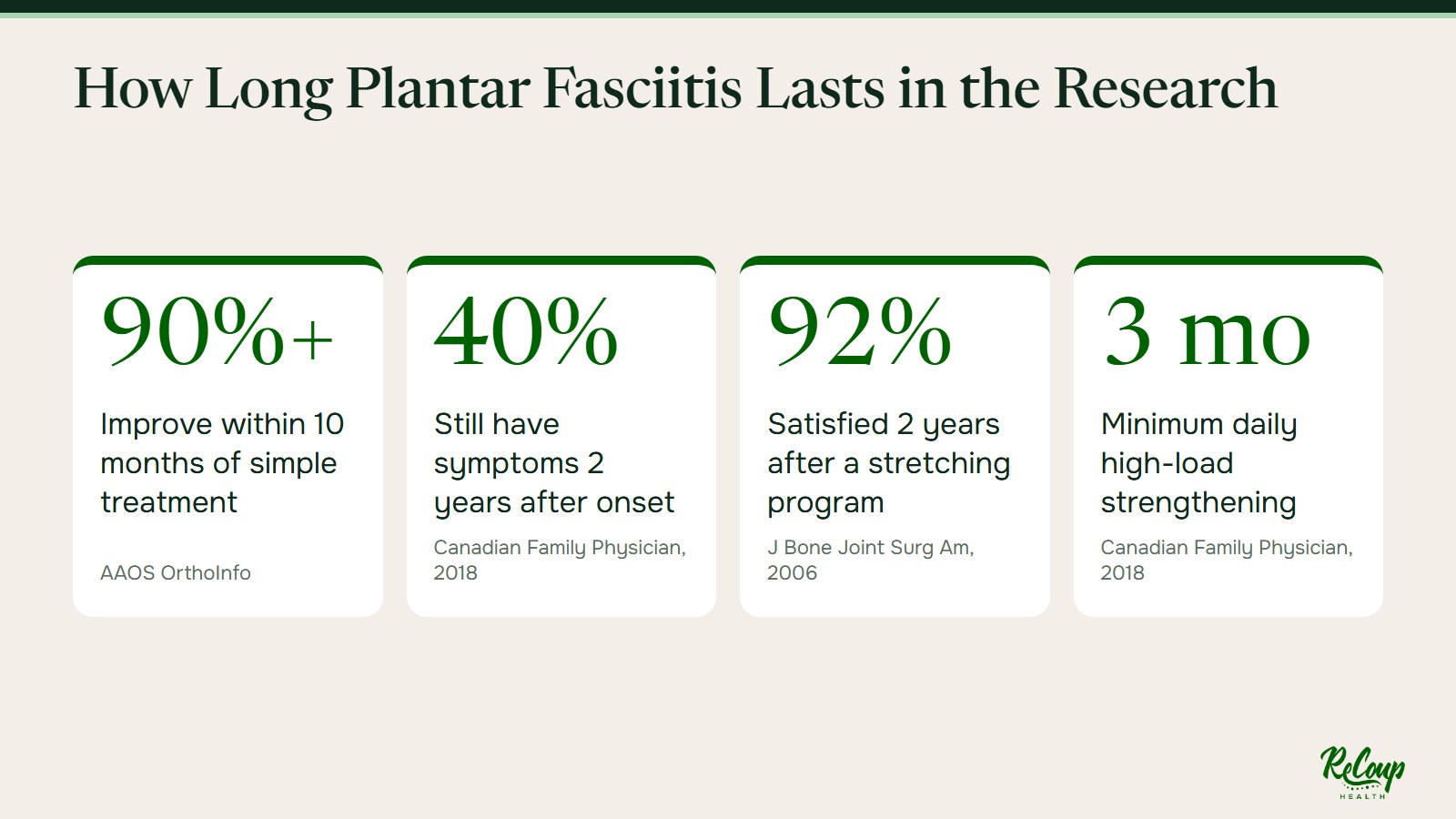
These recovery statistics describe the whole condition. Daily pain follows its own shorter pattern, starting with the first steps each morning.
How Long Does Plantar Fasciitis Pain Last Each Morning
Plantar fasciitis pain each morning lasts for the first steps after waking and eases as the foot warms up. The NHS lists pain with the first steps after sleeping or resting as a main symptom. Pain also returns after long sitting, such as a car ride.
The answer to how long does plantar fasciitis pain last over the whole condition follows the timeline above. First-step pain is a useful progress marker, because a drop in morning pain signals that the fascia is calming down. A small group of people, however, find that heel pain does not settle at all.
Can Plantar Fasciitis Last Forever
Plantar fasciitis does not last forever for the large majority. Symptoms persist past 2 years in about 40% of patients (Canadian Family Physician). Chronic plantar fasciitis means heel pain that keeps going for many months despite care. Chronic cases need a closer look at the cause.
A 2026 review of 459 patients in the Journal of the American Podiatric Medical Association found nerve-related findings in 49%. Among those nerve cases, 56% resolved with conservative (non-surgical) care. Chronic plantar fasciitis recovery time improves once a clinician checks for nerve involvement and other heel pain causes.
Persistent heel pain can also affect sleep, mood and activity. Our chronic heel pain approach looks at load, movement and pain sensitivity together. Several measurable factors explain why some feet heal slower than others.
What Slows Down Plantar Fasciitis Healing Time
Plantar fasciitis healing time slows with higher body weight, a stiff ankle and long hours of standing. A 2003 Journal of Bone and Joint Surgery study found an odds ratio of 23.3 for a stiff ankle. Stiff here means ankle bend of 0 degrees or less. An odds ratio compares the chance of having a condition with and without a factor.
The same 2003 study linked spending most of the workday on your feet to an odds ratio of 3.6. A 2016 meta-analysis in the British Journal of Sports Medicine reviewed 51 studies. Body mass index (BMI) above 27 was the only significant clinical link, with an odds ratio of 3.7. The NHS also lists starting exercise on hard surfaces as a risk factor for plantar fasciitis.
These studies show associations, not proof of cause. Each factor still adds daily load to the fascia, and reducing load supports healing. The comparison below sets slower-healing factors beside the habits linked to faster recovery.
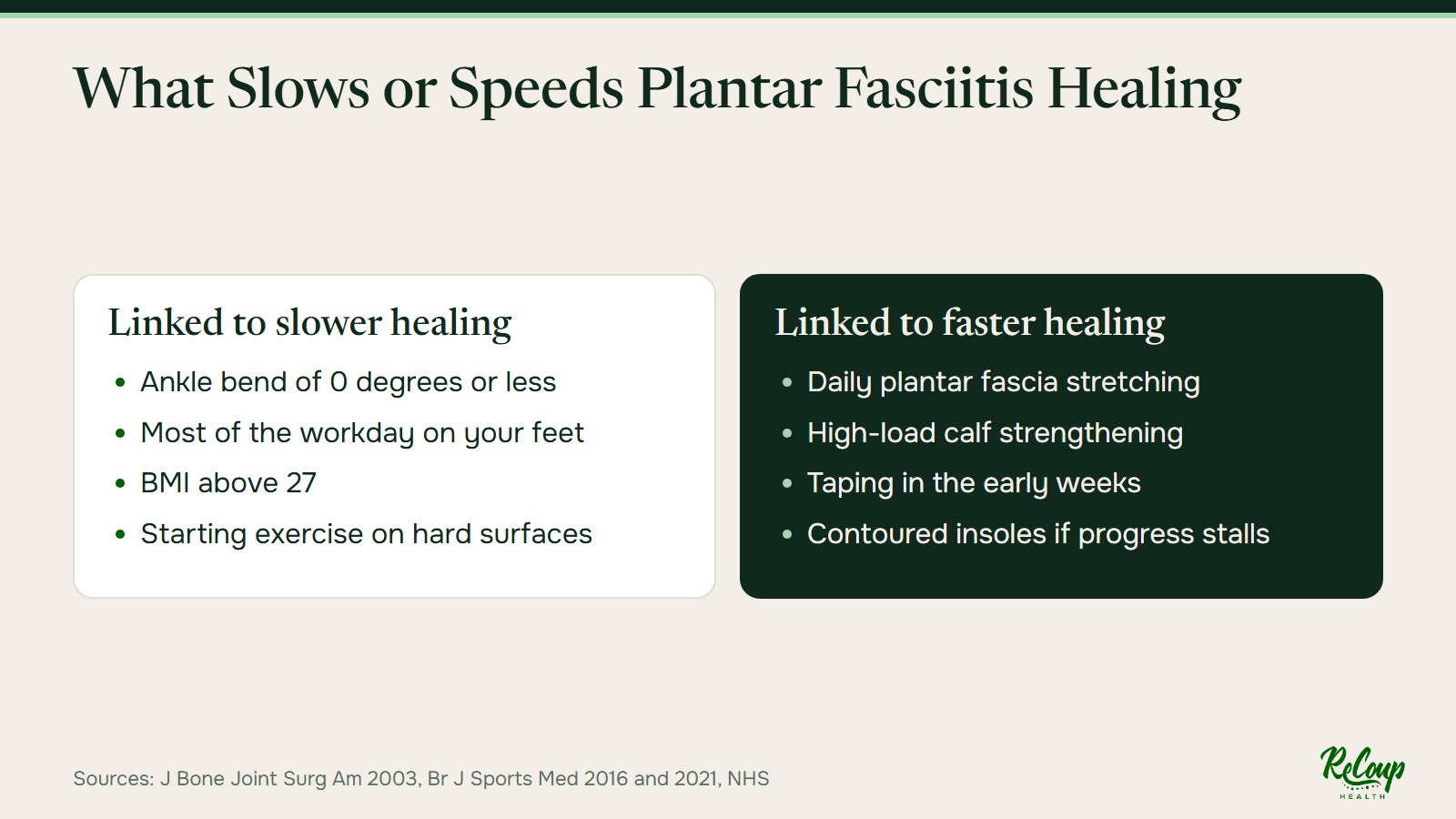
The comparison shows that ankle stiffness and load are changeable factors. Runners and court athletes add impact, and athlete heel rehab adjusts training volume while the fascia recovers. Those changeable factors form the core of a healing plan.
How to Heal Plantar Fasciitis Faster
Heal plantar fasciitis faster by stretching the sole daily, strengthening the calf and foot, and cutting excess load. A 2021 clinical practice review in the British Journal of Sports Medicine covered 51 trials and 4,351 participants. The review named taping, stretching and individual education as the core treatment. The fastest way to heal plantar fasciitis is to start that core treatment early and repeat it daily.
The steps below show how to heal plantar fasciitis with the evidence-based tools from that review and the AAOS.
- Stretch the sole before your first steps each morning, holding 10 seconds and repeating 20 times per foot (AAOS).
- Stretch the calf with the same 10-second hold and 20 repetitions per foot (AAOS).
- Do high-load heel raise strengthening daily for at least 3 months (Canadian Family Physician).
- Use taping in the early weeks to ease first-step pain (British Journal of Sports Medicine, 2021).
- Add contoured insoles from a clinician, such as custom arch orthotics, when progress stalls.
- Book a clinician review at 2 weeks without improvement and again at 6 months with lasting pain.
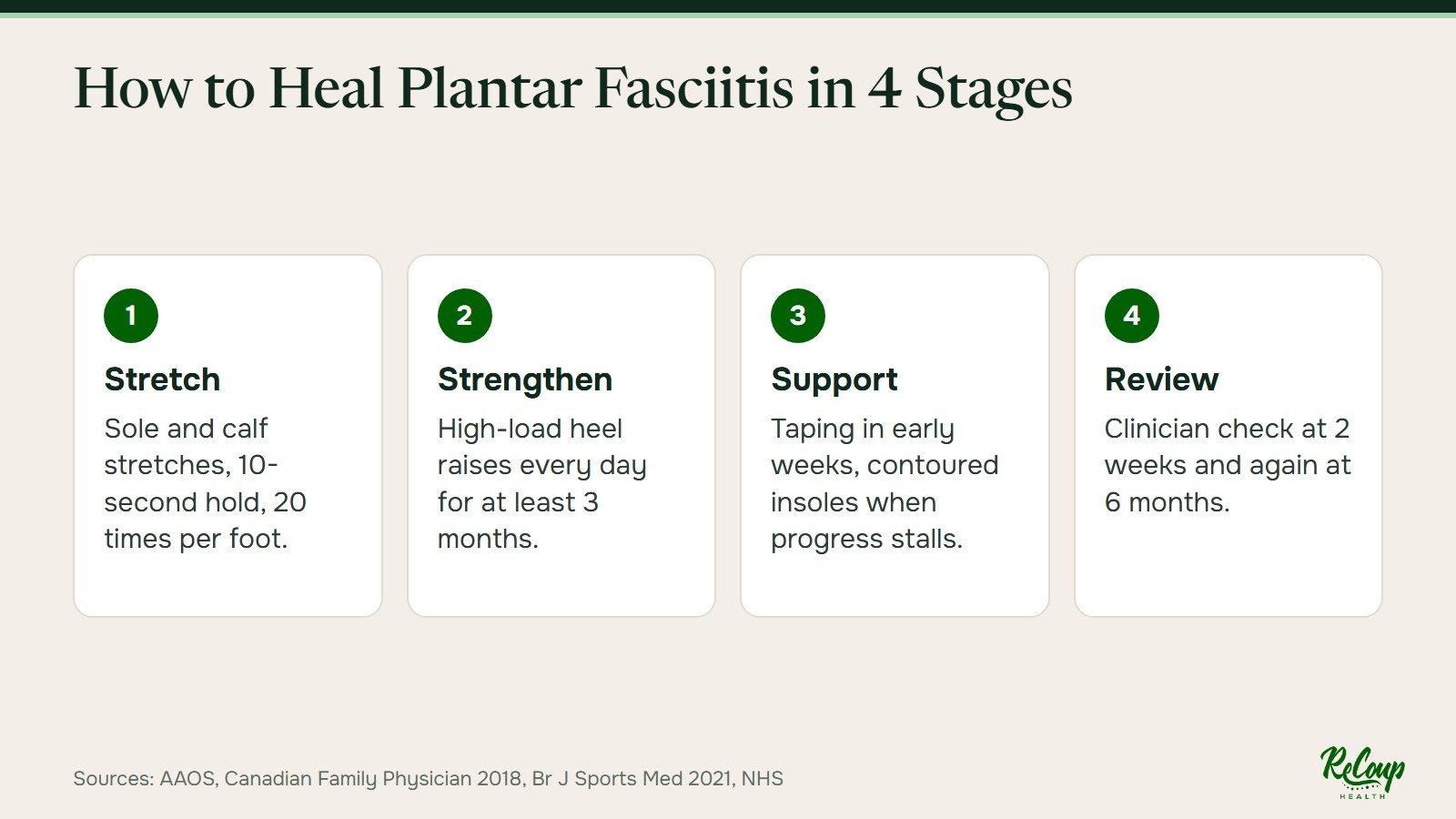
The graphic groups these six healing steps into four stages. A 2018 meta-analysis by Whittaker and colleagues found foot orthoses gave a small medium-term pain benefit over sham devices. A structured physiotherapy plan brings these steps together.
How Long Is Physical Therapy for Plantar Fasciitis
Physiotherapy for plantar fasciitis lasts at least 3 months of daily home exercise, according to Canadian Family Physician. The answer to how long is physical therapy for plantar fasciitis also depends on symptom length before the first visit. Clinic sessions guide the plan, while daily home work does the healing.
In a 2026 trial of 58 adults, sessions ran 3 times weekly for 8 weeks. Our heel strengthening physiotherapy program progresses load every few weeks as first-step pain drops. Progress checks also catch warning signs that need medical care.
When Should You See a Clinician for Heel Pain That Lasts
See a clinician for heel pain that has not improved after 2 weeks of self-care, according to the NHS. Canadian Family Physician advises a family physician visit when symptoms persist beyond 6 months of loading exercise. The following signs call for prompt medical assessment.
- Tingling or loss of feeling in the foot (NHS).
- Diabetes with any new foot pain (NHS).
- Severe pain, or pain that stops normal daily activity (NHS).
- Sudden sharp pain after a steroid injection, which may signal a tear (AAOS).
- Heel pain with fever, redness or heat, which needs urgent care at a walk-in clinic or emergency department.
Talk to your physiotherapist or family doctor about any of these signs before continuing exercise. A physiotherapist can assess your heel without a doctor’s referral. Clinicians also answer the side questions that come up during a long recovery.
What Else Should You Know About Plantar Fasciitis Recovery Time
Plantar fasciitis recovery time also depends on surgery, injections, hands-on care and recurrence risk. Short answers to those side questions follow.
How Long Is Plantar Fasciitis Surgery Recovery Time
Plantar fasciitis surgery recovery time is measured in months, and surgery comes only after 12 months of failed nonsurgical care (AAOS). A 2025 review of endoscopic plantar fascia release followed 978 feet for a mean of 25.6 months. Complications occurred in 8.9% of patients and recurrent pain in 4.2%. Your surgeon sets the return-to-walking plan, and fascia release rehab rebuilds strength afterward.
What Is the Root Cause of Plantar Fasciitis
The root cause of plantar fasciitis is repeated strain on the plantar fascia that outpaces the tissue’s repair. The NHS notes that the exact reason the fascia becomes strained is not always clear. Known risk factors include a tight calf, a stiff ankle, higher body weight and long hours of standing. Easing those strains shortens recovery.
Do Steroid Injections Shorten Plantar Fasciitis Recovery
Steroid injections do not clearly shorten plantar fasciitis recovery. A 2017 Cochrane review of 39 studies found they may slightly reduce heel pain for up to one month. The review rated the evidence as very low quality. Two plantar fascia ruptures were reported in one trial, so the AAOS warns that cortisone can weaken the fascia.
Can Massage or Stretching Therapy Speed Up Healing
Massage-based myofascial release can speed up pain relief compared with calf stretching alone. A 2026 trial of 58 adults found myofascial release better for pain and function after 8 weeks. Our myofascial massage therapy targets the calf and sole.
Stretching therapy adds a second hands-on option for a tight lower leg. A tight calf pulls on the heel, and the 2003 risk study linked a stiff ankle to plantar fasciitis. Assisted calf fascial stretching adds range to a stiff ankle, though trial data on that method are limited.
Can Chiropractic Care Help Plantar Fasciitis Heal
Chiropractic care can help plantar fasciitis heal as part of a combined plan with stretching and strengthening. A 2026 network meta-analysis in Physical Therapy found short-term pain gains for manual therapy added to home exercise. Our chiropractic heel care pairs joint work in the foot and ankle with home exercise.
Can Plantar Fasciitis Come Back After It Heals
Plantar fasciitis can come back after it heals, and the NHS lists recurring pain as a reason to see a clinician. Keeping up calf strength and ankle range lowers the load on the fascia. Limping for months can also shift strain upward, so secondary knee pain deserves a check during recovery.
Frequently Asked Questions About Plantar Fasciitis Duration
Does Plantar Fasciitis Heal on Its Own
Plantar fasciitis does heal on its own in many cases, with symptoms improving within a year of onset (Canadian Family Physician). About 40% still have symptoms at 2 years, so active care is the faster route.
What Is Mild Plantar Fasciitis Recovery Time
Mild plantar fasciitis recovery time has no single published figure. The NHS advises a clinician visit when 2 weeks of self-care brings no change, which keeps early cases from dragging on.
How Long Can Plantar Fasciitis Last at Most
The answer to how long can plantar fasciitis last is 2 years or more for about 40% of patients (Canadian Family Physician). The AAOS considers surgery only after 12 months without improvement.
What Are Signs That Plantar Fasciitis Is Healing
Signs that plantar fasciitis is healing include less pain with the first steps of the morning and less pain after rest. The 2003 stretching trial used first-step morning pain as its main progress measure.
What Are the Final Stages of Plantar Fasciitis
The final stages of plantar fasciitis are either full recovery or chronic heel pain that lasts beyond 12 months. Chronic cases may need a family physician review after 6 months and a surgical opinion after 12 months (Canadian Family Physician, AAOS).
How Common Is Plantar Fasciitis
Plantar fasciitis affects an estimated 3.6% to 7% of the general population (Canadian Family Physician). The AAOS reports that plantar fasciitis is most common in people aged 40 to 60.
How Recoup Health Helps Plantar Fasciitis Heal Sooner
Recoup Health helps plantar fasciitis heal sooner with a step-by-step loading plan, hands-on care and foot support. The answer to how long does plantar fasciitis last changes when treatment starts early and stays consistent. Our foot care clinicians include physiotherapists, registered massage therapists and a chiropractor.
We start with a heel and ankle assessment, then set clear goals for first-step pain, walking and sport. Your plan from physiotherapy visits includes home exercise you can follow between sessions. No doctor’s referral is needed to start care. Each visit tracks first-step pain, walking distance and strength, so you can see recovery progress in numbers.
Patients with heel pain can see Recoup Health’s clinicians on Innovation Drive. The clinic serves Vaughan and nearby communities with physiotherapy, massage therapy, chiropractic care and custom orthotics under one roof.
Booking takes a few minutes, and your first visit includes a full foot and ankle assessment with a clear plan. Use our clinic appointment page to book a heel assessment with a physiotherapist.