
How to fix diastasis recti comes down to a progressive core program that rebuilds tension across the midline of the belly. A 2026 review of 9 trials found structured exercise narrowed the gap by 8.05 mm on average. Mild to moderate separation improves with deep core and pelvic floor training. Surgery stays a later option for severe cases or a hernia.
Key Takeaways
- Exercise is the first-line treatment for diastasis recti, with an average gap reduction of 8.05 mm across 9 trials.
- Starting exercise before 3 months postpartum gave a larger reduction of 10.2 mm in the same 2026 review.
- Crunch-style moves narrow the gap during the movement, so they can return once your core control is solid.
- A 12-week home program raised abdominal strength by 9 Nm even when the gap stayed the same width.
- Surgery is reserved for a hernia, a severe gap or symptoms that last after dedicated rehab.
How Do You Fix Diastasis Recti Step by Step?
Fix diastasis recti step by step by learning core control first, then adding load until the midline stays firm under effort. Diastasis recti is the separation of the rectus abdominis muscles, the two vertical “six-pack” muscles at the front of the belly. Cleveland Clinic defines the condition as a gap wider than 2 cm between these muscles.
The gap sits along the linea alba, a band of connective tissue that joins the left and right muscles. Treatment aims for a linea alba that tightens and resists bulging, beyond a narrower gap. Our diastasis recti rehab follows the 6 steps below, adjusted to your stage after birth.
- Get assessed: a physiotherapist measures gap width and depth at, above and below the belly button.
- Retrain breathing: breathe into the lower ribs, then exhale with a gentle pelvic floor lift.
- Activate the deep core: tighten the transversus abdominis, the deepest abdominal muscle, before each effort.
- Load the six-pack muscles: add head lifts and curl-ups while the midline stays flat and firm.
- Practise daily tasks: lift, carry and roll out of bed with the same core control.
- Retest at each follow-up: track midline tension, doming and symptoms along with finger widths.
Doming is a ridge or cone that rises along the belly when pressure inside the abdomen pushes outward. The graphic below groups these 6 steps into 4 stages of a treatment for diastasis recti.
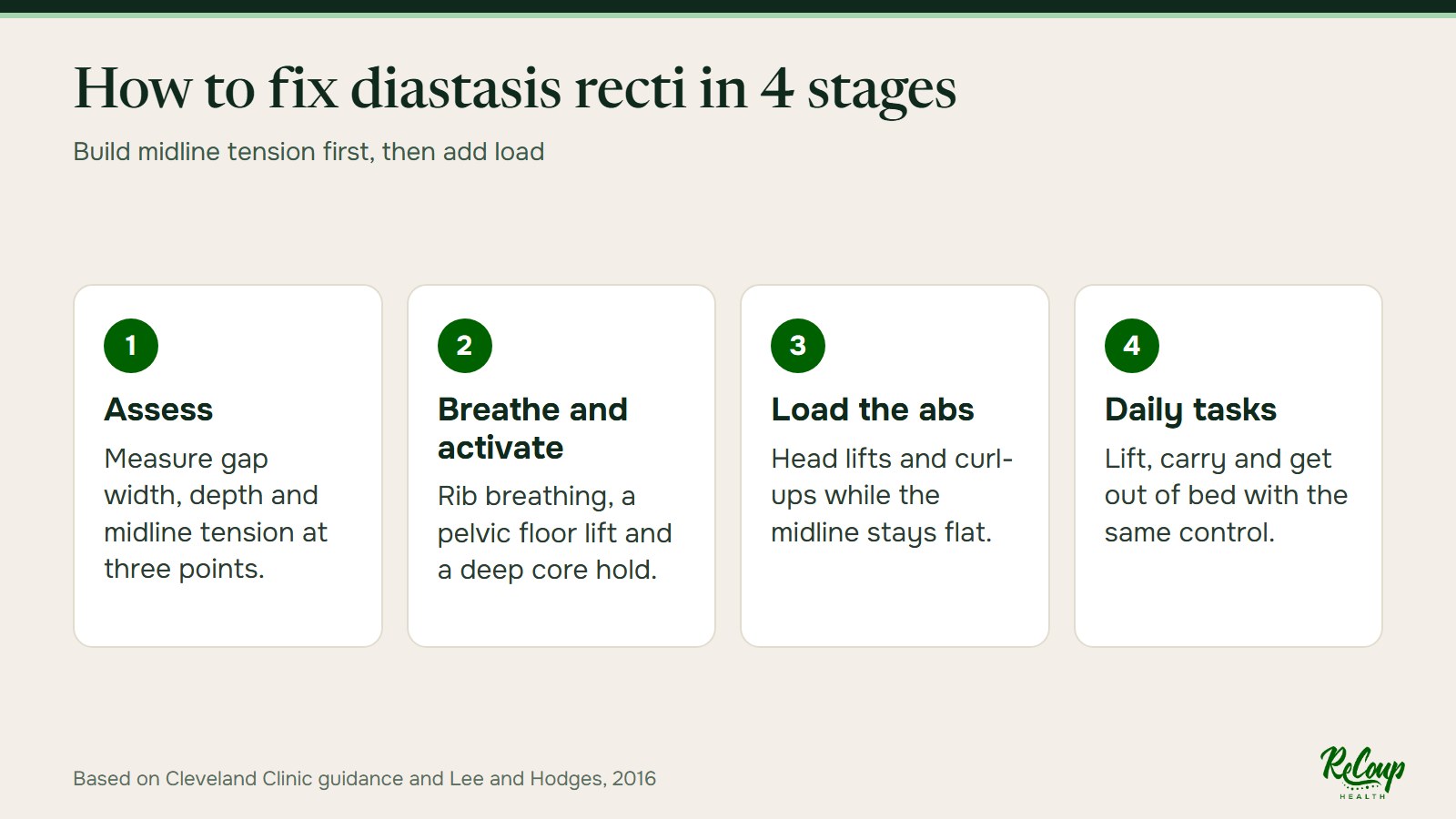
Each stage builds on the one before it. That progression leads to the next question, whether the gap can disappear completely.
Can You Make Diastasis Recti Go Away?
Yes, you can make diastasis recti go away or shrink for many women, though a small gap can remain. Sperstad and colleagues followed 300 first-time mothers in the British Journal of Sports Medicine in 2016. Diastasis recti affected 60.0% of mothers at 6 weeks postpartum and 32.6% at 12 months.
The gap closed on its own for many mothers, yet about 1 in 3 still had a separation after one year. A lasting gap calls for a plan that targets function. That plan starts with knowing why the tissue stretched.
What Is the Main Cause of Diastasis Recti?
The main cause of diastasis recti is pregnancy, as the growing uterus stretches and thins the linea alba. Cleveland Clinic reports that diastasis recti affects 6 in 10 women after childbirth. Ultrasound showed a gap in 100% of 84 first-time mothers at week 35 of pregnancy. Fernandes da Mota and colleagues reported this result in Manual Therapy in 2015.
Heavy lifting adds strain to the stretched tissue. In the Sperstad cohort, lifting heavy loads 20 or more times a week raised the odds of diastasis recti 2.18 times. Kaufmann and colleagues ran a CT study of 329 adults (Hernia, 2022). Older age, higher body mass index (BMI) and more pregnancies were risk factors.
The stretched linea alba still responds to load. The next step is choosing exercises that put the right load on it.
What Are the Top 3 Exercises for Diastasis Recti?
The top 3 exercises for diastasis recti are pelvic floor breathing, a deep core hold and a curl-up. Capoccia Giovannini and colleagues found no significant difference between exercise types in their 2026 review in Hernia.
- Pelvic floor breathing: breathe into your lower ribs, then exhale while gently lifting the pelvic floor.
- Deep core hold: lie on your back, knees bent, and draw the lower belly gently inward for 5 to 10 seconds.
- Head lift or curl-up: tighten the deep core first, then lift your head and shoulders while the midline stays flat.
Lee and Hodges studied 26 women with diastasis recti in the Journal of Orthopaedic and Sports Physical Therapy in 2016. A curl-up narrowed the gap by 1.19 cm, yet the curl-up also distorted the linea alba. Tightening the deep core first reduced that distortion, so the curl-up sits last in the list.
Pelvic floor training earns its place for a separate reason. Beamish and colleagues published a 2025 review in the British Journal of Sports Medicine. Pelvic floor muscle training cut the odds of urinary incontinence by 37%. Mothers with leaking alongside a gap can add pelvic floor rehab to the same program. The curl-up result also challenges an old rule about crunches.
Should You Avoid Crunches With Diastasis Recti?
No, you do not need to avoid crunches with diastasis recti forever, but you should earn crunches with core control first. Mota and colleagues measured 84 first-time mothers with ultrasound in 2015. A crunch narrowed the gap by 1.6 to 20.9 mm across sites and time points. The drawing-in exercise widened the gap below the belly button by up to 3.0 mm.
Cleveland Clinic still advises avoiding crunches and sit-ups in the early weeks after birth, so timing matters. The table below compares how 4 common core exercises affect the gap.
| Exercise | Effect on the gap | Source | What it means for rehab |
|---|---|---|---|
| Crunch or curl-up | Narrows the gap by 1.6 to 20.9 mm during the move | Mota et al., 2015 | Useful once doming is under control |
| Drawing-in (navel to spine) | Widens the gap below the navel by up to 3.0 mm | Mota et al., 2015 | Good for activation, weak as a stand-alone plan |
| Curl-up with deep core first | Narrows the gap with less linea alba distortion | Lee and Hodges, 2016 | Preferred progression for loading the midline |
| Six-pack muscle training soon after birth | Narrowed the gap more than deep core training at 6 and 12 weeks | Simpson and Hahne, 2023 | Small Canadian pilot of 44 women |
The table shows that the gap reacts differently to each exercise, so a physiotherapist sets the order by watching your midline. Picking the right exercises is half the plan, and the other half is giving the tissue enough time.
How Long Does It Take to Heal Diastasis Recti?
Healing diastasis recti takes 6 to 12 months or longer, and 32.6% of first-time mothers still had a gap at 12 months. The honest answer to how long does it take to heal diastasis recti depends on gap size and how early training starts. In the Sperstad cohort, the gap affected 33.1% at week 21 of pregnancy and 45.4% at 6 months postpartum.
Early training speeds up the change. Capoccia Giovannini’s 2026 review found a 10.2 mm reduction when exercise began less than 3 months postpartum. Knowing how to help diastasis recti postpartum starts in the first 6 weeks with gentle breathing and careful lifting.
The diastasis recti recovery timeline below shows the 4 phases we use with new mothers.
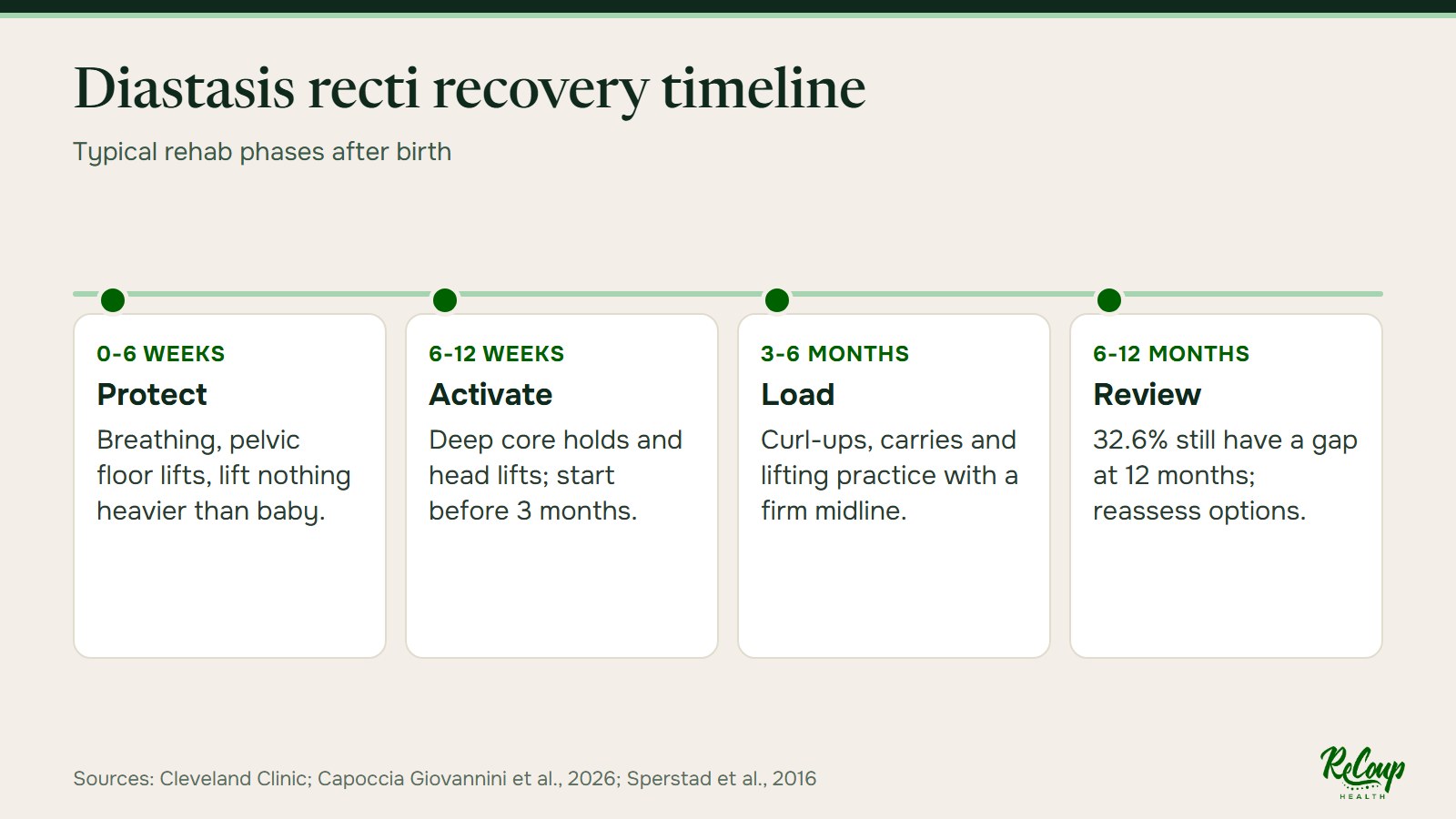
For the first 6 weeks, Cleveland Clinic advises lifting nothing heavier than your baby. Roll onto your side to get out of bed. A structured postnatal core program then moves through each phase with regular checks. Those checks also apply to mothers whose birth was several years ago.
Can You Fix Diastasis Recti Years Later?
Yes, you can fix diastasis recti years later, because the abdominal muscles still respond to training long after birth. Cleveland Clinic states that exercise can repair the separation years after the last delivery. The gap stays common well beyond the postpartum year. Kaufmann and colleagues found a gap over 2 cm in 57% of 329 adults.
Gluppe and colleagues ran a 12-week trial in 70 women who were 6 to 12 months postpartum (Journal of Physiotherapy, 2023). The program still produced a 9 Nm gain in abdominal strength. Those strength gains raise a key question about whether exercise alone is enough.
Can You Fix Diastasis Recti Without Surgery?
Yes, you can fix diastasis recti without surgery in mild to moderate cases, with exercise as the first-line treatment. Mothers who ask can you fix diastasis recti without surgery deserve a clear view of what exercise changes. Capoccia Giovannini and colleagues pooled 9 randomised trials with 450 participants and found an 8.05 mm average gap reduction.
An earlier review reached a softer conclusion. Benjamin and colleagues pooled 16 trials with 698 postnatal women in Physiotherapy in 2023. Abdominal exercise reduced the gap by 0.43 cm compared with usual care, a change the authors judged not clinically significant.
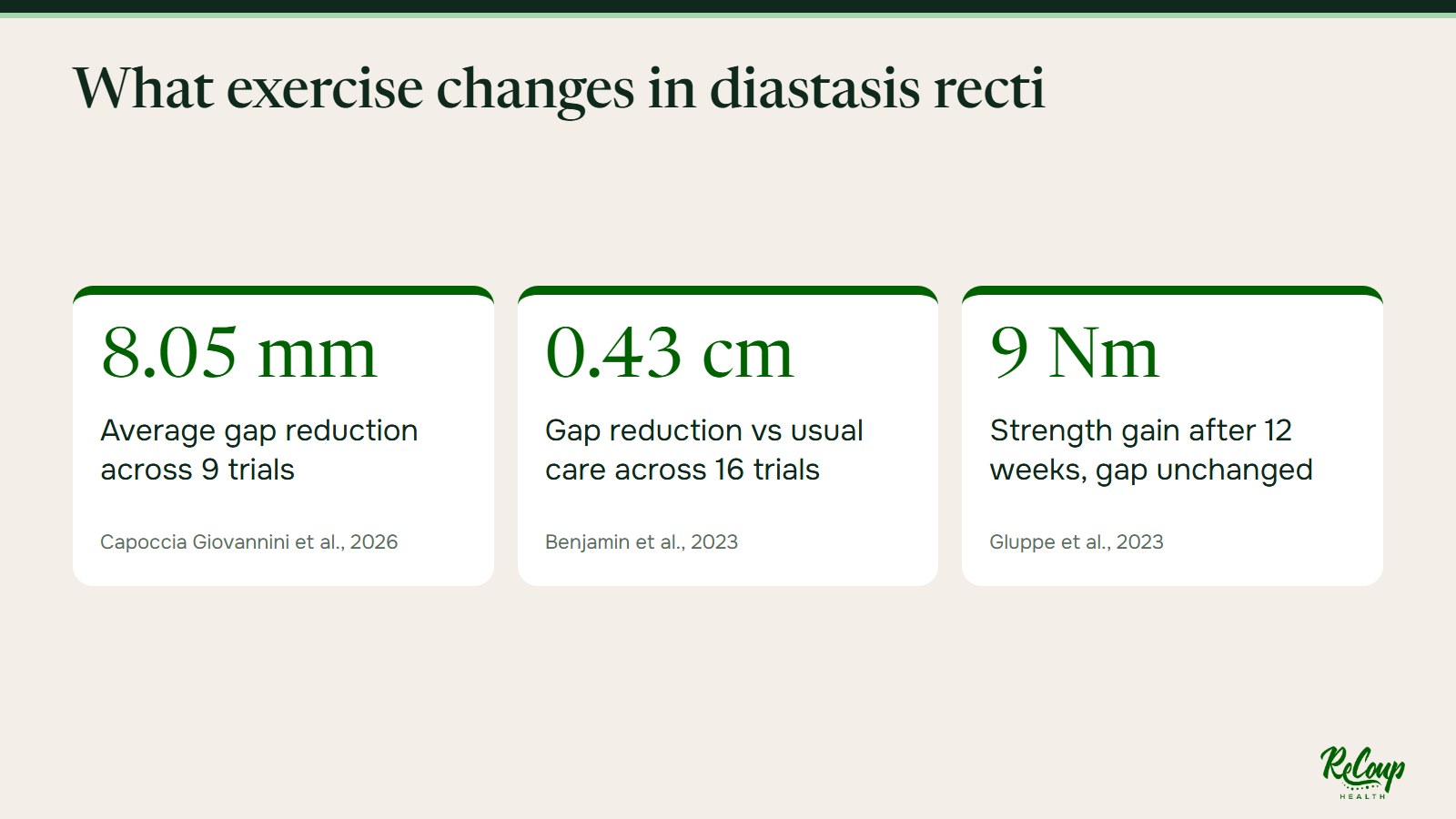
The Gluppe 2023 trial explains part of that gap between reviews. The 12-week program left the gap unchanged at 1 mm, yet rectus abdominis thickness rose 0.7 mm and strength rose 9 Nm. The graphic below compares these 3 results side by side.
A fixed diastasis recti means a firm midline, no doming under load and comfortable daily lifting. Guided core strength physiotherapy measures those markers alongside the gap. Strength and firmness also shape how flat the belly looks.
Can I Get a Flat Tummy With Diastasis Recti?
Yes, a flatter tummy with diastasis recti is possible, but gap width alone does not decide belly shape. Gluppe and colleagues surveyed 460 first-time mothers in Norway in BMC Women’s Health (2022). In that survey, 73.3% had worried during pregnancy about how their belly would look after birth.
Belly shape also depends on abdominal fat, skin laxity and muscle tone. Exercise improves tone, while surgery addresses the gap and loose skin for those who still need more.
When Is Surgery to Fix Diastasis Recti Needed?
Surgery to fix diastasis recti is needed for an umbilical hernia, a severe gap or symptoms that persist after rehab. Cleveland Clinic notes that surgery is generally considered for an umbilical hernia or a requested tummy tuck. An umbilical hernia is a bulge of tissue pushing through the weak area at the belly button.
Mommers and colleagues reviewed 1,691 patients in Surgical Endoscopy in 2017, and open repair was used in 85%. Olsson and colleagues followed 60 women who had a plication, a surgical tuck of the linea alba (BJS Open, 2019). Trunk function improved in 98%, and no recurrence appeared on CT scans at 1 year.
Those surgical results come without an untreated comparison group, so the evidence stays limited. Cleveland Clinic adds that the gap can return with later pregnancies, so timing matters for growing families. Planned abdominal surgery rehab rebuilds core strength before and after the operation. Surgery is one piece, and several other questions shape the full plan.
What Else Should You Know Before Healing Diastasis Recti?
Before healing diastasis recti, you should know how pregnancy, running, manual therapy, binders and warning signs fit into your plan. Learning how to heal diastasis recti also means knowing which choices help and which ones only feel helpful.
Can You Fix Diastasis Recti During Pregnancy?
No, you cannot fully fix diastasis recti during pregnancy, because the gap widens as the baby grows. Ultrasound found a gap in 100% of first-time mothers at week 35 in the Fernandes da Mota study. Benjamin and colleagues found no trials of treatment during pregnancy in their 2023 review.
The goal of how to fix diastasis recti during pregnancy shifts to protection through breathing, pelvic floor work and lifting with control. Our pregnancy core support keeps exercise safe in each trimester. Talk to your family doctor or midwife before starting any new exercise while pregnant.
Does Running Help Diastasis Recti?
No, running does not directly help diastasis recti close, and no trial in the reviews above tested running for the gap. The question does running help diastasis recti has a practical answer. Run once your core handles impact without doming or leaking.
A graded plan with return-to-sport physiotherapy builds hopping, single-leg strength and short running intervals in order. Hands-on care raises a different question.
Can a Chiropractor Help With Diastasis Recti?
A chiropractor can help with diastasis recti related back and pelvic discomfort, but chiropractic care does not close the gap. Patients who ask can a chiropractor help with diastasis recti should know no reviewed trial tested chiropractic or osteopathy on the gap.
Joint and soft-tissue options include pregnancy chiropractic care for the low back and pelvis during and after pregnancy. Manual therapy belongs next to an exercise plan that loads the midline.
Rib and diaphragm stiffness after birth can limit deep breathing. Some mothers find gentle osteopathy helps the rib cage move more freely during breathing drills. Comfort aids such as belly binders raise a similar question.
Does a Belly Binder Fix Diastasis Recti?
No, a belly binder does not fix diastasis recti, because a binder supports the belly without healing the separation. Cleveland Clinic states that an elastic belly band gives support and can remind you to use your core. A binder does not strengthen the core muscles that hold the midline together.
How Do You Fix Diastasis Recti in Men?
Fix diastasis recti in men with the same progressive core program, plus attention to lifting technique and abdominal fat. Cleveland Clinic lists heavy weightlifting, constipation and sudden weight change as causes of the gap in men. Kaufmann and colleagues linked older age and higher BMI to the gap in adults.
What Happens If You Leave Diastasis Recti Untreated?
Diastasis recti left untreated can persist, and Cleveland Clinic lists an umbilical hernia as a possible complication of severe or untreated separation. The pain link is weaker than many websites suggest. Sperstad and colleagues found similar lumbopelvic pain in women with and without the gap at 12 months postpartum.
Gluppe and colleagues found no greater rate of pelvic floor disorders or low back pain in women with the gap (Physiotherapy, 2021). Back pain after birth still deserves care, and postpartum back pain has many causes besides the gap. Some symptoms need faster help than a clinic visit.
Which Warning Signs Need Urgent Care During Diastasis Recti Rehab?
Warning signs that need urgent care during diastasis recti rehab include a painful bulge that will not go back in. The NHS advises urgent help for hernia pain with vomiting, a swollen tummy, constipation, a high temperature or sudden confusion. Cleveland Clinic adds that a hernia that changes colour or goes numb needs medical attention right away.
Go to the emergency department for these signs. Talk to your family doctor or physiotherapist about leaking, pelvic heaviness or new pain alongside a gap.
Frequently Asked Questions About Healing Diastasis Recti
Can Diastasis Recti Cause a Big Belly?
Yes, diastasis recti can cause a belly that bulges above or below the belly button. In the Gluppe 2022 survey, 20.9% of first-time mothers reported a midline protrusion at 6 to 8 months postpartum.
Does Diastasis Recti Need to Be Fixed?
Diastasis recti needs treatment when it causes weakness, doming, a hernia or concern about function. A small gap without symptoms can be monitored by a physiotherapist or family doctor.
Can Pilates Fix Diastasis Recti?
Pilates can help fix diastasis recti when it progresses load and avoids early doming. The 2026 Capoccia Giovannini review found no significant difference between exercise types.
Is It Hard to Fix Diastasis Recti?
Fixing diastasis recti takes steady work over months rather than hard work over days. The 12-week Gluppe program asked for training 5 days a week.
Do Pelvic Floor Exercises Close the Gap?
No, pelvic floor exercises alone did not close the gap in a 2018 trial of 175 first-time mothers. The risk of a gap stayed nearly identical between the exercise and control groups at 6 and 12 months postpartum.
How Does Recoup Health Help You Heal Diastasis Recti?
Recoup Health helps you heal diastasis recti with a physiotherapy-led core program that combines assessment, graded exercise and pelvic floor care. We measure the gap, test midline tension and watch for doming before we set your first exercises.
Our multidisciplinary clinic in Vaughan brings several kinds of care under one roof. You can meet our postnatal physiotherapists, along with a chiropractor and registered massage therapists. No doctor’s referral is needed to start.
Tight back and neck muscles from feeding and carrying a baby add to core strain. Sessions of postpartum massage ease that tension while your exercise program does the rebuilding work.
Understanding how to fix diastasis recti is easier with a clear plan and regular measurements. Request a visit through our core assessment booking page when you are ready to begin.
New and returning mothers can start at any stage, from late pregnancy to years after birth. Each stage calls for different exercises, different loads and different checks on the midline. The clinicians at Recoup Health care match each phase of rehab to your goals.