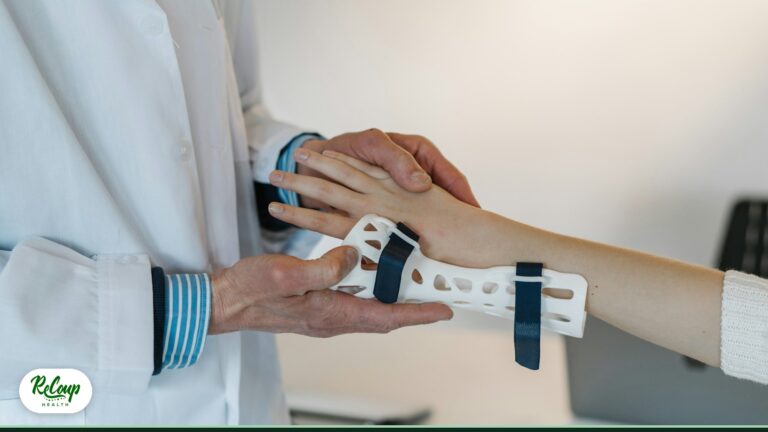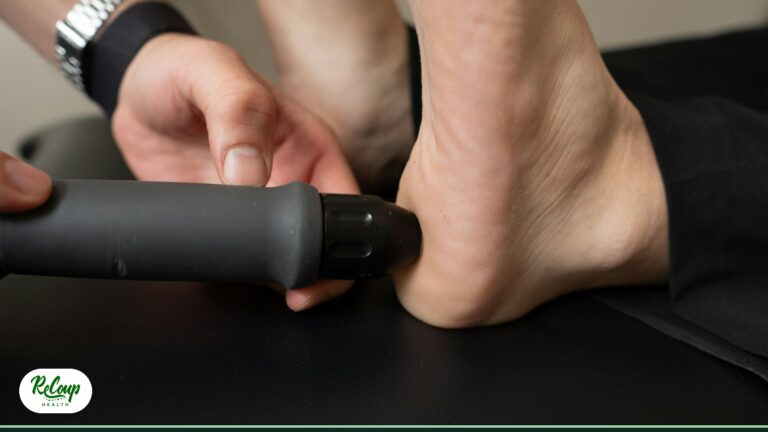

Yes, insoles for plantar fasciitis can ease heel pain when they pair firm arch support with a deep heel cup. A 2018 British Journal of Sports Medicine review of 19 trials found a small medium-term pain drop versus sham insoles. Insoles work as one part of care. Physiotherapy adds the stretching, strengthening and load advice that help the plantar fascia recover.
Key Takeaways
- Foot orthoses gave a small medium-term pain benefit over sham insoles in a 19-trial review from 2018.
- Contoured full-length insoles outperformed heel cups in a 2019 review of 2,837 patients.
- Store-bought and custom insoles performed about the same for pain in two 2018 meta-analyses.
- Plantar fascia stretching showed a larger short-term effect than custom orthoses in a 2021 review of 51 trials.
- More than 90% of people improve within 10 months of simple treatment, according to AAOS.
Do Insoles for Plantar Fasciitis Actually Work
Insoles do work for plantar fasciitis, with research showing a small but real drop in pain over the medium term. Whittaker and colleagues pooled 19 trials with 1,660 participants in the British Journal of Sports Medicine in 2018. Foot orthoses beat sham insoles for medium-term pain, based on moderate-quality evidence. The same review found no clear gain in foot function.
Insole research does not all agree. Rasenberg and colleagues compared 8 orthosis types across 20 studies in a second 2018 review. That review found no meaningful short-term pain difference between store-bought, custom and sham insoles. A 2008 Cochrane review also rated the plantar fasciitis evidence as unclear, while noting orthoses were safe in every included study.
The honest answer to “do insoles work for plantar fasciitis” is yes, with limits. Insole benefit depends on the right shape, a good fit and a wider recovery plan. A foot and gait check helps match the insole to your arch, and our custom-moulded insoles start there. That match matters because of how insoles change the load on the foot.
How Do Plantar Fasciitis Insoles Work
Plantar fasciitis insoles work by supporting the arch and cradling the heel, so the plantar fascia stretches less with each step. The plantar fascia is a thick band of tissue that runs from the heel bone to the toes. That band holds up the arch and tightens every time the foot pushes off.
Plantar fasciitis is irritation and overload of that band where it attaches to the heel. The NHS describes the main symptom as pain on the bottom of the foot around the heel and arch. NHS guidance adds that the pain is worse with the first steps after sleeping or resting. A good insole changes the load on the fascia in three ways:
- Arch support: a firm contour under the arch limits how far the arch drops and how far the fascia stretches.
- Heel cup: a deep, rigid cup centres the fat pad under the heel bone for natural cushioning.
- Shock absorption: a cushioned heel layer softens the impact at heel strike on hard floors.
Those three features explain why the NHS lists insoles among its options for heel pain that does not settle with self-care. Feature quality varies widely between products, so the next step is choosing the right type of insole.
What Type of Insoles for Plantar Fasciitis Should You Choose
The type of insoles for plantar fasciitis to choose is a firm, contoured, full-length insole with a deep heel cup. Schuitema and colleagues reviewed 43 articles with 2,837 patients in the Journal of Sport Rehabilitation in 2019. Contoured full-length insoles outperformed heel cups for plantar fasciitis in that review.
Heel inserts for plantar fasciitis, such as gel heel cups, add cushioning under the heel. Heel inserts give less arch support than a full-length contoured insole. WebMD notes that heel cups are a low-cost option but do not work as well as full inserts. WebMD also states that research has not shown magnetic insoles to work.
Arch height matters as much as insole type. AAOS lists both flat feet and a high arch as risk factors for plantar fasciitis. A flat foot needs firm support that stops the arch collapsing. A high arch needs a contour that fills the gap under the foot and spreads pressure. Matching the arch leads to the next decision, store-bought insole or custom orthotic.
Are Custom Orthotics for Plantar Fasciitis Better Than Store-Bought Insoles
Custom orthotics for plantar fasciitis are not clearly better than store-bought insoles for pain, based on current trials. Whittaker’s 2018 review found custom and prefabricated orthoses gave similar results. Rasenberg’s 2018 review measured a mean difference of only 0.03 between the two for short-term pain. The table below compares the two options, with the main difference first.
| Feature | Store-bought insoles | Custom orthotics |
|---|---|---|
| Main difference | Mass-produced shapes sorted by arch height | Moulded to a cast or scan of your own foot |
| Pain evidence | Similar short-term pain relief to custom (Rasenberg 2018) | Small benefit, SMD 0.41 short term and 0.55 medium term (Morrissey 2021) |
| Fit for unusual feet | Limited shapes and sizes | Suits marked flat feet, high arches or uneven foot shapes |
| Place in care | First step alongside stretching and taping | Step-up option when pain is not improving (Morrissey 2021) |
The table shows that fit and foot shape, not price, decide which option suits you. Morrissey and colleagues reviewed 51 trials in 2021 and placed custom orthoses later in care, for people not improving on core treatment. A custom device makes sense for a foot shape that store-bought insoles cannot match. Our orthotic gait assessment helps sort out which group your foot falls into. Whichever insole you pick, the way you wear it in the first weeks shapes the result.
How Long Should You Wear Insoles for Plantar Fasciitis Each Day
Wear new insoles for a few hours on day one, then add time each day until you wear them all day. Insole makers’ break-in guidance recommends this gradual start so the foot adapts to the new shape. A slow build-up gives the arch muscles and skin time to adjust.
Daily wear time matters because the plantar fascia is loaded with every step. Cleveland Clinic advises against walking barefoot and against flat shoes with no built-in arch support. Insoles help when they sit in the shoes you wear for the longest part of the day. Keep a supportive pair of shoes or slippers by the bed for the first steps in the morning, as WebMD advises.
Insole use should continue through recovery, which can take months. AAOS reports that more than 90% of people improve within 10 months of simple treatment. A slow break-in also lowers the chance that new insoles make the pain worse.
Can Insoles Make Plantar Fasciitis Worse
Insoles can make plantar fasciitis worse when the arch is too high, the fit is wrong or the break-in is too fast. Mild awareness of the insole in the first days is normal. Sharp pain, new pain in another spot or numbness is a sign to stop and get the insole checked.
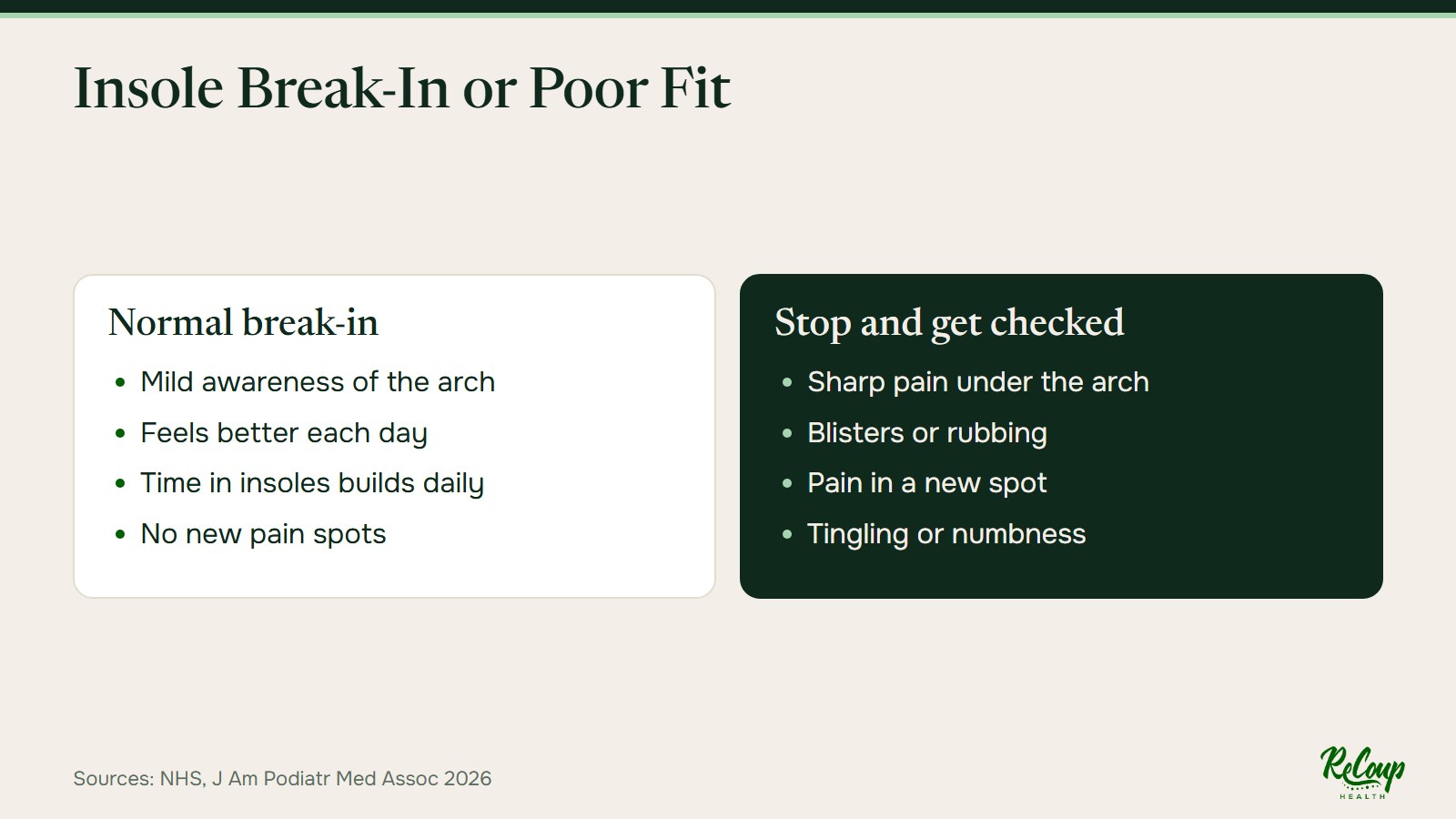
The graphic above compares normal break-in feelings with warning signs of a poor insole fit. Numbness deserves extra care. A 2026 review of 459 plantar fasciitis patients in the Journal of the American Podiatric Medical Association found neurological findings in 49%. Tingling or numbness in the foot is a reason to see a doctor, according to the NHS. An insole cannot fix a nerve problem, which is one reason insoles work better inside a physiotherapy plan.
Why Pair Insoles With Physical Therapy for Plantar Fasciitis
Physical therapy for plantar fasciitis pairs well with insoles because insoles reduce load while exercise builds the tissue’s tolerance to load. Morrissey and colleagues reviewed 51 trials with 4,351 participants in the British Journal of Sports Medicine in 2021. That review named taping, stretching and individualised education as core treatment.
The same 2021 review measured how much each option helped. Plantar fascia stretching showed a standardised effect of 1.21 for short-term first-step pain. Taping scored 0.47, and custom orthoses scored 0.41 in the short term. Those numbers place insoles as a helpful support, while stretching carries more of the short-term load.
Stretching type also matters. DiGiovanni and colleagues tested 101 patients in 2003. Plantar fascia-specific stretching beat Achilles stretching at 8 weeks for first-step morning pain. A physiotherapist teaches that stretch, checks your technique and progresses the exercise. Our plantar heel physiotherapy combines that exercise work with insole advice in one plan, which follows a clear sequence.
What Does a Physiotherapy Plan for Plantar Fasciitis Heel Pain Include
A physiotherapy plan for plantar fasciitis heel pain includes an assessment, insole fitting, stretching, strengthening and a graded return to activity. Each step builds on the one before. The five steps below show how insoles fit inside that plan:
- Assess the foot and ankle. A physiotherapist checks ankle range, arch shape and nerve signs. A 2003 study linked ankle bend of 0 degrees or less to an odds ratio of 23.3 for plantar fasciitis.
- Fit the insole. The physiotherapist matches insole firmness and arch height to your foot, your shoes and your daily standing time.
- Stretch the plantar fascia. AAOS suggests holding the stretch for 10 seconds and repeating it 20 times per foot, in the morning before standing.
- Strengthen with heavy load. Canadian Family Physician advises high-load strengthening exercises daily for at least 3 months or until the pain stops. Hands-on work such as soft-tissue massage therapy can sit alongside that exercise program.
- Return to activity in stages. Walking, standing and sport time increase step by step, guided by pain the next morning.
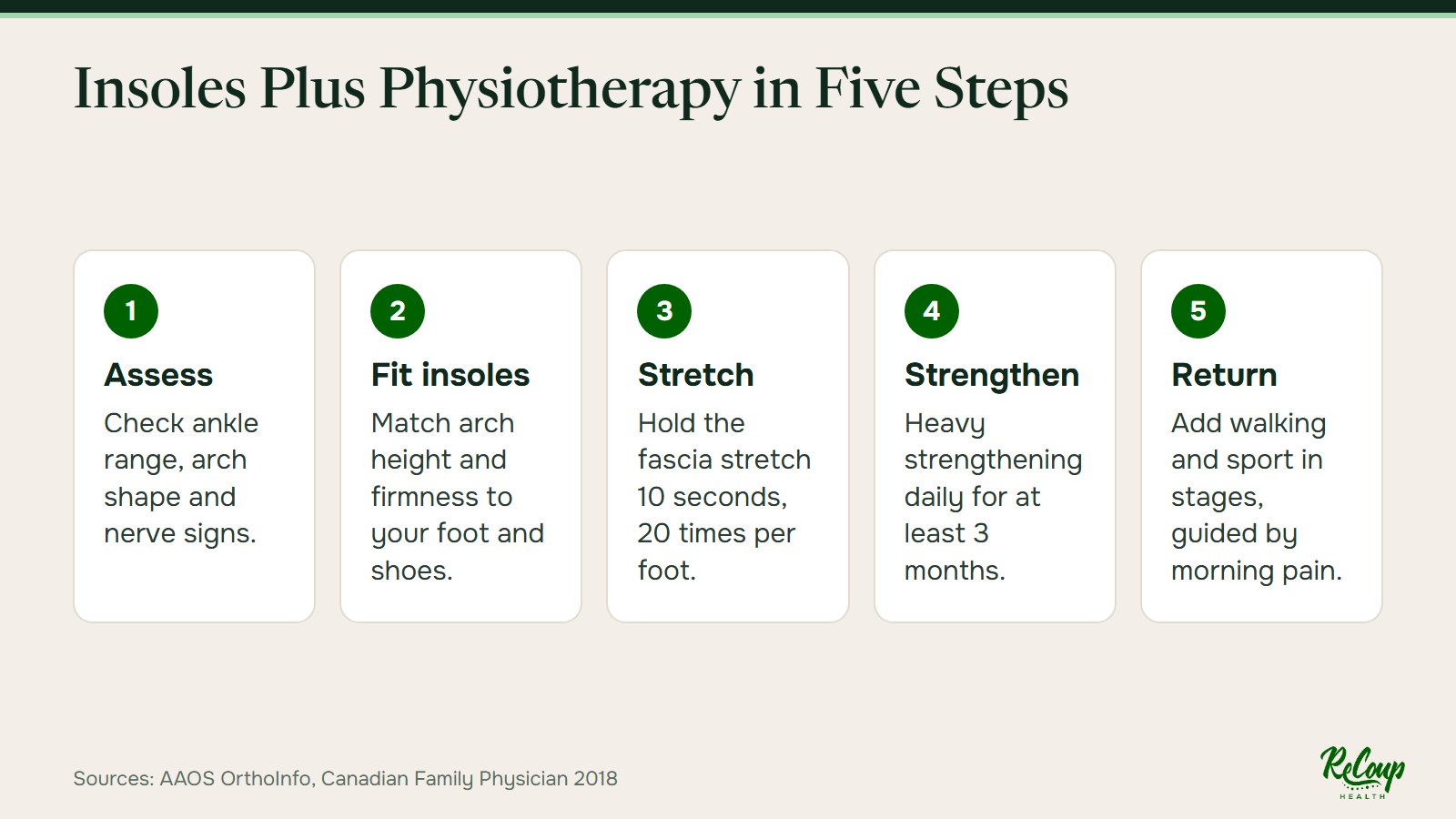
The steps graphic summarizes the same five-stage plan for quick reference.
Hands-on care adds short-term relief on top of exercise. A 2026 Physical Therapy review of 24 trials found short-term pain gains from manual therapy, dry needling and laser. Those gains were measured against home exercise alone. Some people also find fascial stretch sessions eases calf and hamstring tightness that pulls on the heel. That combined plan sets the timeline for recovery.
How Long Does Plantar Fasciitis Take to Improve With Insoles and Physiotherapy
Plantar fasciitis takes up to 10 months to improve for more than 90% of people who start simple treatment, according to AAOS. Canadian Family Physician reported in 2018 that symptoms tend to improve within a year of onset. The same article noted that about 40% of patients still have symptoms at 2 years.
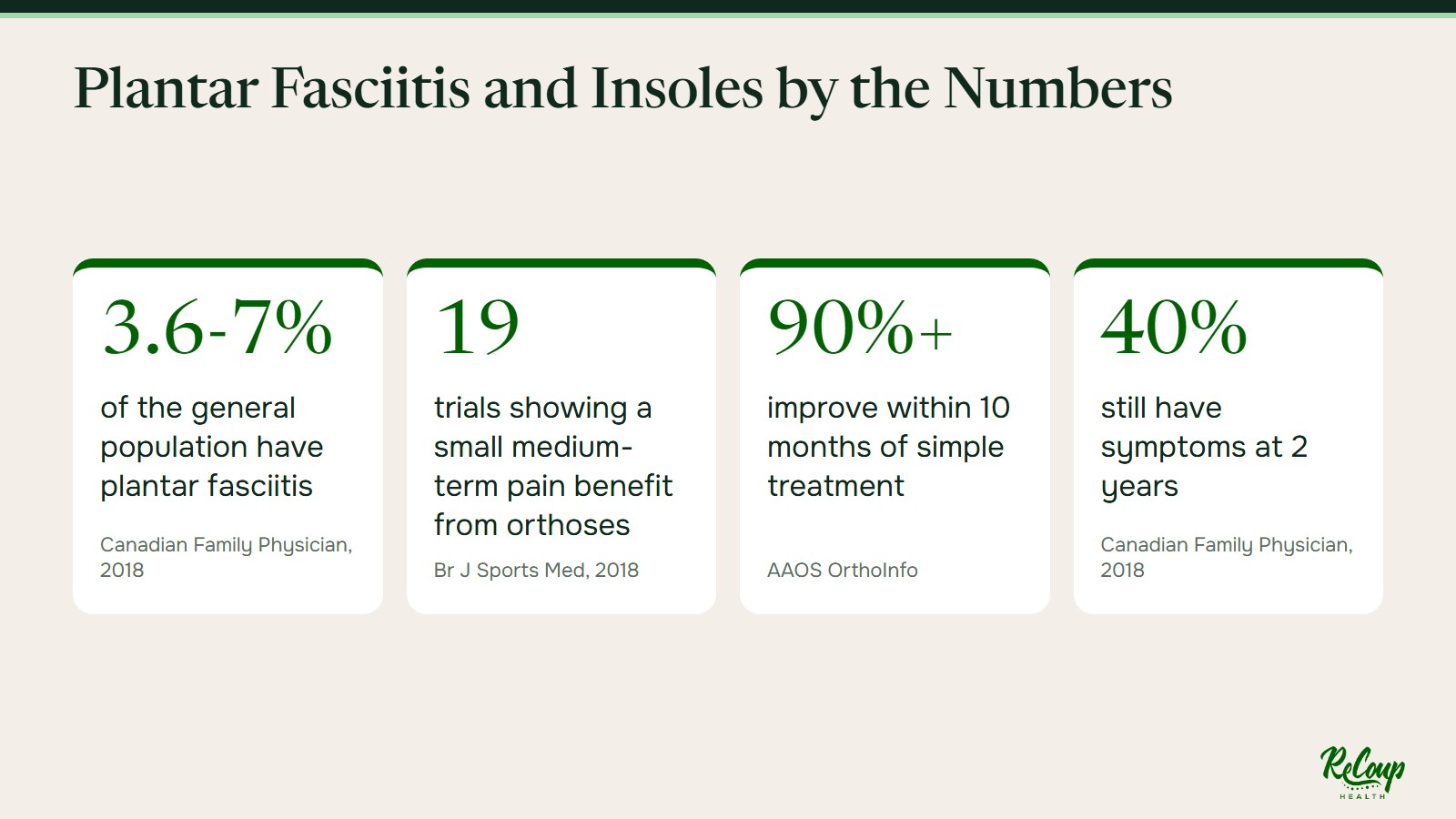
The statistics graphic above brings these recovery figures together. Canadian Family Physician estimates plantar fasciitis affects 3.6% to 7% of the general population. That article advises seeing a family physician when symptoms last beyond 6 months on a loaded exercise program. AAOS reserves surgery for people with no improvement after 12 months of nonsurgical treatment. Slow progress is common, so a few side questions about insoles and heel pain are worth answering next.
What Else Should You Know About Insoles and Heel Pain
Insoles and heel pain raise several practical side questions about flat feet, running, braces, socks and warning signs. The short answers below cover each one.
Which Insoles for Plantar Fasciitis and Flat Feet Work
Insoles for plantar fasciitis and flat feet work when they firmly support the inner arch without forcing it too high. AAOS lists flat feet as a risk factor for plantar fasciitis. A soft, flat cushion does little to stop a low arch from collapsing. A foot that rolls in strongly may need low-arch orthotics moulded to its shape. That support also matters for people who run.
Is Running With Plantar Fasciitis Safe With Insoles
Running with plantar fasciitis is possible with insoles when pain stays mild and settles by the next morning. Canadian Family Physician reports that plantar fasciitis accounts for up to 8% of running-related injuries. Insoles reduce load, but they do not replace a gradual build of distance and pace. A return-to-run program sets weekly limits based on how the heel responds. Runners with stiff ankles sometimes also ask about splints and braces.
Do Night Splints or Braces Help With Insoles
Night splints help with insoles, as Schuitema’s 2019 review found the combination improved pain and function more than either device alone. A night splint holds the foot at a right angle during sleep, so the fascia stays gently stretched. AAOS describes night splints as very effective, though recent trial evidence is limited. For people with a past ankle injury, supportive ankle braces can add stability during sport. Braces and splints are different from compression garments.
Do Compression Socks Help Plantar Fasciitis
Compression socks have no verified trial evidence for plantar fasciitis, so we make no pain-relief claim for them. Some people like the snug feel around the arch. Compression garments have other uses, such as graduated compression stockings for tired or heavy legs after long days standing. Heel pain still calls for load control, which leads to the habits that make it worse.
What’s the Worst Thing You Can Do for Plantar Fasciitis
The worst thing you can do for plantar fasciitis is keep loading a painful heel with no support, rest or plan. Cleveland Clinic warns against barefoot walking and flat shoes without arch support. Repeated steroid injections carry their own risk. A 2017 Cochrane review recorded 2 plantar fascia ruptures among injection side effects. Some warning signs mean the heel needs a professional check.
When Should Heel Pain Be Checked by a Professional
Heel pain should be checked by a professional when it has not improved after 2 weeks of self-care, according to the NHS. Seek urgent care for sudden severe pain, a popping feeling in the sole, fever or a hot, red foot. The NHS also advises early assessment for people with diabetes and for anyone with tingling or loss of feeling. Heel pain lasting many months may need persistent pain management that looks beyond the foot. Talk to your family doctor or physiotherapist about any symptom that feels different from your usual pain.
Frequently Asked Questions About Insoles for Plantar Fasciitis
Is Walking Good for Plantar Fasciitis
Walking is fine for plantar fasciitis in supportive, cushioned shoes. WebMD advises limiting how long and how far you walk when the pain gets worse.
Can Insoles Fix Plantar Fasciitis on Their Own
Insoles alone are not a complete fix for plantar fasciitis. The 2021 Morrissey review named stretching, taping and education as core care, with orthoses as a later add-on.
What Helps Plantar Fasciitis Overnight
A night splint and a plantar fascia stretch before your first steps help plantar fasciitis overnight. AAOS suggests stretching the sole in the morning before standing.
Who Is Most Likely to Get Plantar Fasciitis
People aged 40 to 60 are the most likely to get plantar fasciitis, according to AAOS. A 2016 meta-analysis also linked a body mass index over 27 to 3.7 times higher odds.
Do You Need a Referral for Insoles
You do not need a doctor’s referral to book an insole or orthotic assessment at our clinic. A physiotherapist can check your feet and footwear at the first visit.
How Recoup Health Helps With Insoles and Plantar Fasciitis Recovery
Recoup Health helps with plantar fasciitis by combining insole or orthotic fitting with a physiotherapy exercise plan in one place. We assess the foot, ankle and gait, then match support to your arch and daily load. Your plan covers stretching, strengthening and a staged return to walking, work or sport.
Our multidisciplinary team includes three physiotherapists, three registered massage therapists and a chiropractor. That team shares one plan, so insoles for plantar fasciitis, exercise and hands-on care work together. Patients from Vaughan and nearby areas can book without a referral.
The team at Recoup Health physiotherapy will check your current insoles and footwear at the first visit. Bring the shoes you wear every day so the fit check reflects real life.
To arrange that visit, use our clinic booking form and note your heel pain history.