

A shoulder pain new treatment such as platelet-rich plasma (PRP), shockwave, a nerve block or hydrodilatation helps select cases. The evidence is still modest. A 2026 review of 1,137 patients found physiotherapy outperformed injections for partial rotator cuff tears. Exercise-based care stays first-line, and newer options suit shoulders that stall.
Key Takeaways
- PRP matched steroid injections at 3 months and gave a small, modest gain at 6 months across 10 trials.
- High-energy shockwave helps calcific tendinitis, according to a 28-trial review in Annals of Internal Medicine, but not other tendon pain.
- Nonsurgical care relieves pain and improves function in 80 to 85% of rotator cuff tears, according to AAOS OrthoInfo.
- The NHS advises 2 weeks of self-care, then 6 to 8 weeks of shoulder exercises to stop pain returning.
- Sudden severe pain, a misshapen shoulder or a numb arm needs urgent care at an emergency department.
What New Treatment for Shoulder Pain Is Available Today
A new treatment for shoulder pain today means one of five options: platelet-rich plasma, shockwave, nerve blocks, hydrodilatation or regenerative cell injections. A 2025 network meta-analysis in Orthopaedic Surgery stated there is still no gold-standard treatment for calcific tendinopathy. Each shoulder pain new treatment targets one tissue problem, so the diagnosis comes first.
A physiotherapist or family doctor confirms the source of pain before any injection or device is considered. Our team starts that diagnosis with an assessment of persistent shoulder pain that tests strength, range and the neck. Platelet-rich plasma comes first.
How Does Platelet-Rich Plasma Work for Shoulder Pain
Platelet-rich plasma works for shoulder pain by injecting a concentrate of your own platelets, which carry growth factors, into the injured tendon. A 2026 meta-analysis in Knee Surgery, Sports Traumatology, Arthroscopy pooled 10 randomized trials with 591 patients. PRP and steroid injections gave similar results at 3 to 6 weeks and at 3 months.
At 6 months, PRP showed a small edge in function and pain over steroid injections. The authors called that gain statistically significant but clinically modest. A 2025 network meta-analysis in Orthopaedic Surgery gave PRP an 85% probability of ranking first for function in calcific tendinopathy. Those ranking odds come from small trials, and calcium deposits are also the target of shockwave therapy.
Does Shockwave Therapy Help Calcific Shoulder Tendinitis
Yes, shockwave therapy helps calcific shoulder tendinitis, a condition where calcium deposits form inside a rotator cuff tendon. Extracorporeal shockwave therapy (ESWT) sends strong sound pulses through the skin to the deposit. A 2014 review in Annals of Internal Medicine pooled 28 randomized trials. The authors found high-energy ESWT improves pain and function in chronic calcific tendinitis, with no clear gain over placebo for noncalcific tendinitis.
A 2014 meta-analysis in Clinical Orthopaedics and Related Research compared high-energy and low-energy shockwave in 5 trials with 359 participants. High-energy treatment gave 3.4 times the odds of the calcium fully clearing at 3 months. High-energy sessions are also more painful, so the energy level is a trade-off. Shockwave targets the tendon, while a nerve block targets the pain signal itself.
What Is a Suprascapular Nerve Block for Frozen Shoulder
A suprascapular nerve block is an injection of numbing medicine around the nerve that carries much of the shoulder’s pain signal. Doctors use the block for frozen shoulder, also called adhesive capsulitis, where the joint capsule thickens and tightens. A 2026 meta-analysis in the Journal of Shoulder and Elbow Surgery reviewed 8 randomized trials with 452 patients. The nerve block gave greater pain relief than a steroid injection into the joint at 3 to 12 weeks.
Patients who had the block also lifted the arm about 14 degrees higher to the side at 12 weeks. The authors reported considerable differences between trials, so results vary between people. Cooled radiofrequency ablation is a related method that uses heat to quiet the same shoulder nerves. Healthline, in a 2024 review, describes cooled radiofrequency ablation as one of the newest pain options for shoulder arthritis. Nerve treatments ease pain, while hydrodilatation works on the stiff capsule.
What Is Hydrodilatation for Frozen Shoulder
Hydrodilatation is a procedure that stretches a stiff shoulder capsule by injecting a larger volume of saline into the joint. A 2008 Cochrane review found 5 trials with 196 participants. In the one low-risk trial, saline-and-steroid distension beat placebo for pain and function at 3 weeks. The benefit at 6 and 12 weeks held for only one of two function scores.
Side effects in the Cochrane review were minor, mainly pain during the procedure. Regenerative injections, like hydrodilatation, still await stronger trials.
Are Stem Cell Injections and Newer Surgeries Proven
No, stem cell injections and newer surgeries are not yet proven standard care for shoulder pain. Stem cell and micro-fragmented fat injections use cells from bone marrow or fat to try to repair tissue. Healthline, in a 2024 review, calls these therapies emerging, with success rates not yet defined. Mayo Clinic News Network reports surgical advances such as a dissolvable balloon spacer for large rotator cuff tears.
These surgical and cell-based options suit a small group of patients after conservative care fails. A side-by-side comparison shows where each option fits.
How Do the New Shoulder Treatments Compare
The new shoulder treatments compare first by the condition each one targets, then by the strength of the evidence behind it. The table below lists each option with its trial base and its key limit.
| Treatment | Main target | Evidence so far | Key limit |
|---|---|---|---|
| Platelet-rich plasma (PRP) | Rotator cuff tendinopathy | 10 trials, 591 patients; small 6-month gain over steroid (Knee Surgery, Sports Traumatology, Arthroscopy, 2026) | Gain is clinically modest |
| High-energy shockwave | Calcific tendinitis | 28 trials pooled (Annals of Internal Medicine, 2014) | Painful; no benefit for noncalcific tendinitis |
| Suprascapular nerve block | Frozen shoulder pain | 8 trials, 452 patients (Journal of Shoulder and Elbow Surgery, 2026) | Large differences between trials |
| Hydrodilatation | Frozen shoulder stiffness | 5 trials, 196 participants (Cochrane, 2008) | Small, older evidence |
| Stem cell or fat injections | Arthritis and tendon damage | Small studies (Healthline review, 2024) | Still experimental |
The table shows that every newer option rests on a limited number of trials. Physiotherapy, by contrast, has been tested head to head against injections and surgery.
Do New Treatments Work Better Than Physiotherapy
No, new treatments do not clearly work better than physiotherapy for shoulder pain. A 2026 systematic review in JSES Reviews, Reports, and Techniques covered 22 studies and 1,137 patients with partial rotator cuff tears. Physiotherapy scored higher than injection therapy on the Constant Score, a shoulder function scale.
A 2016 Cochrane review compared manual therapy and exercise with steroid injections in 5 trials. The review found no important differences in pain or function from 4 weeks to 12 months. One trial in the same review found no important difference from arthroscopic surgery at 6 and 12 months. The Cochrane authors rated that evidence low quality, so the results point to similar outcomes rather than a clear winner.
A 2025 network meta-analysis in EFORT Open Reviews ranked comprehensive physiotherapy first for function across 33 trials of calcific tendinitis. Radial shockwave combined with physiotherapy ranked first for pain in the same analysis. That pattern explains why exercise-based physiotherapy remains the base of shoulder pain treatment without surgery.
A physiotherapy treatment for shoulder pain combines strengthening, stretching and hands-on joint mobilization. AAOS OrthoInfo reports that nonsurgical treatment relieves pain and improves function in about 80 to 85% of patients with rotator cuff tears. The graphic below summarizes these evidence figures for new and established shoulder treatments.
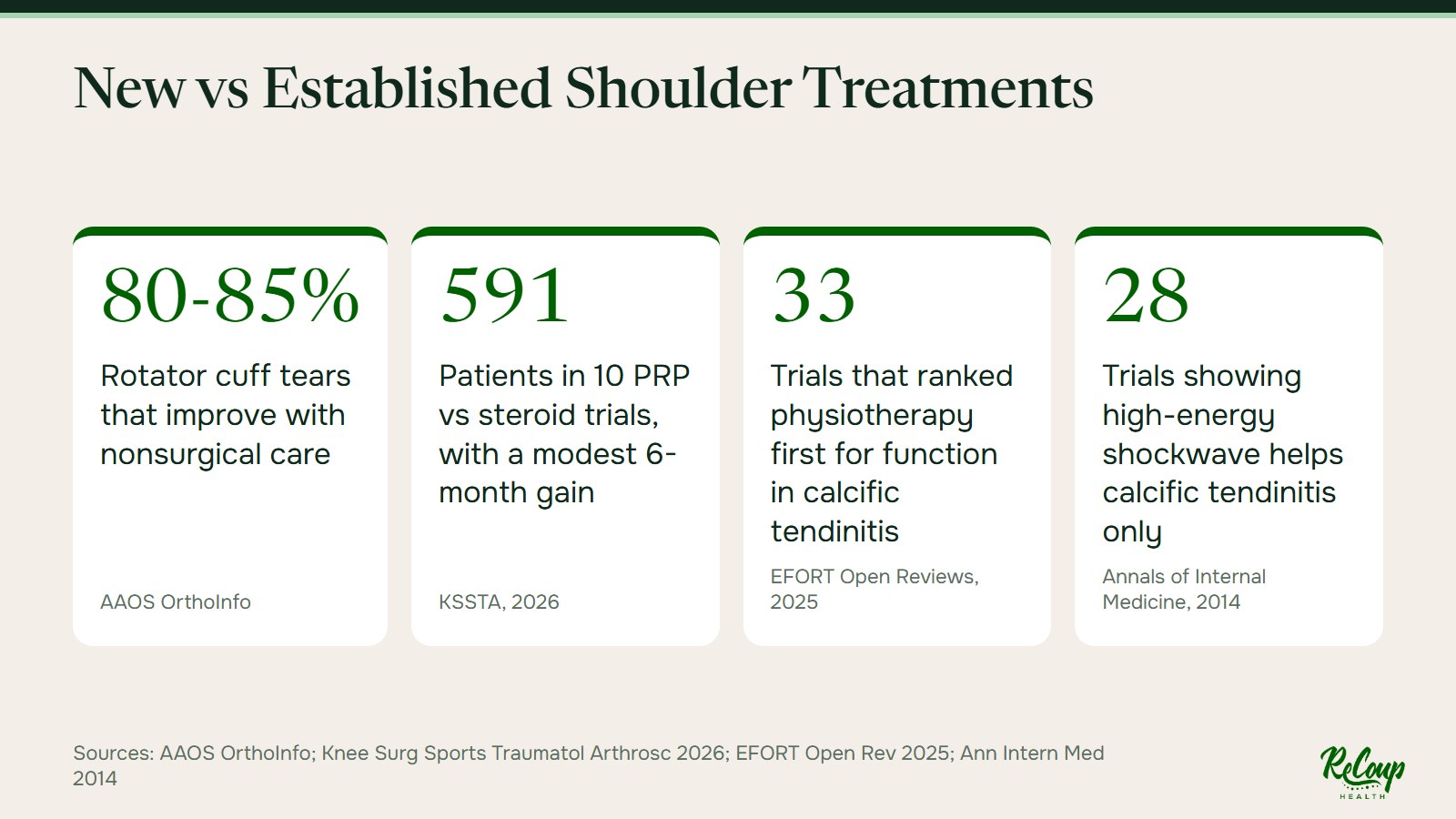
Those numbers favour starting with exercise, and exercise starts at home.
How to Relieve Shoulder Pain at Home
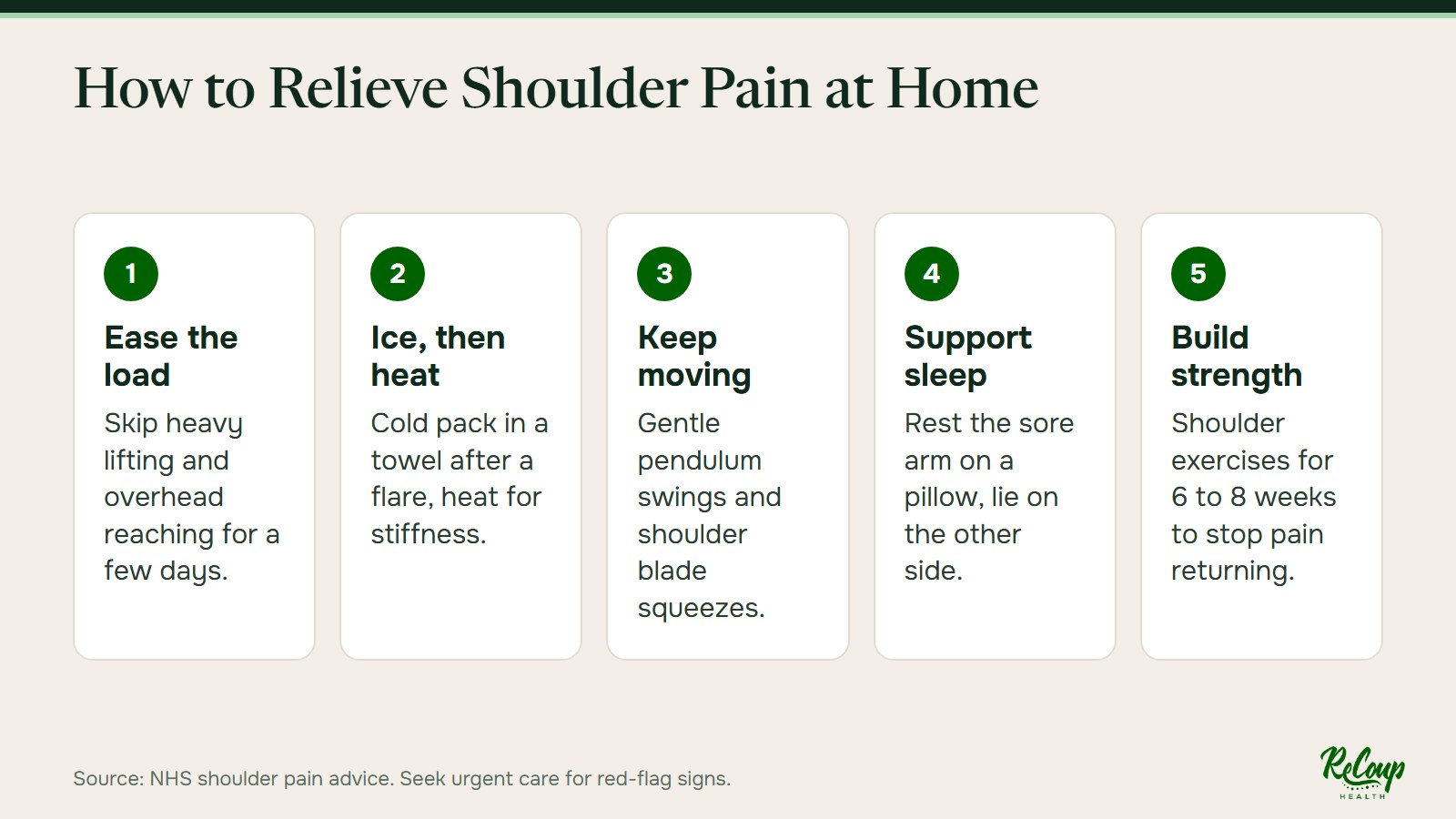
Relieve shoulder pain at home by easing heavy and overhead use, applying ice or heat, and keeping the arm gently moving. The NHS advises about 2 weeks of self-care before shoulder pain starts to ease. A simple shoulder pain home treatment follows five steps.
- Ease the load by avoiding heavy lifting and overhead reaching for a few days while doing light daily tasks.
- Use a cold pack wrapped in a towel after a flare-up, then switch to heat for stiff muscles.
- Keep the arm moving with gentle pendulum swings and shoulder blade squeezes.
- Support your sleep by resting the sore arm on a pillow and lying on the other side.
- Build strength with shoulder exercises for 6 to 8 weeks, as the NHS advises, to stop pain returning.
The steps graphic below shows the same five-step home routine for quick relief for shoulder pain.
A pharmacist can suggest an over-the-counter pain reliever that suits your health history. What helps with shoulder pain at home also depends on avoiding a few common mistakes.
What Should You Not Do With Shoulder Pain
You should not rest a painful shoulder completely, push through sharp pain or keep repeating the movement that triggers it. Complete rest lets the joint stiffen, while gentle movement keeps the joint capsule supple. Sleeping on the sore side, lifting heavy loads overhead and slouching at a desk can keep pain going. Self-care has limits, and pain that lasts for months points to a deeper cause.
What Causes Shoulder Pain That Lasts for Months
Rotator cuff disease, frozen shoulder and shoulder arthritis are the main causes of shoulder pain that lasts for months. Rotator cuff disease accounts for up to 70% of shoulder complaints, according to a 2026 JSES Reviews, Reports, and Techniques review.
Shoulder pain itself is common. A 2022 review in BMC Musculoskeletal Disorders put the median community prevalence of shoulder pain at 16%, higher in women. Frozen shoulder affects an estimated 2% to 5% of people, according to American Family Physician, 2019. AAOS OrthoInfo reports that frozen shoulder mainly affects people aged 40 to 60.
Diabetes raises the risk, and a 2016 meta-analysis found frozen shoulder in 13.4% of people with diabetes. Tendon problems respond to targeted rotator cuff rehab, while frozen shoulder needs gentle range work over many months. Telling muscle pain apart from joint pain is the next step.
How Do You Tell If Shoulder Pain Is Muscular
Shoulder pain is muscular when the ache sits in the muscle, feels tender to press and eases with heat and stretching. Joint or tendon pain tends to catch at one arm angle, wake you at night or bring weakness when lifting.
Tight upper shoulder muscles can ease with shoulder muscle massage and regular stretching. Pain that does not fade with that care raises a different question about long-term effects.
What Happens When Shoulder Pain Does Not Go Away
When shoulder pain does not go away, the shoulder can lose strength and range, and the pain can become chronic. The NHS states that recovery from shoulder pain can take 6 months or longer. Pain that has not improved after 2 weeks of self-care needs assessment, according to the NHS shoulder pain page.
Frozen shoulder can take months or years to get better, according to the NHS. AAOS OrthoInfo describes three frozen shoulder stages. The freezing stage lasts 6 weeks to 9 months, and the frozen stage lasts 4 to 6 months. The thawing stage takes 6 months to 2 years to regain near-normal motion.
Frozen shoulder stiffness can also ease with assisted shoulder stretching alongside a home program. A chronic shoulder pain treatment plan mixes graded strengthening, manual therapy and activity pacing. Pacing means spreading tasks across the day so the shoulder is not overloaded.
Our approach to long-term pain management adds education on sleep, pacing and flare-up plans. Some signs, though, need urgent care instead of a clinic visit.
Seek urgent care at an emergency department for these red-flag signs, listed by the NHS shoulder pain page:
- Sudden or very bad shoulder pain, or an arm you cannot move
- A shoulder that has changed shape or is badly swollen
- Pins and needles that do not go away, or no feeling in the arm
- An arm or shoulder that feels hot or cold to the touch
- Pain after a fall, severe pain in both shoulders, or a fever with shoulder pain
Shoulder pain with chest pain or shortness of breath needs a 911 call, because some illnesses start in the shoulder.
What Else Should You Know About Shoulder Pain Treatment
Shoulder pain treatment also raises six side questions about bursitis, illness, travelling pain, doctor visits, arthritis and surgery.
What Is Bursitis of the Shoulder
Bursitis of the shoulder is inflammation of the bursa, a small fluid-filled sac that cushions the rotator cuff. Shoulder bursitis causes pain when you lift the arm to the side or overhead. Bursitis treatment follows the rotator cuff plan of load control and exercise.
What Illness Starts With Shoulder Pain
Frozen shoulder, rotator cuff disease, arthritis and, rarely, heart or lung problems can start with shoulder pain. Cleveland Clinic notes that a heart attack, aortic dissection or pulmonary embolism can refer pain to the shoulder. Shoulder pain with chest pain or trouble breathing needs a 911 call. Cleveland Clinic adds that a rare Pancoast tumour at the top of the lung can cause shoulder blade pain.
Why Does Pain Travel Down From the Shoulder
Pain travels down from the shoulder when an irritated neck nerve or a rotator cuff tendon refers pain into the arm. Rotator cuff pain tends to stop above the elbow, while a pinched neck nerve can send tingling to the hand. A 2026 review in JSES Reviews, Reports, and Techniques notes that neck disease and rotator cuff disease commonly coexist. Gentle chiropractic joint care and neck exercises can join the plan when the neck is involved.
What Can a Doctor Do for Shoulder Pain
A doctor can examine the shoulder, order an X-ray or ultrasound, prescribe medicine and give an injection. A family doctor or walk-in clinic can also refer you to an orthopaedic surgeon for a tear that fails rehab. A 2003 Cochrane review found that steroid injection effects may be small and not well maintained. Physiotherapy turns a short pain-free window into lasting gains through a structured shoulder pain program.
What Helps Shoulder Arthritis Without Surgery
Exercise, activity changes, pain relievers and injections help shoulder arthritis without surgery. An arthritis shoulder pain treatment plan protects the strength and range that keep daily tasks possible. NYU Langone notes that these treatments ease pain and stiffness but do not reverse the arthritis. Our arthritic shoulder care pairs graded exercise with manual therapy. A bone-on-bone shoulder may still need a joint replacement, which leads to rehab after surgery.
How Is Shoulder Pain Treated After Surgery
Shoulder pain after surgery is treated with a staged rehab plan that protects the repair, then restores motion and strength. A physiotherapist then guides post-operative shoulder rehab from assisted motion to active motion and strengthening.
Frequently Asked Questions About New Shoulder Pain Treatments
Which Over-the-Counter Medicine Helps Shoulder Pain
Over-the-counter pain relievers such as acetaminophen or an anti-inflammatory can ease shoulder pain for a short time. A pharmacist or family doctor can confirm which one is safe with your health conditions and other medicines. NYU Langone notes that long-term anti-inflammatory use can cause stomach and kidney side effects.
Are Steroid Injections Still Used for Shoulder Pain
Yes, steroid injections are still used for shoulder pain, but the gains are short-term. American Family Physician, 2019, reported that steroid injections for frozen shoulder gave pain relief similar to placebo at 4 to 6 weeks. Function improved slightly more with the injection in the same review.
How Long Does Physiotherapy for Shoulder Pain Take
Physiotherapy for shoulder pain takes about 6 to 8 weeks of regular exercise, based on NHS advice. Frozen shoulder physiotherapy runs for 6 weeks or longer, according to the NHS. Full recovery can take 6 months or longer, according to the NHS.
Does Frozen Shoulder Go Away Without Treatment
Frozen shoulder goes away without treatment for many patients over 1 to 2 years, according to American Family Physician, 2019. The same review notes that some people keep limited motion for years. Treatment aims to ease pain and restore movement sooner.
How Recoup Health Helps With Shoulder Pain Treatment
Our clinic helps with shoulder pain treatment by finding the cause first, then building a plan of exercise and hands-on care. No doctor’s referral is needed to book a shoulder assessment.
Each plan is led by our shoulder care team, with chiropractic care, registered massage therapy and fascial stretch therapy as hands-on options. We also explain where any shoulder pain new treatment, such as PRP or shockwave, fits beside rehab.
Shoulder pain that lingers past 2 weeks deserves a proper assessment, and our Vaughan clinic pairs it with an exercise plan. You can contact our team to book a visit, ask about shoulder rehab or plan care around work and sport.
Our physiotherapists, chiropractor and massage therapists work as one team, so your shoulder plan stays consistent from the first visit to discharge. Shoulder patients visit the Recoup Health location on Innovation Drive for shoulder, neck and sports injury care.