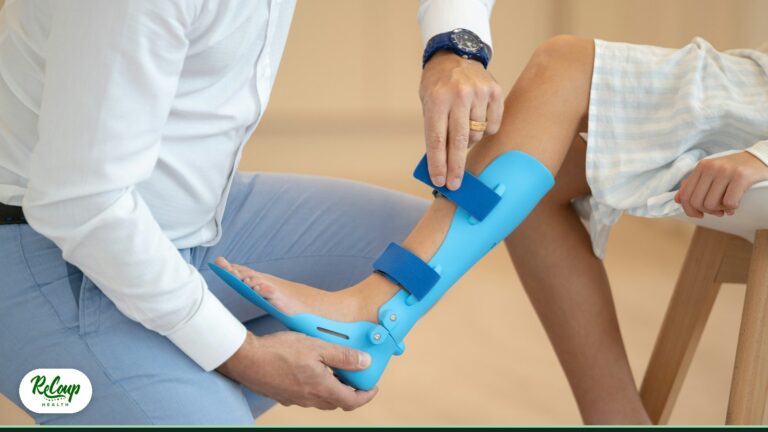

Stretches for knee pain loosen four muscle groups that pull on the knee: the quadriceps, hamstrings, calves and hip flexors. Hold each gentle stretch for 30 to 60 seconds, as the American Academy of Orthopaedic Surgeons (AAOS) advises. Stretch only to a mild pull and stop at any sharp pain. Pair the stretches with strengthening, since strong thigh and hip muscles take load off the joint.
Key Takeaways
- Stretch the quadriceps, hamstrings, calves and hip flexors, holding each stretch 30 to 60 seconds (AAOS).
- Strength work matters as much as stretching, and a Cochrane review of 139 trials found exercise lowered knee arthritis pain.
- Combined hip and knee strengthening gave the most consistent benefit for kneecap pain in a 2026 review of 15 trials.
- The AAOS suggests a 4 to 6 week program, then 2 to 3 days a week to keep the gains.
- Seek urgent care for a knee that locks, gives way, cannot take weight, or turns red and hot with a fever.
What Stretches Get Rid of Knee Pain
The stretches that get rid of knee pain target four muscle groups: the quadriceps, hamstrings, calves and hip flexors. Harvard Health Publishing explains that tight leg muscles pull harder on the tendons around the knee, which can lead to pain. Tight quadriceps, for example, can tug on the kneecap tendon and cause tendinitis, an irritated tendon.
Loosened muscles give the knee more room to move through its range. Regular stretching makes tight muscles more flexible within three weeks, according to physical therapist Jim Zachazewski in Harvard Health Publishing. Those flexibility gains last longer when stretches sit inside a structured plan, such as one of our knee exercise programs. The quadriceps stretch comes first, because the front thigh muscle attaches to the kneecap.
How Do You Do a Standing Quad Stretch for Knee Pain
Do a standing quad stretch by holding a chair, bending one knee and drawing the heel toward your buttock. The AAOS Knee Conditioning Program says to grasp the ankle, pull gently and hold for 30 to 60 seconds. You should feel the pull along the front of the thigh, not inside the kneecap.
Keep your back straight, since the AAOS warns against arching or twisting the back. A towel looped around the ankle helps when the foot sits out of reach.
How Do You Stretch Your Hamstrings Without Straining the Knee
Stretch your hamstrings without straining the knee by lying on your back and pulling on the thigh, not the knee joint. The AAOS describes the supine hamstring stretch: lie with both knees bent, lift one leg and clasp your hands behind the thigh. Straighten that leg and pull it gently toward your head until you feel a stretch behind the thigh and knee.
Keep your hands off the knee joint itself, the AAOS advises. Long hours of sitting tighten the hamstrings and can cause knee pain, according to a Hospital for Special Surgery (HSS) physical therapist.
A sudden, sharp pull in the back of the thigh points to an injury. That pull calls for a hamstring strain assessment before you stretch again. The calf muscles cross the back of the knee too, so they come next.
How Do You Stretch Your Calves for Knee Pain
Stretch your calves for knee pain by facing a wall, stepping one foot back and pressing that heel flat. The AAOS heel cord stretch keeps the back knee straight, presses the hips toward the wall and holds for 30 seconds. The program repeats the calf stretch in 2 sets of 4, 6 to 7 days a week.
The gastrocnemius, the large calf muscle, attaches just above the back of the knee. A slight bend in the back knee shifts the stretch to the soleus, the deeper calf muscle. Above the knee, the hip muscles control how the thigh lines up over the joint.
Which Hip Stretches Help Knee Pain
Hip stretches that help knee pain include the half-kneeling hip flexor stretch and a standing outer hip stretch. Harvard Health Publishing advises focusing on the hip and leg muscles to ease knee pain. For the hip flexor stretch, kneel on a cushion, step one foot forward, tuck the pelvis and shift your weight forward.
The iliotibial (IT) band is a thick strip of tissue running from the outer hip to the outer knee. IT band stretches for knee pain work through the hip muscles attached to the band. Cross one ankle behind the other while standing, then lean the hips away from the back leg until the outer hip pulls.
Some hip positions are hard to reach alone. Our therapists offer leg fascial stretching, moving the leg through each stretch for you. Whether stretching should continue while the knee hurts is the next question to settle.
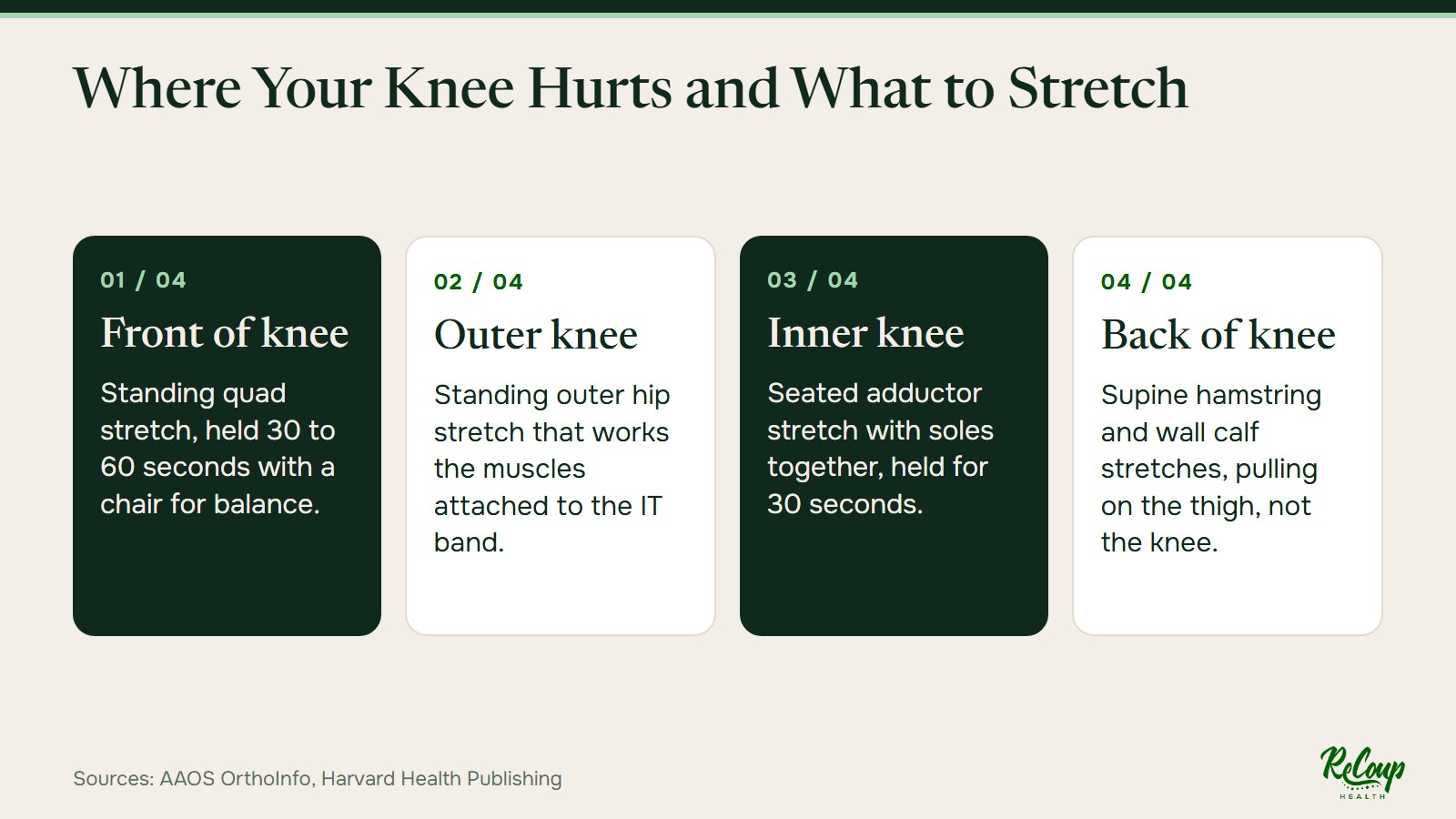
The graphic above matches each sore spot on the knee with its stretch.
Is It Good to Stretch Your Knee When It Hurts
Yes, stretching a sore knee is good when the pain comes from tight muscles and the stretch stays a mild pull. The AAOS states that you should not feel pain during an exercise. Sharp, stabbing or rising pain means stop, while a gentle muscle pull is normal.
Harvard Health Publishing suggests talking to your doctor before stretching a suspected knee or leg muscle injury. Dynamic stretching, such as marching in place for a few minutes, warms the muscles before a workout. Gentle stretches to help knee pain then follow at the end of the workout, when the muscles are warm. Getting the hold time and weekly frequency right is the next step.
How Long Should You Hold Each Knee Stretch
Hold each knee stretch for 30 to 60 seconds, then rest and repeat 2 to 3 times. Harvard Health Publishing recommends holding each static stretch for at least 30 seconds. The AAOS Knee Conditioning Program sets the doses in the table below for stretches and simple strength moves.
| Move | Type | Hold or reps | Days per week |
|---|---|---|---|
| Heel cord (calf) stretch | Stretch | 30-second hold, 2 sets of 4 | 6 to 7 |
| Standing quadriceps stretch | Stretch | 30 to 60 seconds, 2 to 3 reps | 4 to 5 |
| Supine hamstring stretch | Stretch | 30 to 60 seconds, 2 to 3 reps | 4 to 5 |
| Half squat | Strength | 5-second hold, 3 sets of 10 | 4 to 5 |
| Straight-leg raise | Strength | 5-second hold, 3 sets of 10 | 4 to 5 |
| Side-lying hip abduction | Strength | 5-second hold, 3 sets of 20 | 4 to 5 |
| Calf raise | Strength | 2 sets of 10 | 6 to 7 |
The AAOS also advises 5 to 10 minutes of low-impact warm-up, such as walking or a stationary bike, before the first stretch. The strength moves in the table matter as much as the stretches.
What Exercises Help Knee Pain Besides Stretching
Strengthening exercises help knee pain by building the thigh, hip and calf muscles that absorb load at the joint. The AAOS explains that strong muscles reduce stress on the knee and help it absorb shock. Harvard Health Publishing advises strength work at least twice a week.
Evidence for exercises for knee pain is strongest in knee osteoarthritis (OA), the wear-related form of arthritis. A 2015 Cochrane review of 54 trials found exercise cut knee OA pain by 12 points on a 0 to 100 scale. The benefit shrank to 6 points at 2 to 6 months.
Cochrane’s updated review of 139 trials and 12,468 people found a 13.14-point pain drop compared with no treatment. The authors rate certainty as low to moderate, so the effect is real but modest.
These seven exercises come from the AAOS and Arthritis UK programs:
- Half squat: lower the hips about 25 cm as if sitting in a chair, hold 5 seconds, 3 sets of 10.
- Straight-leg raise: tighten the thigh and lift the straight leg 15 to 25 cm, hold 5 seconds.
- Side-lying hip abduction: lift the top leg to 45 degrees with the knee straight, 3 sets of 20.
- Standing hamstring curl: hold a chair, raise the heel toward the ceiling and hold 5 seconds.
- Single-leg calf raise: hold a chair and rise onto the ball of one foot, 2 sets of 10.
- Sit-to-stand: rise from a chair without using your hands, then sit back down slowly.
- Step-up: step onto the bottom stair and back down, holding the bannister when needed.
Physiotherapy exercises for knee pain follow these same moves, with depth and load set to your symptoms. A program of guided knee physiotherapy checks form and progresses each move safely. The muscles these exercises load deserve a closer look.
Which Muscles Should You Strengthen for Knee Pain
Strengthen the quadriceps, hamstrings, buttock muscles and inner and outer hip muscles for knee pain. The AAOS program targets five groups: quadriceps, hamstrings, abductors (outer thigh), adductors (inner thigh) and the gluteal muscles. The answer to what muscles to strengthen for knee pain is clearest for patellofemoral pain.
Patellofemoral pain is a dull ache at the front of the knee with stairs, running, squatting or long sitting. The AAOS says physiotherapy for this condition emphasizes quadriceps, hip and core strengthening. A 2026 systematic review of 15 trials and 1,002 people found combined hip and knee programs gave the most consistent benefits. Resistance bands make that hip work easy to load at home.
Can You Use a Resistance Band for Knee Pain Exercises
Yes, band exercises for knee pain add gentle, adjustable resistance without heavy weights. The AAOS leg press loops an elastic band under the arch of the foot while you lie on your back. Press the leg straight against the band, hold 2 seconds, and repeat for 3 sets of 10.
Choose a band light enough to finish every set with good form.
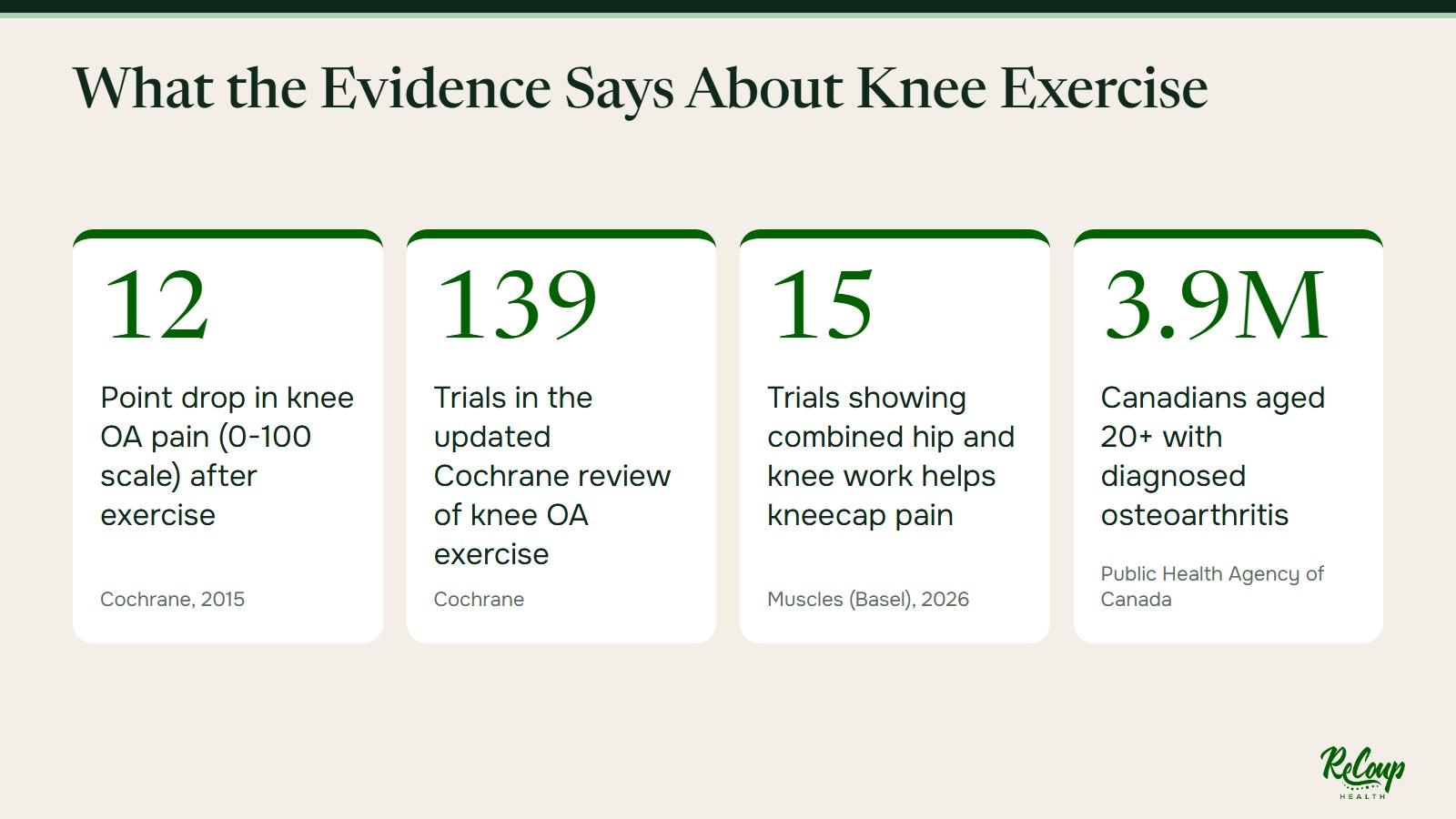
The statistics graphic above sums up the evidence behind knee exercise.
How Can You Rehab Your Knee at Home
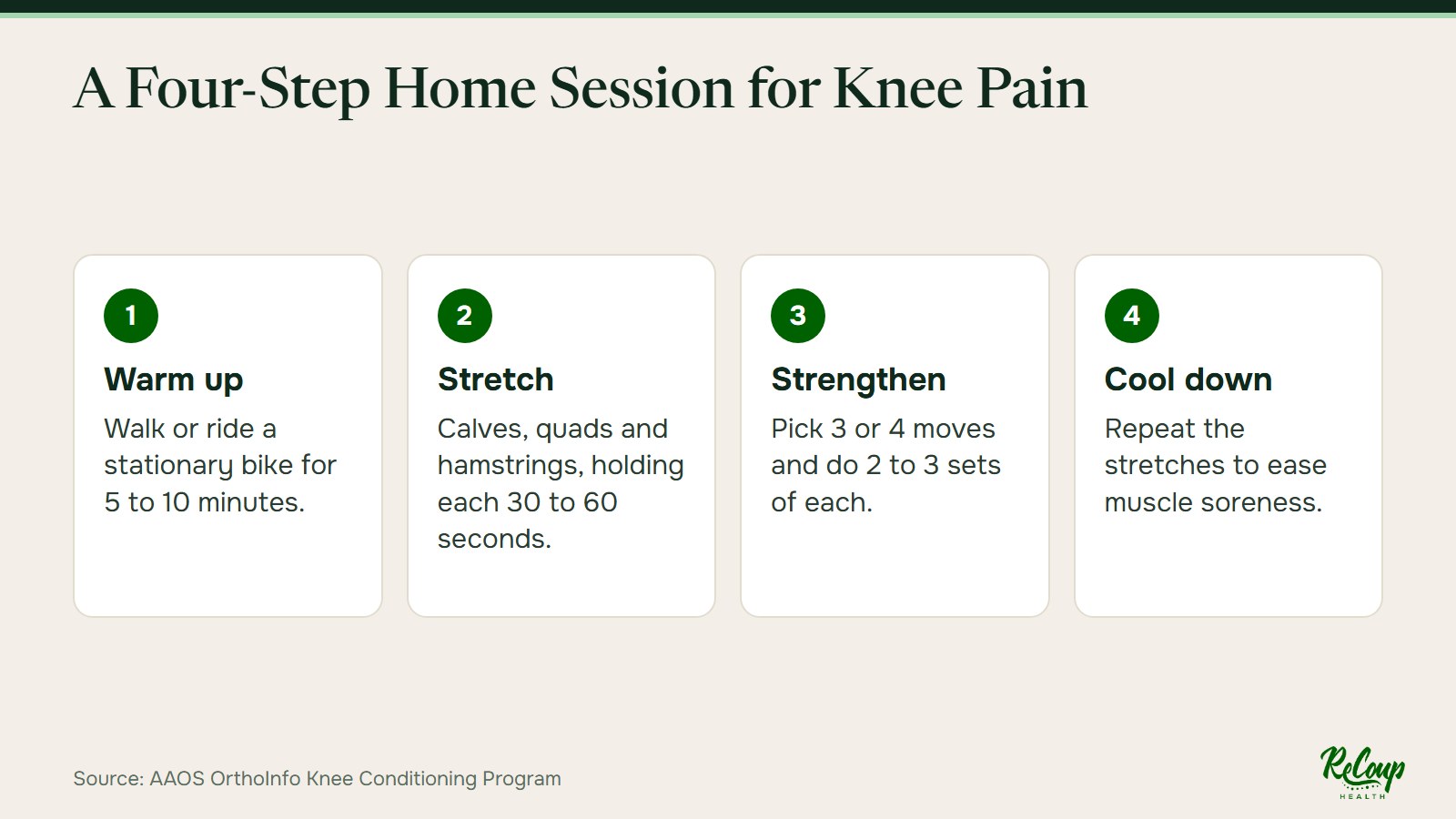
Rehab your knee at home with a four-step session: warm up, stretch, strengthen, then stretch again. The AAOS Knee Conditioning Program follows this exact order. Run the program for 4 to 6 weeks, the AAOS advises. After that, 2 to 3 sessions a week maintain the gains.
- Warm up for 5 to 10 minutes with walking or a stationary bike.
- Stretch the calves, quadriceps and hamstrings, holding each stretch 30 to 60 seconds.
- Strengthen with 3 or 4 moves from the list above, 2 to 3 sets each.
- Repeat the stretches to cool down and reduce muscle soreness.
Home exercises for knee pain work when the form stays clean and the load rises slowly. The steps graphic below shows the same session.
A simple routine also needs the wrong exercises kept out.
Which Exercises Should You Avoid With Knee Pain
Avoid exercises that cause sharp pain, deep loaded knee bends and high-impact jumping while the knee is sore. Healthline’s physiotherapist-reviewed guide notes that running and jumping put more stress on joints than low-impact options. Swimming, cycling and walking load the knee more gently.
The #1 mistake for bad knees is stopping all movement. Keeping a painful knee still can stiffen it and worsen the pain, Healthline’s guide explains. Bouncing during stretches and adding weight too fast also cause flare-ups.
The American College of Rheumatology strongly recommends tibiofemoral knee bracing for knee OA. A knee support brace can help some people keep exercising through a flare. Several side questions about knee exercise come up next.
What Else Should You Know About Knee Pain Exercises
Which Stretches Help Knee Pain From Running
The stretches that help knee pain from running are the quad, calf and hip flexor stretches done after the run. Do stretches for knee pain after running, while the muscles are still warm.
Runners with front-of-knee pain also need hip and quadriceps strength, according to the AAOS. Our running injury physio reviews running form and training load alongside the stretches.
Which Stretches Help Inner Knee Pain
Inner knee pain responds to a gentle adductor (inner thigh) stretch and inner thigh strengthening. Sit with the soles of the feet together and let the knees drop slowly outward for 30 seconds. The AAOS hip adduction exercise lifts the bottom leg 15 to 20 cm, for 3 sets of 20.
These exercises for inner knee pain suit muscle tightness, not a twisting injury. The AAOS notes that a meniscus tear brings a “pop”, then stiffness and swelling over 2 to 3 days.
Can You Do Knee Stretches While Sitting
Yes, you can do knee stretches while sitting, which suits desk workers and anyone who cannot reach the floor. Arthritis UK describes a seated straight-leg raise: hold for a slow count of 10, then repeat 10 times on each leg.
Why Does Your Knee Hurt When You Stretch Your Leg
Your knee hurts when you stretch your leg because of overstretching, cold muscles, or a joint or nerve problem the stretch irritates. Ease off to a mild pull and warm up first. The NHS describes a Baker’s cyst as a soft lump at the back of the knee, linked to knee injury or arthritis.
The NHS also notes that sciatica affects the bottom and back of one leg. A hamstring stretch can therefore stir up sciatic nerve pain that feels like a knee problem.
How Can You Tell If Knee Pain Is Joint or Muscle
You can tell knee pain is muscular when it aches in the thigh or calf and eases with warm-up and gentle stretching. Joint pain sits inside or along the knee itself. Swelling, locking or the knee giving way point to the joint, and the NHS lists these signs for urgent assessment.
Do Exercises Help Knee Arthritis Pain
Yes, arthritis knee pain exercises are a core treatment for knee osteoarthritis. The OARSI 2019 guideline names structured land-based exercise as a core treatment, and the American College of Rheumatology strongly recommends exercise. About 3.9 million Canadians aged 20 and older had diagnosed osteoarthritis in 2016-2017, according to the Public Health Agency of Canada.
Knee OA rises with age, and a 2021 JAMA review reports symptomatic knee OA in 33% of people over 75. Our knee OA management builds exercise into every plan.
What Kind of Physiotherapy Is Good for Knee Pain
Exercise-based physiotherapy is good for knee pain, with a progressive plan of strength, stretching and balance work. Supervised physiotherapy may reduce knee pain more than home exercise alone, according to research cited by Healthline.
Registered massage therapy loosens tight quadriceps and calves before a stretching session. Our leg muscle massage pairs well with the home program above.
When Should You Stop Exercising and Get Help
Stop exercising and get help when the knee cannot bear weight, swells badly or changes shape, according to the NHS. Go to the emergency department for a red, hot knee with fever, since the NHS warns of possible joint infection. Calf pain and swelling in one leg can signal a blood clot, so seek same-day care.
Leg swelling with breathlessness or chest pain needs a 911 call, the NHS advises. Knee pain that does not improve within a few weeks needs a visit to your family doctor or physiotherapist.
Frequently Asked Questions About Stretches for Knee Pain
How Do You Relieve Knee Pain in 30 Seconds
Relieve knee pain in 30 seconds with one gentle held stretch of the tightest leg muscle, such as the quad or calf. Harvard Health Publishing notes that leg stretches may ease an achy knee during a flare-up. Hold the stretch for at least 30 seconds.
What Vitamin Am I Lacking If My Knee Hurts
No single missing vitamin explains why a knee hurts. The NHS lists injuries, osteoarthritis, bursitis and gout as causes, with no vitamin on that list. Ask your family doctor about blood tests when fatigue or bone aches come with the knee pain.
How Do You Lubricate Knee Joints Naturally
Lubricate knee joints naturally by moving them gently every day. Synovial fluid is the slippery fluid inside the joint, and movement spreads it across the cartilage. Gentle daily range of motion keeps a stiff knee moving, and Healthline notes that a still knee stiffens.
Should You Exercise With Knee Pain and Swelling
Exercise with knee pain and swelling should stay gentle, with range-of-motion moves instead of heavy loading. The NHS suggests an ice pack for up to 20 minutes every 2 to 3 hours for a minor strain. Return to strength work once the swelling settles.
How Recoup Health Helps You Stretch and Strengthen a Sore Knee
We help you stretch and strengthen a sore knee with a plan built from a hands-on assessment. Our physiotherapists match stretches for knee pain to tight muscles and to the strength gaps that load the joint. Each visit progresses the exercises as your sore knee treatment moves forward.
Your plan can combine physiotherapy, massage, fascial stretch therapy and bracing under one roof, with no doctor’s referral needed to start. Our Vaughan clinic brings physiotherapists, massage therapists and a performance coach together. You can meet our knee clinicians.
A stronger, more flexible knee comes from the right stretches, steady strength work and a plan that changes as you improve. That plan starts with one assessment at Recoup Health specialists.