

Tension headache vs migraine comes down to how the pain feels and what comes with it. A tension headache is a dull, pressing band on both sides of the head. A migraine throbs on one side, gets worse with movement and brings nausea or light sensitivity. Migraine attacks last 4 to 72 hours, according to the World Health Organization. Tension-type headache is the more common of the two.
Key Takeaways
- A tension headache presses on both sides of the head, while a migraine throbs on one side (ICHD-3 criteria).
- Tension-type headache affects 26.0% of people worldwide and migraine affects 14.0% (Journal of Headache Pain, 2022).
- A tension headache is not a migraine, but one person can live with both disorders.
- Pain relievers used on 15 or more days a month for over 3 months can cause medication-overuse headache with either type.
- A sudden, extremely painful headache, or one with weakness, confusion or vision loss, needs a 911 call.
What Is the Tension Headache vs Migraine Difference?
The tension headache vs migraine difference lies in pain quality, location and strength. The difference between tension headache and migraine also shows in the symptoms that travel with the pain. The International Classification of Headache Disorders, third edition (ICHD-3), sets the official criteria for both types. A 2024 review in Cureus reproduces those criteria side by side. A tension headache presses on both sides, while a migraine throbs on one side.
The table below sets out the tension type headache vs migraine contrast, with the main difference in the first row. Each row comes from the ICHD-3 criteria for tension-type headache and migraine without aura.
| Feature | Tension-type headache | Migraine without aura |
|---|---|---|
| Pain quality (main difference) | Pressing or tightening band | Pulsating or throbbing |
| Side of the head | Both sides | One side |
| Pain strength | Mild to moderate | Moderate to severe |
| Routine activity | Does not make it worse | Makes it worse |
| Other symptoms | No nausea or vomiting; light or sound sensitivity, not both | Nausea or vomiting, or both light and sound sensitivity |
| Attack length | 30 minutes to 7 days | 4 to 72 hours |
The table shows that attack length overlaps, so pain quality and extra symptoms separate the two types better than the clock. Headaches that fit neither column cleanly deserve a proper headache assessment with a trained clinician. Those same features also answer whether a tension headache counts as a migraine.
Is a Tension Headache a Migraine?
No, a tension headache is not a migraine. ICHD-3 lists tension-type headache and migraine as two separate primary headache disorders. A primary headache is a headache that is the condition itself, not a sign of another illness. Tension-type headache and migraine are separate diagnoses, not mild and strong forms of one condition.
Shared triggers such as stress and poor sleep explain why people mix the two up. WebMD notes that a person can have a tension headache and a migraine at the same time. The ICHD-3 criteria in the 2024 Cureus review also require at least 5 attacks before a migraine diagnosis. That attack count means a single bad headache cannot settle the question on its own.
The question of whether a tension headache is a migraine therefore has a firm answer, yet your own attacks still need sorting. Sorting your attacks starts with a few simple observations.
How Do I Know If It Is a Tension Headache or a Migraine?
You know whether it is a tension headache or a migraine by checking the side, feel, strength and extra symptoms. The ICHD-3 features in the table above give five clear checkpoints. Use these 5 steps during your next headache:
- Note whether the pain sits on both sides of the head or on one side.
- Note whether the pain presses like a tight band or throbs with your pulse.
- Rate the pain as mild, moderate or severe.
- Notice whether walking or climbing stairs makes the pain worse.
- Record any nausea, vomiting, light sensitivity or sound sensitivity.
Answers that match the left column of the table point to tension-type headache. Answers that match the right column point to migraine. A headache diary kept over several weeks gives the clearest picture of your pattern. The comparison graphic below shows the five features for each type.
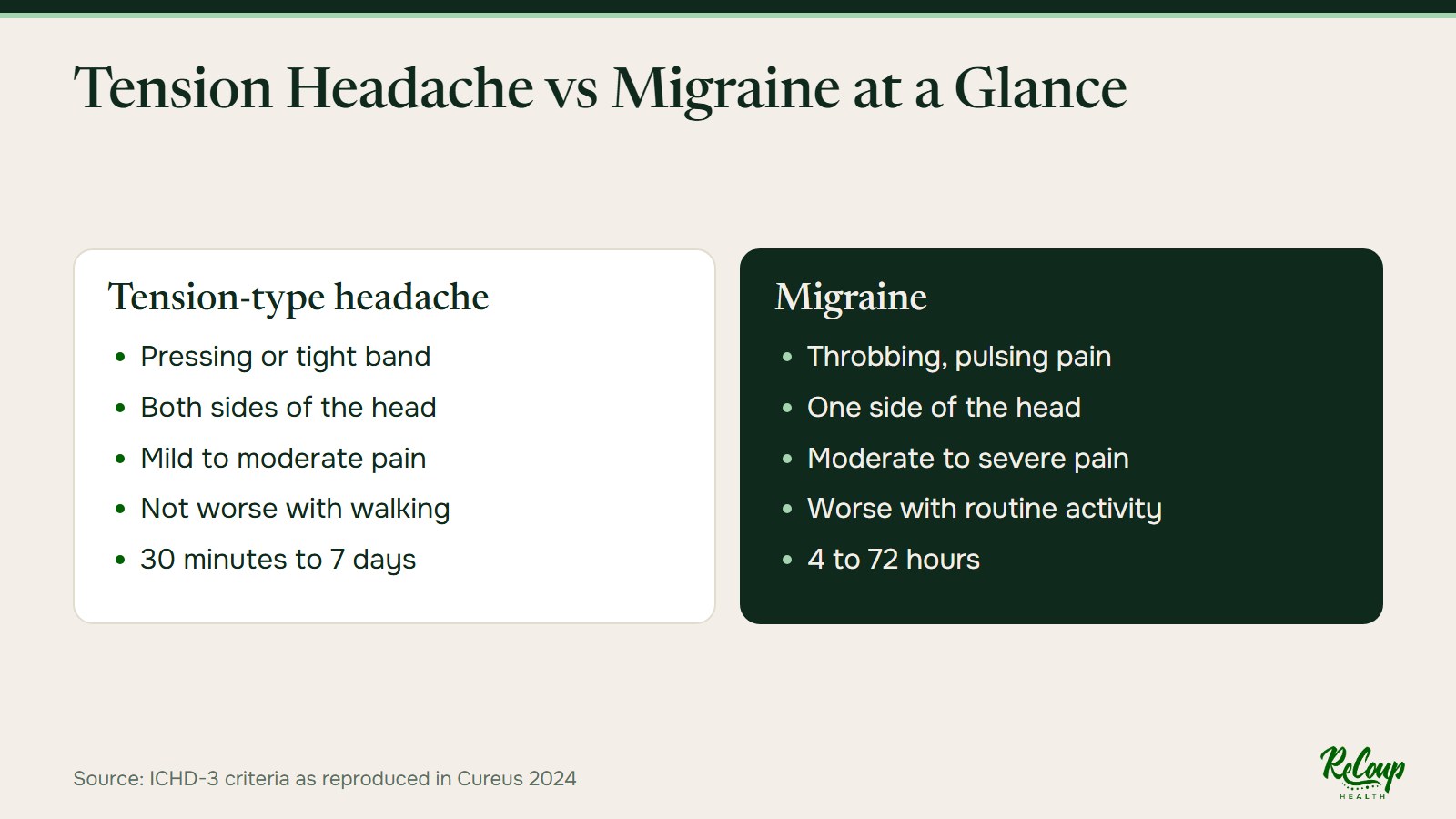
A diary also settles the “do I have a migraine or tension headache” question faster than memory alone. Bring the diary to your family doctor, who makes the formal diagnosis. The diary also captures the symptoms beyond head pain.
What Are Tension Headache vs Migraine Symptoms Beyond Head Pain?
Tension headache vs migraine symptoms beyond head pain differ clearly. Tension headaches bring neck and shoulder tightness, while migraines bring nausea and sensory changes. Neck pain points toward tension-type headache, and nausea points toward migraine.
Neck pain is common in tension-type headache, according to a 2026 study in the journal Headache. Of 80 people with tension-type headache, 57 had normal neck function on testing. Of those 57 people, 52 (91.2%) still reported neck pain. People with ongoing neck and shoulder-neck pain can feel that tightness spread up into the head.
Migraine symptoms extend well beyond the head. Kaiser Permanente lists these 4 migraine signs:
- Nausea, which Kaiser Permanente calls the most common migraine symptom after head pain
- Sensitivity to light
- Sensitivity to sound
- Aura, such as flashing lights or tingling, in some people
These symptoms help separate the two types, yet the triggers behind each attack matter just as much.
What Causes Tension Headaches and Migraines?
Tension headaches and migraines have different causes, though stress triggers both. Stress is the shared trigger, while hormones and sensory triggers lean toward migraine. Kaiser Permanente lists stress, eye strain, too much screen time, neck strain and colds or flu as tension headache triggers. Those triggers answer the common question of what can trigger tension headaches.
Kaiser Permanente lists stress, hormonal shifts such as a starting menstrual cycle, sudden weather changes and strong smells as migraine triggers. Alcohol, skipped meals and too much or too little sleep also appear on that list. WebMD states that the exact cause of migraine is unclear, with genes and environment both playing a role.
Hormones may help explain a sex gap in migraine. Statistics Canada reports that 11.8% of Canadian females had a migraine diagnosis, compared with 4.7% of males. Food and sleep patterns can be reviewed with a naturopathic trigger review alongside your family doctor’s care. Triggers explain when an attack starts, while prevalence and disability show which type weighs heavier.
Which Is Worse, a Tension Headache or a Migraine?
A migraine is worse than a tension headache in pain strength. ICHD-3 rates migraine pain moderate to severe and tension-type pain mild to moderate. Migraine hurts more per attack, but tension-type headache affects more people. A 2022 Journal of Headache Pain review found tension-type headache in 26.0% of people worldwide and migraine in 14.0%.
A 2025 survey of 41,614 adults in 17 countries found 1-year prevalence of 33.2% for tension-type headache and 23.5% for migraine. The World Health Organization states that headache disorders affect about 40% of people, or 3.1 billion in 2021. The statistics graphic below compares these numbers.
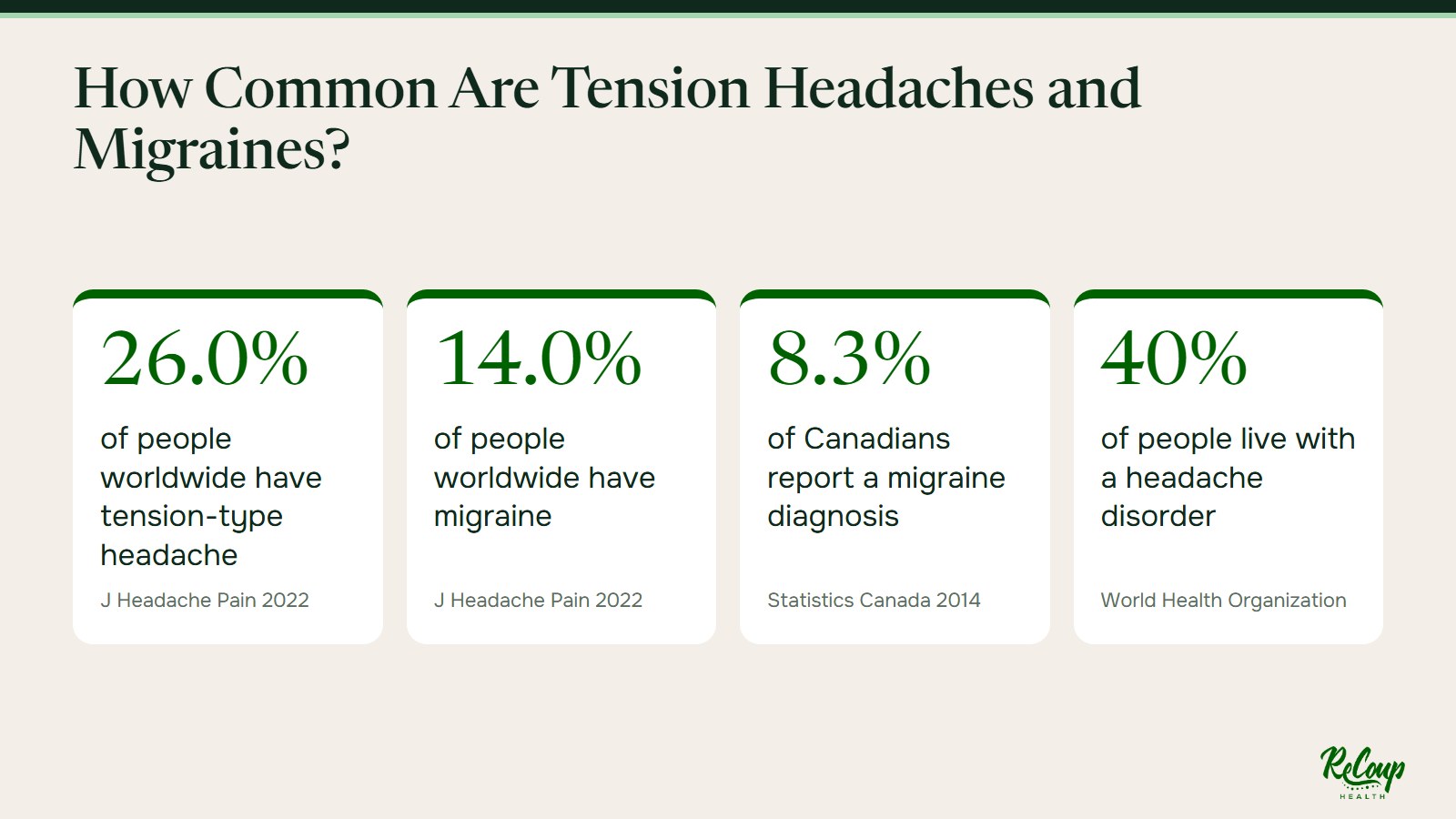
In Canada, 8.3% of people (2.7 million) reported a migraine diagnosis, according to Statistics Canada in 2014. Frequent headache is still draining. Headache on 15 or more days a month affects 4.6% of people worldwide (Journal of Headache Pain, 2022). That frequency matters because the two types can overlap in one person.
Can You Have a Tension Headache and Migraine at the Same Time?
Yes, you can have a tension headache and migraine at the same time, since one person can live with both disorders. WebMD confirms that both headache types can occur together. Migraine and tension headache can share one person and even one day.
A tension headache after migraine attacks, with a sore neck and dull pressure, can blur the line between the two. WebMD describes chronic migraine as headache on 15 or more days a month. On at least 8 of those days, the headache feels like migraine. Episodic headache means fewer than 15 headache days a month, and chronic means 15 or more (German Headache Consortium, 2012). A mixed pattern like this one shapes how treatment is planned.
How Does Tension Headache vs Migraine Treatment Differ?
Tension headache vs migraine treatment differs in focus. Tension-type care targets muscles, posture and stress, while migraine care centres on a medical plan from your family doctor. Tension-type headache responds to hands-on care and exercise, while migraine needs a medical plan first.
A 2022 meta-analysis in Disability and Rehabilitation pooled 15 studies with 1,131 participants with tension-type headache. Soft tissue work beat no treatment for pain and frequency, though the evidence was low certainty. Spinal manipulation alone did not beat no treatment. Soft tissue work from neck tension massage fits within that evidence.
The Ontario OPTIMa guideline (European Journal of Pain, 2019) recommends low-load neck and shoulder blade exercise. That advice covers tension-type headache lasting over 3 months. The same guideline advises against neck manipulation as the only treatment. A neck-focused physiotherapy plan builds that exercise into daily routines.
Hands-on care works as one piece of a wider plan for tension-type headache, not as a stand-alone fix. The OPTIMa guideline also suggests general exercise, multimodal care or clinical massage for chronic tension-type headache. Combined care can also include chiropractic headache care as one part of a wider plan.
Stress management helps too. A 2025 Journal of Headache Pain review of 19 studies found psychological treatments cut tension-type headache days by 4.53 a month. Migraine medicine choices belong with your family doctor or pharmacist.
Medication overuse affects both types. A 2024 Journal of Headache Pain review sets the risk at 10 or more days a month for triptans or combination products. The threshold is 15 or more days a month for acetaminophen or anti-inflammatory drugs, each for over 3 months. Medication-overuse headache affects 1% to 2% of people, according to that review. Ongoing frequent headache care helps cut reliance on pain relievers for either type.
What Else Should You Know About Telling Headache Types Apart?
Telling headache types apart also involves a migraine memory aid, fast relief, neck-related headaches and emergency signs.
What Is the 5 4 3 2 1 Rule for Migraines?
The 5 4 3 2 1 rule for migraines is a memory aid for the ICHD-3 criteria for migraine without aura. The numbers stand for 5 attacks and 4 hours to 3 days per attack. The last numbers mean 2 of 4 pain features and 1 associated symptom group. Five attacks, 4 to 72 hours, two pain features and one symptom group fit migraine. The steps graphic below lays out each part.
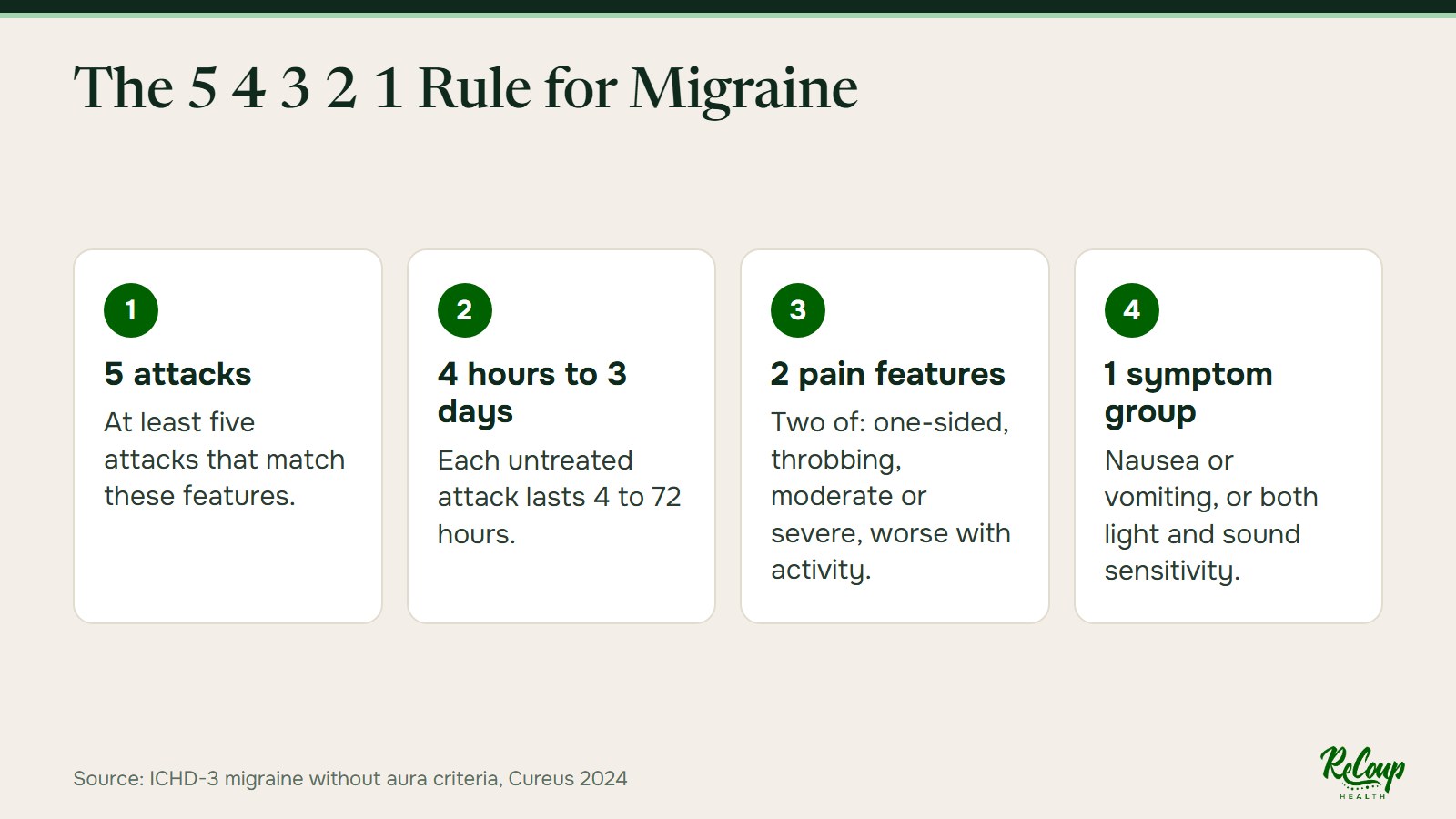
The rule supports a conversation with your family doctor, not a self-diagnosis.
What Is the Fastest Way to Relieve a Tension Headache?
The fastest way to relieve a tension headache is to remove the trigger and relax the tight muscles. Kaiser Permanente suggests a cold or warm compress on the head. Step away from the screen, rest and apply warmth or cold. Our guide on how to relieve tension headaches walks through fast steps in detail.
How Does a Cervicogenic Headache Differ From Tension Headache and Migraine?
A cervicogenic headache is a headache that starts in the neck and spreads into the head. Neck-driven headache is a third look-alike beside tension-type headache and migraine. The Bone and Joint Decade Task Force (European Spine Journal, 2016) found that neck-related headache care should include exercise. Headaches after a car crash can follow this pattern, and our article on whiplash recovery time covers that timeline.
Can Neck Posture Point to Tension-Type Headache?
Neck posture can point to a primary headache, though it cannot prove the type. A 2020 Pain Medicine review of 12 studies with 1,083 people linked chronic primary headache with more forward head posture. Posture is an association, not a proven cause. The review grouped headache types together, so posture cannot tell a tension headache from a migraine.
Which Headache Signs Need Emergency Care?
Headache signs that need emergency care include sudden, extremely painful onset, weakness, numbness, trouble speaking or vision loss (NHS). These signs need a 911 call or a trip to the nearest emergency department. Confusion, or a high temperature with a stiff neck, also needs emergency care. A headache after a head injury in the last 3 months needs urgent review, including concussion care when symptoms linger.
Frequently Asked Questions About Tension Headache vs Migraine
Can a Tension Headache Turn Into a Migraine?
A tension headache does not turn into a migraine by definition, since ICHD-3 classes each attack by its own features. A tension headache to migraine shift happens when a pressing headache later throbs and brings nausea. The attack then meets migraine criteria.
Does a Tension Headache Last Longer Than a Migraine?
A tension headache can last longer than a migraine. ICHD-3 sets episodic tension-type headache at 30 minutes to 7 days. Migraine without aura lasts 4 to 72 hours.
Are Migraines More Common in Women Than Men?
Migraines are more common in women than men in Canada. Statistics Canada reports 11.8% of females and 4.7% of males with a migraine diagnosis. Prevalence peaks between ages 30 and 49.
How Many Canadians Live With Migraine?
Canadians with migraine number 2.7 million with a diagnosis, according to Statistics Canada in 2014. Migraine Canada estimates that 5 million Canadians live with migraine.
How Recoup Health Helps With Tension Headaches and Migraine
Recoup Health helps by assessing the neck, jaw, posture and daily habits behind recurring headaches. We focus on the muscle and posture side of headache, alongside your family doctor’s medical care. Our physiotherapists, chiropractor and registered massage therapists work together on tension-type headache and neck-related pain. Meet our headache clinicians to see who leads each part of care.
No doctor’s referral is needed to book a visit. Questions about tension headache vs migraine patterns can go through our booking enquiry page.
Bring your headache diary, a list of your triggers and any medicines you use to the first visit. Those notes show whether your pattern looks more like tension-type headache, migraine or a mix of both. The team at Recoup Health’s physios in Vaughan will help you build a plan that fits your headache pattern.