
Treatment for spinal stenosis starts with non-surgical care, such as physiotherapy, exercise, posture changes and pain medicine. Injections or surgery come next when those steps stop working. In a 2015 Annals of Internal Medicine trial, physiotherapy and decompression surgery gave similar 2-year function gains. Surgery is kept for severe, worsening or disabling nerve symptoms.
Key Takeaways
- Spinal stenosis treatment follows a ladder: home care, physiotherapy, medicine, injections, then surgery.
- Physiotherapy and surgery gave similar 2-year function gains in a 169-person trial (Annals of Internal Medicine, 2015).
- Supervised physiotherapy beat home exercise alone in a 2021 Clinical Rehabilitation trial of 86 patients.
- Adding a steroid to an epidural injection gave no clear extra benefit at 6 weeks (New England Journal of Medicine, 2014).
- Bladder or bowel changes, saddle numbness or fast leg weakness need same-day emergency care.
What Is the Treatment for Spinal Stenosis
The treatment for spinal stenosis is a step-by-step plan that eases pressure on the nerves and keeps you moving. Cleveland Clinic states that care begins at home for mild symptoms, then adds physiotherapy, medicine, injections and finally surgery. Each step depends on the cause, the level of the spine and how severe the symptoms are.
Spinal stenosis is a narrowing of the spinal canal, the bony tunnel that holds the spinal cord and nerve roots. The narrowing comes from bone spurs, thick ligaments or bulging discs, according to Cleveland Clinic. Our spinal stenosis treatment page explains how a clinic assessment fits into this plan.
The treatment ladder below shows the order clinical guidance follows. Cleveland Clinic reports that most people with spinal stenosis do not need surgery.
- Home care: pacing, heat, gentle walking and posture changes that open the spinal canal.
- Physiotherapy: strength, flexibility and walking training, ideally supervised.
- Medicine: over-the-counter or prescription pain relief chosen with your family doctor or pharmacist.
- Injections: epidural injections for short-term relief of leg pain.
- Surgery: decompression for severe, disabling or progressive nerve symptoms.
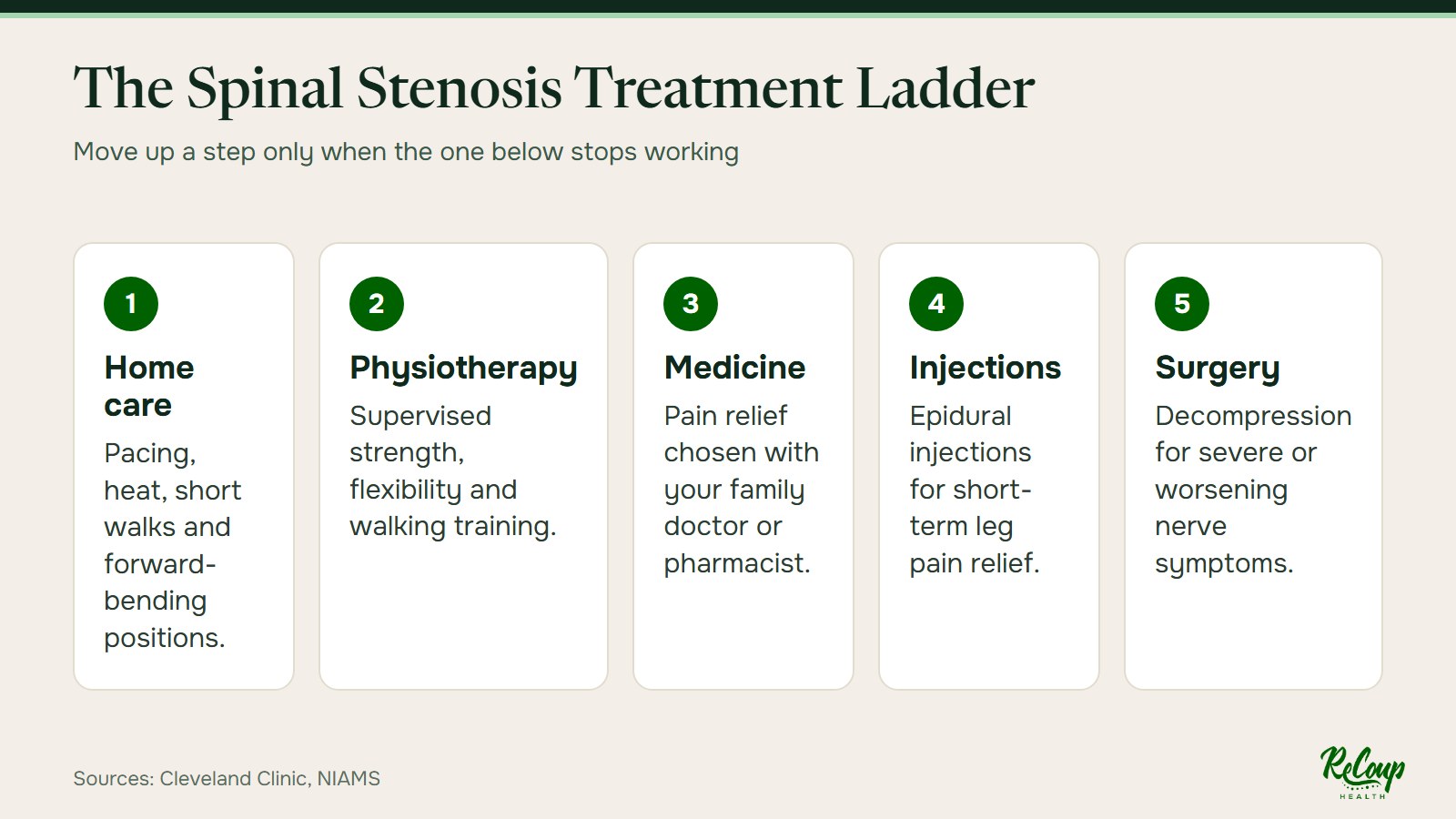
The graphic above shows the same five treatment steps in order. People move up the ladder only when the lower step stops controlling symptoms, as Cleveland Clinic describes. The next question is whether any step can fix the narrowing itself.
Can You Fix Spinal Stenosis
You can fix spinal stenosis structurally only with decompression surgery, which removes bone or ligament to widen the canal. Non-surgical care does not widen the canal. Non-surgical care instead lowers pain, improves walking and builds strength, according to NIAMS. NIAMS is the National Institute of Arthritis and Musculoskeletal and Skin Diseases.
Narrowing on a scan also does not equal symptoms. Cleveland Clinic reports that up to 95% of people have degenerative spine changes by age 50. Treatment therefore targets symptoms and function, and the first tool for both is non-surgical care.
How Do You Treat Spinal Stenosis Without Surgery
Treat spinal stenosis without surgery by combining exercise, physiotherapy, activity pacing and short-term pain relief. NIAMS lists physiotherapy, braces, complementary care and medicine as the main non-surgical options. Treatment for spinal stenosis without surgery suits people with mild to moderate symptoms and no red flags.
Evidence for this approach is real but limited. A Cochrane review of 21 trials and 1,851 participants found that moderate and high-quality evidence for non-surgical treatment is lacking. Physiotherapy still has the strongest trial data of any non-surgical option.
Does Physical Therapy Help Spinal Stenosis
Yes, physiotherapy helps spinal stenosis by improving walking tolerance, strength and daily function. The answer to “does physical therapy help spinal stenosis” comes from the Delitto trial in Annals of Internal Medicine, 2015. That trial randomized 169 surgical candidates aged 50 or older to surgery or physiotherapy.
At 2 years, physical function scores rose 22.4 points with surgery and 19.2 points with physiotherapy. The 0.9-point gap was not significant. Still, 57% of the physiotherapy group later chose surgery, which limits a clean comparison.
Supervision also matters. A 2021 Clinical Rehabilitation trial of 86 patients found meaningful symptom gains in 60.5% with supervised physiotherapy versus 32.6% with home exercise. Surgery within 1 year fell to 7.0% versus 23.3%. A stenosis-focused physiotherapy plan uses that supervised model, and walking is a key part of it.
Does Walking Help Spinal Stenosis
Yes, walking helps spinal stenosis when you pace it and use positions that open the canal. AAOS OrthoInfo, from the American Academy of Orthopaedic Surgeons, links longer walks to symptoms. Walking more than 1 or 2 blocks may bring on leg pain or weakness. Short, frequent walks build tolerance without a flare.
Several walking strategies reduce pressure on the nerves:
- Walk in short bouts and rest by sitting or bending forward before leg symptoms build.
- Lean on a shopping cart or walker, a flexed posture that AAOS OrthoInfo links to easier walking.
- Choose a stationary bike, which keeps the spine slightly bent forward.
- Pick flat or uphill routes, since Cleveland Clinic notes downhill walking worsens symptoms.
Leg pain that starts after a few blocks can mimic sciatica symptoms, so a clinician checks which nerve is involved. That walking pattern also points to the posture that aggravates stenosis.
What Is the Real Enemy of Spinal Stenosis
The real enemy of spinal stenosis is long periods of upright standing and walking that arch the low back. Cleveland Clinic reports that pain worsens with prolonged standing and walking downhill. Pain eases with sitting, leaning forward or walking uphill.
Arching backward narrows the canal further, while bending forward opens it. Inactivity is the second enemy, because weak hip and trunk muscles reduce walking tolerance over time. Movement-based care such as chiropractic and massage therapy aims to keep the spine and hips moving.
Can a Chiropractor Help With Spinal Stenosis
Yes, a chiropractor can help with spinal stenosis symptoms through gentle mobilization, flexion-based techniques and exercise advice. NIAMS lists spinal manipulation as a complementary treatment that may relieve pain. The question “can a chiropractor help with spinal stenosis” has limited trial evidence behind it, so care stays gentle and symptom-guided.
Chiropractic care for stenosis avoids forceful extension of the low back. Flexion-based chiropractic techniques open the canal rather than close it. Our chiropractic back care pairs these techniques with a home exercise routine, and acupuncture is a further option.
Can Acupuncture Help With Spinal Stenosis
Yes, acupuncture can help with spinal stenosis pain in the short term, based on low-certainty evidence. A 2026 network meta-analysis of 35 trials and 3,147 participants found short-term pain and function gains with acupuncture versus placebo. No non-surgical treatment in that analysis clearly improved walking distance.
The authors called the overall findings inconclusive, so the answer to “can acupuncture help with spinal stenosis” stays cautious. Acupuncture fits as an add-on to exercise, not a stand-alone treatment. Massage plays a similar supporting role.
Does Massage Help Spinal Stenosis
Yes, massage helps spinal stenosis symptoms by easing muscle tension in the back, hips and legs. NIAMS lists hands-on massage of the spine and muscles among complementary treatments. Massage does not change the size of the spinal canal.
Muscle guarding around the low back adds to pain during standing and walking. Massage gives short-term comfort that makes exercise easier to complete. Registered massage therapy such as lower back massage fits alongside physiotherapy, and medicine is the next tool many people ask about.
Which Medicine Helps Spinal Stenosis Pain
No single medicine suits every case of spinal stenosis pain. Cleveland Clinic lists anti-inflammatory medicines, gabapentin, tricyclic antidepressants and muscle relaxants as options. Your family doctor or pharmacist chooses a medicine based on your age, kidneys, stomach and other drugs.
Anti-inflammatory medicines carry stomach and heart risks in older adults, according to WebMD. Nerve pain medicines can cause drowsiness or dizziness. Medicine controls pain for a period, but spinal stenosis pain relief lasts longer when paired with exercise. Injections come next for leg pain that medicine does not settle.
Do Steroid Injections Work for Spinal Stenosis
Steroid injections give spinal stenosis only modest, short-term relief, based on trial data. A 2014 New England Journal of Medicine trial of 400 patients compared steroid plus lidocaine with lidocaine alone. At 6 weeks, leg pain and disability scores showed no significant difference.
A Cochrane review found injection benefit up to 2 weeks, from a single very low-quality trial. AAOS OrthoInfo states that injections reduce pain and numbness but not weakness. AAOS OrthoInfo limits epidural steroid injections to no more than three per year. Persistent symptoms after these steps lead to the question of surgery.
When Is Surgery Needed for Severe Spinal Stenosis
Surgery is needed for severe spinal stenosis when nerve symptoms are disabling, worsening, or affect bladder, bowel or leg strength. NIAMS states that doctors may recommend surgery right away for weakness that limits walking or bladder changes. Severe spinal stenosis treatment otherwise follows a failed trial of non-surgical care.
Seek emergency care the same day for these red-flag signs, listed by NIAMS and AAOS OrthoInfo:
- New loss of bladder or bowel control, or trouble passing urine.
- Numbness in the groin, genitals or inner thighs, called saddle numbness.
- Fast-worsening leg weakness or a dragging foot.
- Clumsy hands and poor balance, such as trouble buttoning a shirt, from neck stenosis.
The table below compares surgery with non-surgical care on the outcomes trials measured.
| Factor | Non-surgical care | Decompression surgery | Source |
|---|---|---|---|
| Main difference | Eases symptoms, canal stays narrow | Widens the canal directly | Cleveland Clinic |
| 2-year function gain | 19.2 points | 22.4 points | Annals of Internal Medicine, 2015 |
| Pain and disability after failed care | Smaller gains | Larger gains, narrowing over time | Spine, 2011 (5 trials, 918 patients) |
| Walking ability | No clear difference | No clear difference | Spine, 2011 |
| Side effects | None reported in trials | 10% to 24% of surgical groups | Cochrane, 5 trials, 643 people |
The table shows that surgery wins on pain in people whose non-surgical care has failed, but carries more risk. The Spine 2011 review covered patients after 3 to 6 months of failed conservative care. That raises the question of which operation gives the strongest results.
What Is the Most Successful Procedure for Spinal Stenosis
Laminectomy, a decompression surgery, is the most common procedure for spinal stenosis, according to Cleveland Clinic. The surgeon removes the lamina, the bony roof of the canal, plus bone spurs and thick ligament. AAOS OrthoInfo reports good to excellent results for most patients, with leg pain improving more than back pain.
Spinal fusion joins two vertebrae and is a last option for an unstable spine, per Cleveland Clinic. The SPORT trial in the New England Journal of Medicine randomized 289 patients. Within 2 years, 43% of those assigned to non-surgical care had surgery anyway. Recovery after surgery follows a clear timeline.
How Long Is Recovery After Spinal Stenosis Surgery
Recovery after spinal stenosis surgery takes about 2 to 3 months for normal activities, according to AAOS OrthoInfo. Decompression alone allows discharge within a day or so. Fusion adds about 2 to 3 days in hospital, and desk work resumes within days to weeks.
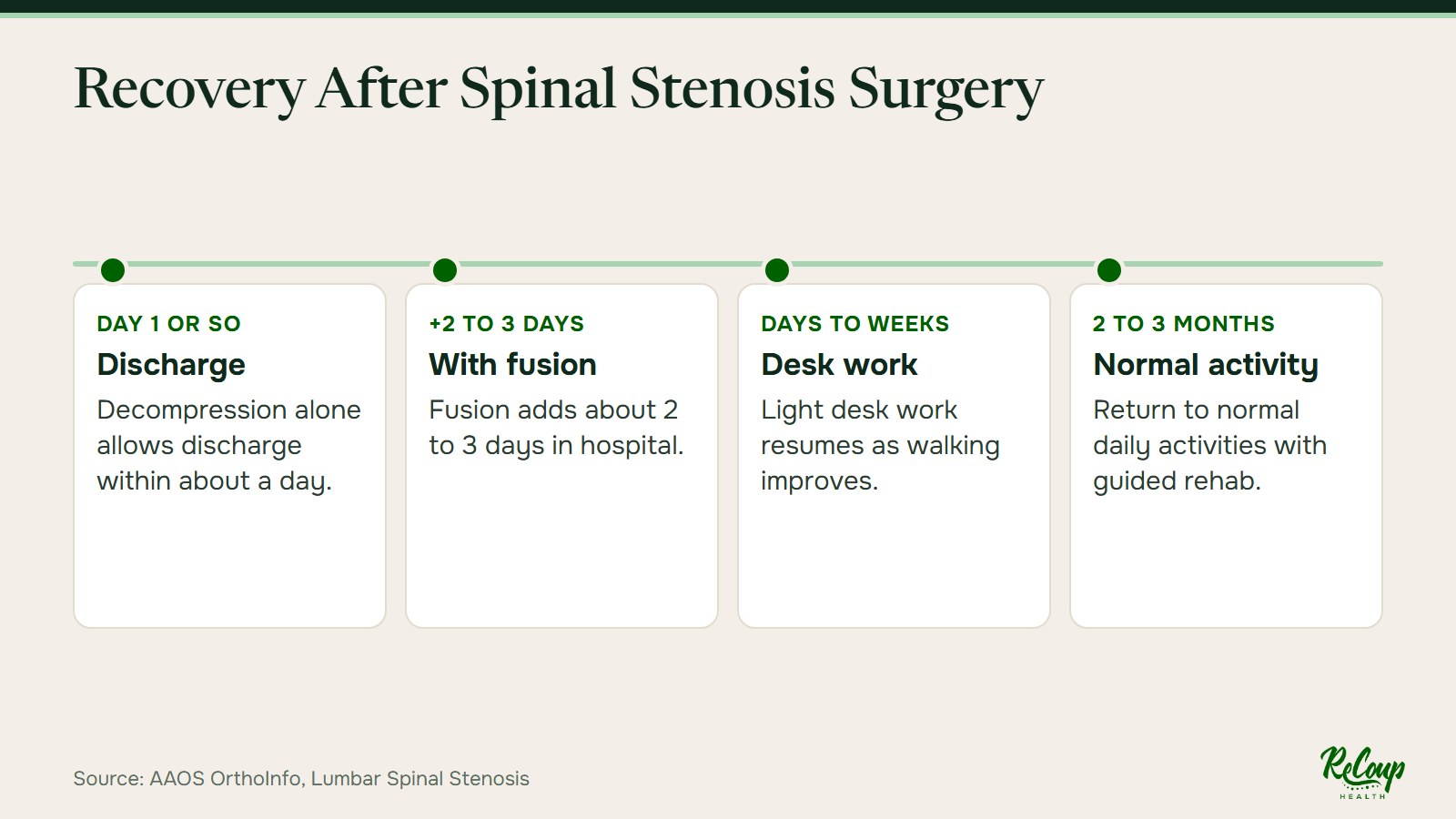
The timeline graphic shows these laminectomy recovery stages in order. Guided walking and core training after surgery support the return to normal activity. Structured decompression surgery rehab also builds strength before the operation. The level of the spine also changes the plan.
How Does Treatment Differ for Lumbar and Cervical Spinal Stenosis
Treatment differs for lumbar and cervical spinal stenosis mainly in urgency and exercise focus. Lumbar spinal stenosis treatment centres on walking tolerance, forward-bending exercise and core strength. Cervical spinal stenosis treatment centres on watching for spinal cord signs, such as poor balance or clumsy hands.
The lumbar spine has 5 vertebrae and the cervical spine has 7, according to Cleveland Clinic. Lumbar stenosis pain overlaps with lower back pain and leg cramping. Cervical stenosis with hand or balance changes needs prompt medical review before any neck treatment.
Thoracic stenosis in the mid back is rare, per Cleveland Clinic. Spinal stenosis treatment at every level shares the same goal of keeping nerves calm and the body active. Several side questions also shape that plan.
What Else Should You Know About Treating Spinal Stenosis
Can a Person Live With Spinal Stenosis
Yes, a person can live a full life with spinal stenosis. Cleveland Clinic reports that many people stay active with non-surgical treatment alone. Regular exercise, pacing and early care for flare-ups keep daily function steady.
Stenosis linked to facet joint arthritis responds to the same exercise approach. Long-term living also raises questions about new therapies.
Is There a New Treatment for Spinal Stenosis
Yes, there is new treatment for spinal stenosis under study, including interspinous spacers, minimally invasive decompression and stem cell therapy. Verywell Health notes that long-term data for these options is not yet available. A new treatment for spinal stenosis still needs a trial of exercise-based care first.
What Foods Should I Avoid With Spinal Stenosis
No specific food causes or worsens spinal stenosis, based on current evidence. Cleveland Clinic advises a healthy weight and enough calcium for bone health. Extra body weight adds load to the spine, and naturopathic weight support can help with diet planning.
How Is Spinal Stenosis Treated in Older Adults
Spinal stenosis is treated in older adults with the same ladder, plus closer attention to medicine side effects and fall risk. AAOS OrthoInfo reports that stenosis happens most often in adults over 60. Balance training and a walker or cane support safe walking.
How Long Does Spinal Stenosis Treatment Take
Spinal stenosis treatment takes 3 to 6 months or longer before surgery is considered. The Spine 2011 review enrolled patients only after 3 to 6 months of failed non-surgical care. The 2021 supervised physiotherapy trial measured results at 1 year, reflecting the long-term nature of care.
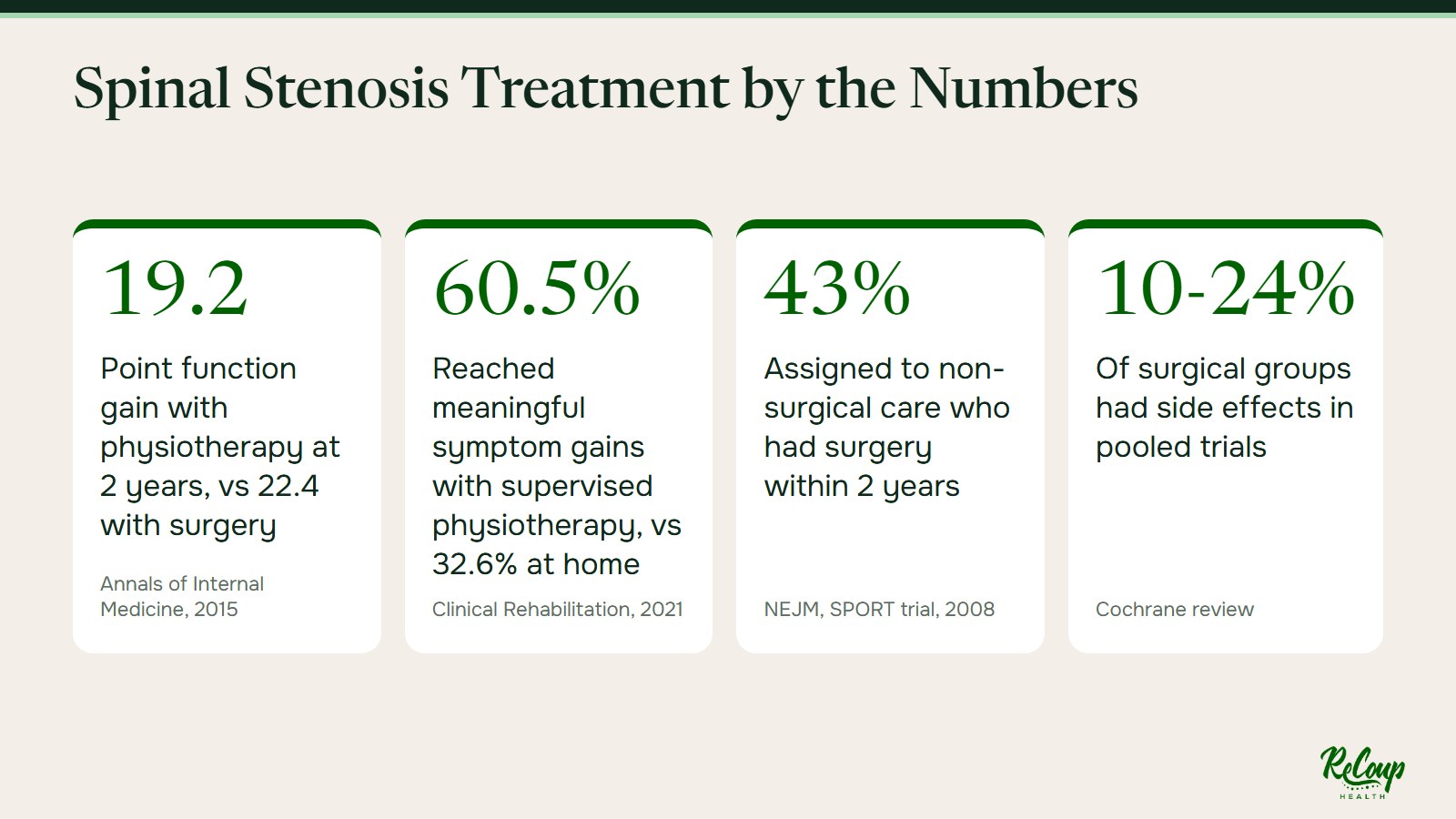
The graphic above summarizes the key trial numbers behind these timelines. Our spine care clinicians use these figures to set realistic goals.
Frequently Asked Questions About Spinal Stenosis Treatment
Can Spinal Stenosis Go Away on Its Own
No, the narrowing in spinal stenosis does not go away on its own. Symptoms can settle for long periods with exercise and pacing. NIAMS notes that symptoms progress slowly in many people.
Is Heat or Ice Better for Spinal Stenosis
Heat is the first choice for spinal stenosis aching, according to Cleveland Clinic. Heat relaxes muscles and eases stiff joints. Ice for 20 minutes at a time is an option when heat does not help.
Should You Wear a Back Brace for Spinal Stenosis
A back brace helps some people with spinal stenosis for short periods, according to NIAMS. Braces suit people with weak abdominal muscles or changes at several spine levels. WebMD notes that wearing a brace too much can weaken muscles.
How Recoup Health Helps With Spinal Stenosis Treatment
Recoup Health helps with spinal stenosis treatment through physiotherapy, chiropractic care, massage therapy and post-operative rehab under one roof. We start with a full movement and nerve assessment, then build a stenosis symptom management plan around walking goals.
Our team includes physiotherapists, a chiropractor who also offers acupuncture, registered massage therapists and a naturopathic doctor. No doctor’s referral is needed to start care at Recoup Health rehabilitation on Innovation Drive in Vaughan.
Talk to your family doctor first about any red-flag symptoms, new weakness or medicine questions. Bring your imaging reports and a list of current medicines to your first physiotherapy or chiropractic visit. To arrange that first visit, use our stenosis assessment booking page to arrange an appointment.