
Injury, arthritis and overuse are the main answers to what causes knee pain, according to Cleveland Clinic. Osteoarthritis alone affects more than 4 million Canadians, says Arthritis Society Canada. Knee pain can also start outside the knee, in a lower back nerve, the hip or the foot. Sciatica-type nerve pain can reach the knee when a lumbar nerve root is pinched.
Key Takeaways
- Knee pain comes from three main groups: injuries, arthritis and overuse.
- Osteoarthritis, bursitis, gout and Baker’s cysts can cause knee pain without any injury.
- A pinched L3 or L4 nerve root in the lower back can send pain to the knee.
- Hip arthritis and hip impingement can refer pain down to the knee, says Harvard Health Publishing.
- A knee that cannot bear weight, locks, or turns red and hot with fever needs urgent care.
What Causes Knee Pain in Adults
Knee pain in adults comes from three groups of problems: injuries, arthritis and overuse. Damage to the joint, its cushioning cartilage or the soft tissues around it is the common thread, according to Cleveland Clinic. The knee is the largest joint in the body, and it carries a large share of body weight with every step.
That weight load explains why the knee wears and strains so easily. A clear cause guides the right care, and a hands-on knee pain assessment sorts injury from arthritis or referred pain. The sections below follow the same order a clinician uses, starting with the common causes of knee pain.
What Are the Common Causes of Knee Pain
The common causes of knee pain split into injury-related and non-injury causes, according to the NHS. Injury causes include sprains and strains, tendonitis, torn ligaments, a torn meniscus and a dislocated kneecap. Non-injury causes include osteoarthritis, bursitis, gout, septic arthritis and Osgood-Schlatter disease.
A meniscus is a C-shaped pad of cartilage that absorbs shock between the thigh bone and shin bone. A meniscus tear can cause a “pop”, with stiffness and swelling that build over 2 to 3 days, says AAOS OrthoInfo. A twisted or overstretched ligament falls under ligament sprain care, while torn ligaments need a medical assessment. Those injury causes have a clear starting moment, but many knee problems begin without one.
What Can Cause Knee Pain Without Injury
Wear, inflammation and fluid build-up are what can cause knee pain without injury. Osteoarthritis is a major non-injury cause. A 2022 Rheumatology International survey found the knee was the commonest osteoarthritis site in British Columbia adults. That survey of 2,233 adults put diagnosed knee osteoarthritis at 8.8%.
Osteoarthritis is a condition where the smooth cartilage lining the joint thins and the bone underneath changes. A 2021 JAMA review reports that 33% of people over 75 have symptomatic knee osteoarthritis on x-ray. The Public Health Agency of Canada links higher osteoarthritis risk to age, female sex, past joint injury, obesity and genetics.
The graphic below shows how widespread osteoarthritis is in Canada, a key fact behind knee pain causes without injury.
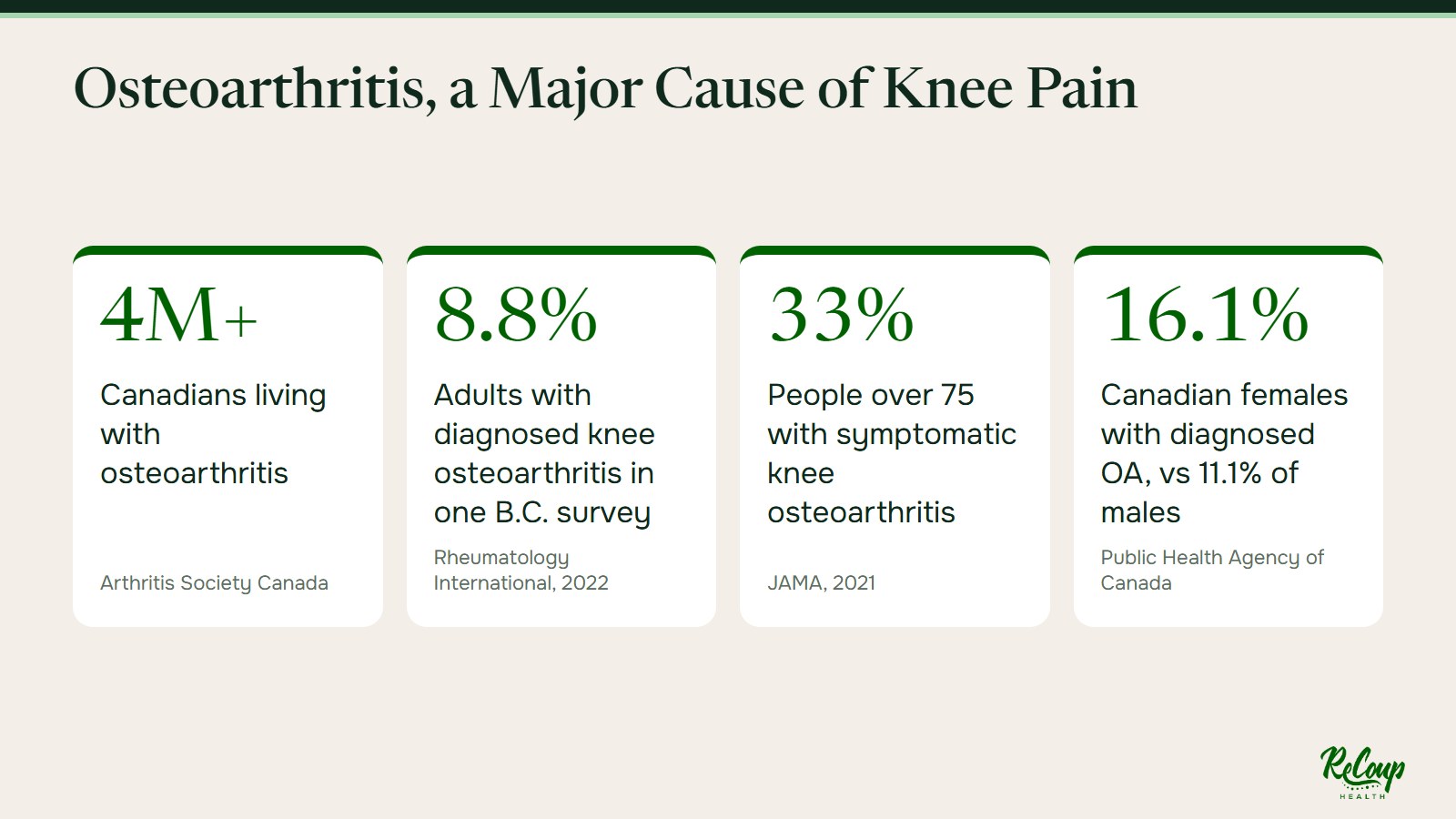
Those osteoarthritis figures show why early knee osteoarthritis care matters for active adults. Other non-injury causes include bursitis, which is swelling of a small fluid sac that cushions the knee. Tendinitis causes a dull ache that grows with use, and a Baker’s cyst forms a fluid lump behind the knee.
What Disease Starts With Knee Pain
Osteoarthritis, rheumatoid arthritis, gout and joint infection are diseases that can start with knee pain. Rheumatoid arthritis is an autoimmune disease that attacks joint linings and tends to affect several joints on both sides. Gout is a build-up of uric acid crystals that causes sudden, hot, swollen joints.
Septic arthritis is a joint infection, and the NHS lists fever with a red, hot knee as an urgent warning sign. A Baker’s cyst in adults develops when another condition, such as osteoarthritis or gout, damages the joint, says the NHS. That NHS page notes Baker’s cysts are more common between ages 35 and 70. Pain location helps separate these diseases from injuries.
How Do I Know What Type of Knee Pain I Have
Pain location, timing and feel are how you know what type of knee pain you have. Cleveland Clinic advises noting where it hurts, when it started, and whether you feel a click or pop. Harvard Health Publishing adds questions about locking, buckling and pain on stairs.
The table below links each pain location to its likely causes, based on Cleveland Clinic and AAOS OrthoInfo.
| Where It Hurts | Possible Causes | Common Clues |
|---|---|---|
| Front of the knee | Patellofemoral pain syndrome, arthritis, bursitis | Dull ache with stairs, squats, running or long sitting |
| Inner side of the knee | MCL (medial collateral ligament) sprain, arthritis, meniscus tear | Pain after a twist or a blow to the outer knee |
| Outer side of the knee | IT band syndrome, LCL sprain, meniscus tear | Sharp outer pain during running or cycling |
| Back of the knee | Baker’s cyst, tendon injury, arthritis, tight muscles | Fullness or a soft lump behind the knee |
| Knee plus thigh or groin | Lumbar nerve root or hip problem | Numbness, tingling, or a knee that looks normal |
The last row of the table points to causes outside the knee itself. Those referred causes lead straight to the question of sciatica.
Can Sciatica Cause Knee Pain
Yes, sciatica-type nerve pain can cause knee pain when a lower back nerve root is compressed. Compression of the L3 or L4 nerve root can cause knee pain and weakness, according to Spine-health. These nerve roots leave the spine at the third and fourth lumbar levels. They supply the front of the thigh and the knee.
Classic sciatica follows the sciatic nerve, which forms from the L4 to S3 roots. The NHS says sciatica affects the bottom and the back of one leg, often reaching the foot and toes. Nerve-related knee pain therefore fits a wider lumbar nerve-root picture, and sciatica nerve care targets the source in the back. Spine-health notes this nerve pain affects one knee in typical cases.
Evidence on this link is limited. Spine-health is a patient education site, and no study with prevalence figures was found. That gap makes a careful physical exam the key to telling nerve pain from joint pain.
How Can You Tell Sciatic Knee Pain From a Knee Joint Problem
Sciatic knee pain differs from a knee joint problem because it spreads beyond the knee and comes with nerve signs. Spine-health describes L3 pain in the front of the thigh, the side of the hip and the groin. Joint problems such as a meniscus tear cause swelling, clicking or locking, says AAOS OrthoInfo.
The comparison below lists the main clues for each source of pain.
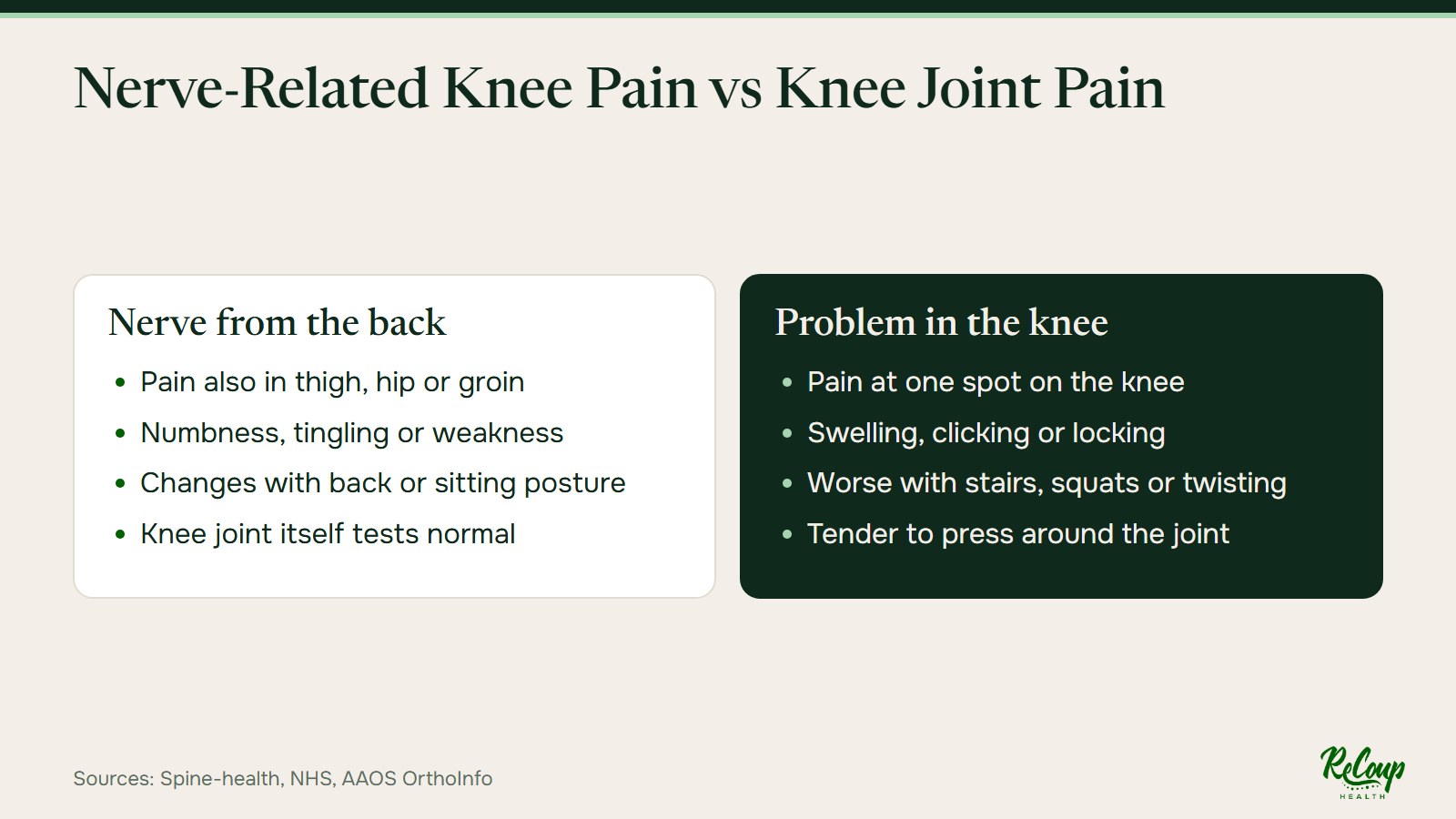
Nerve pain changes with back posture or sitting, while joint pain changes with stairs, squats or twisting. A knee joint that tests normal, plus thigh numbness or tingling, points back to the spine. The spine conditions behind that nerve pressure come next.
Can a Herniated Disc Cause Knee Pain
Yes, a herniated disc can cause knee pain when it presses on the L3 or L4 nerve root. A disc is the rubbery cushion between two spinal bones, and a herniation lets its soft centre bulge out. The NHS names a slipped disc as the commonest cause of sciatica.
A disc that irritates an upper lumbar root sends pain toward the thigh and knee, says Spine-health. Targeted disc herniation rehab eases that nerve pressure through movement and strengthening. The NHS says sciatica gets better within a few weeks to a few months. Cleveland Clinic adds that many cases improve within four to six weeks without medical treatment.
Can Spinal Stenosis Cause Knee Pain
Yes, spinal stenosis can cause knee pain through the same nerve-root pathway. Spinal stenosis is a narrowing of the spaces in the spine, which squeezes nerves as they exit. Spine-health lists stenosis alongside disc herniation as a cause of L3 and L4 nerve-root compression.
Stenosis pressure on an upper lumbar root can send pain into the thigh and knee. People with that pattern benefit from lumbar stenosis care that opens space for the nerves. Back stiffness that comes with knee pain also deserves a closer look at the lower back.
Can Lower Back Pain Cause Knee Pain
Yes, lower back pain can cause knee pain when the back problem involves a lumbar nerve root. Spine-health links the two areas through the L3 and L4 nerve roots. Those roots carry signals between the lower back and the knee.
Back pain plus knee pain on the same side is a reason to have the spine checked. A focused lower back rehab plan can calm the nerve and the knee together. The hip is the next joint a clinician tests.
Can Hip Pain Cause Knee Pain
Yes, hip pain can cause knee pain through a process called referred pain. Referred pain is pain felt in one area while the problem sits in another. Harvard Health Publishing reports that hip osteoarthritis and hip impingement can both send pain down to the knee.
Hip impingement is a pinching that happens when the hip bones do not fit together smoothly. A Harvard orthopaedic surgeon explains that he examines the joints above and below the knee for this reason. A knee that tests normal while hip movement triggers knee pain points to the hip.
Can Flat Feet Cause Knee Pain
Yes, flat feet can cause knee pain by changing how load travels up the leg. The foot, shin and knee move as one chain during walking. Clinicians check foot posture for that reason when the knee hurts.
Heel and arch pain can change walking patterns in a similar way. People who ask whether plantar fasciitis causes knee pain describe the same chain effect from the foot up. Custom flat foot orthotics support the arch and reduce that inward roll. A 2026 Health Science Reports review of 4 trials found orthotics and physiotherapy each improved knee osteoarthritis pain. That review was small, so the evidence remains limited.
What Else Should You Know About Knee Pain Causes
Activity, muscle tightness and warning signs round out the picture of knee pain causes. The short answers below cover running, tight muscles, walking and warning signs.
What Causes Knee Pain When Running
Patellofemoral pain syndrome and IT band syndrome cause knee pain when running. Patellofemoral pain is a dull ache at the front of the knee with stairs, running, squats or long sitting, says AAOS OrthoInfo. A 2026 review of 15 trials found combined hip and knee strengthening helped patellofemoral pain. Guided runner’s knee rehab builds that strength step by step.
Can a Tight IT Band Cause Knee Pain
Yes, a tight IT band can cause knee pain on the outer side of the knee. The iliotibial (IT) band is a thick strip of tissue running from the hip to the outer knee. Cleveland Clinic says IT band syndrome can cause sharp pain on the outside of the knee. Tight hips add to this pull, and assisted hip stretching can restore hip motion.
Does Walking Help Knee Pain
Yes, walking and other exercise help knee pain from osteoarthritis. A 2015 Cochrane review pooled 44 trials with 3,537 people. Exercise cut pain by 12 points on a 0 to 100 scale. Many trials were not blinded, which may inflate that effect. Some people walk more comfortably with supportive knee braces, which the 2019 American College of Rheumatology guideline strongly recommends for knee osteoarthritis.
How Do I Tell If My Knee Pain Is Serious
Serious knee pain shows clear warning signs that need same-day care. The NHS lists these red flags, adapted here for Ontario:
- The knee cannot bear weight, or it is badly swollen or changed in shape.
- The knee locks, gives way or clicks painfully.
- A fever or shivering comes with a red, hot knee, a possible joint infection.
- One calf or thigh throbs and swells, a possible blood clot, says the NHS.
- Leg pain comes with breathlessness or chest pain, so call 911 right away.
- Leg symptoms appear on both sides, with numbness around the genitals or new bladder or bowel changes.
Go to the emergency department for these signs, or call Telehealth Ontario at 811 for guidance. Talk to your family doctor or physiotherapist about knee pain that does not improve within a few weeks.
Frequently Asked Questions About Knee Pain Causes
How Can I Relieve Knee Pain
Relieve minor knee pain with rest, gentle movement and an ice pack for up to 20 minutes every 2 to 3 hours. The NHS says people start to feel better in a few days. Ongoing pain needs an assessment to find the cause.
What Causes Knee Pain at Night
Knee pain at night follows heavy activity earlier in the day for many people, says Cleveland Clinic. Arthritis pain can also flare at rest. Night pain with fever or swelling needs prompt care.
What Causes Knee Pain in Females
Osteoarthritis is a major cause of knee pain in females. The Public Health Agency of Canada reports diagnosed osteoarthritis in 16.1% of females versus 11.1% of males. Female sex is a listed risk factor for osteoarthritis.
Can Sciatica Cause Knee Pain and Swelling
No, the NHS does not list knee swelling among sciatica symptoms. Swelling points to a joint problem such as arthritis, a meniscus tear or a Baker’s cyst. A person can have nerve pain and a swollen joint at the same time.
How Recoup Health Helps Find the Cause of Knee Pain
Recoup Health helps by testing the knee, hip, lower back and feet in one visit. That full-chain exam answers what causes knee pain for each person, instead of treating the knee alone. No doctor’s referral is needed to book.
Our physiotherapists, chiropractor and registered massage therapists work together on knee and spine problems. Each plan for knee pain physiotherapy combines hands-on care, strength work and activity advice. Each plan also tracks progress so the underlying cause gets addressed along with the symptoms.
Every clinician reviews the knee, hip, back and feet before starting care. You can meet our physiotherapy team to find the right clinician for your knee. Knee pain that keeps returning deserves a clear answer about its source, and a full-chain exam gives that answer.
Knee pain care works well when the plan matches the real source. The team at Recoup Health clinic in Vaughan can find what causes knee pain and build a plan to settle it.