

Frozen shoulder is a condition in which the shoulder joint capsule becomes inflamed, thick and tight. The result is pain, stiffness and lost movement. The medical name is adhesive capsulitis. American Family Physician estimates frozen shoulder affects 2% to 5% of people. The condition moves through 3 stages, and AAOS OrthoInfo notes full recovery can take up to 3 years.
Key Takeaways
- Frozen shoulder (adhesive capsulitis) is a thick, tight shoulder capsule that blocks movement, even when someone else moves the arm.
- Frozen shoulder syndrome is another name for the same condition, not a separate disease.
- AAOS OrthoInfo describes 3 stages: freezing, frozen and thawing.
- Women aged 40 to 60 and people with diabetes carry a higher risk, according to American Family Physician.
- Diagnosis rests on a hands-on exam, with X-rays used to rule out arthritis.
- Physiotherapy, injections and, rarely, surgery help restore motion while the shoulder recovers.
What Is Frozen Shoulder and What Happens Inside the Joint
Frozen shoulder is a condition in which the joint capsule around the shoulder thickens, tightens and loses its normal stretch. The capsule is a sleeve of strong connective tissue wrapped around the ball-and-socket joint. Google’s summary of Mayo Clinic guidance describes this capsule becoming inflamed and thickened, with bands of scar tissue forming inside.
Those scar tissue bands are called adhesions. Adhesions shrink the space the upper arm bone (humerus) needs to glide and turn. Cleveland Clinic adds that less synovial fluid, the joint’s natural lubricant, is left inside the capsule. The result is pain plus stiffness in every direction of shoulder movement.
Shoulder stiffness has many possible sources, so frozen shoulder care starts by confirming that the capsule is the real problem. That capsule-based stiffening process is also what people mean by frozen shoulder syndrome.
Is Frozen Shoulder Syndrome Different From Frozen Shoulder
Frozen shoulder syndrome is not different from frozen shoulder; the two names describe the same capsule condition. A search for “what is frozen shoulder syndrome” leads to the same answer as a search for adhesive capsulitis. The word “syndrome” simply labels a recognizable cluster of signs. That cluster includes gradual pain, stiffness in all directions and blocked movement even with help.
The syndrome label helps clinicians separate frozen shoulder from a single sore tendon. The cluster of signs can appear in two forms, depending on whether a clear trigger exists.
What Are Primary and Secondary Frozen Shoulder
Primary and secondary frozen shoulder differ by trigger. Primary frozen shoulder appears with no clear injury, while secondary frozen shoulder follows an event that stops the arm moving. Health.com reports that the primary form is linked with diabetes and thyroid disorders.
Secondary frozen shoulder can follow a fracture, a stroke, heart surgery or breast surgery, according to WebMD and Harvard Health. Harvard Health lists wearing a sling for more than a few days without stretching as a risk. The question “what is a frozen shoulder injury” points to this secondary form. The injury itself does not freeze the joint; the weeks of stillness that follow do.
Both forms start with similar early signs, and spotting those signs early helps people seek an assessment sooner.
What Are the First Signs of Frozen Shoulder
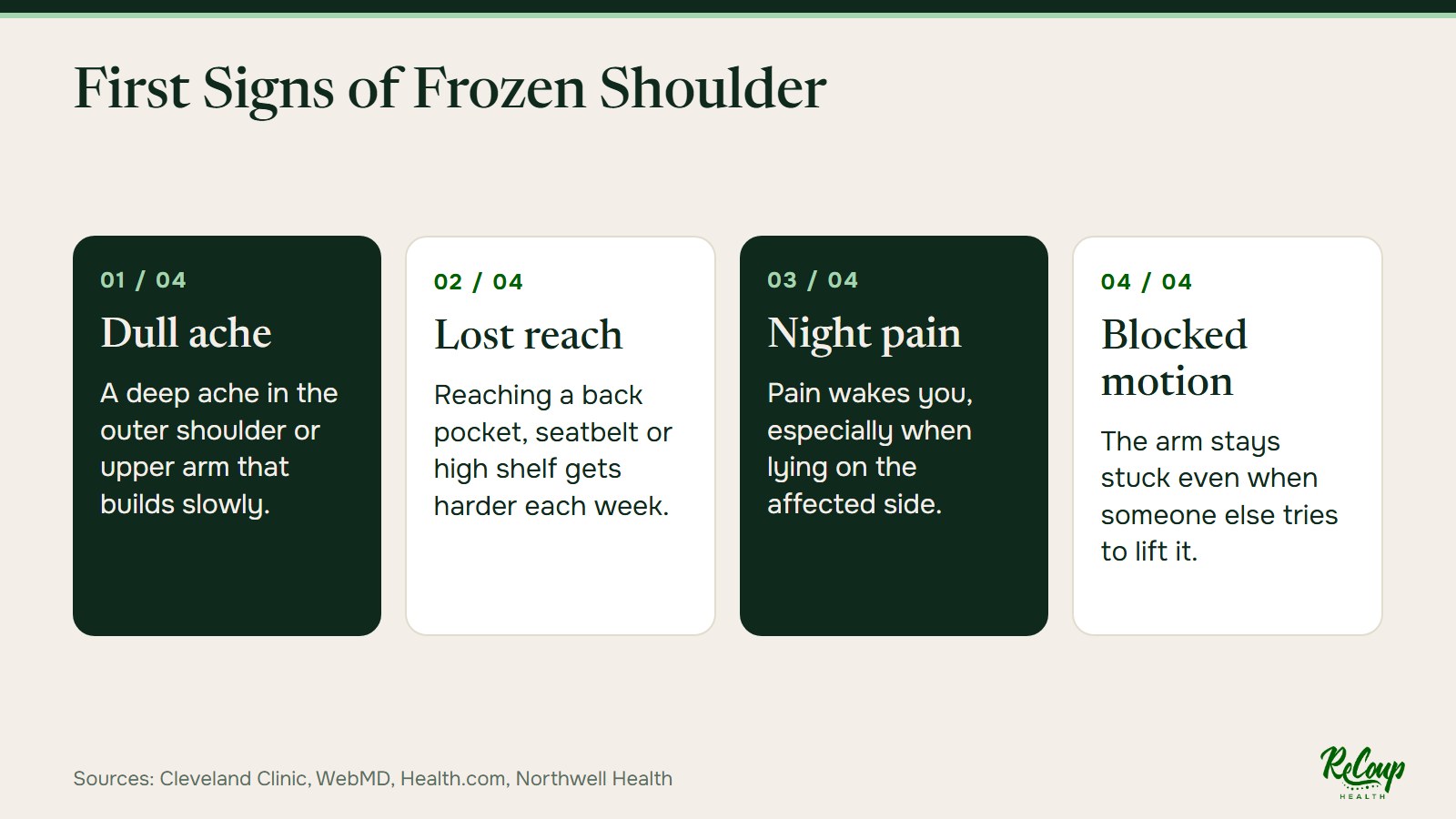
The first signs of frozen shoulder are a dull ache in one shoulder and a slow loss of reach. Reaching overhead and behind the back suffers first. A physiotherapist quoted by Health.com names night pain as one of the early signs. Cleveland Clinic notes that pain slowly increases during the first stage. Common early signs include:
- A deep, dull ache in the outer shoulder or upper arm
- Trouble reaching a back pocket, bra strap or seatbelt
- Pain when lying on the affected side
- Stiffness in every direction, not just one
- Movement that stays blocked when another person lifts the arm
The last sign matters most to clinicians, according to a Northwell Health orthopaedic surgeon. Blocked passive movement separates a frozen shoulder from a painful but mobile one. The four cards below summarize these frozen shoulder signs.
Each of these signs comes with a particular kind of pain, which the next section describes.
What Is Frozen Shoulder Pain Like
Frozen shoulder pain is a dull or aching pain felt in one shoulder and sometimes in the upper arm, according to WebMD. The ache flares with quick or end-of-range movements, such as reaching back for a seatbelt. Cleveland Clinic describes the shoulder as stiff and painful to move in the first stage.
Shoulder muscles tighten to protect the sore joint, a reaction called muscle guarding. Muscle guarding adds its own soreness, and rotator cuff massage from a registered massage therapist (RMT) may ease that muscle tension. That muscle tension tends to build through the day and show up at night.
Why Is Frozen Shoulder Worse at Night
Frozen shoulder is worse at night for many people, and Cleveland Clinic lists night pain as a feature of the freezing stage. Lying on the sore side presses on the inflamed capsule. WebMD suggests sleeping on the other side with a pillow hugged under the sore arm. Back sleepers can rest the arms by their sides with palms down, according to WebMD.
Night pain is strongest early on, and the pattern of pain changes as the condition moves through its stages.
What Are the Stages of Frozen Shoulder
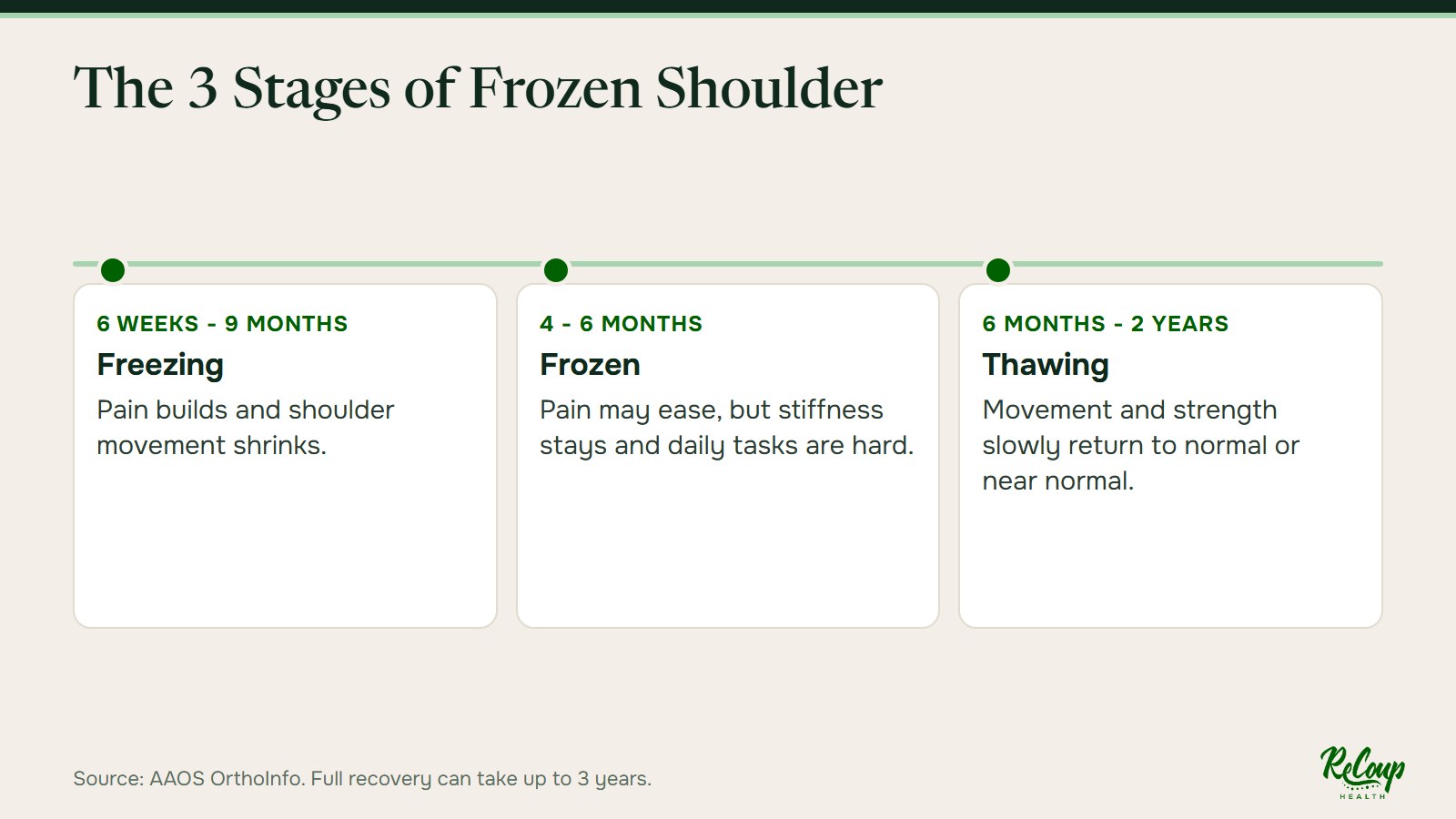
The stages of frozen shoulder are freezing, frozen and thawing, according to AAOS OrthoInfo. Each stage has its own balance of pain and stiffness:
- Freezing: pain builds and movement shrinks. AAOS OrthoInfo says this stage lasts 6 weeks to 9 months.
- Frozen: pain may ease, but stiffness stays. AAOS OrthoInfo gives 4 to 6 months, with daily tasks very difficult.
- Thawing: movement slowly returns. A near-normal return of strength and motion takes 6 months to 2 years.
Stage timelines differ between sources. Google’s summary of Mayo Clinic guidance gives 2 to 9 months for freezing. The same summary gives 4 to 12 months for frozen and 5 to 24 months for thawing. The ranges differ because each person’s shoulder follows its own pace. The timeline below shows the AAOS stages of frozen shoulder.
Adding these stages together gives the overall length of the condition.
How Long Does Frozen Shoulder Last
Frozen shoulder lasts 1 to 3 years in total, based on AAOS OrthoInfo stage ranges. AAOS OrthoInfo notes that full recovery can take up to 3 years. The NHS says frozen shoulder can take months or years to get better. American Family Physician (2019) states that most patients have been expected to recover fully without treatment over 1 to 2 years.
The same 2019 review notes mixed evidence. A 2017 systematic review found only limited range-of-motion gains over 1 to 4 years without treatment. That long, uncertain timeline makes the underlying cause an important question.
What Is the Main Cause of Frozen Shoulder
The main cause of frozen shoulder is inflammation that thickens and scars the shoulder capsule. Cleveland Clinic states that researchers do not know what starts it. The plain answer to “what is the cause of frozen shoulder” is that the first trigger stays unknown in primary cases. Known risk factors make the condition more likely without proving cause.
Cleveland Clinic lists age 40 to 60, female sex, and a recent shoulder injury or surgery as risk factors. The same list adds diabetes, thyroid disease, stroke, Parkinson’s disease and heart disease. Harvard Health adds rotator cuff problems and skipped exercise after tendinitis. These risk factors cluster in certain groups of people.
Who Gets Frozen Shoulder and Why Are Women at Higher Risk
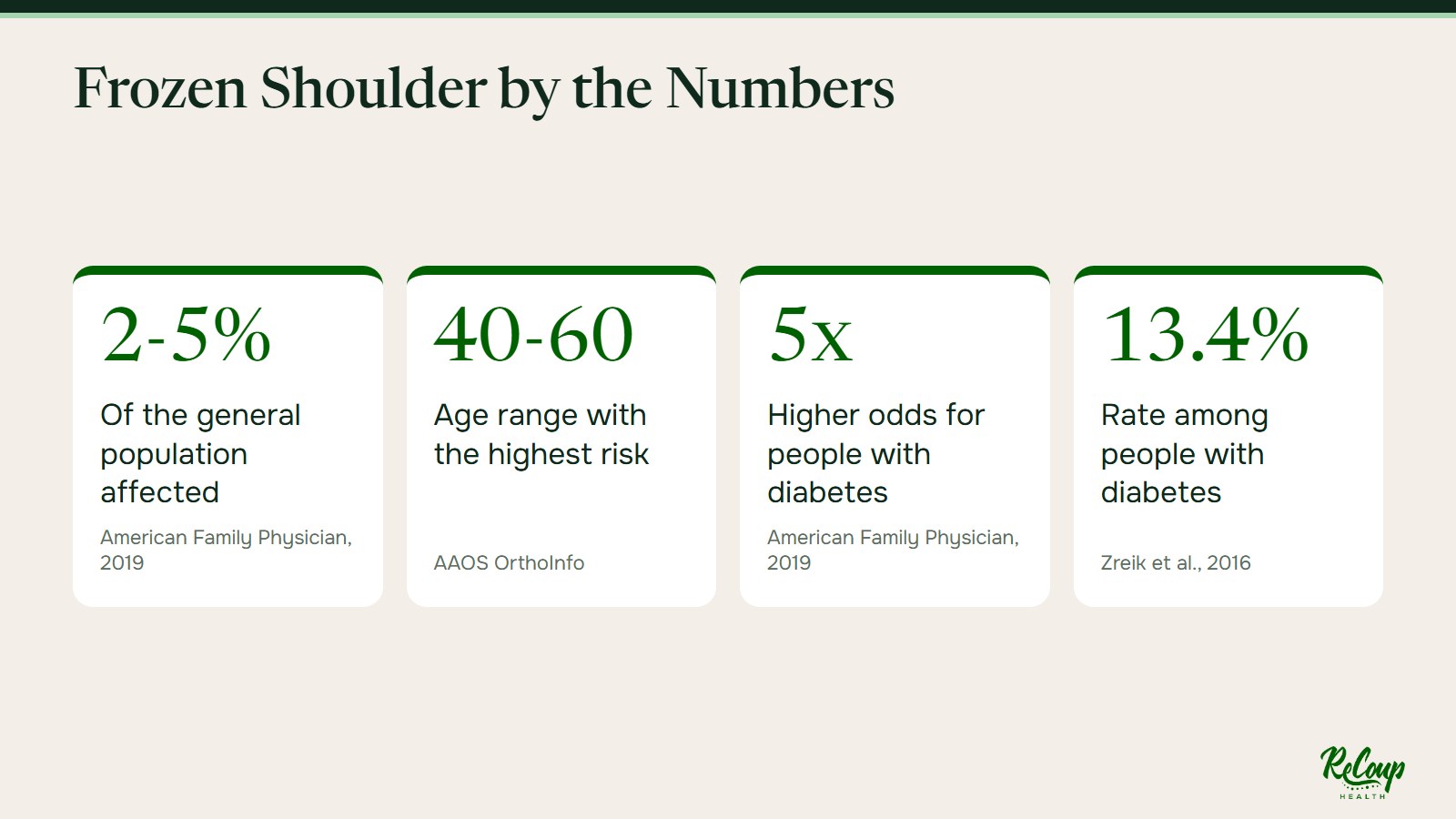
Frozen shoulder affects adults aged 40 to 60 more than other age groups, according to AAOS OrthoInfo. American Family Physician (2019) states that most patients diagnosed with adhesive capsulitis are women between 40 and 60. Researchers are studying whether falling estrogen around menopause plays a role, Health.com reported in 2026. That hormone link is still unproven.
Frozen shoulder is far less common than general shoulder pain. A 2022 review in BMC Musculoskeletal Disorders found a median community prevalence of 16% for shoulder pain. Frozen shoulder sits at 2% to 5%, per American Family Physician. The figures below show these frozen shoulder numbers.
Of all the risk groups, people with diabetes show the clearest link in research.
How Is Diabetes Linked to Frozen Shoulder
Diabetes is linked to frozen shoulder through much higher rates of the condition in people with diabetes. American Family Physician (2019) reports that patients with diabetes were five times more likely to have adhesive capsulitis. A 2016 meta-analysis by Zreik and colleagues found a pooled rate of 13.4% among people with diabetes. That analysis combined 18 studies.
The same meta-analysis found diabetes in 30% of people with frozen shoulder. The authors suggest considering diabetes screening for people who present with frozen shoulder. The link is an association from observational studies, not proof of cause. The NHS advises people with diabetes to keep regular check-ups.
Blood sugar control belongs with your family doctor. Alongside that medical care, naturopathic medicine can support diet and lifestyle habits. Knowing your risk factors helps, but only an exam confirms the condition.
How Do You Know If You’ve Got a Frozen Shoulder
You know you’ve got a frozen shoulder when a clinician confirms that the shoulder stays stiff whether you or they move it. Cleveland Clinic explains that clinicians compare active range of motion with passive range of motion. Active motion is how far you move the arm yourself. Passive motion is how far the arm moves when someone else lifts it.
Frozen shoulder limits both active and passive motion, according to Cleveland Clinic. WebMD notes there is no single specific test. A stiff shoulder assessment checks movement in every direction and compares both arms. X-rays help rule out arthritis, and MRI or ultrasound may check for a rotator cuff tear.
That exam step matters because several conditions look like a frozen shoulder at first.
What Can Be Mistaken for Frozen Shoulder
Rotator cuff problems, shoulder arthritis and pain referred from the neck can be mistaken for frozen shoulder. Up to 70% of shoulder complaints come from rotator cuff disease, according to a 2026 review in JSES Reviews, Reports, and Techniques. The table below compares frozen shoulder with three common look-alikes.
| Condition | Main difference | Assisted (passive) movement | Typical clue |
|---|---|---|---|
| Frozen shoulder | Tight capsule limits movement in all directions | Blocked | Gradual ache, night pain, age 40 to 60 |
| Rotator cuff problem | Tendon pain or tear, joint capsule normal | Mostly preserved | Weakness when lifting the arm |
| Shoulder osteoarthritis | Worn joint surfaces | Can be limited, with grinding | Joint changes on X-ray |
| Neck nerve irritation | Pain referred from the neck | Normal | Tingling or pain travelling down the arm |
The table shows that assisted movement is the key test across these conditions. Northwell Health explains that rotator cuff injuries hurt but still allow passive motion.
Worn joint cartilage in the ball-and-socket joint, known as glenohumeral osteoarthritis, shows clear changes on X-ray. Frozen shoulder X-rays look normal, according to Cleveland Clinic’s use of X-rays to rule out other problems.
Neck problems can also send pain into the shoulder. A bulging disc pressing on a nerve, sometimes called neck disc irritation, brings tingling rather than a stiff joint. Once the diagnosis is clear, treatment can match the stage.
Which Treatments Help a Frozen Shoulder Recover
Treatments that help a frozen shoulder recover focus on pain relief first and movement second. The short answer to “what is the treatment for frozen shoulder” is pain control plus graded stretching. Procedures are kept for shoulders that do not progress. The NHS describes pain relief first, then a steroid injection when needed, then exercises to regain movement.
Physiotherapy for frozen shoulder lasts at least 6 weeks, according to the NHS. Guided frozen shoulder physiotherapy matches stretch intensity to the stage, keeping exercises gentle during the painful freezing stage. Research on the main options shows:
- Steroid injection: American Family Physician (2019) reports slightly better function than placebo, with similar pain relief at 4 to 6 weeks.
- Injection plus physiotherapy: the same review found injection and physiotherapy similar, with the combination possibly better than physiotherapy alone.
- Hydrodilatation stretches the capsule with injected fluid. A 2008 Cochrane review of 5 trials and 196 participants found short-term benefit in one low-risk trial.
- Suprascapular nerve block: a 2026 meta-analysis of 8 trials and 452 patients found better pain relief than steroid injection.
The 2026 nerve block analysis also reported 14.44 degrees more arm lift to the side at 12 weeks. The authors note considerable differences between trials. Hands-on care can support exercise, and gentle osteopathic care uses slow joint and soft tissue techniques. Talk to your family doctor about injections. Surgery comes up only when these steps fail.
What Is Frozen Shoulder Surgery
Frozen shoulder surgery is a procedure that loosens or cuts the tight capsule to restore movement. Cleveland Clinic describes two options: manipulation under general anaesthetic and arthroscopic capsular release through small incisions. Surgery is considered after about a year of non-surgical care without relief, according to Cleveland Clinic.
Movement must start soon after the operation so the capsule does not tighten again. Structured capsular release rehab guides that early motion. Surgery is the last step, and several shorter questions remain.
What Else Should You Know About Frozen Shoulder
Is Frozen Shoulder 100% Curable
Frozen shoulder is not 100% curable in every case, though the outlook is good. American Family Physician (2019) states that full resolution over 1 to 2 years has been the expected outcome for most patients. Some people keep a small, lasting loss of motion. A 2017 systematic review cited in that article found limited gains over 1 to 4 years without treatment.
Can You Fix a Frozen Shoulder in 1 Minute
No, you cannot fix a frozen shoulder in 1 minute. Capsule stiffness changes over months, not minutes. AAOS OrthoInfo stage ranges add up to 1 to 3 years. Short daily stretches, repeated over weeks, are the realistic approach. Table-based assisted mobility stretching can add gentle range work between home sessions.
Is Frozen Shoulder Dangerous
Frozen shoulder is not dangerous to life, but it can disrupt sleep, dressing and work for months. The main harm is lost function, not damage to other organs. The diabetes link means a check-up with your family doctor is worthwhile, according to the Zreik meta-analysis authors.
Can Frozen Shoulder Be Prevented
Frozen shoulder can be prevented in some secondary cases by moving the shoulder early after injury or surgery. Cleveland Clinic advises starting therapy shortly after a shoulder injury that makes movement painful. Gentle, regular motion keeps the capsule from tightening. Primary frozen shoulder has no proven prevention.
When Should You Seek Urgent Care for Shoulder Pain
Seek urgent care for shoulder pain that comes on suddenly or severely, according to the NHS. Go to an emergency department or walk-in clinic for these warning signs:
- You cannot move the arm, or the shoulder has changed shape or is badly swollen
- Pins and needles that do not go away, or no feeling in the arm
- The arm or shoulder feels hot or cold to touch
- Pain after a fall or injury, severe pain in both shoulders, or fever
Frequently Asked Questions About Frozen Shoulder
Can Frozen Shoulder Affect Both Shoulders
Frozen shoulder can affect both shoulders, either at the same time or one after the other, according to Health.com. The condition affects one shoulder in the typical case. Health.com notes a slightly higher rate in the non-dominant arm.
Does Frozen Shoulder Show on an X-Ray
Frozen shoulder does not show on an X-ray. Cleveland Clinic explains that X-rays are used to rule out other problems such as arthritis. The diagnosis comes from the hands-on movement exam.
Should You Rest a Frozen Shoulder
You should not fully rest a frozen shoulder. Harvard Health advises avoiding painful overhead lifting while still stretching the capsule to the point of tension, not pain. Long immobility raises the risk of stiffness, according to Cleveland Clinic.
How Recoup Health Helps People With Frozen Shoulder
Recoup Health helps people with frozen shoulder by confirming the diagnosis and matching care to the stage. We start with a full movement exam that compares active and passive range in both arms. No doctor’s referral is needed to book.
Your plan may combine physiotherapy, massage therapy and assisted stretching, guided by our shoulder physiotherapists and supported by acupuncture where it fits. We set clear goals for each stage of frozen shoulder, from easing night pain to regaining overhead reach.
Understanding what is frozen shoulder, and which stage you are in, makes the long recovery easier to plan. Our clinic sits on Innovation Drive in Vaughan, and you can use the frozen shoulder appointment page to book a first visit.
Each visit builds on the last, with home exercises updated as your shoulder moves from freezing to thawing. The clinicians at Recoup Health’s physiotherapy clinic will talk through your timeline and goals.