

Rotator cuff problems, frozen shoulder, arthritis and injuries are the main answers to what causes shoulder pain. Rotator cuff disease accounts for up to 70% of shoulder complaints, says a 2026 review in JSES Reviews, Reports, and Techniques. Pain can also start in the neck. Carpal tunnel syndrome does not cause shoulder pain on its own, but a pinched neck nerve can cause both.
Key Takeaways
- Rotator cuff disease accounts for up to 70% of shoulder complaints, per a 2026 JSES review.
- Frozen shoulder, arthritis and tendon wear can cause shoulder pain without any injury.
- Carpal tunnel syndrome causes finger, hand or arm pain, and the NHS does not list shoulder pain.
- A pinched nerve in the neck can send pain into the shoulder and tingling into the hand.
- Sudden severe pain, a misshapen shoulder or left shoulder pain with chest pain needs urgent care.
What Causes Shoulder Pain in Adults?
What causes shoulder pain in adults is a problem in the joint, its tendons, or a nerve that supplies the arm. Rotator cuff disease accounts for up to 70% of shoulder-related complaints, according to a 2026 review in JSES Reviews, Reports, and Techniques. The rotator cuff is a group of four muscles and their tendons that hold the upper arm bone in its socket.
Those four tendons work every time the arm lifts, so strain on them builds over years. Shoulder pain is common worldwide. A 2022 BMC Musculoskeletal Disorders review found a median of 16% of people in community studies report it. The same review counted a median of 37.8 new cases per 1000 people each year.
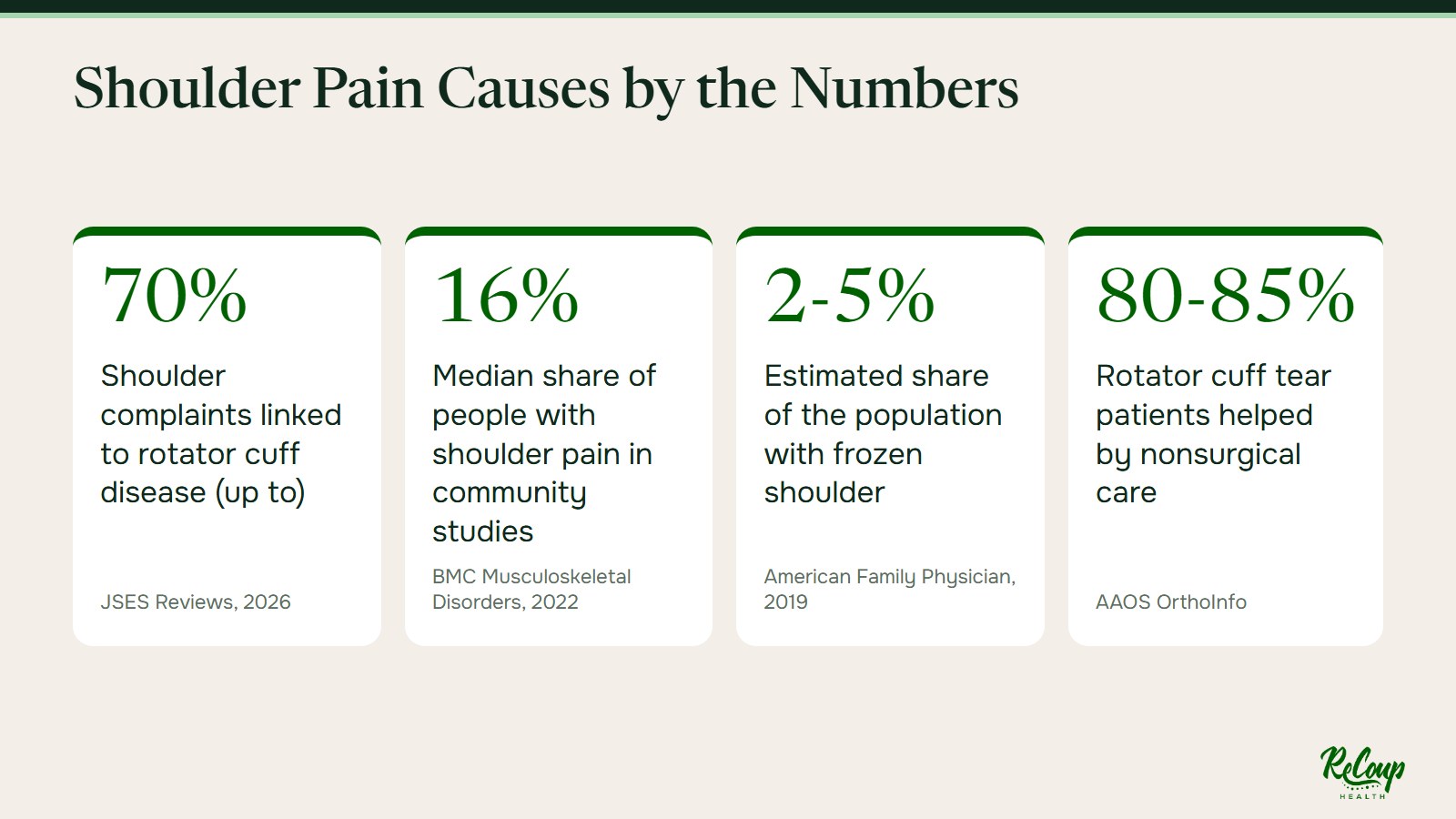
The graphic above shows the four shoulder pain numbers that frame this guide. A careful shoulder pain diagnosis separates tendon, joint and nerve sources before any treatment starts. Those sources sort into a short list of common causes.
What Are the Common Causes of Shoulder Pain?
The common causes of shoulder pain are tendon problems, joint stiffness, arthritis, instability and injury, according to the NHS. Each cause has its own pattern of pain, which helps narrow the search. The NHS groups these causes by symptom, and the table below follows that approach.
| Pain pattern | Possible cause | Typical clue |
|---|---|---|
| Pain worse while using the arm | Tendonitis, bursitis or impingement | Pain when lifting the arm overhead or out to the side |
| Pain and stiffness lasting months or years | Frozen shoulder or arthritis | Movement lost in several directions |
| Clicking, locking, tingling or a weak arm | Shoulder instability | Shoulder feels like it may slip out of place |
| Sudden very bad pain, arm hard to move | Dislocation, fracture or torn tendon | Follows a fall or blow, and the shape may change |
| Pain on top of the shoulder | Acromioclavicular (AC) joint problem | Tender where the collarbone meets the shoulder |
| Pain spreading down the arm with pins and needles | Pinched nerve in the neck | Neck movement changes the pain |
The table shows that the pattern of pain matters as much as its location. Tendonitis is inflammation of a tendon, and bursitis is inflammation of a bursa, a small fluid-filled cushion. Both conditions can appear with no fall or blow at all.
What Causes Shoulder Pain Without Injury?
What causes shoulder pain without injury is wear, overuse or stiffening of the shoulder tissues rather than one accident. Rotator cuff tendonitis, frozen shoulder and osteoarthritis can all start with no clear event, according to Cleveland Clinic. Repeated overhead work, such as painting a ceiling, strains the rotator cuff a little at a time.
Frozen shoulder, also called adhesive capsulitis, is a thickening and tightening of the joint capsule. Frozen shoulder affects an estimated 2% to 5% of the general population, says a 2019 American Family Physician review. People with diabetes were five times more likely to have it, the same review reports. Frozen shoulder peaks between the ages of 40 and 60, according to the American Academy of Orthopaedic Surgeons (AAOS) OrthoInfo.
Osteoarthritis is the gradual breakdown of the smooth cartilage that covers the ends of the bones. Cleveland Clinic describes a deep ache at the back of the shoulder and trouble reaching behind the back. Care for wear-and-tear arthritis focuses on keeping the joint moving and the muscles strong. Several of these non-injury causes share one sign, which is pain that wakes people at night.
Why Does Shoulder Pain Get Worse at Night?
Shoulder pain that gets worse at night points first to the rotator cuff and the bursa above it. Night pain is a hallmark sign of a rotator cuff tear, according to an orthopaedic surgeon quoted by Cleveland Clinic. Calcific tendonitis, where calcium deposits form inside a tendon, also flares at night, says Verywell Health.
People over 40 face a greater risk of rotator cuff tears, says AAOS OrthoInfo. The same AAOS page reports that nonsurgical treatment relieves pain and improves function in about 80 to 85% of patients. Night pain together with weakness when lifting the arm calls for an assessment. Lifting pain is the next clue to sort.
What Causes Shoulder Pain When Lifting Your Arm?
Shoulder pain when lifting your arm comes from impingement, tendonitis, bursitis or a cuff tear, say the NHS and Cleveland Clinic. Impingement is a pinching of the rotator cuff tendons and bursa under the bony tip of the shoulder blade. Medical News Today names this bony tip the acromion.
Pain at the front of the shoulder that spreads into the upper arm can come from the biceps tendon, says Verywell Health. A muscle pulled during a sudden heavy lift falls under upper body strains, a separate group from tendon problems. Some lifting pain is sudden and severe, and that pattern needs faster action.
What Causes Severe Shoulder Pain?
What causes severe shoulder pain is a dislocation, a fracture, a torn tendon, or pain referred from the heart or another organ. Sudden very bad pain with an arm that cannot move needs urgent care, according to the NHS. A dislocation means the ball of the upper arm bone has come out of its socket.
Shoulder pain is serious when any of the signs below appear, according to the NHS:
- Sudden or very bad shoulder pain, or an arm that will not move
- A shoulder that has changed shape or is badly swollen
- Pins and needles that do not go away, or no feeling in the arm
- An arm or shoulder that is hot or cold to touch
- Pain after a fall or accident, or severe pain in both shoulders
- Fever or feeling unwell along with shoulder pain
Left shoulder pain with chest pain or shortness of breath can signal a heart attack, says Cleveland Clinic. Call 911 for that combination rather than waiting for a clinic visit. Pain that travels down the arm with numbness can also come from the neck, which leads to the carpal tunnel question.
Can Carpal Tunnel Cause Shoulder Pain?
No, carpal tunnel syndrome does not cause shoulder pain directly, because the nerve squeeze sits at the wrist. The NHS lists pain in the fingers, hand or arm as carpal tunnel symptoms, with no mention of the shoulder. Carpal tunnel syndrome is pressure on the median nerve as it passes through a narrow tunnel in the wrist.
Shoulder pain with hand tingling deserves a closer look at the neck. A pinched neck nerve causes pain that radiates into the shoulder and arm, plus tingling in the fingers, says AAOS OrthoInfo. That pattern can look like median nerve compression at first, but the source sits higher up.
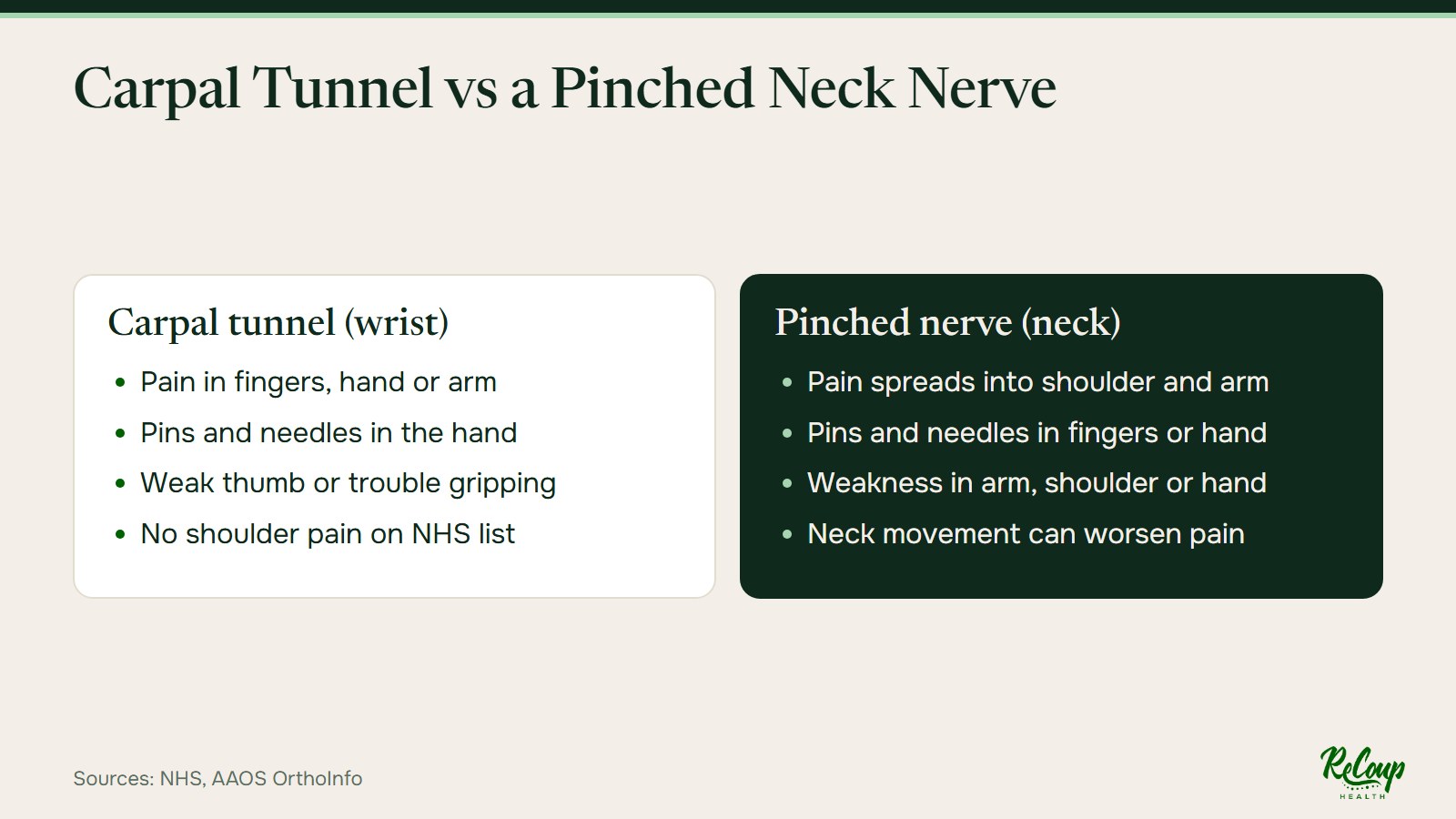
The comparison above sets carpal tunnel signs beside pinched neck nerve signs. Some people have pressure on the same nerve at two points, called double crush syndrome. A 2026 review in the journal Hand reported incidence figures from 6.7% to 73%. That wide range reflects a lack of agreed diagnostic criteria, so the link between the two sites stays uncertain.
A clinician checks the neck, shoulder, elbow and wrist in one exam to sort these overlaps. The neck deserves the first look, since a pinched nerve there explains shoulder and hand symptoms together.
Can a Pinched Nerve in the Neck Cause Shoulder Pain?
Yes, a pinched nerve in the neck can cause shoulder pain, through a condition called cervical radiculopathy. Pressure on a nerve where it branches away from the spinal cord sends pain into the shoulder and arm, says AAOS OrthoInfo. Cervical means relating to the neck, and radiculopathy means irritation of a nerve root.
Causes of cervical radiculopathy differ by age, according to the same AAOS page. A sudden disc herniation is the leading cause in younger people. A slipped neck disc can press directly on the nerve root. Wear-and-tear changes such as arthritis drive it in older adults.
Nearly half of middle-aged and older people have worn discs and pinched nerves without painful symptoms, AAOS adds. That figure means a scan alone cannot prove the neck is to blame. A 2026 paper in JSES Reviews, Reports, and Techniques notes that neck disease and rotator cuff disease commonly coexist. The elbow is the next place shoulder-area pain can come from.
Can Tennis Elbow Cause Shoulder Pain?
No, tennis elbow does not cause shoulder pain on its own. The NHS places tennis elbow pain on the outside of the elbow and forearm. Tennis elbow is irritation of the forearm tendons where they attach to the outer elbow bone. Pain that runs from the shoulder past the elbow points to a neck nerve, based on the AAOS radiculopathy description.
Both areas can hurt at the same time for separate reasons. Heavy gripping strains the elbow tendons, while overhead work strains the rotator cuff. Separate tennis elbow care and shoulder care make sense once a clinician confirms two sources. Sorting one source from two follows a simple order of checks.
How Do You Narrow Down the Cause of Shoulder Pain?
Narrow down the cause of shoulder pain by noting where it hurts, what triggers it, and whether the arm or hand tingles. Cleveland Clinic advises describing the start, location, spread and feel of the pain to a provider. These six checks build that description:
- Note the start: a fall or heavy lift points to injury, while slow onset points to tendons or arthritis.
- Mark the spot: top, front, outside or back of the shoulder.
- Test the triggers: lifting overhead, reaching behind the back, or lying on that side.
- Check for nerve signs: tingling, numbness or weakness in the arm or hand.
- Turn the neck slowly: pain that changes with neck movement suggests a nerve root.
- Track the timeline: self-care needs about 2 weeks before pain starts to ease, says the NHS.
Bring these notes to a physiotherapist or family doctor, since they shorten the exam. Shoulder pain that does not improve after 2 weeks needs an assessment, says the NHS. A plan for painful shoulder care starts once the source is clear. Some shoulder pain causes sit outside the shoulder itself.
What Else Should You Know About Shoulder Pain Causes?
Shoulder pain causes also include posture, arthritis, pregnancy and links with headaches. The short answers below cover each one.
Can Bad Posture Cause Shoulder Pain?
Yes, bad posture can cause pain at the top and back of the shoulder. Slouching or sitting with the head forward at a computer or phone for long periods brings on this pain, says Verywell Health. Long desk hours fall under office posture injuries when work is the trigger. Regular breaks and a screen at eye level reduce that load.
Can Arthritis Cause Shoulder Pain?
Yes, arthritis can cause shoulder pain, through osteoarthritis or rheumatoid arthritis. The NHS links both types to pain and stiffness that lasts months or years. Rheumatoid arthritis is an autoimmune disease, where the immune system attacks the lining of the joints. Arthritis in the AC joint at the top of the shoulder causes grinding when reaching across the chest, says Verywell Health.
Can Pregnancy Cause Shoulder Pain?
Yes, pregnancy can cause shoulder pain, and the reasons range from nerve symptoms to an emergency. The NHS lists pregnancy as a risk factor for carpal tunnel syndrome, which brings arm and hand pain. Shoulder tip pain in early pregnancy with belly pain or bleeding can signal an ectopic pregnancy, says the NHS. Seek emergency care for that combination.
Gentle movement and posture support can ease shoulder and upper back aches later in pregnancy. Our pregnancy comfort care covers comfort through each trimester and after birth.
Can Shoulder Pain Cause Headaches?
No, shoulder pain does not cause headaches directly, but tight neck and upper shoulder muscles are linked with tension-type headaches. Mayo Clinic lists tenderness in the scalp, neck and shoulder muscles as a sign of tension headache. The neck sits between both areas, so one exam of the neck and shoulder helps. Ongoing neck-related headaches deserve their own assessment.
What Vitamin Deficiency Causes Shoulder Pain?
No vitamin deficiency appears as a cause of shoulder pain on the NHS or AAOS shoulder pages. Tendons, joints and nerves remain the established sources in that guidance. A blood test from a family doctor answers questions about low vitamin D or other nutrient gaps. A naturopathic nutrition review can then look at diet alongside physiotherapy care.
How Can You Relieve Shoulder Pain While You Find the Cause?
Relieve shoulder pain while you find the cause by keeping the arm gently moving and using ice or heat. The NHS suggests a wrapped ice pack for up to 20 minutes, 3 times a day. A wrapped hot water bottle for up to 20 minutes, 2 to 3 times a day, is the heat option.
To stop the pain in your shoulder from returning, the NHS advises shoulder exercises for 6 to 8 weeks. The fastest way to heal shoulder pain is treatment matched to its cause, so a clear diagnosis comes first. Ask a pharmacist or family doctor before taking any pain medicine.
Frequently Asked Questions About Shoulder Pain Causes
Can Shoulder Pain Get Better on Its Own?
Yes, shoulder pain can get better on its own, and the NHS says self-care needs about 2 weeks before pain eases. Full recovery can take 6 months or longer, the NHS adds. Resolution without treatment over one to two years has been the expected outcome for frozen shoulder, says American Family Physician.
What Causes Shoulder Pain in Females?
Shoulder pain in females has the same causes as in males. Rates run higher in women, says the 2022 BMC Musculoskeletal Disorders review. Women between 40 and 60 make up the largest group diagnosed with frozen shoulder, according to American Family Physician. Pregnancy also raises carpal tunnel risk, per the NHS.
Can Shoulder Pain Be Related to Heart Problems?
Yes, shoulder pain can be related to heart problems, and left shoulder pain needs the closest watch. Sudden, intense left shoulder pain with chest pain or trouble breathing can signal a heart attack, says Cleveland Clinic. Call 911 right away for that combination.
What Illness Starts With Shoulder Pain?
Frozen shoulder is an illness that starts with shoulder pain, followed by stiffness, according to AAOS OrthoInfo. Rheumatoid arthritis, gallbladder or liver problems and heart disease can also show up as shoulder pain, says WebMD. Cleveland Clinic notes that a rare lung tumour at the top of the lung can cause shoulder blade pain. See your family doctor for shoulder pain with unexplained weight loss, fever or night sweats.
How Long Does Shoulder Pain Take to Heal?
Shoulder pain takes from 2 weeks to 6 months or longer to heal, depending on the cause, according to the NHS. The NHS advises shoulder exercises for 6 to 8 weeks to stop pain returning. Frozen shoulder can take one to two years to settle, says American Family Physician.
How Does Recoup Health Help Find the Cause of Shoulder Pain?
Recoup Health helps find the cause of shoulder pain with one exam that covers the neck, shoulder, elbow and wrist. Knowing what causes shoulder pain in each person shortens the path to the right plan. Our team uses hands-on physiotherapy to test movement, strength and nerve signs before treatment begins.
Chiropractic care, registered massage therapy and osteopathy join the plan where they fit the cause. A physiotherapist or family doctor should review any red flag signs first. No doctor’s referral is needed for a visit to the Recoup Health office on Innovation Drive in Vaughan.
Bring your notes on where the pain sits, what triggers it and whether the hand tingles. Those details help our clinicians separate a shoulder problem from a neck or wrist problem in the first visit. Use the appointment booking page to choose a time.