

Carpal tunnel syndrome symptoms are numbness, tingling, burning and pain in the thumb, index, middle and half of the ring finger. The cause is pressure on the median nerve at the wrist. A 1999 JAMA survey found 14.4% of adults reported these sensations, yet only 2.7% had confirmed carpal tunnel syndrome (CTS). The NHS says these symptoms are usually worse at night.
Key Takeaways
- Numbness, tingling, burning and pain in the thumb side of the hand are the core signs.
- Night symptoms come first, according to NIAMS, then daytime symptoms follow as pressure builds.
- Weak grip, dropping objects and a shrinking thumb base point to a later stage.
- Tingling in the little finger points away from the median nerve and needs a wider check.
- Pregnancy, diabetes, thyroid problems and repetitive wrist bending raise the risk.
What Are Carpal Tunnel Syndrome Symptoms in the Hand?
CTS symptoms in the hand are numbness, tingling, burning and pain in the thumb, index, middle and ring fingers, according to OrthoInfo. OrthoInfo is the patient site of the American Academy of Orthopaedic Surgeons (AAOS). These sensations come from the median nerve, which runs through a narrow channel at the wrist called the carpal tunnel.
The carpal tunnel is about 2.5 cm (1 inch) wide, per OrthoInfo. Small wrist bones form its floor and sides, and the transverse carpal ligament forms its roof. Nine flexor tendons share that tight space with the nerve. Swelling around those tendons squeezes the nerve.
The 5 symptoms of carpal tunnel are numbness, burning pain, shock-like feelings, clumsiness and dropping objects. OrthoInfo lists these five main symptoms of carpal tunnel syndrome in hand use and daily life:
- Numbness, tingling or “pins and needles” in the thumb and first three fingers
- Burning pain in the same fingers that wakes people from sleep
- Brief shock-like feelings that shoot into the fingers
- Weakness and clumsiness with fine tasks such as doing up buttons
- Dropping objects because of numbness or reduced hand awareness
The common carpal tunnel syndrome symptoms above follow one pattern, since each sign maps onto the median nerve. Early assessment with carpal tunnel physiotherapy helps confirm that nerve pattern. That nerve map also explains which fingers are involved.
Which Fingers Does Carpal Tunnel Syndrome Affect?
Carpal tunnel syndrome affects the thumb, index finger, middle finger and the thumb side of the ring finger, according to OrthoInfo. The median nerve gives feeling to these fingers. The same nerve controls the muscles at the base of the thumb.
NIAMS, part of the US National Institutes of Health, describes early numbness and tingling in the thumb, index and middle fingers. The ring finger may feel split, with tingling on one half only. That split is a useful clue for a clinician, since the little finger sits outside the median nerve area.
Finger location also explains thumb weakness. The median nerve powers the thenar muscles, the padded muscles at the thumb base. Weak thenar muscles make pinching and opening jars harder, and those tasks feel worse at specific times of day.
Why Are Carpal Tunnel Syndrome Symptoms Worse at Night?
Night symptoms are worse because many people sleep with their wrists bent, which raises pressure on the median nerve, according to OrthoInfo. A bent wrist narrows the tunnel for hours at a time. The squeezed nerve then sends tingling and pain that wake the sleeper.
NIAMS states that symptoms first appear in one or both hands at night and fade during the day. People wake up and shake out their hands to restore feeling. OrthoInfo notes that moving or shaking the hands relieves symptoms for many patients.
Daytime triggers follow the same wrist-position rule. Holding a phone, driving or reading a book with the wrist bent brings symptoms on, per OrthoInfo. These daytime triggers explain why symptoms seem to appear and vanish.
Can Carpal Tunnel Syndrome Symptoms Come and Go?
Yes, CTS symptoms can come and go, and OrthoInfo says symptoms come and go at first for many patients. Symptoms begin gradually and without a specific injury. Over time, flare-ups happen more frequently and last longer.
Intermittent symptoms still reflect real nerve pressure. The NHS describes symptoms that start slowly and come and go before settling into a steadier pattern. A log of when tingling starts, which fingers it reaches and how long it lasts helps your physiotherapist or family doctor.
Symptom tracking also shows whether the condition is moving from one stage to the next. Clinicians group that progression into three broad stages.
What Are the Stages of Carpal Tunnel Syndrome?
The stages of carpal tunnel syndrome are mild, moderate and severe. Staging rests on how frequently symptoms appear and whether the thumb muscles weaken. Medical News Today, a medically reviewed health site, describes these three stages, and each stage adds signs to the one before it.
The table below compares the three stages by main signs, timing and exam findings.
| Stage | Main signs | When signs appear | What a clinician looks for |
|---|---|---|---|
| Mild | Numbness and tingling in the thumb and first fingers | Mainly at night, fading by day | Normal strength, symptoms on wrist tests |
| Moderate | Tingling plus clumsiness and dropping objects | Night and during wrist-bent tasks by day | Reduced fingertip feeling, weaker pinch |
| Severe | Constant numbness, weak grip, trouble with buttons | Much of the day and night | Visible shrinking of the thumb base muscles |
The stage table shows that daytime symptoms and thumb weakness mark the shift away from a mild case. The graphic below sums up the same three stages as a timeline.
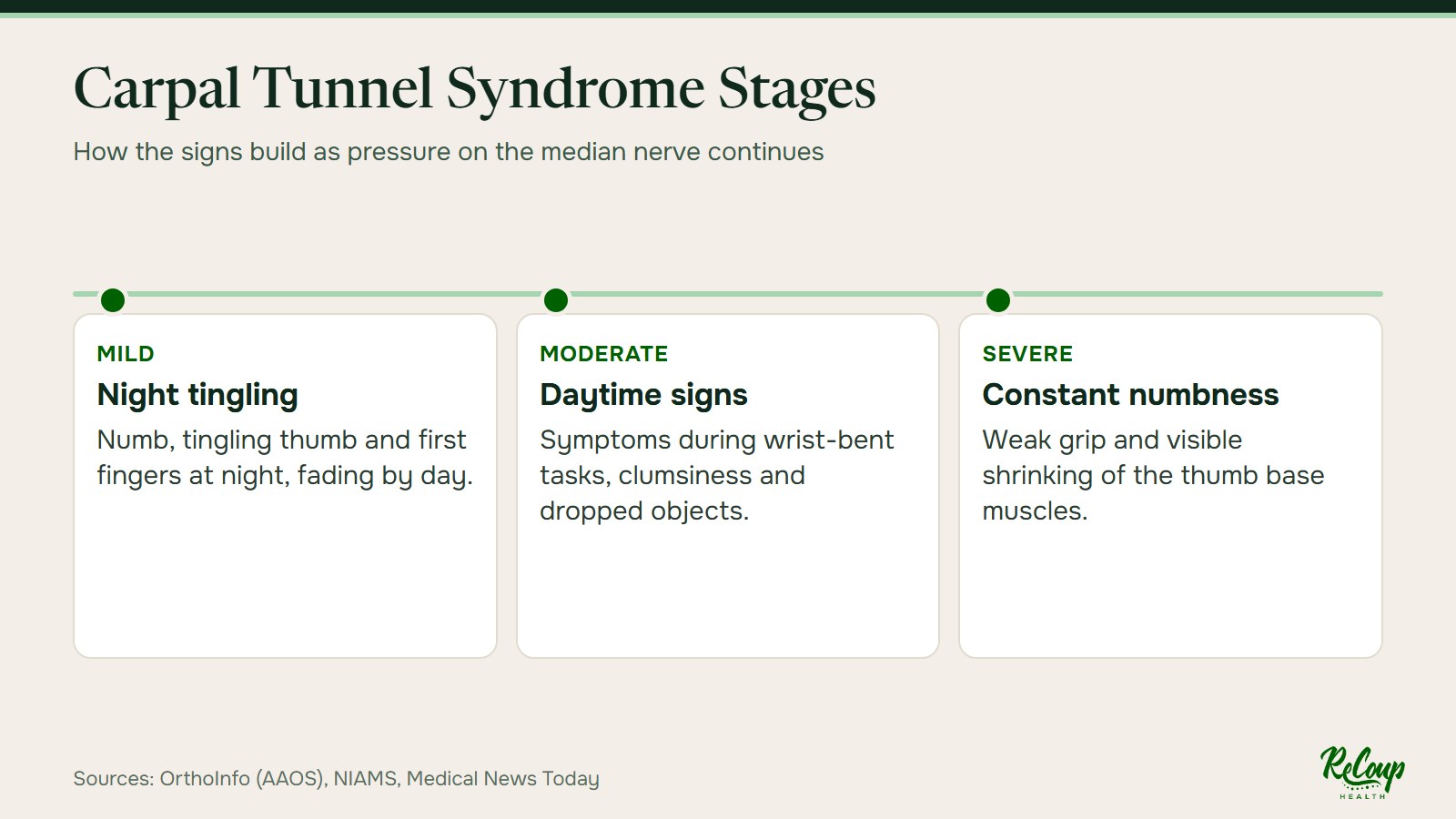
Stage matters because the severe stage carries specific warning signs.
What Are the Signs of Severe Carpal Tunnel Syndrome?
The signs of severe carpal tunnel syndrome are constant numbness, a weak grip and a shrinking thumb base, per OrthoInfo. Fine tasks such as fastening a zipper become hard. Objects slip from the hand.
OrthoInfo warns that long-standing pressure can lead to permanent loss of feeling and weakness in the hand. WebMD reports that some people with symptoms of severe carpal tunnel syndrome lose hot and cold sensing by touch. These changes reflect nerve damage rather than simple irritation.
Seek prompt assessment from your family doctor for any of these three signs:
- Numbness that no longer fades between flare-ups
- A flattened or hollow area at the base of the thumb
- Dropping cups, keys or tools without warning
Call 911 for sudden numbness or weakness on one side of the body, a drooping face or slurred speech. Heart and Stroke Foundation of Canada lists these as stroke warning signs, separate from CTS. Severe nerve signs lead back to the question of what squeezes the nerve in the first place.
What Causes the Symptoms of Carpal Tunnel Syndrome?
What causes the symptoms of carpal tunnel syndrome is pressure on the median nerve from a narrowed tunnel or swollen tendon lining. OrthoInfo names that lining the synovium, the tissue that covers the flexor tendons. Pressure also cuts the nerve’s blood supply.
OrthoInfo names five contributing factors:
- Heredity, since a smaller tunnel can run in families
- Repetitive hand and wrist motions over long periods
- Extreme wrist bending or extending for long stretches
- Pregnancy, through hormone-driven swelling
- Health conditions such as diabetes, rheumatoid arthritis and thyroid imbalance
The NHS adds being overweight and work with vibrating tools to the risk list. Desk staff, trades and assembly workers who bend the wrist for hours fit this profile. Those keyboard work injuries follow the same wrist-pressure mechanism.
Thyroid health adds a nuance to that risk list. A 2025 Neurology International study of 480 people linked hypothyroidism to CTS in people under age 50. The odds ratio in that younger group was 2.59. Related health conditions can be reviewed through naturopathic care alongside your family doctor. Testing then confirms whether the median nerve is the true source.
How Do Clinicians Test for Carpal Tunnel Syndrome Signs?
Clinicians test for carpal tunnel syndrome signs with a history, a hand exam and simple wrist tests, according to OrthoInfo and NIAMS. A history and exam alone confirm many cases. Nerve tests are added when the picture is unclear.
OrthoInfo describes four exam steps:
- Tap over the median nerve at the wrist to see if tingling shoots into the fingers (Tinel’s sign).
- Bend and hold both wrists in a flexed position to see if numbness appears (the Phalen test).
- Touch the fingertips lightly with an instrument while the eyes are closed to test feeling.
- Look at the thumb base for muscle shrinkage.
Test accuracy varies between studies. A 2025 Cureus review reports the Phalen test at about 85% sensitivity, meaning it flags 85 of every 100 true cases. A 2026 Journal of Clinical Orthopaedics and Trauma meta-analysis found the hammer-tap Tinel test at 62.1% sensitivity.
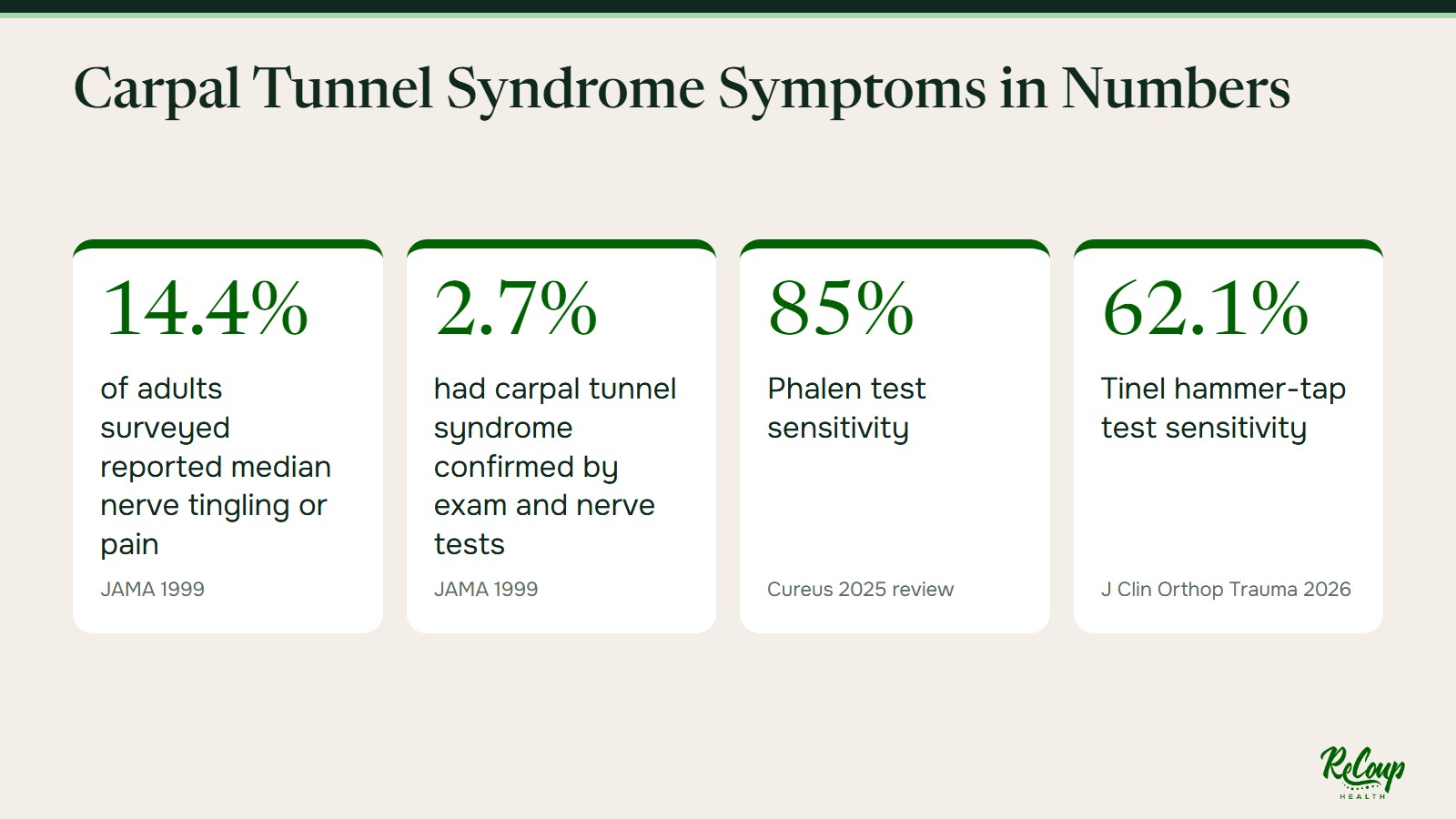
The statistics graphic above shows why one positive test does not settle a diagnosis. Nerve conduction studies measure signal speed across the wrist, per NIAMS. A wrist physiotherapy exam also screens the neck, shoulder and elbow. A full exam then rules out lookalike problems and other causes.
What Else Should You Know About Carpal Tunnel Syndrome Symptoms?
CTS symptoms also differ by life stage, by mimic condition and by treatment stage. The short answers below cover side questions about pregnancy, lookalike conditions, recovery and timing.
What Are Carpal Tunnel Syndrome Pregnancy Symptoms?
Carpal tunnel syndrome pregnancy symptoms are the same tingling, numbness and night pain, driven by fluid swelling, per NIAMS. A 2012 Iranian Journal of Public Health study found CTS in 3.4% of pregnant and 2.3% of non-pregnant women. A 2026 Journal of Hand Surgery Global Online review found rates highest in the third trimester. The NHS notes that pregnancy-related cases sometimes settle within a few months, and gentle prenatal hand support can ease that waiting period.
Can You Have Carpal Tunnel Symptoms but Not Carpal Tunnel Syndrome?
Yes, you can have carpal tunnel symptoms without the syndrome, because other nerve and tendon problems cause similar tingling or wrist pain. WebMD names de Quervain tenosynovitis, a thumb tendon problem that hurts when turning the wrist. The median nerve starts as roots in the neck, per OrthoInfo. Those neck disc problems can send tingling into the same fingers. The 1999 JAMA survey estimated that 1 in 5 people with these symptoms had true CTS.
Can Carpal Tunnel Syndrome Cause Symptoms in the Wrist and Forearm?
Yes, carpal tunnel syndrome can cause aching in the wrist and pain that spreads up the forearm, according to OrthoInfo. The symptoms of carpal tunnel syndrome in wrist and forearm areas sit alongside finger tingling. Wrist pain without any finger symptoms points to joint, ligament or tendon problems. A wrist pain clinician can sort out those causes.
Who Is at Higher Risk of Carpal Tunnel Syndrome?
Women aged 40 to 60 carry the highest risk, per a 2025 Cureus review, making sex and age key risk markers. An older Dutch community study found confirmed cases in 5.8% of women and 0.6% of men. The Lancet Neurology calls CTS the most common nerve entrapment worldwide. Office, factory and trade work that bends the wrist for hours adds to that risk. Forearm tightness from that work is one target of hand massage therapy.
How Long Do Carpal Tunnel Symptoms Last?
Carpal tunnel symptoms can last from a few months to years, depending on stage and cause. The NHS says pregnancy cases may settle within a few months. A night splint may need up to 6 weeks before it helps, per the NHS. OrthoInfo states that CTS worsens over time without treatment for most people. Early median nerve care aims to slow that progression.
What Are the Symptoms Before and After Carpal Tunnel Syndrome Surgery?
The symptoms before and after carpal tunnel syndrome surgery shift from night numbness to fast night relief and slower strength gains. Night symptoms improve dramatically for most patients in the first week, per OrthoInfo. Grip and pinch strength return by about 2 to 3 months, and full recovery may take up to a year. The NHS says the release takes around 20 minutes. Structured post-release hand rehab supports the return to normal tasks within about a month.
How Can You Check Yourself for Carpal Tunnel Syndrome?
Check yourself for carpal tunnel syndrome by noting which fingers tingle, when they tingle and whether pinch grip feels weak. Tingling in the thumb, index and middle fingers that wakes you at night fits the median nerve pattern, per NIAMS. Look at the base of the thumb for a flattened area. WebMD cautions that home wrist tests can be done in the wrong position, so a clinician should confirm the result.
How Do You Fix Carpal Tunnel Syndrome?
Fix carpal tunnel syndrome by starting with a night wrist splint and activity changes, then stepping up care only when symptoms persist. A 2023 Cochrane review found that night splinting improved symptoms in the short term, though the evidence was low certainty. The NHS lists a steroid injection when a splint does not help. Surgery probably brings clinical improvement to more patients than splinting, according to a 2024 Cochrane review.
What Are the Top 3 Exercises for Carpal Tunnel Syndrome?
The top 3 exercises for carpal tunnel syndrome are median nerve glides, tendon glides and gentle wrist stretches. Physiotherapists use these to keep tissues moving. OrthoInfo notes that nerve gliding exercises help the median nerve move more freely in the tunnel. A 2012 Cochrane review of 16 studies with 741 participants rated the exercise evidence as very low quality. Ask your physiotherapist to set the right dose for your stage.
When Should You See Someone About Carpal Tunnel Signs?
See a physiotherapist or family doctor about carpal tunnel signs when tingling lasts several weeks, wakes you up or weakens your grip. OrthoInfo stresses early diagnosis because early stages may be slowed or stopped. Bring a symptom log that lists fingers, times of day and triggers. The cards below show four signs worth reporting.
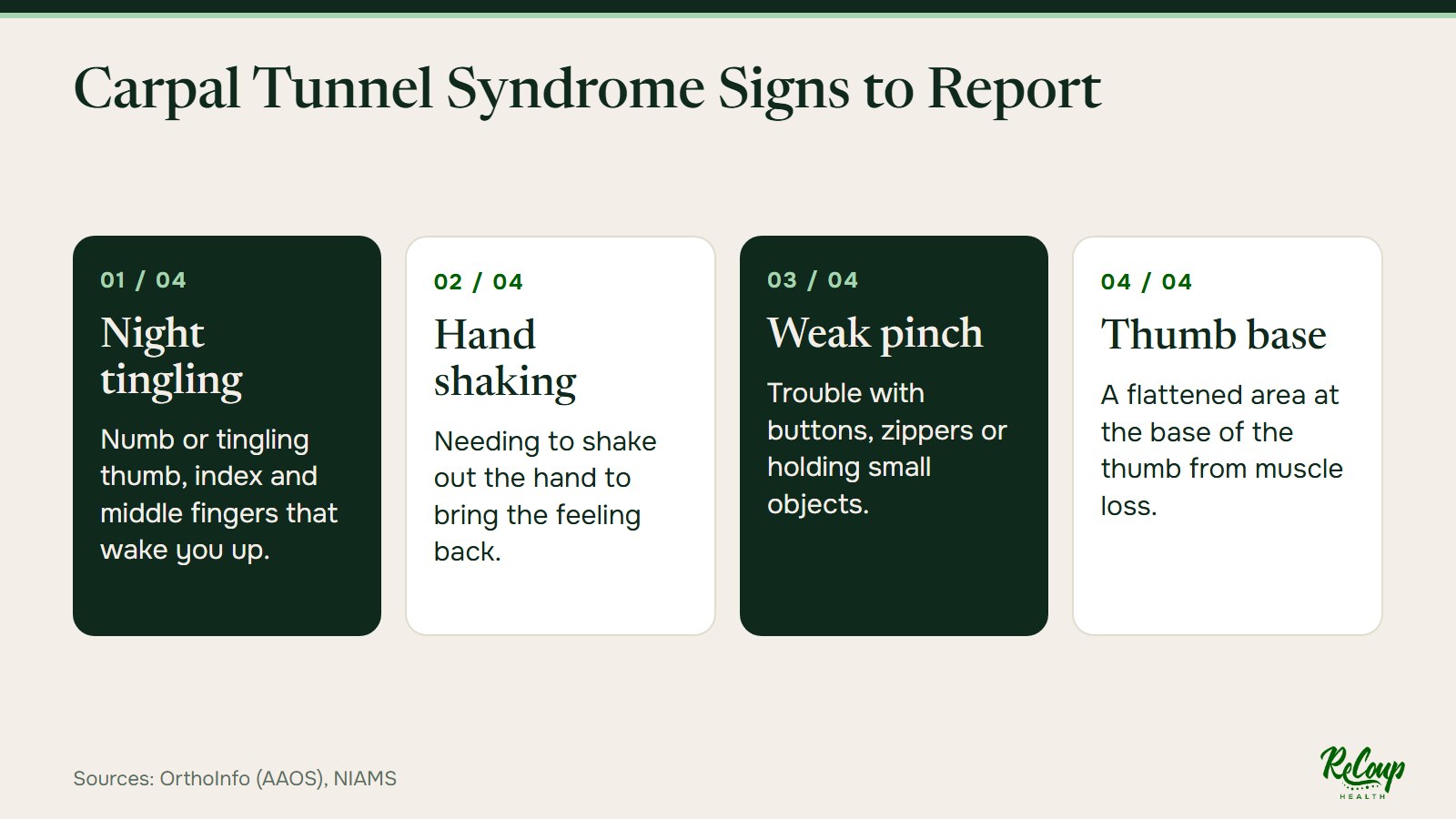
These four cards match the warning signs in the severe stage section. Our hand clinicians review each sign during an assessment.
Frequently Asked Questions About Carpal Tunnel Syndrome Symptoms
Can Carpal Tunnel Syndrome Affect Both Hands?
Yes, carpal tunnel syndrome can affect both hands at the same time. NIAMS states that symptoms appear in one or both hands, starting at night. The dominant hand tends to feel worse during the day because it does more gripping.
Does Carpal Tunnel Syndrome Cause Tingling in the Little Finger?
No, carpal tunnel syndrome does not cause little finger tingling, because the little finger lies outside the median nerve area. OrthoInfo maps the nerve to the thumb through half of the ring finger. Tingling in the little finger points to a different nerve at the elbow or neck.
Can You Drive With Carpal Tunnel Syndrome?
Yes, you can drive with carpal tunnel syndrome in many cases. OrthoInfo notes that holding the wheel with a bent wrist can bring on numbness. Talk to your family doctor about driving safety for constant numbness or weakness.
Can Carpal Tunnel Go Away on Its Own?
Carpal tunnel can go away on its own in some pregnancy-related cases within a few months, according to the NHS. Other cases tend to worsen over time, per OrthoInfo. A clinician can judge which pattern fits your hand.
What Vitamin Deficiency Causes Carpal Tunnel?
No vitamin deficiency is named as a cause of carpal tunnel by NIAMS, OrthoInfo or the NHS. Their risk lists cover pregnancy, diabetes, thyroid problems, arthritis and repeated wrist bending. Ask your family doctor about blood tests for nerve symptoms that do not fit the median nerve pattern.
How Recoup Health Helps With Carpal Tunnel Syndrome Symptoms
Recoup Health helps with CTS symptoms through a hand, wrist, elbow and neck exam that confirms the nerve source first. Our physiotherapists check the wrist tests, fingertip feeling and thumb strength described above. We then build a plan around night splinting, nerve gliding, workplace changes and strength work.
No doctor’s referral is needed to book an assessment at our Vaughan clinic. The Recoup Health caregivers on our team work together on hand and wrist problems. That team includes physiotherapists, registered massage therapists and a naturopathic doctor.
A clear record of your signs gives every visit a strong starting point. Early carpal tunnel rehab builds on that record, from night splint fitting to nerve gliding and grip work.
Bring your symptom log, a list of daily wrist tasks and any past test results to the first visit. Use the hand assessment booking to arrange that first assessment.