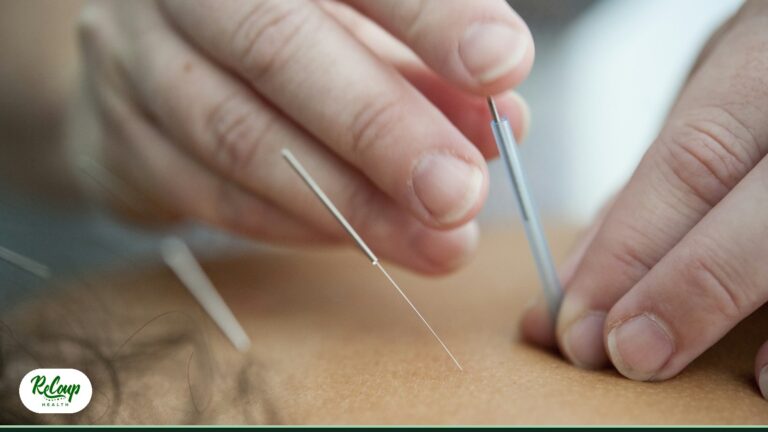

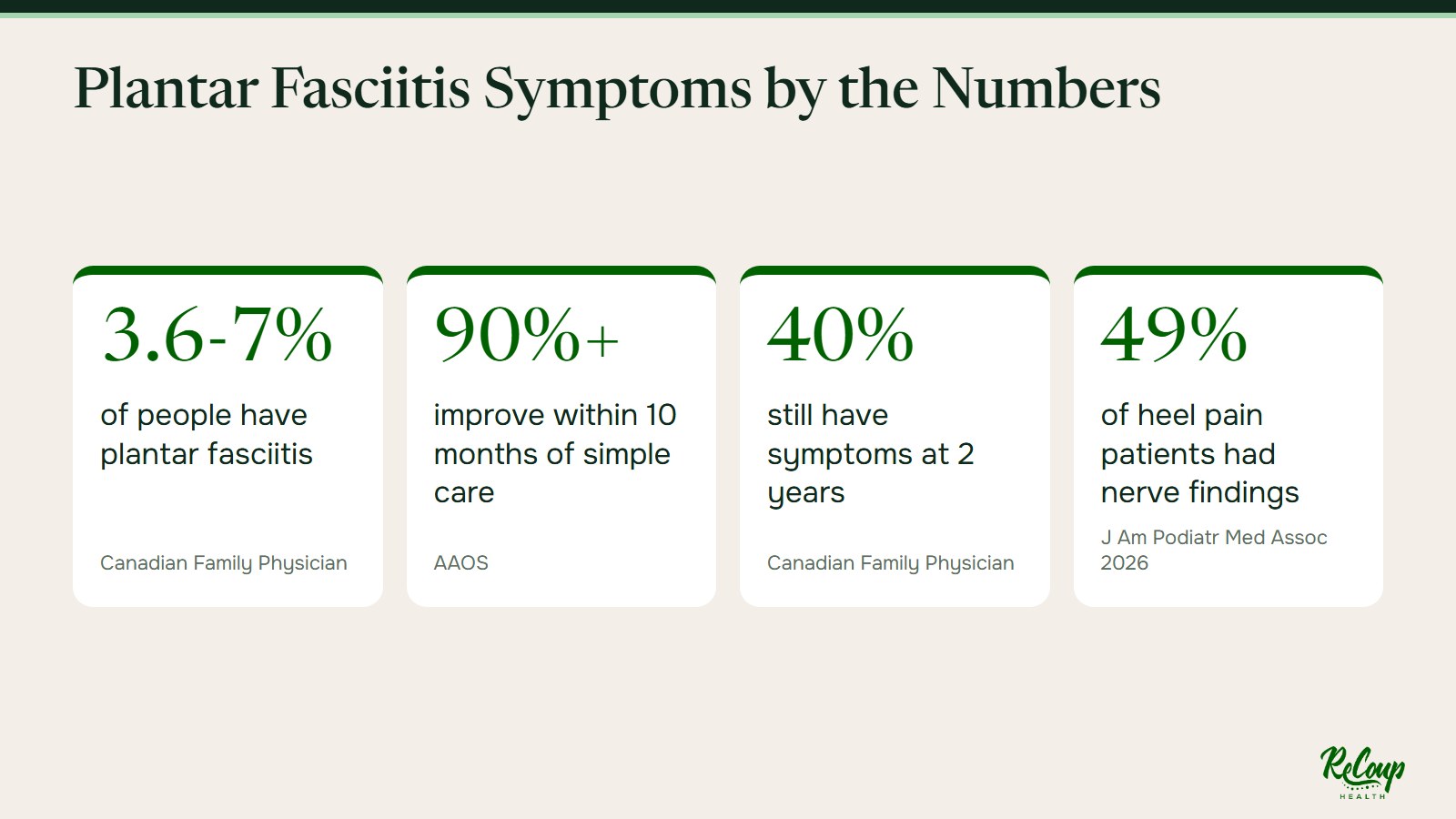
The symptoms of plantar fasciitis are a sharp or aching heel and arch pain that peaks with the first steps after rest. The pain then eases after a few minutes of walking and returns after long standing. The NHS names this first-step pattern as the main sign. Canadian Family Physician estimates that 3.6% to 7% of all people develop the condition at some point.
Key Takeaways
- The core symptom is heel or arch pain with the first steps after rest, which fades as the foot warms up (NHS).
- Pain that builds after activity, not during it, fits plantar fasciitis (Harvard Health Publishing).
- Numbness, tingling, a sudden pop or bruising point away from simple plantar fasciitis and need a clinical check.
- Healing shows up as shorter morning pain, less stiffness and longer pain-free walks.
- More than 90% of people improve within 10 months of simple treatment (American Academy of Orthopaedic Surgeons).
What Are the Symptoms of Plantar Fasciitis
The symptoms of plantar fasciitis are heel and arch pain, stiffness after rest, and tenderness when pressing the heel. The NHS adds that pain is worst with the first steps after sleeping or resting and that stretching the sole can hurt. Plantar fasciitis is irritation of the plantar fascia. The plantar fascia is a thick band of tissue running from the heel bone to the toes.
Cleveland Clinic lists five symptoms: heel pain, arch pain, stiffness, swelling around the heel and a tight Achilles tendon. The Achilles tendon is the cord joining the calf muscles to the back of the heel. A tight calf limits ankle movement, which loads the fascia with every step. Our plantar fasciitis orthotics page explains how foot support spreads that load across the arch.
Timing matters as much as location. Harvard Health Publishing notes that the pain worsens after physical activity but is not typically felt during exercise. Climbing stairs can also be painful, per the same source. This timing pattern separates plantar fasciitis from many other heel problems.
What Does the Beginning of Plantar Fasciitis Feel Like
The beginning of plantar fasciitis feels like a bruised or tight spot under the heel on the first steps out of bed. The first signs of plantar fasciitis are mild and short, lasting a few minutes before the foot loosens. Hull University Teaching Hospitals NHS Trust (2025) notes that the pain eases with gentle exercise, such as walking around in the morning.
Early heel pain then shows up after a long shift on hard floors or a weekend of extra walking. A sudden rise in activity, long periods of standing and tight calves are listed as triggers in the same NHS leaflet. Early symptoms are worth tracking, because a short pain diary shows whether the pattern is growing or settling.
Where Do You Feel Plantar Fasciitis Pain in the Foot
Plantar fasciitis pain is felt on the inner, front edge of the heel bone, where the fascia attaches. The symptoms of plantar fasciitis in heel tissue can spread forward into the arch, per the NHS. Harvard Health Publishing describes an area of maximum tenderness just in front of the heel bone.
Pain in other spots can point to a different problem. The table below links each symptom location to what it tends to suggest.
| Where it hurts | Typical feel | What it may point to |
|---|---|---|
| Bottom of heel, inner front edge | Sharp first-step pain, dull ache later | Classic plantar fasciitis (NHS, Harvard) |
| Middle of the arch | Ache or burning along the sole | Plantar fasciitis spreading forward (Harvard) |
| Inner side of foot or heel | Burning, tingling or numbness | Possible nerve involvement (J Am Podiatr Med Assoc 2026) |
| Back of heel | Pain where the tendon meets the bone | Insertional Achilles tendon problem (Harvard) |
| Whole heel, worse with each step | Deep pain that does not ease with walking | Possible heel stress fracture (Harvard) |
Plantar fasciitis symptoms side of foot complaints are less typical, so outer-edge or ankle pain deserves an exam. Location is the first clue, and a simple self-check adds the next layer of detail.
How Do You Know If You Have Plantar Fasciitis
You know you may have plantar fasciitis when heel pain follows the first-step pattern. The tender spot also sits under the front of the heel. A clinician confirms it with a physical exam, according to Cleveland Clinic, and imaging is not routinely needed. Run through these signs you have plantar fasciitis before booking an assessment:
- Note the first 5 to 10 steps after waking, and check whether the heel hurts more then than later.
- Walk for a few minutes, and check whether the pain eases as the foot warms up.
- Press the inner front edge of the heel with your thumb, and check for a sharp tender point.
- Pull your toes up gently, and check whether the stretch under the sole is painful.
- Recall your last long day on your feet, and check whether the ache built afterwards.
- Check for numbness, tingling, bruising or swelling, which point to something else.
Four or more “yes” answers to the first five checks match the textbook pattern. A “yes” to the sixth check calls for a professional exam, not more home care. The next step is knowing what self-checks can and cannot rule out.
Can You Self Diagnose Plantar Fasciitis
You can self-identify a likely case of plantar fasciitis, but a clinician should confirm it. Harvard Health Publishing notes that doctors look for the absence of signs from look-alike conditions before settling on the diagnosis. A symptom-guided physiotherapy assessment tests ankle movement, calf length and the tender point together. That exam matters, because several conditions mimic heel pain.
What Can Be Mistaken for Plantar Fasciitis
Conditions that can be mistaken for plantar fasciitis include insertional Achilles tendinitis, a calcaneal (heel bone) stress fracture and plantar nerve entrapment. Harvard Health Publishing lists all 3 as conditions a doctor rules out. Heel spurs add confusion, though Cleveland Clinic notes that many people with a spur feel no pain from it.
A stress fracture is a tiny crack in the bone from repeated load. Stress fracture pain tends to worsen with walking instead of easing. Nerve entrapment is a pinched nerve, and it brings burning or tingling more than stiffness. Low back problems can also send pain into the foot, so a sciatic nerve irritation screen belongs in a full heel exam. Nerve signs lead straight to the numbness question.
Is Numbness a Symptom of Plantar Fasciitis
Numbness is not a classic symptom of plantar fasciitis, and it suggests nerve involvement. A 2026 review in the Journal of the American Podiatric Medical Association found neurological findings in 49% of 459 heel pain patients. Of those 225 patients, 56% resolved with conservative care. Plantar fasciitis symptoms numbness reports belong with a clinician. The NHS advises seeing a doctor for tingling or loss of feeling.
Is Swelling a Symptom of Plantar Fasciitis
Swelling is a possible but uncommon symptom of plantar fasciitis. Cleveland Clinic lists swelling around the heel, while the NHS symptom page does not mention it. Visible puffiness, warmth or redness calls for an exam to rule out a fracture, infection or joint problem. Changes like these also mark the line between a steady case and a worsening one.
What Are Signs Plantar Fasciitis Is Getting Worse
Signs plantar fasciitis is getting worse include longer first-step pain each morning, pain during activity, and limping by evening. Hull University Teaching Hospitals NHS Trust (2025) advises physiotherapy for people who struggle to bear weight despite self-care. The NHS also advises seeing a GP when pain is severe, keeps coming back or has not improved after 2 weeks.
Severe plantar fasciitis symptoms can stop a person walking normally. A limp shifts load onto the knee, hip and the other foot, which spreads the problem. Long-term cases matter too: Canadian Family Physician reports that about 40% of patients still have symptoms at 2 years. Chronic plantar fasciitis symptoms beyond 6 months of exercise deserve a family physician review, per the same journal. Our page on long-standing heel pain covers that slower path.
Risk factors also shape how hard symptoms hit. A 2016 British Journal of Sports Medicine meta-analysis linked a body mass index over 27 with 3.7 times higher odds. A 2003 study in the Journal of Bone and Joint Surgery linked limited ankle bend with 23.3 times higher odds. Worsening symptoms raise one more concern, and that is a tear.
What Are Plantar Fasciitis Tear Symptoms
Plantar fasciitis tear symptoms are a sudden pop or sharp heel pain, followed by bruising, swelling and trouble pushing off. A tear (rupture) is a partial or full split in the fascia. The American Academy of Orthopaedic Surgeons (AAOS) warns that cortisone injections can weaken the fascia and may lead to a tear. A Cochrane review (2017) recorded 2 ruptures in 1 injection trial. Sudden pain like this needs prompt medical care, not stretching.
What Are the Signs Plantar Fasciitis Is Healing
Signs plantar fasciitis is healing are shorter and milder first-step pain, less morning stiffness, and longer walks before the heel aches. First-step pain is the main marker clinicians track. The DiGiovanni trial (Journal of Bone and Joint Surgery, 2003) tracked first-step morning pain in 101 patients over 8 weeks.
The graphic below compares signs your plantar fasciitis is healing with signs it is getting worse.
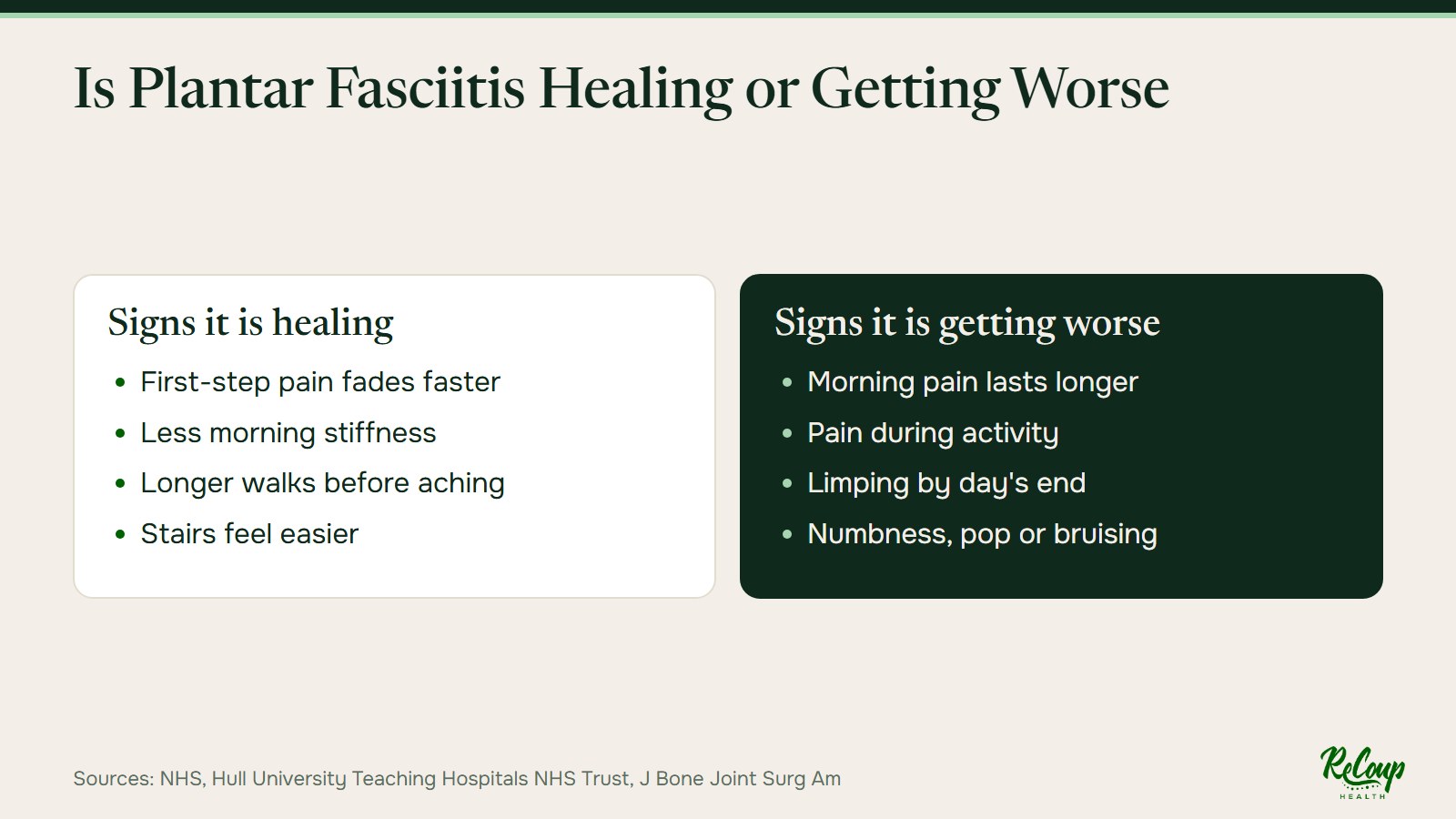
Healing is rarely a straight line. A long walk can bring a 1 or 2 day flare even while the overall trend improves. The 2-year follow-up of the DiGiovanni trial (2006) found that 94% of 66 respondents had less pain. That same follow-up found 77% had no limits on recreation. A weekly score from 0 to 10 for first-step pain shows the trend better than day-to-day memory.
Healing speed also links to support and load. A running heel rehab plan raises activity in steps so the fascia adapts without a flare. Those steps lead to the question of how long mild cases last.
How Long Does Mild Plantar Fasciitis Last
Mild plantar fasciitis lasts a few weeks to a few months, according to Cleveland Clinic. Simple treatment helps more than 90% of patients within 10 months, according to the AAOS. Our post on plantar fasciitis duration breaks that timeline into phases. Duration also depends on what started the problem.
What Else Should You Know About Plantar Fasciitis Symptoms
Plantar fasciitis symptoms connect to causes, daily activity, home care and prevention. The short answers below cover the side questions people raise once the heel pain is identified.
What Is the Root Cause of Plantar Fasciitis
The root cause of plantar fasciitis is repeated strain on the fascia where it attaches to the heel bone. The NHS notes that the exact reason is not always clear. Known risk factors include age 40 to 60, a tight calf, extra body weight and standing work. The full list sits in our guide to plantar fasciitis causes, which pairs each one with the heel load it adds.
Is Walking Good for Plantar Fasciitis
Walking is good for plantar fasciitis in short, comfortable bouts on supportive footwear. Gentle walking eases first-step pain, per Hull University Teaching Hospitals NHS Trust (2025). Long walks or standing on hard floors can flare symptoms, so build distance gradually. Pain that lingers the next morning signals that the last walk was too long.
How to Treat Plantar Fasciitis at Home
Treat plantar fasciitis at home with relative rest, calf and sole stretches, supportive shoes and ice. Hull University Teaching Hospitals NHS Trust (2025) advises ice wrapped in a damp towel for 15 to 20 minutes. Hands-on soft tissue work from arch massage therapy can add short-term relief. Ask your pharmacist or family doctor before starting any pain medicine.
How Can You Prevent Plantar Fasciitis From Coming Back
Prevent plantar fasciitis from coming back by keeping the calf flexible, raising activity gradually and wearing cushioned shoes with arch support. Cleveland Clinic advises replacing running shoes every 6 to 9 months, or about 400 to 800 km. Shoe support can pair with supportive custom orthotics for people with flat feet or high arches. Standing work deserves extra care, since a 2003 study linked it with 3.6 times higher odds of plantar fasciitis.
Can Chiropractic Care Help With Heel Pain Symptoms
Chiropractic care can help with heel pain symptoms as part of a broader plan that includes exercise. A chiropractic foot assessment checks ankle and foot joint movement that affects heel load. Evidence for joint work alone in plantar fasciitis is limited, so it works alongside stretching and strengthening.
The figures below sum up how common plantar fasciitis is and how it tends to progress.
Frequently Asked Questions About Plantar Fasciitis Symptoms
What Are 2 Symptoms of Plantar Fasciitis
Two symptoms of plantar fasciitis are first-step heel pain after rest and tenderness under the front of the heel. The NHS also lists pain when stretching the sole of the foot.
Can Plantar Fasciitis Affect Both Feet
Plantar fasciitis can affect both feet at once. Cleveland Clinic states that most people have it in one foot at a time. Pain in both heels together deserves a check for wider causes.
Who Gets Plantar Fasciitis Symptoms
Plantar fasciitis symptoms appear in adults aged 40 to 60 more than other ages, per the NHS. Runners are also at risk, since the condition makes up to 8% of running injuries, per Canadian Family Physician.
When Should You Seek Urgent Care for Heel Pain
Seek urgent care for heel pain after a pop, when you cannot bear weight, or with fever, redness and heat. People with diabetes and foot pain should get assessed early, per the NHS.
How Recoup Health Helps With Plantar Fasciitis Symptoms
Recoup Health helps by matching your symptoms of plantar fasciitis to a clear diagnosis and a staged plan. No doctor’s referral is needed to start. The graphic below shows the first signs our clinicians screen for at a heel assessment.
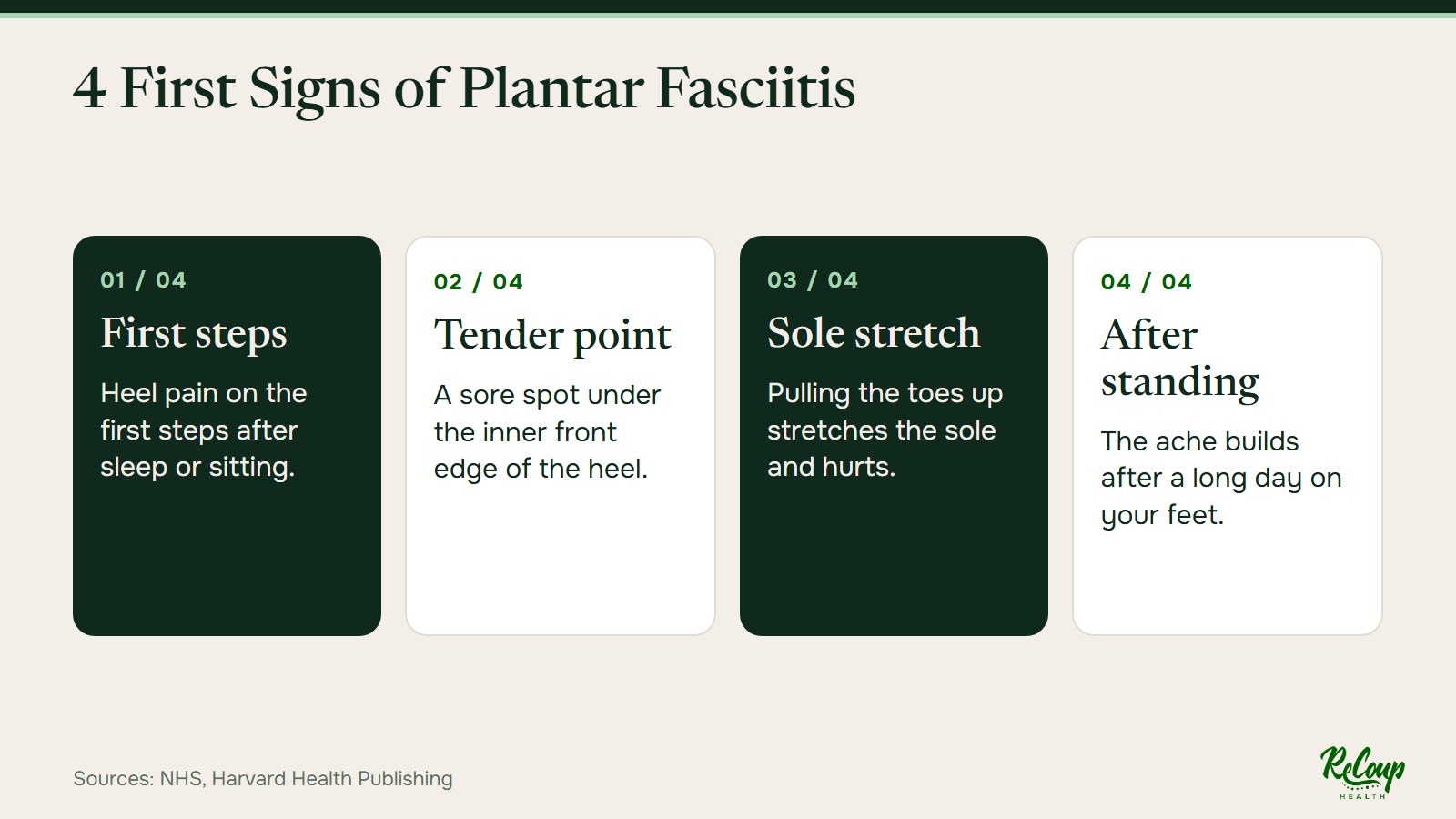
Each visit starts with the self-check signs above, plus ankle range and calf strength tests. The plan can combine physiotherapy, massage therapy, orthotics and stretching, guided by our heel clinicians in Vaughan. Treatment shifts as first-step pain, stiffness and walking tolerance change week to week.
Heel pain that has lasted more than 2 weeks is a good reason to book. Use our heel symptom assessment request to start with a full foot exam, including gait, footwear and calf strength checks.
Progress is measured, not guessed. Each follow-up rechecks first-step pain, morning stiffness and walking distance against your starting scores. Visits with Recoup Health’s specialists include a check of your healing signs each time.