
Pain after knee replacement is normal for the first few months. The sharpest pain comes in the first weeks, and the NHS expects walking without aids from about 6 weeks. About 20% of people still have knee pain 3 months or more after surgery (Wylde, 2013). Nerve pain and numbness near the scar are common too, and they fade for many people with time and guided rehab.
Key Takeaways
- Pain peaks in the first weeks after surgery and eases steadily over 6 to 12 months.
- Outer-knee numbness shows up on testing in up to 100% of people after a total knee replacement.
- Skin hypersensitivity from small nerve injury lasts about 2 to 6 months, according to a CHRISTUS Health surgeon.
- Pain in the hip, back, shin, ankle or foot can come from a changed walking pattern or swelling.
- Calf swelling, fever, a hot red knee or chest pain need same-day medical care.
How Long Does Pain Last After Knee Replacement?
Pain after knee replacement is strongest in the first few weeks, then fades over 6 to 12 months. The NHS says full recovery takes several months or longer. A CHRISTUS Health orthopaedic surgeon states that complete recovery can take 6 to 12 months.
Recovery time depends on age, fitness before surgery and other health conditions, according to Cleveland Clinic. Steady rehab in the first 3 months matters. A structured total knee rehab plan sets weekly targets for bending, strength and walking. Those targets show whether the pain is following a normal healing curve.
The timeline below shows how knee replacement recovery pain changes from the first weeks to the one-year mark.
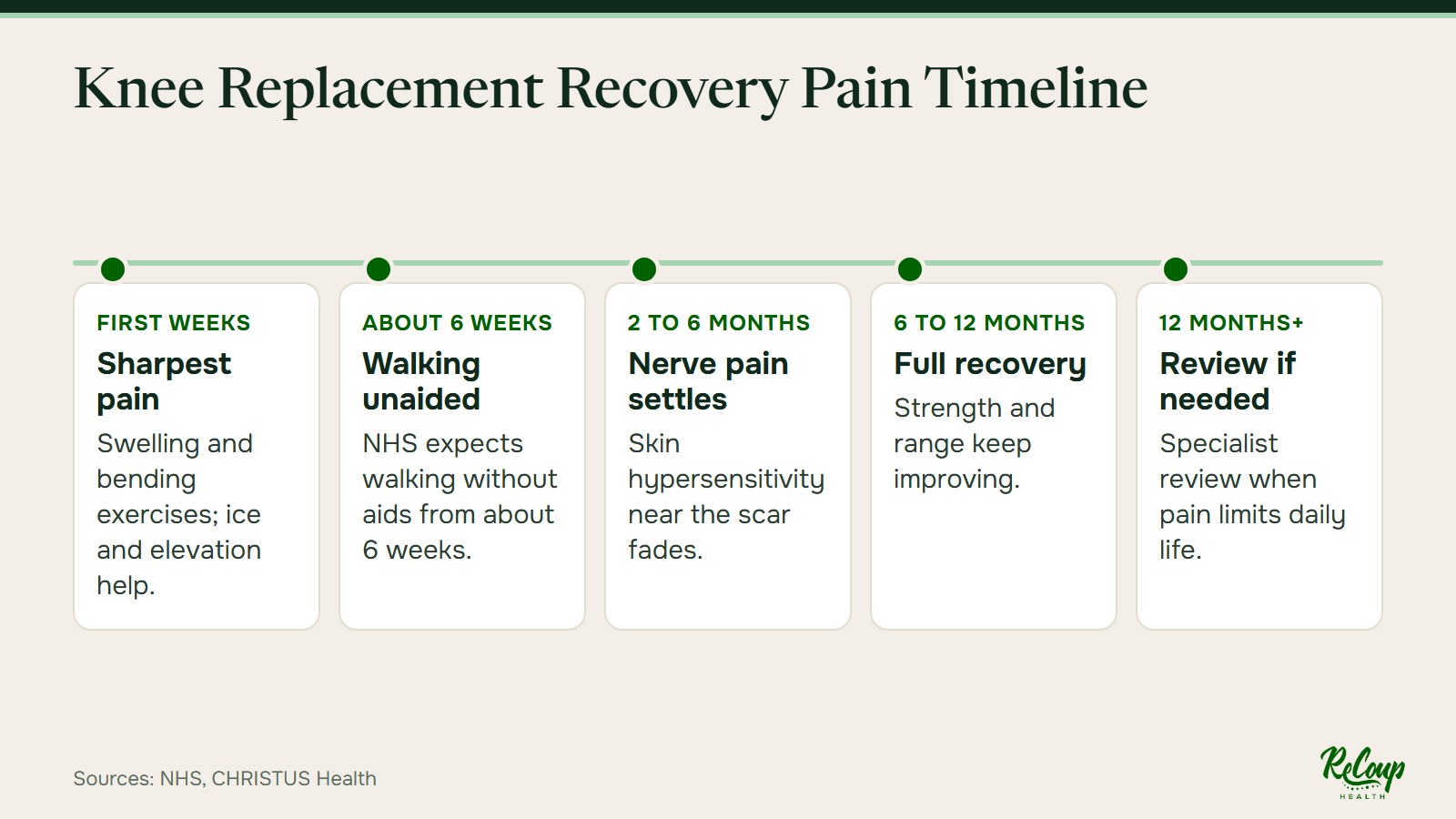
The timeline is a general guide, and each phase can run shorter or longer. The worst stretch sits at the very start of that timeline.
When Is the Worst Pain After Surgery?
The worst pain after surgery comes in the first few weeks. Cleveland Clinic links that pain to the surgery itself and to early healing. Swelling, bruising and early bending exercises all add to that early soreness.
Early pain is a sign of healing tissue, not a failed joint. That healing pattern is easier to read once you know what the second week looks like.
What Should I Expect 14 Days After a Knee Replacement?
Fourteen days after a knee replacement, expect swelling, warmth around the scar, stiffness in the morning and pain with exercise. The NHS expects walking aids for the first weeks, with walking unaided from about 6 weeks. Daily bending and straightening exercises remain the main task at this stage.
Your surgeon or physiotherapist checks the scar and knee bend around this point. The next question is which of those sensations count as normal.
What Pain Is Normal After Knee Replacement?
Normal pain after surgery eases with rest, ice and elevation and lets you sleep and move the next day. A CHRISTUS Health surgeon says pain at 6 weeks can still be normal. Pain that keeps getting worse, or that rest and ice do not settle, needs a review.
The table below compares expected healing pain with warning signs.
| Feature | Expected healing pain | Warning sign to report |
|---|---|---|
| Overall trend | Better week by week, with good and bad days | Steadily worse over several days |
| Response to rest and ice | Settles after rest, ice and elevation | No change with rest, ice or elevation |
| Swelling | Rises after activity, falls overnight | Sudden swelling, heat or redness |
| Calf and leg | Mild ache from walking more | Throbbing calf pain or one swollen leg |
| Wound | Dry scar, mild warmth | Drainage, fever or chills |
Use the right-hand column as your call list for the surgeon or family doctor. Nerve pain is the one type of pain that can feel unlike anything in this table.
Is It Normal to Have Nerve Pain After Knee Replacement?
Yes, nerve pain after knee replacement is normal for the first few months, as long as it slowly improves. Outer-knee numbness appears on testing in up to 100% of patients, per the Annals of the Royal College of Surgeons of England. Earlier studies in that review found 37% to 55% of people noticed the numbness themselves.
Numbness is a loss of feeling, while nerve pain is burning, tingling or zapping. Both come from the same small skin nerves, which leads straight to the cause.
What Causes Nerve Pain After a Knee Replacement?
Nerve pain after a knee replacement comes from small skin nerves that are cut or stretched during the incision. The main one is the infrapatellar branch of the saphenous nerve, a sensory nerve that crosses the front of the knee. A CHRISTUS Health surgeon explains that surgeons protect the large leg nerves, but these small skin nerves cannot all be avoided.
In one series, 25 of 93 knee replacements (26.9%) had patient-reported sensory changes on the outer knee. The rate was 72.7% where numbness was recorded in the notes, compared with 22.1% where it was not. That gap shows nerve symptoms are easy to miss unless someone records them, so describing the feeling matters.
What Does Knee Replacement Nerve Pain Feel Like?
Knee replacement nerve pain feels like burning, electric shocks, pins and needles or extreme sensitivity to light touch. A CHRISTUS Health surgeon notes that bed sheets brushing the skin can disturb sleep. The area sits beside or below the scar, while deep aching inside the joint is a different pain.
Nerve pain in lower leg after knee replacement is less typical and deserves a physiotherapy or medical check. Once the feeling is named, a few simple steps help settle it.
What Helps Nerve Pain After a Knee Replacement?
Desensitization, gentle movement and soft tissue work help nerve pain after a knee replacement. A CHRISTUS Health surgeon lists physiotherapy with soft tissue work, cold therapy, massage and electrical stimulation. Medicines that calm nerve signals are a decision for your surgeon or family doctor.
Physiotherapists use a graded desensitization routine for hypersensitive skin, which retrains the nerves to accept touch:
- Mark the tender area around the scar so changes are easy to track.
- Rub a soft fabric, such as silk or cotton, over the edge of the area for 1 to 2 minutes.
- Move to rougher textures, such as a towel, as the soft fabric becomes comfortable.
- Apply a cold pack wrapped in a towel for about 20 minutes, as Cleveland Clinic advises for knee pain.
- Keep bending and straightening the knee each day so scar tissue stays mobile.
Gentle scar tissue massage starts only once the wound has fully closed and your surgeon agrees. The routine works over weeks, which raises the question of how long the nerve pain stays.
How Long Does Nerve Pain Last After Knee Replacement Surgery?
Nerve pain after a knee replacement lasts about 2 to 6 months for skin hypersensitivity, according to a CHRISTUS Health surgeon. The same surgeon looks further when nerve pain lasts beyond 6 to 12 months or does not respond to treatment. Numbness can shrink over time, but a small patch may stay permanently.
A painless numb patch is not harmful on its own. Ongoing pain, though, raises the bigger question of why recovery hurts so much.
Why Is There So Much Pain After a Knee Replacement?
There is so much pain after a knee replacement because the surgery cuts bone, moves muscle and stretches the joint capsule. Swelling then fills the knee and pushes against healing tissue. Daily exercises stretch that tissue on purpose to rebuild movement.
Stiffness adds its own pain. A CHRISTUS Health surgeon states that knee bending is easier to gain in the first 6 to 8 weeks. In that window, knee replacement physiotherapy targets bending range before scar tissue tightens. Stiff, swollen knees also hurt more at night, the next problem to solve.
What Helps Pain at Night After Knee Replacement?
Ice, elevation, a set bedtime routine and well-timed medicine help pain at night after knee replacement. Cleveland Clinic advises icing the knee a few times a day for 20 minutes. The American Association of Hip and Knee Surgeons (AAHKS) suggests 20 to 30 minutes on, then 30 minutes off. A towel belongs between the ice and the skin.
- Raise the leg so the foot sits above heart level for 20 to 30 minutes before bed.
- Sleep on your back with the knee straight, not with a pillow under the knee.
- Do a short set of gentle ankle pumps before lying down to move fluid.
- Ask your pharmacist or surgeon how to time pain medicine around bedtime.
- Keep sheets loose over the scar when nerve sensitivity disturbs sleep.
A pillow under the knee feels good but can lock in a bent position. Night pain eases as swelling settles, but some pain stays longer than a year.
Why Does My Knee Replacement Still Hurt After a Year?
A knee replacement still hurts after a year for a minority of people, mostly with movement rather than at rest. A 2022 Journal of Pain Research study followed 605 patients. At 2 years, 12.1% had pain at rest and 37.7% on movement. Only 9.8% had moderate-to-severe pain on movement.
Knee replacement pain after 1 year has several causes. Possible sources include stiffness, implant loosening, infection, nerve sensitization and pain from the hip or back. Doctors call pain lasting past 3 months chronic post-surgical pain, and it needs a full assessment.
The wider picture is still positive. CIHI reports that one year after surgery, 86% of people under 65 and 87% of people 65+ were satisfied. A CHRISTUS Health surgeon recommends a joint replacement specialist review when pain limits daily life at 12 months. The next section lists signs that cannot wait that long.
When Should You Worry About Knee Pain After Surgery?
Worry about knee pain after surgery when it comes with calf swelling, fever, wound drainage or chest pain. The NHS lists these deep vein thrombosis (DVT) signs, meaning a blood clot in a leg vein:
- Throbbing pain in the calf or thigh, typically in one leg.
- Swelling in one leg, with red or darker skin.
- Chest pain or breathlessness with leg pain, which needs 911 right away.
- A hot, red knee with fever or chills, a possible joint infection.
- A knee that suddenly gives way or feels unstable.
Go to the emergency department for these signs rather than waiting for a rehab visit. Other aches sit outside the knee and are rarely urgent.
What Else Should You Know About Pain After Total Knee Replacement?
Pain after a total knee replacement can show up far from the scar, and the questions below cover the common sites. About 83,700 knee replacements for osteoarthritis are done in Canada each year, and 90% are total replacements (CIHI).
Why Do I Have Hip Pain After a Knee Replacement?
Hip pain after knee replacement comes from a changed walking pattern, weak hip muscles and leaning on walking aids. A limp shifts load onto the hip on both sides. Hip strength work and gait retraining in post-operative knee care help even out that load.
Can a Knee Replacement Cause Sciatic Nerve Pain or Back Pain?
Sciatic nerve pain after knee replacement can come from existing back problems that flare with a limp and long hours in bed. The NHS says sciatica affects the bottom and back of one leg, sometimes down to the foot. Pain that runs from the buttock down the leg suggests nerve root sciatica rather than the new knee.
Back pain after knee replacement responds to walking practice, core strength work and frequent changes of position through the day. Your physiotherapist checks whether the lower spine or the hip drives the pain. Persistent stiffness in the lower spine may benefit from lumbar pain treatment alongside knee rehab.
What Causes Pain in Back of Knee After Knee Replacement?
Pain in back of knee after knee replacement comes from tight hamstrings, swelling or a knee that will not fully straighten. Calf pain with swelling behind the knee can signal a blood clot, so treat it as urgent (NHS). Our guide to back-of-knee pain explains other causes in this area.
Why Do the Shin and Ankle Hurt After Surgery?
Shin and ankle pain after knee replacement comes from swelling that drains down the leg and from a changed walking pattern. Fluid pools in the lower leg when you sit or stand for long periods. Elevation and post-op compression stockings, when your surgeon approves them, help move that fluid.
Why Does a Knee Replacement Hurt After 10 Years?
A knee replacement can hurt after 10 years from wear of the plastic spacer, loosening or a late infection. The NHS states an artificial joint can last up to 20 years. New pain in a long-standing replacement needs a surgeon review, since knee pain causes change over time.
Does Physiotherapy Reduce Long-Term Pain After Surgery?
Physiotherapy improves short-term function after knee replacement, but long-term pain evidence is limited. A 2007 BMJ review found exercise improved function at 3 to 4 months, but the benefit was gone at one year. A 2018 BMJ Open review of 17 trials found no single physiotherapy type was superior for chronic pain.
Those limits support steady home exercise long after formal rehab ends. Simple home strategies for relieving knee pain fit well into that routine.
What Are the Top 5 Mistakes to Avoid After Knee Replacement Surgery?
The top 5 mistakes to avoid after knee replacement surgery start with skipping exercises and propping the knee bent on a pillow. The other three are overdoing activity, ignoring swelling and missing warning signs. Each one either adds stiffness or hides a complication. Pacing activity day to day keeps pain in a manageable range.
Frequently Asked Questions About Pain After Knee Replacement
How Bad Is the Pain After Knee Replacement Surgery?
The pain after surgery is strong for the first few weeks, then eases steadily. Cleveland Clinic advises a mix of prescribed medicine, ice, elevation and home exercises.
When Does Knee Replacement Pain Get Better?
Knee replacement pain gets better in clear steps by about 6 weeks, when the NHS expects walking without aids. Full recovery takes several months or longer.
Is Knee Replacement Pain Worse at Night?
Knee replacement pain is worse at night for many people because swelling builds through the day. Ice and elevation before bed help.
Do You Still Have Pain After a Knee Replacement?
Yes, some people still have pain years after a knee replacement. A 2022 study found 37.7% had pain on movement at 2 years, but only 9.8% rated it moderate to severe.
How Recoup Health Helps With Pain After a Knee Replacement
Recoup Health supports recovery after a knee replacement with physiotherapy, massage therapy and compression care in one place. The figures below summarize what the research says about recovery.
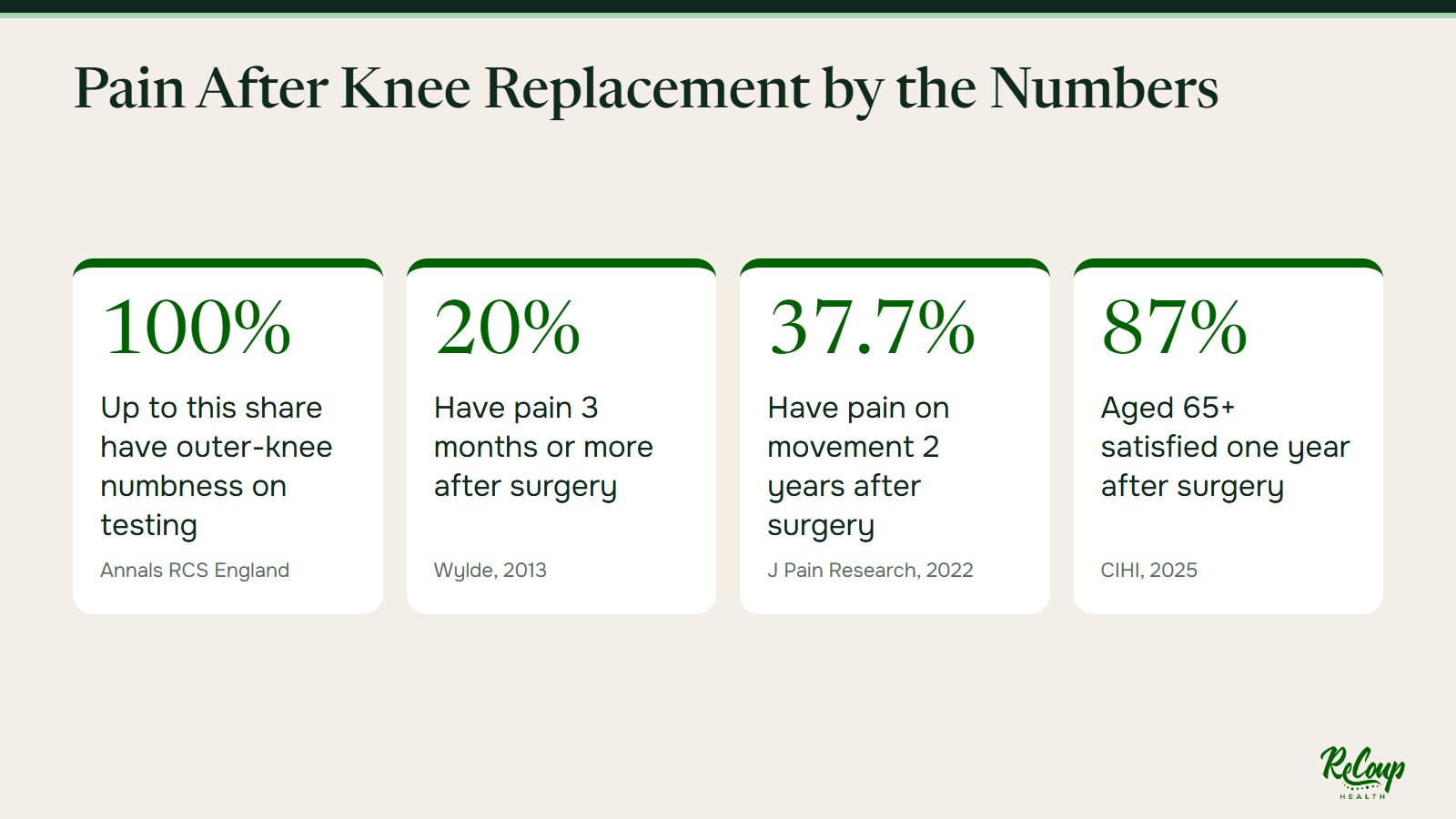
Those numbers show that CIHI found high satisfaction at one year, while a minority need extra help. A joint replacement rehab plan can start before surgery to build strength while you wait.
Our physiotherapists track bending range, swelling and nerve sensitivity at each visit, and our massage therapists treat tight tissue around the scar. No doctor’s referral is needed to book with our post-op clinicians at our Vaughan clinic.
Each visit also covers the red flags in this guide, so you know when to call your surgeon instead of waiting. CIHI reports that 88% of people saw a better quality of life one year after surgery. Lean on Recoup Health’s rehab clinicians to guide each stage of that year.