
Yes, acupuncture for frozen shoulder can ease pain and improve movement over the short term, though proof of lasting benefit is weak. A 2020 review of 13 trials with 966 patients found less pain and better shoulder function, but rated the evidence very low. Needling works as one part of a care plan, alongside physiotherapy that restores shoulder motion.
Key Takeaways
- Trials show acupuncture can reduce frozen shoulder pain for weeks, but no review has shown lasting gains over other care.
- Cochrane found only short-term shoulder benefits, over 2 to 4 weeks, in 9 small trials.
- LI15 and TB14, two points at the shoulder tip, were used most in a 2020 review of trials.
- Physiotherapy restores reach and strength, and the NHS says it lasts at least 6 weeks.
- Frozen shoulder moves through 3 stages, so needling and exercise change as the joint recovers.
Does Acupuncture for Frozen Shoulder Work
Acupuncture for frozen shoulder works as a short-term pain reliever, with weaker proof for range of motion. A 2020 meta-analysis by Ben-Arie and colleagues pooled 13 controlled trials with 966 patients. Acupuncture reduced pain and improved shoulder function compared with control treatments, according to that review. The same authors rated the overall evidence “very low” for beating other treatments.
Frozen shoulder, also called adhesive capsulitis, is a thick, tight joint capsule that limits movement in every direction. Pain relief matters because pain stops people from doing the stretching that brings motion back. Needling from a chiropractor or physiotherapist trained in chiropractic acupuncture can calm pain enough to let exercise continue. That pairing of needles and movement explains why the research details matter.
What Does the Research Say About Acupuncture and Frozen Shoulder
The research on acupuncture and frozen shoulder shows modest short-term benefits from small, mixed-quality trials. The Cochrane review by Green, Buchbinder and Hetrick in 2005 included 9 trials and over 500 adults with shoulder pain. Cochrane concluded there is not enough evidence to say whether acupuncture works or causes harm.
Newer reviews add trials but not certainty. Ji and colleagues, writing in Frontiers in Medicine in 2025, pooled 84 randomized trials with 7,125 participants. That review rated the certainty of evidence low to moderate. Only three of those trials clearly reported allocation concealment, a step that keeps researchers from choosing who gets which treatment.
The figures below sum up how large, and how limited, the trial base is.
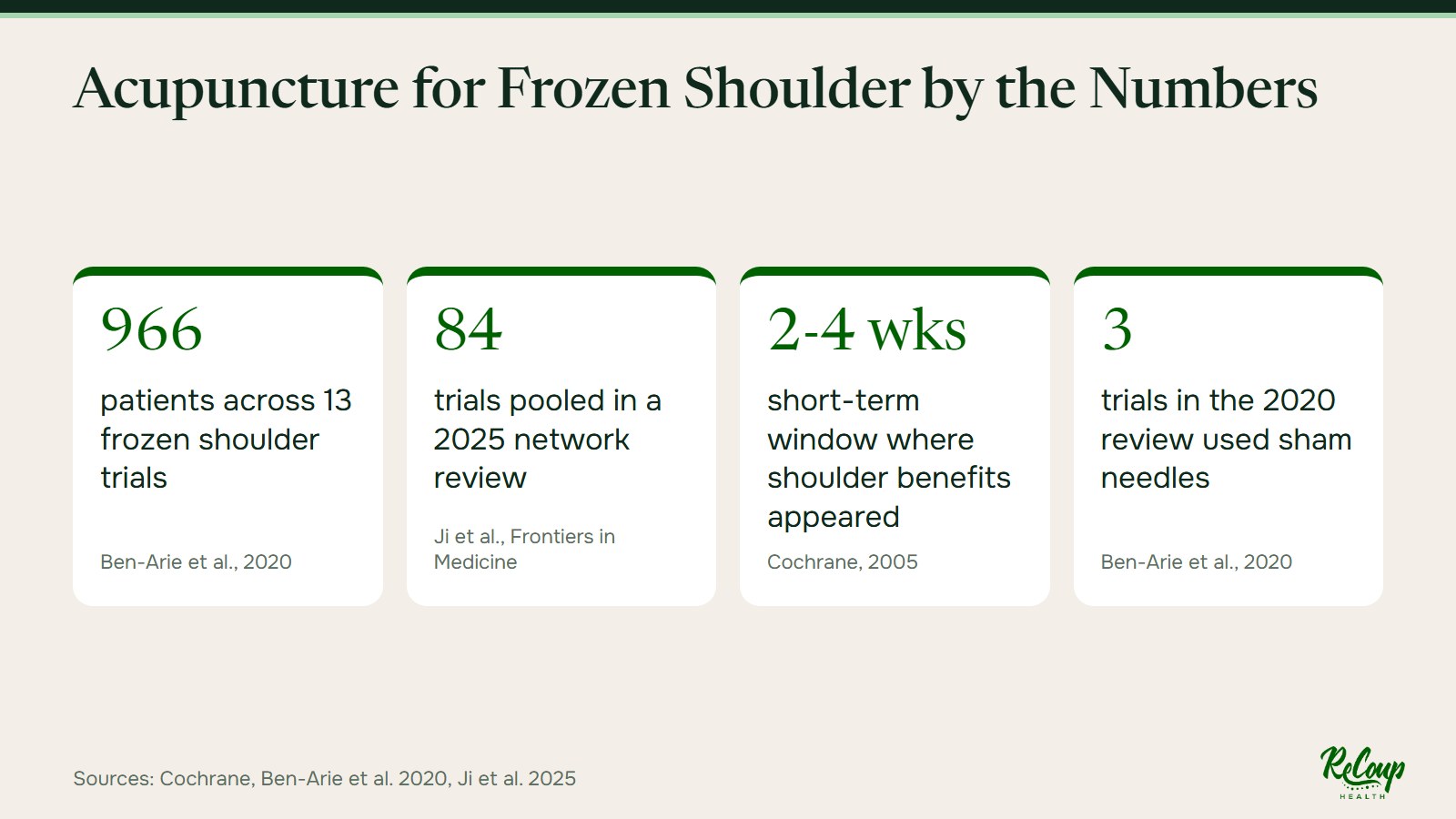
Ben-Arie and colleagues also noted that only 3 of their 13 trials used sham needles. Sham needles look real but do not pierce the skin or hit true points. Trials without a sham group cannot separate the needle effect from the expectation effect. Those gaps shape how acupuncture should be described, which leads to how needling may act on a stiff shoulder.
How Does Acupuncture Help a Frozen Shoulder
Acupuncture helps a frozen shoulder mainly by lowering pain and muscle guarding around the joint. Acupuncture is the placement of thin, solid, single-use needles into set points on the skin. Researchers in the 2020 Ben-Arie review list manual acupuncture, electroacupuncture and press tack needles as the main methods.
Electroacupuncture adds a mild electrical current between two needles. Press tack needles are tiny needles under a sticky patch that stay in place for days. Each method aims to reduce pain signals so the shoulder muscles relax. Relaxed muscles let a clinician move the arm further, and the points chosen shape that effect.
Which Acupuncture Points Are Used for Frozen Shoulder Treatment
Acupuncture points used for frozen shoulder treatment sit both on the shoulder and far from it. LI15 (Jianyu) and TB14 (Jianliao) were the points used most, according to the 2020 Ben-Arie review. LI15 sits at the front edge of the shoulder tip, and TB14 sits just behind it.
Distal points, meaning points far from the sore area, also appear in trial protocols. LI4 on the back of the hand and ST38 on the lower leg showed up in several trial point lists. Acupuncture Canada faculty describe starting with distal points when the shoulder is too sore for local needles. No single acupuncture point for frozen shoulder has proven superior, so point choice follows the exam. That exam also decides between acupuncture and dry needling.
Is Acupuncture Different From Dry Needling for a Frozen Shoulder
Acupuncture is different from dry needling for a frozen shoulder in its target, though both use the same thin needles. Acupuncture follows mapped points and channels from traditional practice. Dry needling targets trigger points, which are tight, tender knots inside a muscle.
Trigger points in the deltoid, trapezius and rotator cuff muscles can add to shoulder pain. Acupuncture Canada faculty caution that direct muscle needling in the painful early stage can flare symptoms. A clinician picks the method based on stage and pain level. The method chosen also affects how many sessions a frozen shoulder needs.
How Many Acupuncture Sessions Does a Frozen Shoulder Need
A frozen shoulder needs roughly 6 to 18 acupuncture sessions, based on the schedules used in published trials. Trials in the 2020 Ben-Arie review ran from weekly visits for 6 weeks to 18 sessions at 2 to 3 per week. A short trial of 4 to 6 weeks, with a reassessment, is a practical starting point before committing to more.
Progress is measured with simple tests, such as how high the arm lifts and how well it rotates. Pain scores and sleep quality add a second check. Visits that bring no change after a reassessment are a signal to shift the plan. The next question is how fast any change should appear.
How Long Does It Take for Acupuncture to Work for Shoulder Pain
Acupuncture takes about 2 to 4 weeks to show its effect on shoulder pain, based on Cochrane findings. The 2005 Cochrane review reported possible gains in pain and function over that short window. Follow-up in the 2020 Ben-Arie review lasted mostly 1 to 3 months, so longer effects remain unknown.
Some people notice easier movement within a session, while others feel nothing for several visits. Pain relief that fades between visits still opens a window for exercise. That window is where physiotherapy does the heavy lifting.
What Are the Physical Therapy Options for Frozen Shoulder
The physical therapy options for frozen shoulder are stretching, joint mobilization, strengthening and a home exercise program. The NHS says physiotherapy for frozen shoulder lasts at least 6 weeks. Physiotherapy restores the reach that acupuncture alone cannot rebuild, because only movement stretches the tight capsule over time.
Searchers use “physical therapy for frozen shoulder” and physiotherapy as the same thing, and a Canadian clinic offers both under one name. A frozen shoulder rehab plan starts with measuring motion in each direction. The comparison below shows how needling and physiotherapy split the work.
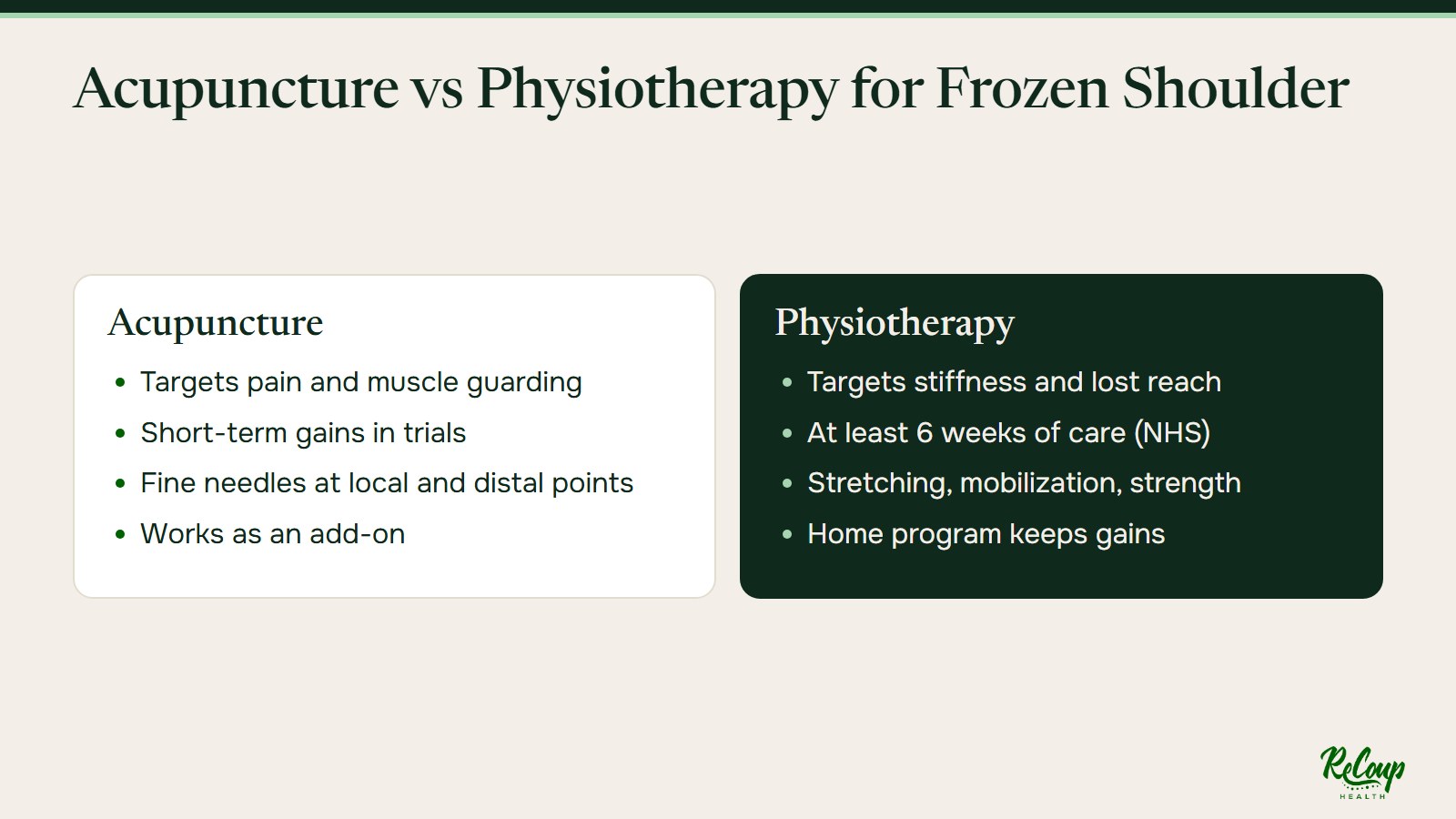
The comparison shows acupuncture aimed at pain and physiotherapy aimed at motion and strength. A Cochrane summary found a steroid injection beat manual therapy and exercise for pain and function up to seven weeks. That result is short-term, and exercise remains the base for regaining reach. The type of exercise also depends on the stage.
How Does Physiotherapy Change Through the Stages of Frozen Shoulder
Physiotherapy changes through the stages of frozen shoulder from pain control to stretching to strength. AAOS OrthoInfo describes the freezing stage lasting 6 weeks to 9 months and the frozen stage lasting 4 to 6 months. The thawing stage takes 6 months to 2 years, according to the same source.
The timeline below matches the care focus to each stage.
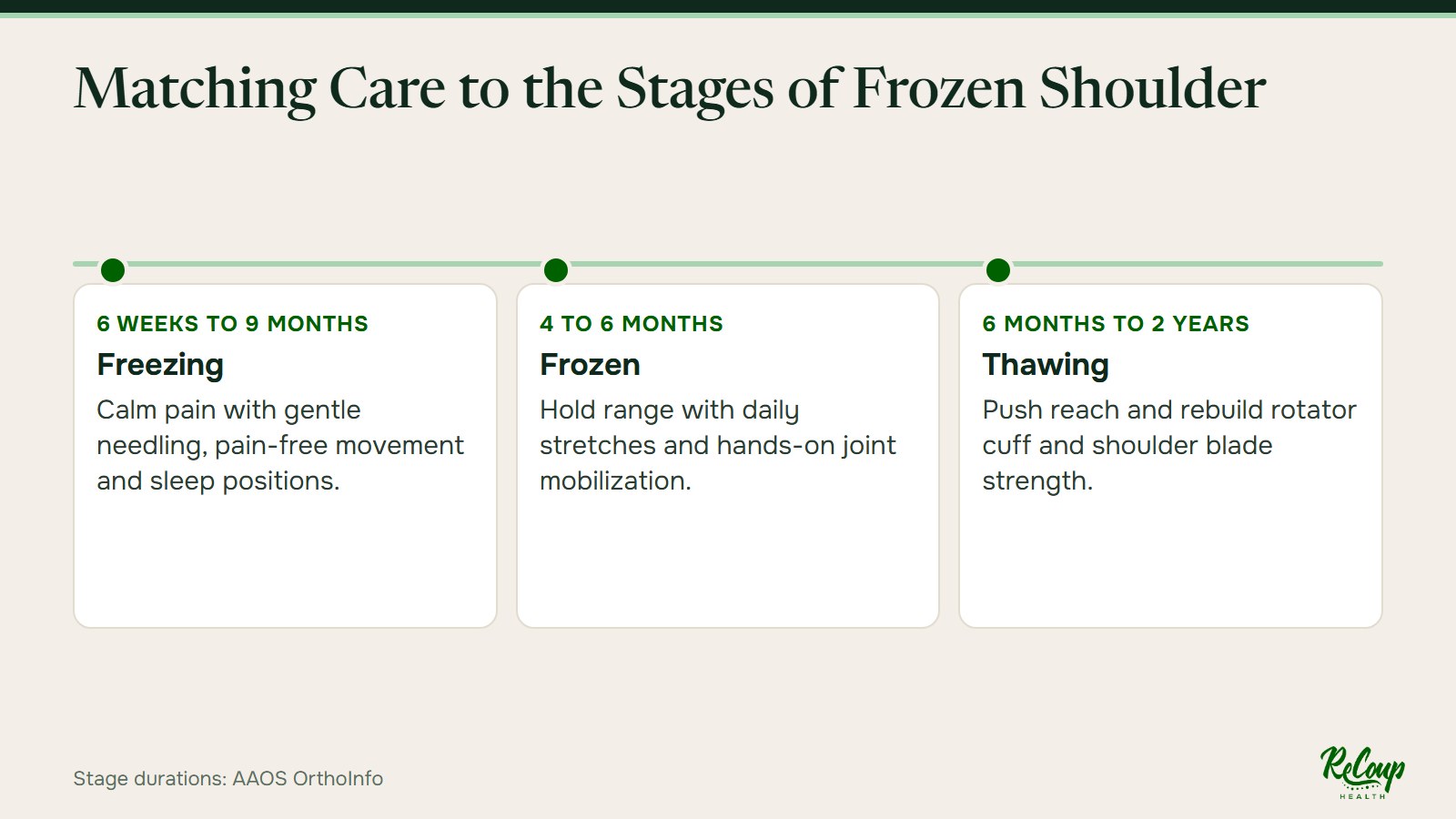
In the freezing stage, needling and gentle, pain-free motion take priority over hard stretching. In the frozen stage, daily stretches hold range while hands-on work loosens the capsule. The frozen shoulder basics post covers how each stage feels in daily life. Hands-on work forms the next piece of care.
What Does Manual Therapy for Frozen Shoulder Involve
Manual therapy for frozen shoulder involves a clinician moving the joint and soft tissue by hand to regain range. Joint mobilization is a slow, repeated glide of the arm bone in the socket. Soft tissue release works on tight muscles around the shoulder blade and upper arm.
Assisted stretching adds a held, guided stretch at the end of the available range. Some patients add partner-assisted stretching from a trained therapist between physiotherapy visits. Hands-on gains fade without home practice, so a home routine follows.
How to Release a Frozen Shoulder Safely at Home
Release a frozen shoulder safely at home with gentle, pain-free movements done several times a day. Talk to your physiotherapist before starting, since stage and pain level change which moves fit. Here is how to release a frozen shoulder with five common moves:
- Pendulum swing: lean on a table and let the sore arm hang and circle slowly for 30 seconds.
- Table slide: sit at a table and slide the hand forward on a towel, then return.
- Stick-assisted outward rotation: hold a stick with both hands and push the sore arm outward.
- Towel stretch behind the back: pull a towel up gently with the good arm.
- Wall walk: walk the fingers up a wall to a mild stretch, then lower slowly.
Stop any move that causes sharp pain or pain that lasts over an hour. A wider set of shoulder stretching routines suits people in the thawing stage. Home work speeds progress, which raises the question of the fastest treatment overall.
What Is the Fastest Way to Treat a Frozen Shoulder
The fastest way to treat a frozen shoulder is a combined plan of pain relief plus early, regular movement. American Family Physician reports that a steroid injection plus physiotherapy may beat physiotherapy alone. A family doctor or sports medicine doctor decides on injections, not a physiotherapist or chiropractor.
The table below compares common options so the main difference is clear first.
| Option | Main difference | What the evidence shows | Who provides it |
|---|---|---|---|
| Acupuncture | Eases pain, little direct effect on capsule | Short-term pain and function gains, very low certainty (Ben-Arie 2020) | Trained chiropractor or physiotherapist |
| Physiotherapy | Restores motion and strength | Core of care for at least 6 weeks (NHS) | Physiotherapist |
| Steroid injection | Fast pain relief in the joint | Beat manual therapy and exercise up to 7 weeks (Cochrane) | Physician |
| Hydrodilatation | Stretches the capsule with fluid | Benefit at 3 weeks in 1 low-risk trial (Cochrane 2008) | Physician with imaging |
| Suprascapular nerve block | Numbs the main shoulder nerve | More pain relief than steroid injection up to 12 weeks, 8 trials (JSES 2026) | Physician |
The table shows each option targets a different part of the problem. Several of these options sit among newer shoulder treatments with limited long-term data. Speed of relief differs from a lasting fix, which the next section addresses.
What Is the Permanent Solution for Frozen Shoulder
The permanent solution for frozen shoulder is time plus movement, since the capsule loosens on its own over months. American Family Physician states full resolution without treatment has been the expected outcome for most patients over one to two years. Treatment aims to make those months less painful and more functional.
Surgery is held back for shoulders that stay stiff after many months of care. A common question is do you need surgery for frozen shoulder, and the answer is rarely. Capsular release surgery cuts the tight capsule, and post-release shoulder rehab starts within days. Beyond surgery, several side questions come up around needling.
What Else Should You Know About Acupuncture and Frozen Shoulder
How Do Chinese Treat Frozen Shoulder
Chinese medicine treats frozen shoulder with acupuncture, electroacupuncture, moxibustion and cupping. Moxibustion warms points with burning mugwort herb held near the skin. The 2025 Ji network review included warm needle and needle-knife variants alongside standard acupuncture. Evidence for cupping for frozen shoulder is thin, and cupping is used for comfort rather than capsule change.
Is Acupuncture Safe for a Frozen Shoulder
Acupuncture is safe for a frozen shoulder in adults when a trained clinician uses sterile, single-use needles. The 2020 Ben-Arie review reported no serious adverse events. The 2025 Ji review described adverse events as infrequent and mild. Bruising, brief soreness and light-headedness are the common minor effects.
Can a Chiropractor Help a Frozen Shoulder
A chiropractor can help a frozen shoulder with acupuncture, soft tissue work and joint mobilization. A chiropractor for frozen shoulder care also checks the neck and upper back, since stiffness there can add to arm pain. Our chiropractic shoulder care pairs needling with movement work.
Does Massage Help a Frozen Shoulder
Massage helps a frozen shoulder by easing muscle tension around the joint, not by loosening the capsule itself. Massage for frozen shoulder targets the trapezius, chest and upper arm muscles that tighten to guard the joint. Many patients book upper arm massage on the same day as stretching.
When Should You See a Doctor About a Frozen Shoulder
See a doctor about a frozen shoulder when pain and stiffness do not settle or pain makes the arm hard to move. American Family Physician reports people with diabetes are five times more likely to develop adhesive capsulitis. Seek urgent care for these warning signs, listed by the NHS:
- Sudden or very bad shoulder pain, or an arm that cannot move
- A shoulder that has changed shape or is badly swollen
- Pins and needles that do not go away, or no feeling in the arm
- An arm or shoulder that is hot or cold to touch
- Pain after a fall or injury, or fever with shoulder pain
Other shoulder problems mimic frozen shoulder, so a stiff shoulder treatment plan starts with a full exam.
Frequently Asked Questions About Acupuncture for Frozen Shoulder
Can Acupuncture Make Frozen Shoulder Worse
Acupuncture can briefly flare frozen shoulder pain, mainly when local needles go in during the painful freezing stage. Gentle, distal points lower that risk. Soreness from needling fades within a day or two.
How Common Is Frozen Shoulder
Frozen shoulder affects an estimated 2% to 5% of people, according to American Family Physician. People asking how common is frozen shoulder should know AAOS OrthoInfo names ages 40 to 60 as the peak range.
Is Frozen Shoulder Painful
Frozen shoulder is painful, with the worst pain in the freezing stage. Night pain and pain on reaching are typical. Pain eases in the frozen stage while stiffness stays.
Can I Work With a Frozen Shoulder
Working with a frozen shoulder is possible for many people with some changes to overhead and lifting tasks. Desk work suits the condition better than heavy manual jobs. Talk to your family doctor about modified duties during the painful stage.
How Recoup Health Combines Acupuncture and Physiotherapy for Frozen Shoulder
Recoup Health combines acupuncture and physiotherapy for frozen shoulder under one roof in Vaughan. Dr. Khaira, our founding chiropractor, provides acupuncture and cupping to calm pain. Our physiotherapists build the stretching and strength plan that restores reach. Manual therapy for frozen shoulder from both teams keeps progress moving between visits.
Each plan starts with a full assessment of motion, stage and any red flags. Acupuncture for frozen shoulder is added when pain blocks exercise, and dropped when it no longer helps. You can meet our clinicians before choosing which care fits your stage of recovery.
No doctor’s referral is needed to start care. The first visit focuses on what your shoulder can do today, then sets clear goals for each stage. Patients follow that plan with regular reassessment and home practice at Recoup Health’s practice.
Questions about which therapy to start with are welcome before any visit. A clinician reviews each request and follows up with next steps and suggested appointment times for your shoulder. Send your question through our frozen shoulder booking page.